

You close a document to join a conversation, but keep composing the sentence you left behind. The new task has started; part of your thinking is still with the old one. A useful next step may be a small handoff to your future self, rather than trying to finish every open task before moving on.
The aim is a workable transition. A note that makes returning easier is not evidence that you have become more productive overall, and it does not have to make you feel calm to be useful.
The short answer
Attention residue describes thinking about a previous task while trying to attend to another. Sophie Leroy’s 2009 paper introduced the work-task account through two experiments. Its accessible abstract supports difficulty disengaging from unfinished work and poorer subsequent-task performance under the studied conditions; it does not establish a fixed everyday recovery time. [S1]
A brief plan for returning is a plausible, low-commitment option when it is safe to pause. The evidence is promising but limited. Treat easier restarting, fewer lingering thoughts, actual task performance and fatigue as separate outcomes. Improving one does not establish improvement in all of them.
Definitions and scope
An interrupted task is the work you leave. An interrupting task is what you turn to. That distinction matters: a study of performance on the interrupting task does not automatically tell you how quickly the original work will be finished later.
Attention residue is also different from noticing a notification, forgetting your place, feeling anxious about a deadline, or having a broad concentration problem. Those experiences can overlap, but they are not interchangeable measurements. This article cannot identify the reason for an individual’s difficulty from a short description.
The scope is ordinary adult study or work transitions. Attention varies with the person, task and circumstances. A difficult switch is not a diagnosis, a character flaw or proof that someone lacks discipline. No treatment, medication change or clinical screening is proposed here.
The practical option below is an editorial adaptation of research on return plans. It is not a validated workplace procedure for every occupation, a timed productivity prescription or permission to delay an urgent responsibility.
How it works
An unfinished job can leave several unresolved questions: what you had done, what comes next, and what still needs a decision. Without a record, you may try to keep those details active while doing something else. A return note puts the restart information somewhere you can find it later.
That is a useful organizational description, not proof that a note empties working memory or switches off a particular brain mechanism. The note also does not finish the work, remove a deadline or settle the consequences of a real problem.
Leroy and Theresa Glomb’s 2018 paper examined anticipated time pressure when returning to interrupted work. Its publisher abstract reports support across four studies for a return-planning intervention that reduced residue and protected performance on the interrupting task. Only the abstract was available for this guide’s direct reading; detailed study methods and a precise everyday dose are not asserted from it. [S2]
One possible explanation emphasizes a clearer commitment about returning. Another emphasizes having useful task information available. The evidence summarized here does not establish that one mechanism explains every interrupted transition. It is enough to ask a narrower question: does a specific, manageable note help with this kind of handoff?
What the evidence supports
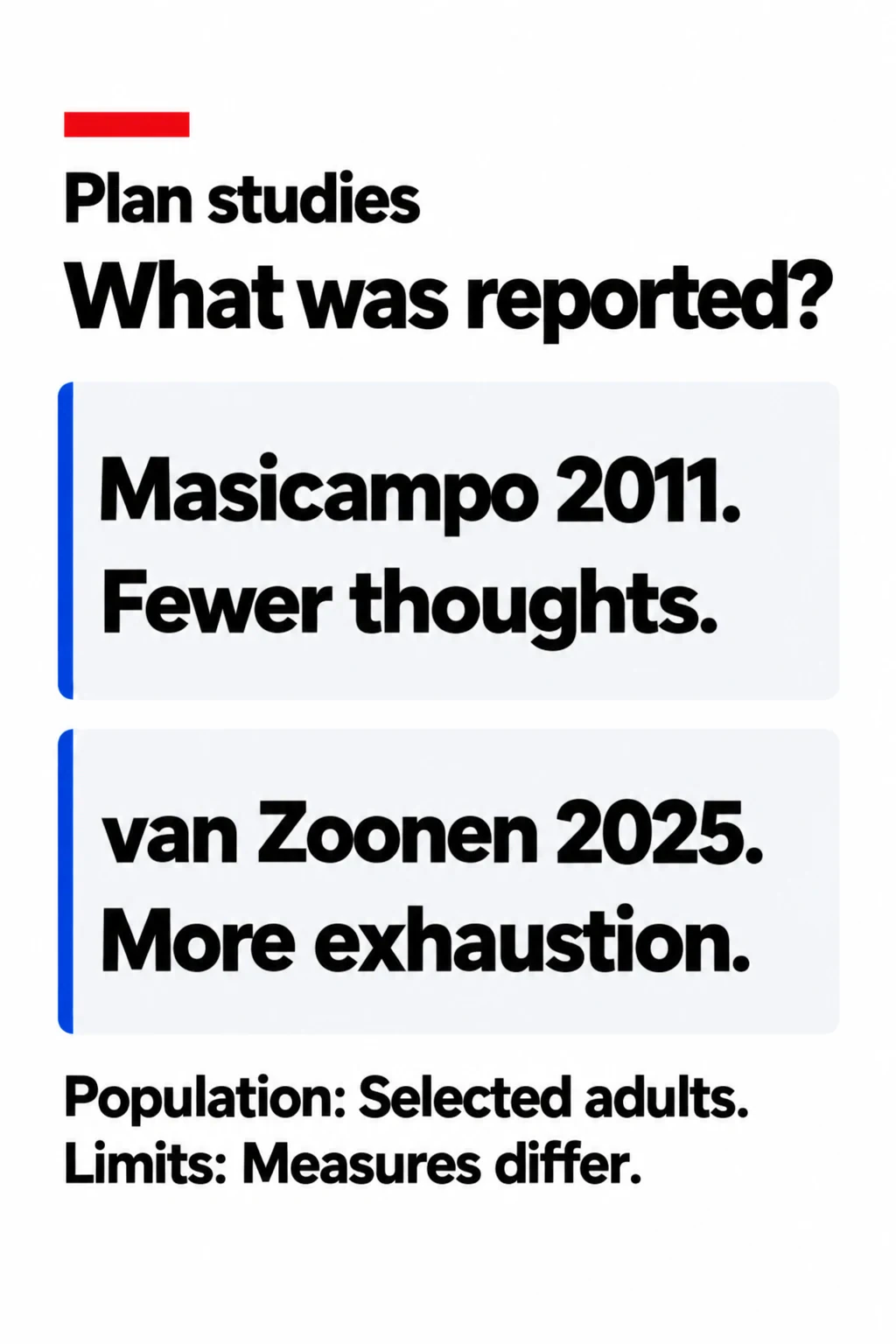
Masicampo and Baumeister’s 2011 research examined specific plans for unfinished goals in several experiments. In Study 5B, 77 participants remained after exclusions. The planning group reported fewer task-related thoughts during reading than the unfinished-task comparison group: mean ratings were 2.14 versus 3.37 on a seven-point scale. These are ratings in one experiment, not percentages of work capacity. The same study found no statistically significant planning-versus-unfinished-task differences in the measured emotions. Fewer lingering thoughts did not establish relief from anxiety. [S3]
A later workplace study by van Zoonen and Scharp, published in 2025, used data collected in May 2021. Fifty employees at one Dutch technology consultancy supplied 200 daily reports over four days; those are repeated reports, not 200 independent workers. The plan group reported less attention residue, while its average exhaustion was higher. The reported relationship between daily residue and exhaustion was also weaker in that group. Those findings can coexist. [S4]
The study was small, short and largely self-reported, with post-assignment attrition. Its daily associations do not prove causation. Statistical-reporting inconsistencies in the accepted manuscript also limit confidence in its exact coefficient estimates. [S4]
The practical conclusion is conditional: a return plan may help some transitions, while also adding effort. This evidence does not justify demanding a note for every interruption, promising a fixed productivity gain or claiming that the routine treats burnout.
Use the following distinctions when interpreting a result:
| What you notice | A reasonable observation | What it does not establish |
|---|---|---|
| You can identify the next step on returning | The note preserved useful task information | That the entire job is finished faster |
| The earlier task comes to mind less during another activity | Less noticed carryover on that occasion | A diagnosis, a mechanism or a universal treatment effect |
| You still worry about the deadline | The practical problem or worry remains | That the note necessarily failed as a restart aid |
| Recording notes feels tiring | The routine has an effort cost for you | That more detailed tracking will necessarily help |
The table is an interpretive aid, not a questionnaire, diagnostic scale or reconstruction of a study dataset. An ordinary observation can inform your next choice without becoming a scientific test of the theory.
Misconceptions and uncertainty
You do not have to complete every task before switching. Some work depends on another person, requires a longer session or must yield to a more important demand. The purpose of a handoff is to preserve a useful starting point, not to manufacture completion.
A longer note is not automatically better. Adding status fields, ratings and repeated explanations can turn a small transition aid into another job. The relevant question is whether the information is worth its cost in this situation. There is no optimal number of minutes established here.
A calm feeling is not the only outcome. A clear note and a real deadline can exist together. If the note identifies what to do next while the deadline still concerns you, keep those observations separate. Rewriting the same note until the worry disappears is a different activity, with a different burden.
An interruption can be necessary. Collaboration, a customer’s problem or an urgent care need may deserve attention. A personal routine should fit the responsibility and workplace rules. It should not become a reason to ignore people or withhold time-sensitive information.
Research access and overlap limit confidence. Two foundational papers were read only at abstract level. The later full manuscripts support narrower checks, including the distinction between cognitive reports and emotional or exhaustion outcomes. The two Leroy papers share an author, and multiple studies within one paper are not multiple independent replications by different teams. No pooled effect or claim that this is a complete current systematic review is made.
Myth or Real?

Claim
Social paraphrase: A specific return plan may reduce task-related thoughts during some ordinary task transitions.
Verdict
REAL
Facts
Selected studies report less task carryover, but other outcomes differ; some plan groups reported more exhaustion.
Specific samples, self-reports, attrition and reporting limits remain; no universal recovery time or validated whole note routine.
The archived post suggests writing a brief stopping status, but its fixed recovery time and sweeping superiority/elimination language are not adopted. The REAL verdict addresses only the narrower possibility that some specific plans reduce task-related thoughts in studied settings. Masicampo and Baumeister2011 reported fewer task-related thoughts during a reading task after specific planning; nonsignificant measured emotion contrasts do not prove equivalence or anxiety relief. In the small2025workplace report using2021data, the plan group reported lower residue but higher mean exhaustion. Fifty final workers,200repeatedreports overfourdays, post-assignment attrition, self-report, one-site context and reporting discrepancies constrain interpretation; exact field coefficients remain quarantined. Thoughts, actual performance, emotions and fatigue are different outcomes. Two author manuscripts reuse the mainfourpaper set; social is claim discovery, not independent research or fresh demand. This does not validate the article whole optional return-note organiser, prescribe a timing dose or replace workplace/safety/privacy procedures or professional assessment. Skip the note when an urgent duty cannot wait. Use only approved storage, simplify/stop burdensome repeated checking, and seek qualified support for persistent interfering difficulties or distress.
Takeaway
Keep duties first; use safe optional notes, stop burdensome checking and seek appropriate support when needed.
Sources
Claim discussion: Archived r/Habits discussion of task switching and a brief stopping note.
Evidence: Masicampo and Baumeister2011 author advance manuscript; van Zoonen and Scharp2025 accepted author manuscript.
Checked 2026-10-20. Scope: Ordinary adult task context only. REAL addresses possible reduction in reported task thoughts, not the social post fixed15–20minute timer, fastest/guaranteed elimination, clinical relief, personal diagnosis or a tested whole organiser. No verified personal/author experience or current demand.


Practical meaning and sources
Try a return note for one ordinary, attention-demanding task when a short pause is safe. This is a practical adaptation, with no tested time limit or promised benefit attached.
- Mark the actual stopping point. Identify the document, section or physical stage where you left off. Use enough context to recognize it later.
- Name one next action. Prefer something observable, such as comparing two figures or drafting the next paragraph, rather than an instruction to focus harder.
- Record a live question. Preserve an unresolved decision or needed information. If returning depends on someone else, say what you are waiting for instead of inventing a completion plan.
- Put the note where the task will resume. Use an appropriate notebook or approved work system. Do not copy confidential material into an unapproved app merely to try the routine.
- Switch, then use the handoff on return. Check whether the information is still current. A changed priority may make the old next step irrelevant.
These steps organize a possible handoff; they do not reproduce a complete study protocol. Start with the smallest record that answers your actual restart question. If a routine task is already easy to resume, doing nothing extra may be the more useful choice.
For example, a draft report might need a particular supplier figure before its next section can be written. A useful handoff identifies the unfinished section, the missing figure and the action to take when it arrives. If no answer has arrived when you return, the next step may be a permitted follow-up or another assigned task. Repeating a concentration exercise cannot supply the missing information.
An original example note could read:
Stopped: the comparison paragraph is drafted, but the supplier figure is unconfirmed. Next: check the approved source and update the paragraph when the figure is available. Open question: if it is still missing, confirm the appropriate follow-up with the project owner.
That note preserves a dependency and a next action. It does not certify that the figure is correct or that the report is complete. Keep the wording specific to the real task and your authority to act.
Assess the result at an ordinary return point: could you find where you stopped, identify what came next, and act on the information? Also notice whether maintaining the note added work or made the transition more tiring. You do not need a daily attention score, constant symptom checking or an invented before-and-after productivity percentage.
Stop or simplify the routine if recording becomes burdensome, leads to repeated checking or makes switching harder. Follow the appropriate emergency or safety procedure when a demand cannot wait; a note can be skipped. An attention article does not replace occupational procedures or professional assessment.
If concentration, intrusive thoughts, distress or exhaustion persist and interfere with daily functioning, seek support from a qualified health professional. These research terms are not a diagnosis, and a return note does not replace assessment, therapy, medication advice or urgent care.
Sources
Checked October 16, 2026. This guide uses four research papers: two publisher abstracts and two downloaded author manuscripts with relevant methods, results and limitations inspected. It is not an independent clinical review. No app, employer program or productivity product is endorsed; there are no affiliate links or sponsorships.
- S1: Sophie Leroy, Why is it so hard to do my work? The challenge of attention residue when switching between work tasks, 2009. Publisher abstract only; no detailed methods or numerical effect estimate claimed.
- S2: Sophie Leroy and Theresa M. Glomb, Tasks Interrupted, 2018. Publisher abstract only; its four-study summary does not establish a universal note-writing dose.
- S3: E. J. Masicampo and Roy F. Baumeister, Consider It Done! Plan Making Can Eliminate the Cognitive Effects of Unfulfilled Goals, 2011. Author-hosted advance manuscript; relevant planning, reading, anagram and emotion results.
- S4: Ward van Zoonen and Yuri S. Scharp, Managing daily work intrusions, 2025. Accepted manuscript of the workplace study, with separate residue and exhaustion findings.
FAQ
Common questions
Does a note have to make me calm to be useful?
A clear note and a real deadline can exist together.
Must I complete every task before switching?
You do not have to complete every task before switching.
Is the complete routine a validated workplace procedure?
It is not a validated workplace procedure for every occupation, a timed productivity prescription or permission to delay an urgent responsibility.
Topic hubs
Tags

