
Once you know how something ended, the earlier clues can look unusually clear. The answer was there, the warning was obvious, and you feel sure you would have spotted it. Yet the information available beforehand may have supported several possibilities.
Hindsight bias names a family of shifts in judgments after an outcome becomes known. It gives us a reason to inspect the earlier evidence carefully. It does not tell us that every criticism made after an event is unfair, or that learning from results is a mistake.
The short answer
Knowing an ending can change how predictable it seems and how you remember your earlier expectations. To examine an ordinary decision, distinguish three questions: what information was available then, what you actually expected, and what you learned afterward.
A dated note can provide a reference for the second question. It cannot establish that your forecast was well founded, remove all bias, or prove that a decision was sensible. Think of it as preserving something to compare, rather than as a certificate of good judgment.
The useful aim is a fairer account of uncertainty. You can acknowledge a disappointing result, look for missed information and improve a future decision while keeping later knowledge out of your description of what was known earlier.
Definitions and scope
Researchers study hindsight in more than one way. In a hypothetical design, some participants receive an outcome and estimate what its likelihood would have been without that knowledge. Their responses can be compared with responses from people who were not given the outcome. In a memory design, people make an initial judgment, receive later information and try to recall that initial judgment.
These designs answer related questions. The first need not involve remembering a prediction the person actually made. The second provides an earlier response against which remembered confidence can be checked. Calling both hindsight bias should not erase that difference. Fischhoff, 1975, Fischhoff and Beyth, 1975.
Keep predictability separate from decision quality, too. “Could this result have been anticipated?” differs from “Was the choice reasonable given the evidence and alternatives?” An outcome can matter greatly without answering both questions by itself. This article focuses on ordinary reflection on expectations; it does not adjudicate anyone’s competence or responsibility. It is not a diagnosis.
How it works
A known result supplies a powerful organising fact. When a story has an ending, details consistent with that ending can seem especially relevant. Reconstructing an earlier expectation from your present understanding may therefore produce a different answer from consulting a response recorded at the time.
That description should remain a possible account of the pattern, rather than a claim to read someone’s mind. Reconstructive recall and adjustment from present knowledge are explanations discussed in the original research. A group difference after outcome information does not establish the exact mental process responsible for a particular person’s comment. Fischhoff and Beyth, discussion.
There is also legitimate learning. A result may reveal a missing constraint, a faulty assumption or a reason to revise future expectations. The distinction is between updating what you now believe and rewriting what you previously knew. A person can say, “I understand the result better now,” while acknowledging that it was less clear beforehand.
For example, a hobby group might discover that members prefer a simpler poster design. That feedback is useful for its next poster. It does not, by itself, show that the preference was certain before members voted. Nor does one vote establish a permanent rule about every future audience. Preserve the difference between a new observation and a general conclusion drawn from it.
What the evidence supports
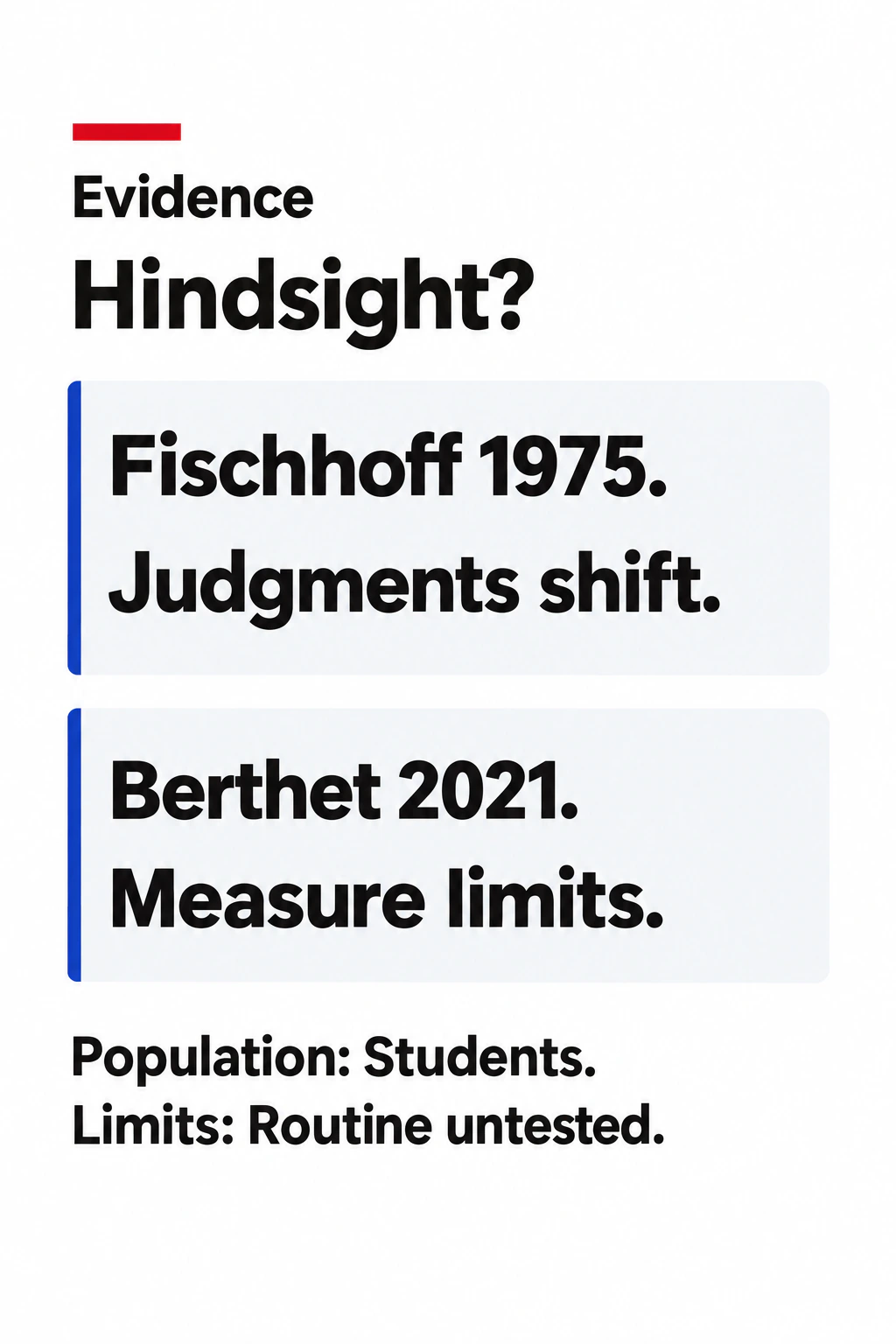
Outcome knowledge can affect judgments of earlier predictability. In Fischhoff’s 1975 experiments, groups read brief event descriptions with or without a reported outcome. In the first experiment, the reported outcome received higher likelihood judgments across the tested comparisons. The average difference was 10.8 percentage points; it was an average over particular comparisons, rather than a universal increase in anyone’s certainty. Participants asked to disregard an outcome also showed difficulty doing so. The participants were selected student groups, and some groups responded to more than one event. Original study.
Remembered forecasts can differ from recorded forecasts. Fischhoff and Beyth asked students to estimate possible outcomes of Nixon’s 1972 visits to China and the USSR, then later remember or reconstruct those estimates. Recollections shifted toward events participants believed had happened. Attendance and follow-up varied, and beliefs about what happened were not identical to independently established events. This supports a memory-comparison concern in that setting, without showing deliberate dishonesty or a universal amount of distortion. Original study.
Later experiments support related patterns with limits. Chen and colleagues reported replications and extensions using American online samples. In their third study, average estimated success of a replication was about 73% after a successful result was reported, 65% without a reported result, and 52% after a failed result was reported. These were probability judgments about a research scenario. They were not rates of success at removing bias, and proposed explanations involving surprise or confidence received mixed support. Chen and colleagues, 2021.
Measuring an individual’s susceptibility is a separate problem. Berthet’s empirical work examined measures of several biases. In its third study, 102 French undergraduates completed a revised hindsight measure with 15 items; its internal-consistency estimate was 0.62. That value is a property of a measure in a sample, not the percentage of people who are biased or a personal diagnostic score. Reliable differences between people cannot simply be assumed from a group effect. Berthet, 2021.
Misconceptions and uncertainty
Hindsight is not a synonym for remembering anything incorrectly. A useful claim needs a defined earlier judgment or a relevant comparison condition and a specified later outcome. If those are unavailable, describe the uncertainty rather than assigning a precise amount of bias to yourself or someone else.
Likewise, changing your mind after new evidence is not automatically a failure. Suppose you initially favour one explanation and a later observation rules it out. Revising your view may be appropriate. The problem discussed here concerns an inaccurate account of earlier predictability or earlier expectations, not the mere act of updating.
An outcome may also expose a genuine earlier oversight. Perhaps relevant information was available and was missed. Checking for hindsight does not resolve that possibility in your favour. Compare the earlier information, reasonable alternatives and actual decision process before reaching a conclusion.
The research set contains four reports, including two by overlapping original authors. They use different tasks and populations, and they do not test the complete reflection routine suggested below. The later replication paper also distinguishes supported judgment effects from uncertain explanations. Neither a tidy story nor a striking average establishes a guaranteed method for improving everyday decisions.
Treat an isolated example proportionately. Someone saying “I knew it” might be expressing frustration, making an accurate claim or reconstructing their memory. The phrase alone cannot distinguish those possibilities. Ask what evidence exists before turning a research concept into a label for the person.
Myth or Real?
Claim
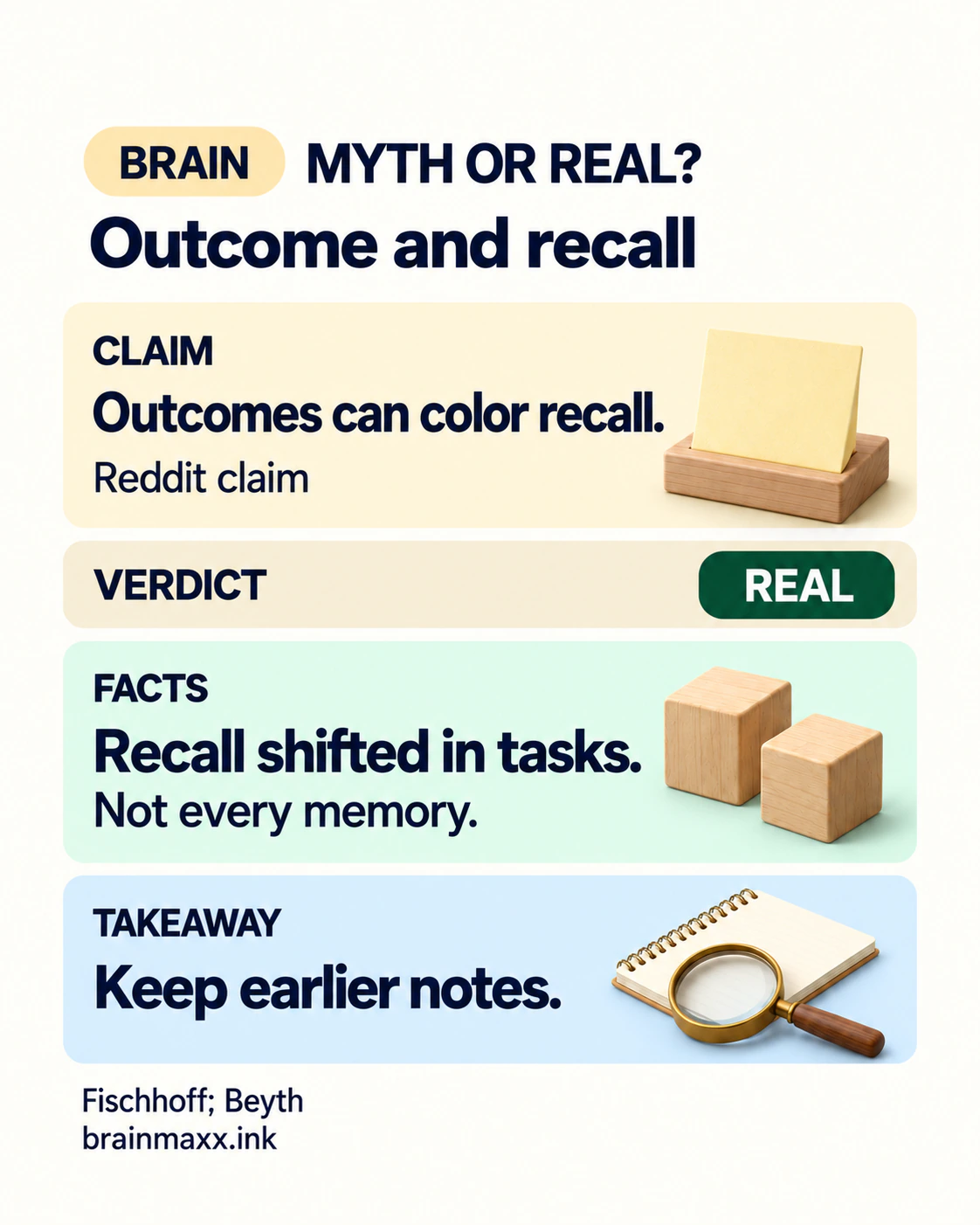
Social paraphrase: Knowing how something ended can affect how you remember the earlier decision context.
Verdict
REAL
Facts
The memory study found later recollections shifting toward events participants believed had occurred.
Selected student tasks do not establish universal distortion, dishonesty or a proven benefit from the complete note-taking routine.
REAL applies to the conditional task effect, not to every statement in the public post. The memory study compared earlier recorded forecasts with later recall or reconstruction and related shifts to what participants believed had happened. Believed occurrence is not identical to an independently confirmed event, and overlapping classes and incomplete follow-up limit generalisation. The companion hypothetical experiments examined judgments of earlier predictability rather than recall of an actual forecast. These two publications share Fischhoff and are reused from this article; they are not two independent trials of journaling. A particular person saying they knew an outcome may be accurate, mistaken or expressing frustration. The phrase alone cannot diagnose hindsight or dishonesty. New results can also reveal genuine earlier omissions and support legitimate learning. For one ordinary low-consequence question, an earlier note can preserve a comparison point. It cannot certify good judgment, a stable trait or a guaranteed reduction in bias. Keep the original intact, write recollection before rereading and add actual outcome/new information separately. The full reflection routine remains optional and untested as a complete intervention. Keep it private, brief and proportionate; stop distressing repeated review. Consequential questions require relevant professional evidence/process, and persistent distress can warrant appropriate qualified support.
Takeaway
Optionally keep an earlier record intact and write later recollection separately before rereading it.
Sources
Claim discussion: Public game-development discussion of hindsight and decision records.
Evidence: Fischhoff: Hindsight is not equal to foresight; Fischhoff and Beyth: I knew it would happen.
Checked 2026-10-20. Scope: Only the conditional possibility of outcome-related recollection shifts. The public post broader universal framing, commercial book promotion, workplace accusations, disaster example and claimed organisational benefits are outside this verdict.
Practical meaning and sources
For an ordinary, low-consequence decision, you can choose to preserve a small amount of useful information beforehand. Record the question, your present expectation, the main reason for it and a plausible alternative. Include what would count as an outcome and when you expect to learn it. Exact percentages are optional; artificial precision does not make weak evidence stronger.
After the result, keep the original entry intact. Add what happened and what you learned in a separate entry. If you want to examine memory, write your recollection before reopening the earlier note, then compare them. That comparison concerns one recorded expectation. It does not establish a stable trait, explain every discrepancy or show that the note prevented hindsight.
Consider a fictional starting point. Avery’s hobby club is choosing between two poster designs. Before the vote, Avery records a 60% expectation that members will prefer A, based on a small preview, with B as the alternative. The full group later chooses B. Avery now feels that B’s appeal should have been obvious. The question is how to compare that feeling with the earlier record.
Avery writes down that recollection before reopening the note. On reading it, Avery sees that the original entry favoured A and left a substantial possibility for B. Avery keeps that entry intact and adds a correction: “I now prefer B, but my earlier expectation favoured A.” The new result belongs in the later account; it does not turn the earlier estimate into certainty about B.
For the next poster, Avery decides to seek a broader preview because the original preview represented only a few members. That is a possible change to the information-gathering process, not proof that it will improve the next vote prediction. One group choosing B cannot establish that all future groups will prefer it. The completed comparison preserves an earlier expectation and identifies a question for next time; it does not measure Avery’s personality or demonstrate that keeping notes reduced bias.
Keep this exercise optional and brief. Do not collect other people’s private information to build a case against them. If repeated review becomes distressing or takes over the activity it was meant to help, pause it. Questions involving serious harm or consequential decisions need the relevant professional process and evidence, rather than a hobby example or an informal bias label.
Sources
The four primary reports are linked beside their claims. Research checked 18 October 2026. The two 1975 reports share Fischhoff; the two Elsevier articles share a publisher. Selected methods, results and limitations were read, rather than every appendix or raw dataset. This article’s optional reflection steps are an editorial organiser and have not been validated together as an intervention.
FAQ
Common questions
Does hindsight bias make every criticism after an event unfair?
It does not tell us that every criticism made after an event is unfair, or that learning from results is a mistake.
Does keeping an earlier note prove a decision was good?
A dated note can provide a reference for the second question. It cannot establish that your forecast was well founded, remove all bias, or prove that a decision was sensible. Think of it as preserving something to compare, rather than as a certificate of good judgment.
Can one changed recollection establish a stable trait?
That comparison concerns one recorded expectation. It does not establish a stable trait, explain every discrepancy or show that the note prevented hindsight.
Topic hubs
Tags