

Eighteen nearly identical desk lamps can feel like freedom for one shopper and punishment for another. The difference is not simply eighteen versus three.
Choice overload refers to worse outcomes attributed to a larger option set: delaying, regretting, switching, or feeling less confident or satisfied. It is a real result in some studies. It is not a universal law.
One meta-analysis found almost nothing on average
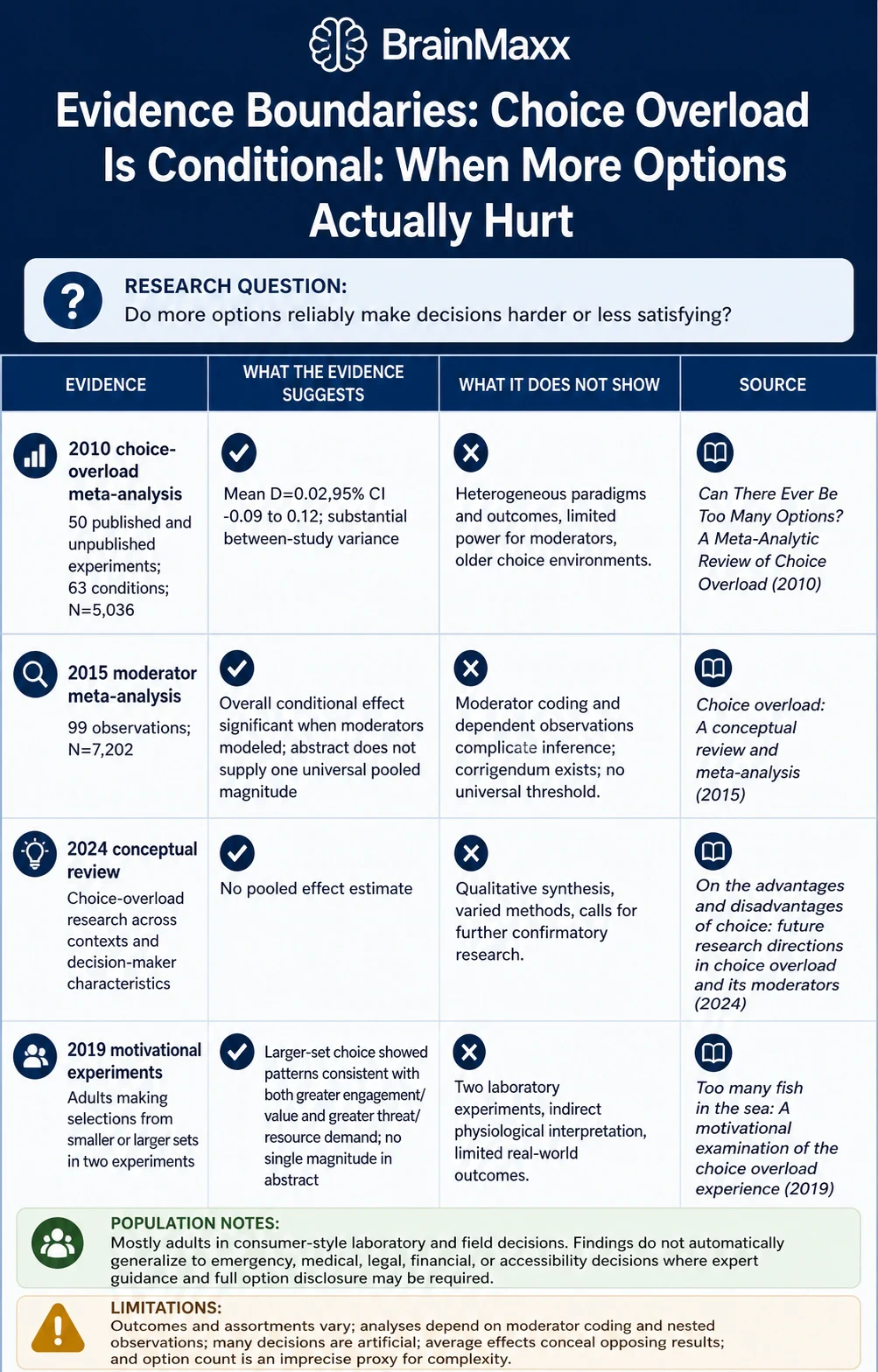
A 2010 meta-analysis combined 63 conditions from 50 published and unpublished experiments, totaling 5,036 participants. The mean choice-overload effect was D = 0.02, with a 95% confidence interval from -0.09 to 0.12—effectively zero on average.
But the studies varied substantially. Some found that more options hurt; others found no difference or an advantage. The authors explored possible preconditions but could not identify a sufficient one. “No average effect” therefore did not mean every context was identical. It meant option count by itself was a poor prediction.
A later synthesis found conditional overload
A 2015 review and meta-analysis included 99 observations and 7,202 participants. It organized the variation around four factors:
- how complex the options were;
- how difficult the comparison task was;
- how uncertain the chooser was about preferences; and
- whether the goal emphasized minimizing effort.
When those moderators were modeled, the authors found a reliable conditional overload effect. A 2024 qualitative review likewise emphasized both the decision environment and characteristics of the chooser.
This does not supply a magic maximum number. Ten easily ranked options can be simpler than four incomparable ones. A person who knows the required size, budget, and feature may welcome variety; someone choosing for an unfamiliar recipient may not.
More options can create value and threat together
Two 2019 experiments measured cardiovascular responses while people selected from larger or smaller sets. Larger-set choice produced patterns interpreted as greater engagement—seeing more value in the task—and greater threat—perceiving fewer resources to manage it.
That result resists a simple “choice is good” or “choice is bad” story. Physiological patterns are not direct measures of decision quality, and two laboratory experiments cannot diagnose stress. They do illustrate how attraction and burden can coexist.
Count is a proxy for the real problem
Option count often travels with other changes. More items may add attributes, scrolling, unclear tradeoffs, expectations of finding a perfect match, and imagined regret. Or they may increase the chance of finding an option that fits.
Expertise, a dominant option, aligned attributes, decision aids, and reversibility can reduce comparison cost. Time pressure, unfamiliar features, and conflicting goals can increase it. These moderator patterns mostly come from comparisons across studies, so they suggest conditions rather than proving a single mechanism.
A large meta-analysis of choice-architecture interventions found that restructuring alternatives often outperformed information-only approaches. That broader literature does not prove that removing options is best. Structure can also mean categories, defaults, consistent attributes, or staged comparison while preserving access.
The evidence ladder explains the disagreement
The 2010 and 2015 meta-analyses are the broadest evidence but answer different questions: an unconditional average versus a model organized around moderators. The 2024 review updates the moderator map without supplying a pooled causal estimate. The two physiological experiments illustrate mixed motivation in one paradigm, while the wider choice-architecture synthesis supports structure in general, not this article’s exact shortlist. The exercise below is therefore a reversible decision aid, not a proven cure for overload.
Use a reversible shortlist
For a low-stakes decision, reduce comparison work without pretending excluded options are bad.
- Write the goal in one sentence.
- Choose two genuine must-have attributes.
- Remove options dominated on both.
- Compare three finalists using the same attributes.
- Set a stopping rule before further searching.
- Reopen the full set only if every finalist fails a must-have.
Do not optimize every feature. A stopping rule might be: “Choose the lowest-cost finalist that meets both requirements and has no material defect.”
For example, Jo has 24 lamps open in browser tabs. Her goal is a reading lamp for a narrow bedside table; the must-haves are a base under 15 centimeters and an adjustable warm light. Six options qualify. Three are dominated because they cost more without improving either criterion. She compares the remaining three on warranty and switch access, then stops. If none had met both must-haves, reopening the set would be sensible. The method reduced incomparable details; it did not prove the chosen lamp was objectively best.
This is not appropriate for hiding material choices from someone else. Medical, legal, financial, safety, and accessibility decisions may require full disclosure and qualified guidance. A convenient shortlist must not erase risks, rights, or accommodations.
Persistent decision difficulty or anxiety can have many causes; option count does not diagnose them. Seek qualified professional support when choices are high stakes or the difficulty is significantly impairing.
The more useful question
Instead of asking “How many options are too many?” ask: How hard are these options to compare, how clear are my preferences, and what would let me stop safely?
More choice is not automatically freedom or overload. Its effect depends on the decision it creates.


Sources
- 2010 meta-analytic review
- 2015 conceptual review and meta-analysis
- 2024 moderator review
- 2019 motivational experiments
- Choice-architecture meta-analysis
This article is educational and is not a diagnosis or treatment plan.


