

The message is marked read. The answer has not arrived. Somewhere between those two facts, a small question about Saturday’s plans can become a much larger story: they are annoyed, they do not care, the friendship is finished. The screen supplies a status. You supply the explanation, often without noticing where the handover happened.
A read receipt can tell you something about a messaging feature. It cannot tell you why a person has not answered. Calling the silence ghosting may describe how the situation feels or how you understand a relationship ending, but the label does not turn the receipt into evidence of a particular motive. You can decide what to do with an unanswered message while leaving that reason unknown.
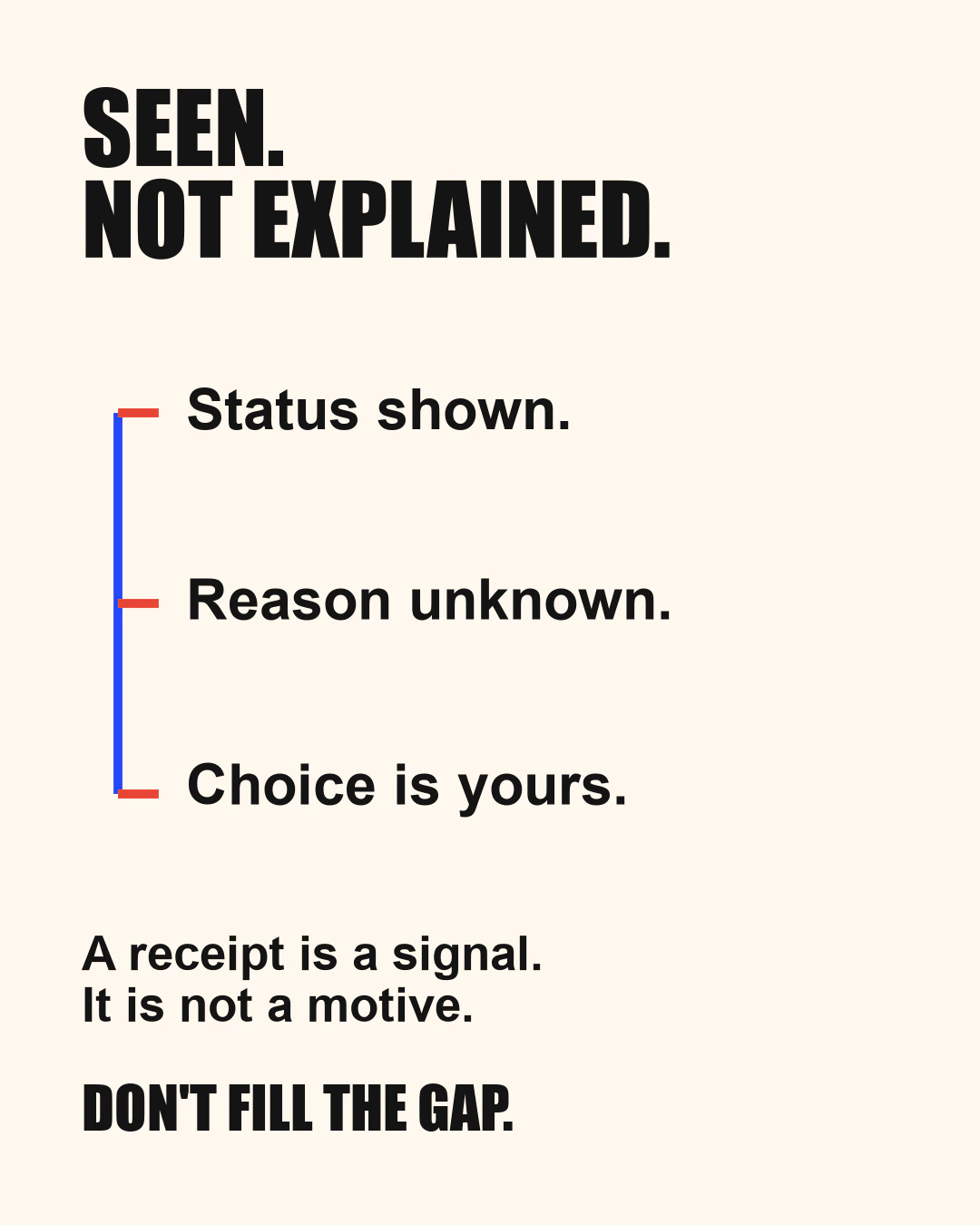
Graphic context — 01-article-hero: This original qualitative rail separates a feature status, an unknown reason for a missing reply and an ordinary choice. The connectors organise descriptions; they do not identify a cause, determine how someone feels or show an inevitable relationship ending.
Text equivalent: SEEN. NOT EXPLAINED. Status shown. Reason unknown. Choice is yours. A receipt is a signal. It is not a motive. DON’T FILL THE GAP. A displayed read status has the scope of the actual service and feature. It does not by itself establish why an answer is absent. Neither a hostile nor a reassuring explanation becomes known from the label. An explicit answer or no-contact boundary supplies different information and must be respected. No message, account change, private inspection or research finding about a group is used to test this person. Four actual primary publisher groups supply one accepted-author research manuscript, two commercial issuer help documents and a dictionary definition, not four routine trials. No individual motive detector, universal guilt, current growth/prevalence, clinical/legal/security certification, promised reply or measured benefit from these original choices. Full source versions, dates, reading limits and exact accessible text remain adjacent. There is no empirical routine-efficacy trial of these original choices.
Who this is for
This guide concerns an ordinary, optional exchange: a hobby question, a casual invitation or a conversation that can remain unfinished. It is for the person waiting for an answer and the person deciding whether to continue a conversation. Neither role requires a new app, a paid service or access to another person’s private activity.
Cambridge Dictionary’s stopping-communication sense of ghosting describes ending a relationship by abruptly cutting off communication. Researchers also use broader definitions. One recent paper studies unexplained nonresponse as a subjective process, including situations that may eventually resume. A delayed answer and an established relationship ending are therefore not interchangeable facts. [S3, S1A]
The useful question here is smaller than whether you can prove someone has ghosted you: what do you actually know, what remains an interpretation and what decision do you need to make? You do not need a final explanation of the other person’s feelings to stop waiting for a casual plan or choose where to put your attention.
Before you start
Choose an imagined example or an ordinary exchange that does not contain sensitive information. Do not copy private conversations, identify another person or collect screenshots for this exercise. There is no need to reopen a painful relationship, inspect someone’s online activity or compare their replies to different people.
Separate an optional conversation from something that requires action. A missed social invitation differs from an urgent practical responsibility, a concrete safety concern or an existing workplace procedure. Use the appropriate established route for those situations. This guide offers no waiting period, emergency assessment or instruction to postpone a necessary decision.
It also offers no diagnosis or treatment. A wish for a reply is not a clinical finding, and a delayed message does not diagnose either person’s character or mental health. If the situation brings persistent distress or interferes with daily life, suitable qualified support is more useful than repeatedly applying a messaging checklist.
Start with the smallest accurate description. You sent a question; you have not received an answer. A feature may show a read status. Keep that separate from whether the recipient had time, wanted to reply, understood the question or intended to end contact. Some of those things may later become clear. They do not become clear simply because the status remains on the screen.
Graphic context — 02-concept-model: These pairs distinguish the information a messaging feature supplies, the explanation it leaves unresolved and the choice a reader can make. Arrows map terms rather than causal stages, probabilities or a method for predicting another person’s intentions.
Text equivalent: A STATUS IS NOT A REASON. Receipt Feature status. Reason Still unknown. Choice Your boundary. Possible is not proven. No mind-reading. SEPARATE THE QUESTIONS. Apple’s chosen iOS 26 guide and Google’s RCS help describe specific feature meanings and conditions. They are commercial issuer explanations, not an independent behavior benchmark or a universal rule for every app. Cambridge’s stopping-communication definition differs from the paper’s broader subjective-process operationalization. No receipt alone confirms a particular motive, availability, guilt or future response. A missing receipt can also have multiple possible explanations under actual feature conditions. Four actual primary publisher groups supply one accepted-author research manuscript, two commercial issuer help documents and a dictionary definition, not four routine trials. No individual motive detector, universal guilt, current growth/prevalence, clinical/legal/security certification, promised reply or measured benefit from these original choices. Full source versions, dates, reading limits and exact accessible text remain adjacent. There is no empirical routine-efficacy trial of these original choices.
The feature and the feeling answer different questions
Apple’s version-specific iPhone guide explains that read receipts can show Read beneath a message and describes general and individual-contact settings. Its stated iMessage conditions matter. The selected guide is for iOS 26; that version label is not a publication date or a claim about the newest software. This is issuer information about a feature, not a reading of another person’s intentions. [S2]
Google’s own RCS help likewise makes receipt information conditional on the recipient enabling it. A feature’s absence can therefore leave more than one possibility open. The Apple and Google descriptions concern their own services; neither supplies a universal rule for every messaging app, every conversation or every reason an answer might be missing. [S4]
Research published online in August 2026 examines predictions about the feelings of people who stop responding. Its recalled experiences, imagined scenarios and brief live task are different designs. The live task’s overall primary comparison did not show the headline underestimation effect; a later analysis involving perceived ghosting differed. That distinction matters. [S1A]
The work used United States samples and cannot reveal the feelings of the person in your own conversation. It is not a trial of the steps below, a universal measure of guilt or evidence that a read receipt identifies a motive. The accepted author manuscript, journal publication date and author-site posting date are also distinct records. [S1A]
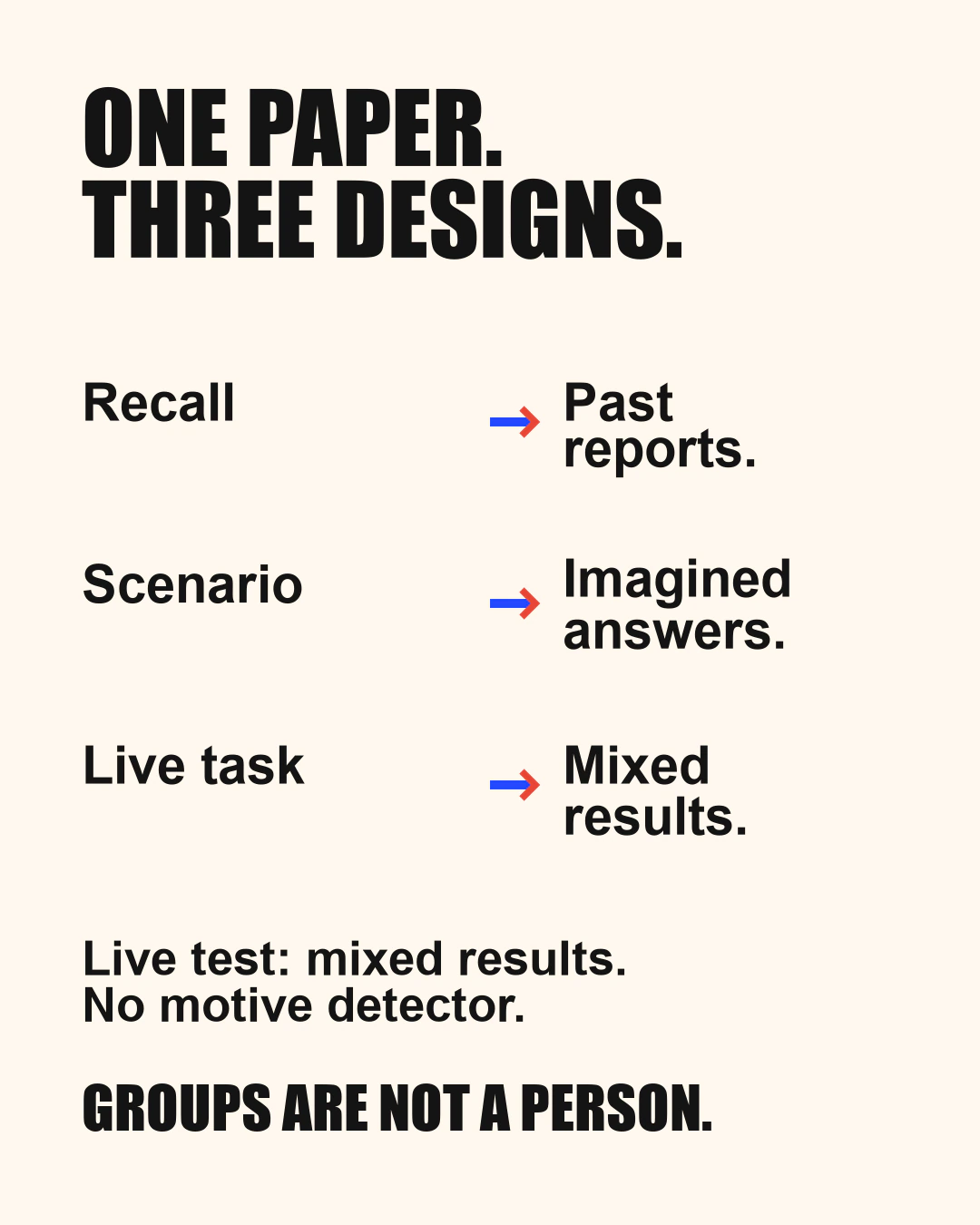
Graphic context — 03-evidence-infographic: Three rows describe different designs within one accepted author manuscript: recalled experiences, imagined scenarios and a brief live conversation task. They are not three independent teams or three tests of the article’s original optional sequence.
Text equivalent: ONE PAPER. THREE DESIGNS. Recall Past reports. Scenario Imagined answers. Live task Mixed results. Live test: mixed results. No motive detector. GROUPS ARE NOT A PERSON. In the live task the overall primary comparison was not statistically significant. A later analysis involving perceived ghosting differed and was not preregistered. Its subgroup result must not replace the overall comparison or become an estimate of one person’s feelings. United States samples, recall, hypothetical responses, chosen behavior and a short incentivized interaction limit generalization to ordinary or long-term relationships. Main accepted-manuscript pages 1–44 were read; references, supplements, preregistrations and OSF data were not independently read or reproduced. Journal first-online August 31, 2026 differs from the September 17 author post and PDF creation/modification. No current growth or prevalence is encoded. Four actual primary publisher groups supply one accepted-author research manuscript, two commercial issuer help documents and a dictionary definition, not four routine trials. No individual motive detector, universal guilt, current growth/prevalence, clinical/legal/security certification, promised reply or measured benefit from these original choices. Full source versions, dates, reading limits and exact accessible text remain adjacent. There is no empirical routine-efficacy trial of these original choices.
Actions in order
1. Describe the visible event without finishing the story
Try a sentence such as: I asked about the walk and have not received an answer. If a receipt is relevant, add only what the actual feature displays. Avoid changing the sentence into they deliberately ignored me, they must be busy or they obviously want another message. Both hostile and reassuring explanations can go beyond what you know.
This is not an instruction to dismiss your experience. An unanswered exchange can disappoint you, and a repeated pattern may affect whether you want to keep making plans. Describe those things directly. You can dislike the situation without presenting an unverified explanation as an established fact.
You also do not have to prove that the other person had a good reason before allowing the conversation to remain unfinished. The purpose of the description is to keep facts and interpretations separate, not to win a case for either participant. A screen status is one piece of information with a limited scope.
2. Name the decision you actually need to make
Is there a practical choice, such as whether to reserve a place, leave for an event or make a different weekend plan? Or are you trying to resolve the more open question of what another person thinks of you? The first question may have an ordinary stopping point. The second may remain unresolved by any amount of receipt checking.
For a casual invitation, a decision might be to make a plan that does not depend on an answer. For an open-ended conversation, it might be to leave the thread alone. These are possible choices, not a rule that every exchange should end in the same way. Your actual commitments and any existing boundaries still matter.
If a required procedure already specifies what happens when a response is missing, follow that procedure rather than inventing a social explanation. The guide does not replace a professional responsibility, confidentiality requirement or safety process. A message status is not confirmation that a necessary task has been completed.
3. Keep possible reasons in the possible category
There may be several explanations for a delay, but you do not need to build a long list or decide which is most flattering. Not knowing the reason is itself an accurate description. Replacing a negative certainty with a positive certainty still claims knowledge that a receipt cannot provide.
Do not use the research as a way to fill in the person’s mind. A result about a group in a study does not establish that this particular individual feels guilty, intends to return or wants to preserve the relationship. Nor does a nonsignificant study result prove that nobody has those feelings. The limits run in both directions.
The same restraint applies to yourself. You can notice that the wait is frustrating without treating the feeling as proof of rejection or as evidence that you are overreacting. A description of an experience and an explanation for someone else’s behavior are different things. You may need to decide what is acceptable to you while the explanation stays incomplete.
4. Choose an option that respects the existing situation
For an optional exchange, leaving the conversation alone is available. Making an independent plan may also fit. In an ongoing relationship where ordinary contact is welcome, a clear practical clarification can be an option, but this guide does not require another message or promise that it will produce a reply.
Existing boundaries take priority. A request for no contact, a block, a safety concern or an inappropriate power imbalance is not an invitation to try a different channel. Do not enlist friends to investigate, create another account, send a test message or ask someone to enable read receipts so that you can complete the exercise.
Leaving the reason unknown does not mean proving the other person innocent, offering another chance or persuading yourself to feel differently. You can decide that the present pattern does not work for you without claiming to know its cause. An explicit boundary remains a boundary even when you are curious about the private reasons behind it.
If you are the person deciding whether to answer, you can consider what you actually want to communicate within your circumstances. You are not required to disclose private reasons, promise future availability or resume an unwanted exchange. A brief response may be possible where appropriate; it is not a universal duty or a treatment for someone else’s uncertainty.
5. Stop when the ordinary choice is made
Decide what will end this particular round of attention. That might be choosing another plan, leaving the optional thread untouched or recognizing that you need support with the wider situation. It is not a scientifically established number of minutes, a reply deadline or a test that tells you when silence becomes a relationship ending.
There is no need to keep checking the same status, monitor whether someone is active elsewhere or repeat the exercise after each notification. Those actions do not give the receipt new powers. If the process consumes more attention than the original optional exchange deserves, choose a simpler stopping point.
You can keep a boundary without obtaining a confession or a complete account of the other person’s feelings. You can also leave room for later communication without promising to wait indefinitely. The guide does not rank those choices; it asks you to describe the decision rather than claim certainty about the motive.
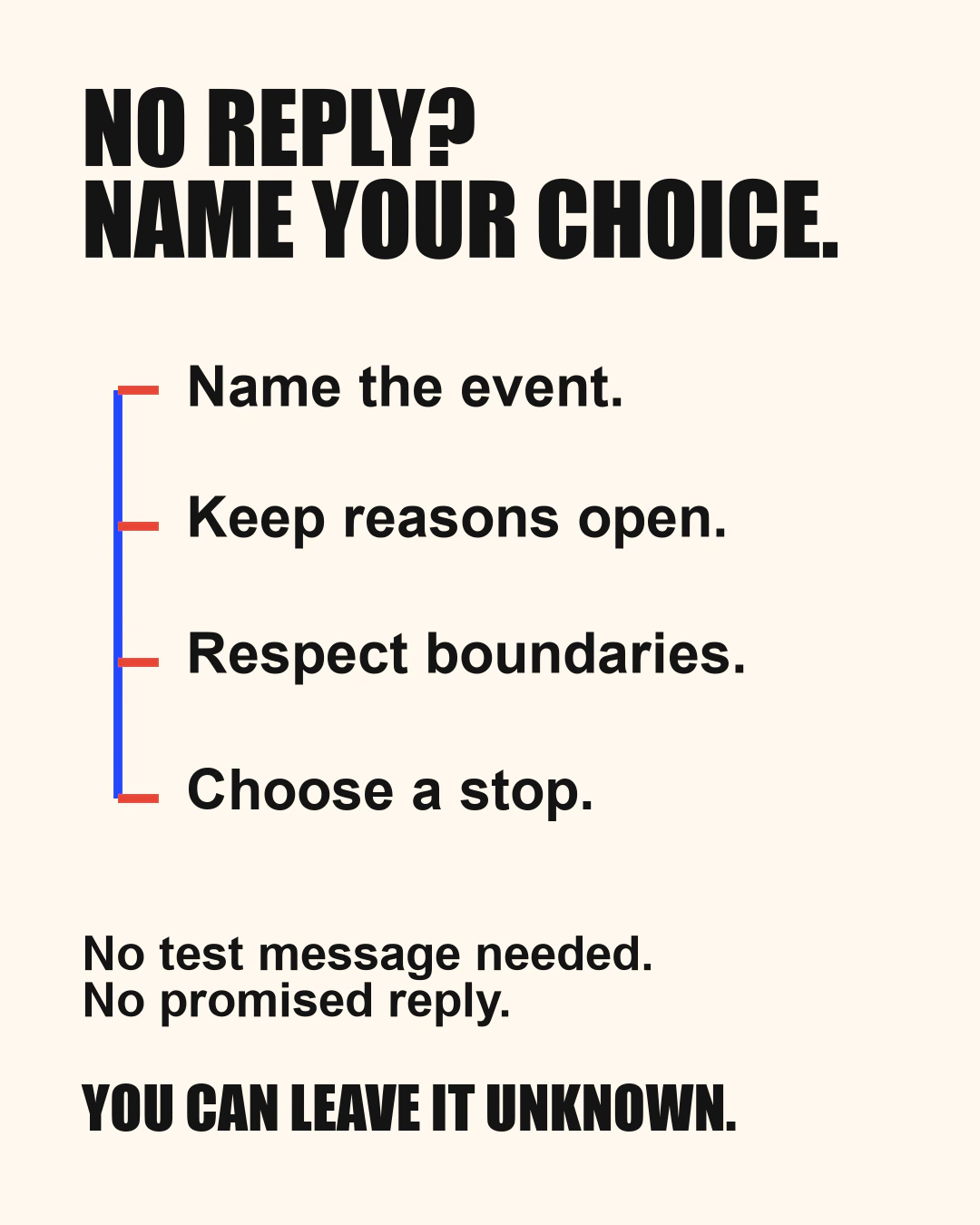
Graphic context — 04-practical-support: Four reminders condense five original optional choices: describe the event, name the actual decision, preserve unknown reasons, respect existing boundaries and choose a stopping point. This is an editorial aid, not an evaluated intervention or a response deadline.
Text equivalent: NO REPLY? NAME YOUR CHOICE. Name the event. Keep reasons open. Respect boundaries. Choose a stop. No test message needed. No promised reply. YOU CAN LEAVE IT UNKNOWN. Leaving a reason unknown does not require proving innocence, offering another chance or discarding a stated boundary. No-contact requests, blocks and appropriate existing safety, confidentiality or responsibility procedures still apply. There is no test message, repeated status checking, private-account inspection, alternate account, purchase or required reconciliation. Do not delay urgent needed action for this optional reflection. Stop when effort exceeds the ordinary decision; use suitable qualified support for persistent distress or a wider serious concern. The fictional Nia sketch-walk case is invented, not an observed result. Four actual primary publisher groups supply one accepted-author research manuscript, two commercial issuer help documents and a dictionary definition, not four routine trials. No individual motive detector, universal guilt, current growth/prevalence, clinical/legal/security certification, promised reply or measured benefit from these original choices. Full source versions, dates, reading limits and exact accessible text remain adjacent. There is no empirical routine-efficacy trial of these original choices.
One invitation, two unanswered questions
Imagine a fictional reader, Nia, asking an acquaintance whether they want a spare place on a weekend sketch walk. A read status appears, but no answer follows. Nia notices two questions: whether to keep the spare place available and why the acquaintance has not replied.
The place has an ordinary planning consequence. The motive does not have an answer in the message status. Nia chooses a plan that does not rely on the acquaintance attending and leaves the optional conversation alone. Nia does not ask another friend to check the person’s activity or treat the silence as proof of dislike.
This is an invented example, not an observed participant or a measured improvement. No source tested Nia’s choice. Another person with an established, welcome planning exchange might choose a practical clarification. Someone who has been asked not to make contact should respect that boundary. A serious responsibility needs its appropriate existing route.
The counterexample is a genuinely clear answer or an explicit boundary. If someone has said they cannot attend, that statement gives information a receipt does not. If they have asked for no further contact, uncertainty about their private reasons does not erase the request. Leaving motives unknown does not mean ignoring what someone has actually communicated.
Costs, risks and stop criteria
The cost here is attention, and it varies. There is no validated duration, daily schedule, subscription or measured emotional benefit for this original sequence. You can use a fictional example without opening a messaging app. You can also decide that reflecting on the exchange is not useful right now.
Do not turn the idea into an excuse for either repeated pursuit or compulsory forgiveness. The distinction between status and motive does not tell you that a relationship is healthy, that a response is owed or that you must maintain contact. It cannot assess harassment, coercion, abuse, a concrete threat or a personal legal obligation.
Avoid sharing another person’s private messages to seek a verdict. Public commentary and anecdotes do not make their motives accessible. The exercise requires no screenshots, hidden activity tools, contact through an alternative account or disclosure of sensitive material. Keep applicable confidentiality and safety procedures in place.
The evidence has several limits. A dictionary supplies language context, commercial issuers explain their own features and one research paper studies particular designs and samples. They are not four trials of this guide. There is no platform endorsement, independent professional assessment or clinical review of the article.
How to assess the result
A descriptive result is enough: the unanswered message, the status the actual feature shows, the reason that remains unknown and the practical choice you made. That record can stay in your head. It is not a score for emotional maturity, a diagnosis or proof that the relationship is over.
For Nia, the result is simply that the walk plan no longer depends on an answer. The reason for the missing reply remains unresolved. That may be less satisfying than a neat explanation, but it is more accurate than turning a read receipt into a claim about another person’s intentions.
If the exercise becomes repeated checking, stop using it as a way to seek certainty. Make the ordinary decision you need, preserve existing boundaries and seek suitable support for a wider concern. A read status can remain a read status. You do not have to make it carry the whole meaning of the relationship.
Myth or Real?

Claim
Social paraphrase: A read receipt alone establishes that the recipient is ready to answer the message.
Verdict
FALSE
Facts
The issuer feature reports a message status under its stated conditions; that status alone does not establish readiness or a reason for no reply.
FALSE rejects status alone as sufficient readiness proof, not all receipt information or every possible explanation.
An archived AskRedditUK original question asks whether readers prefer being left on read or delivered. This card explicitly reframes that preference question as a sufficiency claim about readiness to answer, not a quotation or belief attributed to the author. Comments, anecdotes, the post’s numeric phone-use assertion, votes and moral judgments are not evidence. Apple explains the read status in a chosen iOS 26 guide with iMessage and individual-contact conditions. Google explains conditional receipt information in RCS. These commercial issuers describe features, not a measurement of a particular recipient’s readiness, willingness or reason. FALSE rejects a receipt alone as sufficient proof. It does not mean receipts contain no information, a missing receipt proves a message is unread or every service follows the same rules. Both help documents are undated and were accessed October 26, 2026; the selected Apple version is not a publication date or newest-version claim. No person’s mind, character or mental health is assessed. Leave the reason unknown, respect explicit boundaries and make an ordinary optional decision. No test message, repeat checking, alternate account, setting change, compulsory contact, purchase or reconciliation is needed. Existing safety, confidentiality and responsibility procedures remain separate; do not delay needed action for this reflection.
Takeaway
Choose an ordinary stopping point while respecting stated boundaries; no test message or further contact required.
Sources
Claim discussion: Archived question about read versus delivered status preferences.
Evidence: Turn read receipts on or off in Messages on iPhone; Turn on RCS chats in Google Messages.
Checked 2026-10-26. Scope: Receipt-versus-readiness sufficiency only. No personal motive/availability detector, allplatform equivalence, duty to answer/reconcile or promisedreply; no account/contact action.
Sources
- S1A — Li, Zheng and Schroeder: The Pain of Ghosting?, accepted author manuscript linked from the coauthor’s official site. Journal first online August 31, 2026; author posting and PDF metadata September 17, 2026. Main methods, results and limitations read; underlying references, supplements, preregistrations and linked data were not independently read or reproduced.
- S2 — Apple: Turn read receipts on or off in Messages on iPhone, undated version-specific iOS 26 guide, accessed October 26, 2026. Issuer feature meanings and conditions only, with no account action or newest-version claim.
- S3 — Cambridge Dictionary: Ghosting, stopping-communication sense, undated and accessed October 26, 2026. Language context, not evidence of current growth, diagnosis or an individual motive.
- S4 — Google: Turn on RCS chats in Google Messages, undated issuer help accessed October 26, 2026. Conditional receipt information, not a universal messaging rule or a recommendation to change settings.
The research source is the accepted author manuscript rather than the publisher-formatted article. The publisher’s failed native response and the untouched repository verification page are retained in research records. The ordered choices, Nia example and counterexample are original editorial applications, not evaluated interventions.
FAQ
Common questions
Does read mean ready to answer?
A read status does not by itself establish readiness, willingness or a reason for no reply. Its meaning and availability depend on the actual service and feature conditions.
Must I send another message to find out?
No. Leaving an optional exchange alone or making an independent plan can be available. Respect no-contact requests, blocks and existing procedures; no contact test is needed.
Does uncertainty require offering another chance?
No. You can decide that a pattern does not work for you without claiming to know its cause. An explicit boundary remains a boundary, and this guide does not require reconciliation.
Topic hubs
Tags


