

The explanation makes sense while you read it. The worked answer looks familiar. You close the page and discover that starting from the question alone is a different task. That mismatch can make a study session feel more complete than a later attempt shows.
Confidence can provide useful information, but it is a judgment to check against performance. You can ask what you expect to produce, make an appropriate attempt without the answer in view, and compare the result with a trustworthy standard. The aim is a better next study decision, rather than becoming permanently certain or permanently doubtful.
The short answer
A feeling of readiness is not a substitute for evidence that you can do the relevant task. Equally, feeling unsure does not prove that you cannot do it. Treat confidence and accuracy as separate observations, then use their agreement or disagreement to decide what needs checking.
Laboratory studies show that information available during study can influence predictions about later recall. Research on delayed judgments of learning also suggests that postponing a prediction can help people distinguish stronger from weaker items. That is a claim about monitoring learning under particular conditions, not a promise of higher grades, a reliable personal score prediction, or a universal waiting interval.
This guide concerns ordinary adult studying. It does not diagnose a memory problem, measure intelligence, or offer treatment for anxiety or another condition. The sources illustrate foundational research from 1992–2011; they are not presented as a complete current review of every classroom, subject, or learner.
Definitions and scope
A judgment of learning is a prediction about later memory performance. For example, after studying a term and its meaning, you might predict whether you will recall the meaning when given only the term. That prediction differs from saying the explanation is clear or that you enjoyed studying it.
Accuracy concerns what you actually produce under specified conditions: a correct recalled answer, a sufficiently complete explanation, or a solution that meets the relevant criteria. You need an answer key, rubric, teacher explanation, or another suitable standard to check it. Familiarity with the wording alone does not establish that standard.
Two monitoring questions are also different. Absolute calibration concerns how close a prediction is to the amount of performance it predicts. Relative accuracy, sometimes called resolution, concerns whether predictions distinguish better-remembered from less-remembered items. You could identify your weakest topic while still expecting too much from every topic. Research using one measure should not automatically be described as proving improvement in the other. Koriat and Bjork, 2005.
Finally, a useful self-check and an improvement in memory are separate outcomes. A check may reveal a gap without repairing it. Repair still requires appropriate study, feedback, or help with the missing knowledge. A successful attempt today also does not establish permanent retention or transfer to a different type of problem.
How it works
The answer changes the situation
When a question and answer appear together, the connection may be easy to appreciate. Later, the question has to lead you to an answer that is no longer visible. Those situations supply different information.
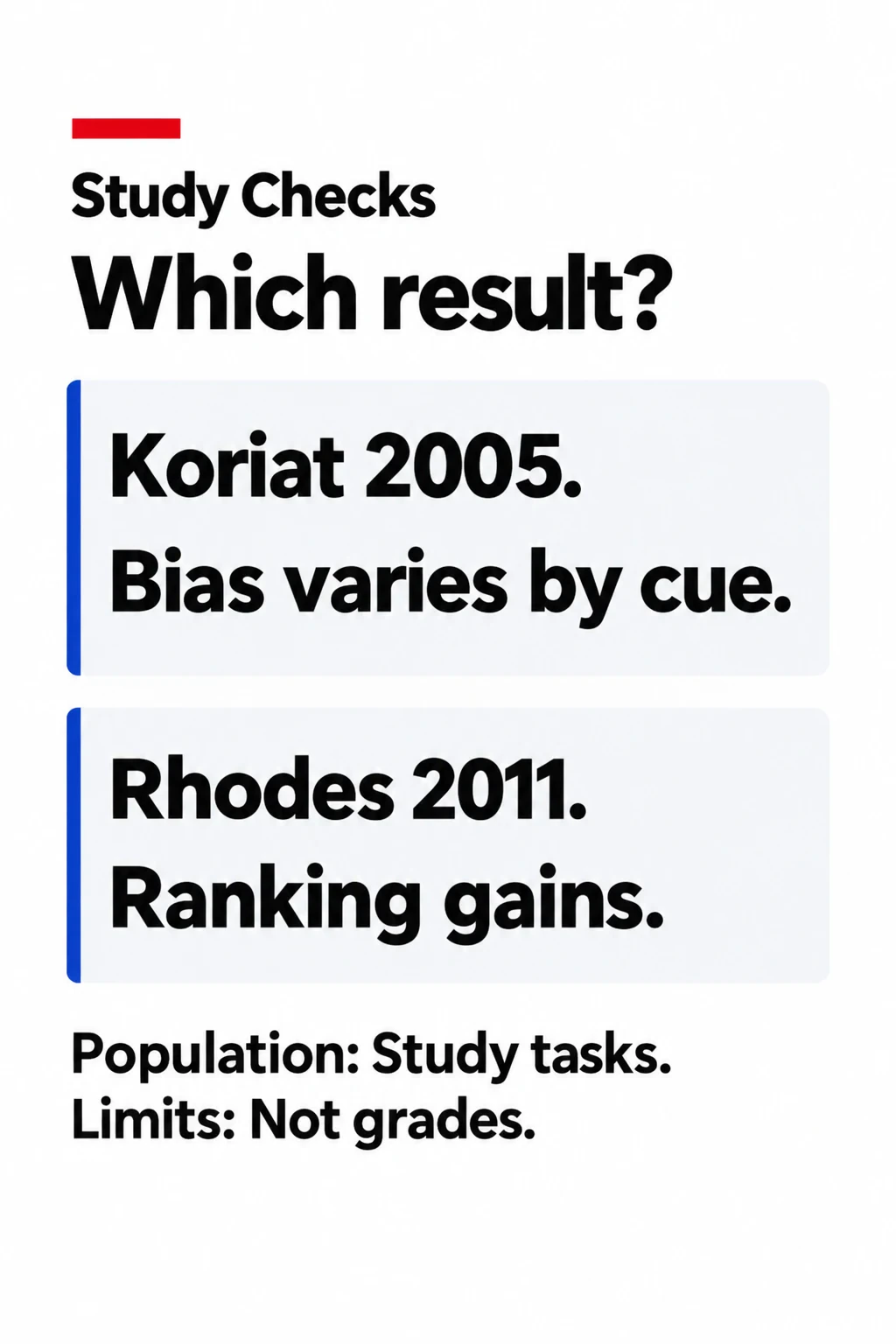
Koriat and Bjork studied this problem using paired words. Their account emphasizes that the relationship apparent when both words are present can differ from the relationship that helps a cue bring an answer to mind. The paper includes conditions in which predictions were reasonably matched to recall and others in which predictions were inflated. It does not show that all confidence is false. Koriat and Bjork, 2005.
An everyday example is recognizing a familiar step in a worked solution without being able to choose that step from a fresh problem. That is an illustration of the distinction, not a finding that every familiar-looking answer creates the same bias. The appropriate check depends on what you eventually need to do.
A delay can change the information behind a judgment
Immediately after studying, the answer may still be readily available. A later judgment can draw on different evidence. In Dunlosky and Nelson’s paired-associate study, the reported delayed-judgment benefit depended strongly on the cue: presenting the question-side alone differed from presenting the question and answer together. Waiting while looking at the answer is therefore not the same manipulation as trying to judge from the cue alone. The available publisher abstract supports that distinction; it does not establish an optimal routine for your course. Dunlosky and Nelson, 1992.
Several explanations may contribute, including access to more useful memory information, opportunities for retrieval, and the relationship between study and test cues. The evidence does not justify presenting one uniquely established brain mechanism or a timer that works for everyone.
A self-check can also affect what happens next
Trying to retrieve an answer is not necessarily a neutral measurement. It can be part of learning. Once you have attempted a question or seen corrective information, you have changed the experience that a later answer draws on. Do not treat repeated success on the same recently revealed item as an untouched prediction of a future exam.
This does not make self-checking useless. It means recording what you did matters. “Answered after seeing a hint” and “answered from the original question” describe different evidence. Both can be useful, provided they are not quietly combined into the same claim of independent recall.
What the evidence supports
Monitoring can improve more than memory performance
Rhodes and Tauber’s 2011 meta-analysis reported a standardized benefit of g = 0.93 for relative monitoring accuracy when judgments were delayed rather than immediate. Its reported memory-performance benefit was much smaller: g = 0.08 after two stated outlier exclusions, and g = 0.06 with those cases included. These are effect sizes for different outcomes, not percentages, exam points, or a comparison showing one activity is a fixed number of times better. Rhodes and Tauber.
Materials, cues, timing, and test types varied, with much of the research using paired associates. The review supports separating monitoring from memory outcomes. It does not establish that a particular delay improves your absolute score prediction or that simply waiting replaces further learning.
Similar confidence can accompany different later recall
In Karpicke and Roediger’s 2008 experiment, college students learned vocabulary pairs under different repeated-study and retrieval arrangements. Their group-level predictions of later performance were similar, while recall a week later differed substantially. The supporting methods identify a small sample of 40 undergraduates studying 40 word pairs. This is evidence of a specific mismatch, rather than a rule that confidence never relates to knowledge or that every kind of reading is ineffective. Karpicke and Roediger, supporting methods.
The papers and review also do not represent four independent replications by unrelated teams. They share a research tradition, and the review includes earlier work. Their value here is in explaining distinct measurement questions and boundaries, rather than multiplying an apparent count of independent confirmations.
Misconceptions and uncertainty
“If it feels easy, I have learned it.” Ease can reflect what is visible, recently encountered, or familiar. Check the task you need to perform, with its relevant conditions. That does not require making every activity difficult for its own sake.
“If I struggle, nothing was learned.” A difficult attempt can reveal the precise step or fact that needs attention. Look at the actual answer and criteria rather than turning one struggle into a judgment about ability.
“A delayed prediction proves my expected score.” A method can improve the ordering of stronger and weaker items without making the predicted overall score accurate. A small set of practice questions may also omit important parts of the assessed material.
“The longer I wait, the better.” These sources do not supply a universal optimum delay. A useful gap depends on the task and available study time. Do not sacrifice course requirements, rest, or necessary instruction merely to prolong a self-check.
“The confidence number itself does the learning.” A prediction can guide a decision, but recording more predictions is not automatically a better study routine. The response to a discovered gap matters, and the record should earn the effort it costs.
Myth or Real?

Claim
Social paraphrase: Rereading creates familiarity rather than real understanding.
Verdict
MIXED
Facts
Cue-dependent prediction errors occur in study tasks; that does not establish that all reading is ineffective.
Small vocabulary studies separate confidence from recall, not every form of understanding, grade or learner.
MIXED preserves a useful warning while limiting a blanket conclusion. In the paired-word experiment, one cue direction produced inflated predictions while another group mean was close to recall. Familiarity during study therefore cannot certify later performance, but confidence is not always wrong. The other experiment compared specific repeated-practice arrangements after successful vocabulary recall. Similar group predictions accompanied different delayed recall. That is not a test of every kind of reading or broad understanding. These are reused foundational article sources, not new independent validations or a comprehensive2026review. Absolute score prediction, relative item ranking, recall, understanding and course grades remain distinct. For an ordinary study task, an optional attempt can be checked against a trustworthy answer or rubric; record hints and avoid calling an assisted attempt unaided. An attempt can itself affect learning. Do not change a correct answer only because confidence is low. The complete organiser is an untested editorial adaptation, with no universal delay or grade guarantee. Keep monitoring brief and proportionate, protect course requirements/rest, and stop unhelpful repetition or distress. Ask a teacher about unclear criteria; persistent functional impairment warrants appropriately qualified support.
Takeaway
For an ordinary study task, optionally check one appropriate attempt against a trustworthy criterion.
Sources
Claim discussion: Public study discussion: Rereading feels productive because it removes doubt temporarily.
Evidence: Koriat and Bjork2005: Illusions of Competence in Monitoring One’s Knowledge During Study; Karpicke and Roediger2008: The Critical Importance of Retrieval for Learning.
Checked 2026-10-20. Scope: Checks the public blanket reading claim and its useful warning about familiarity. Does not judge the author personal experience, claim every confidence estimate wrong, or endorse universal self-testing dosage or grade promises.


Practical meaning and sources
Try one bounded comparison
Choose a manageable piece of material and identify the performance you need: recall a term, explain a reason, or solve an appropriate problem. Use a check that fits that goal. Reciting an answer to a factual question does not demonstrate that you can apply the concept to a new situation.
Before looking at the answer, make a brief prediction if it helps: confident, unsure, or an estimate tied to clearly defined questions. Keep it simple. Then attempt the task under suitable conditions and compare with the relevant standard. If you use a hint, record that distinction rather than treating the result as an unaided attempt.
If you want to compare immediate familiarity with a later check, return after an ordinary gap in your study, without keeping the answer in view. Note the gap and conditions approximately; there is no prescribed number of minutes here. This is a practical adaptation, not the exact intervention or an individually tested dosage from a paper.
Use the mismatch to choose a next action. The table is an editorial decision aid, not a validated scoring algorithm.
| Your judgment and checked response | A useful next question |
|---|---|
| Confident and correct | Does the response meet the full criterion, and will a later or different appropriate check be useful? |
| Confident and incorrect | Which assumption, fact, or step needs correction before another attempt? |
| Unsure and correct | Is the reasoning sound, or did a guess happen to match? |
| Unsure and incorrect | What explanation, example, or help is needed to understand the missing part? |
Do not keep changing a correct answer solely because confidence is low. Check the reasoning and standard. If an answer key appears inconsistent or the marking criterion is unclear, ask the teacher or relevant expert rather than training yourself to memorize an unresolved error.
A small example of a prediction gap
Imagine eight equally weighted practice questions and a prediction of six correct answers. That predicts 75% correct. Suppose the checked responses earn four correct answers, or 50%. The prediction exceeds that result by 25 percentage points. These are invented numbers illustrating an absolute prediction gap, not a research effect, a relative-accuracy statistic, or an actual student’s result.
The useful follow-up is to inspect the missed questions. Perhaps one definition was recognized but not recalled, or a solution omitted a required reason. Choose the relevant correction rather than deciding that you are simply an overconfident person. If the prediction were four correct and the result six, the direction of the gap would reverse; low confidence would not make those checked answers incorrect.
Eight selected questions are still a small and potentially unrepresentative sample. The result does not forecast an exam percentage or measure a permanent trait. A later attempt after correction is new evidence under new conditions, not proof that the original prediction was right all along.
Keep the record useful
A short note can capture the question, what you predicted, what you produced, and the next learning action. You do not need to score your personality or turn every lesson into a monitoring exercise. Use the information to make a study choice, then get on with the learning that choice requires.
Revisit something when there is a reason, such as after correcting a misunderstanding or when checking retention at a relevant later point. Constantly repeating a recently revealed answer can make the record look successful while answering a narrower question than you intended.
Simplify or stop the monitoring routine if it consumes the study time you need, encourages repeated checking, or adds distress without a useful decision. For persistent concentration or memory difficulties, distress, or exhaustion that impairs everyday functioning, seek appropriately qualified support. This guide is educational and does not replace assessment or treatment.
Judge the routine by whether it exposes a specific, actionable gap at a reasonable effort cost. The outcome can be as ordinary as realizing that you can recognize a worked example but need help explaining one step independently. That is a useful next question, even before confidence or a test score changes.
Sources
Access boundaries:
- Koriat and Bjork, 2005: Illusions of Competence in Monitoring One’s Knowledge During Study. Actual author-hosted paper; paired-word study/test mismatch and calibrated versus inflated judgments.
- Dunlosky and Nelson, 1992: Importance of the kind of cue for judgments of learning and the delayed-JOL effect. Publisher abstract read; full paper not obtained. Cue distinction only, without detailed protocol or universal timing claim.
- Rhodes and Tauber, 2011: The influence of delaying judgments of learning on metacognitive accuracy. Actual author-shared paper; relative accuracy, memory performance, stated exclusions and transfer limits kept separate.
- Karpicke and Roediger, 2008: The Critical Importance of Retrieval for Learning. Actual author-hosted paper and supporting methods; specific small vocabulary experiment, not a classroom-wide grade guarantee.
FAQ
Common questions
Does feeling unsure prove that I cannot do the task?
Equally, feeling unsure does not prove that you cannot do it.
Does a delayed judgment establish an optimal study routine?
The available publisher abstract supports that distinction; it does not establish an optimal routine for your course.
Should I change a correct answer just because confidence is low?
Do not keep changing a correct answer solely because confidence is low. Check the reasoning and standard.
Topic hubs
Tags


