

You finish a page of nearly identical problems and feel comfortable. Then a mixed quiz removes the chapter heading. Before you can calculate, you have to answer a different question: which method belongs here?
That gap between carrying out a method and choosing it is where interleaving can help. You mix related types within practice so the problem itself must guide your choice. It is a useful option for a particular learning problem, rather than a reason to make every session harder.
What you are mixing
Blocked practice groups examples: A-A-A, then B-B-B. Interleaving changes the order: A-B-A-B, or another mixture. The useful distinction is between the categories, not simply the amount of variety.
Spacing distributes practice across time. Retrieval practice asks you to produce an answer from memory. Interleaving varies the category or method among examples. A session can use all three, but they describe different decisions.
It also differs from multitasking. Finishing one problem and then attempting a related type is sequential practice. Checking messages during either problem adds distraction; it does not become a learning technique because activities alternate.
What the strongest summaries show
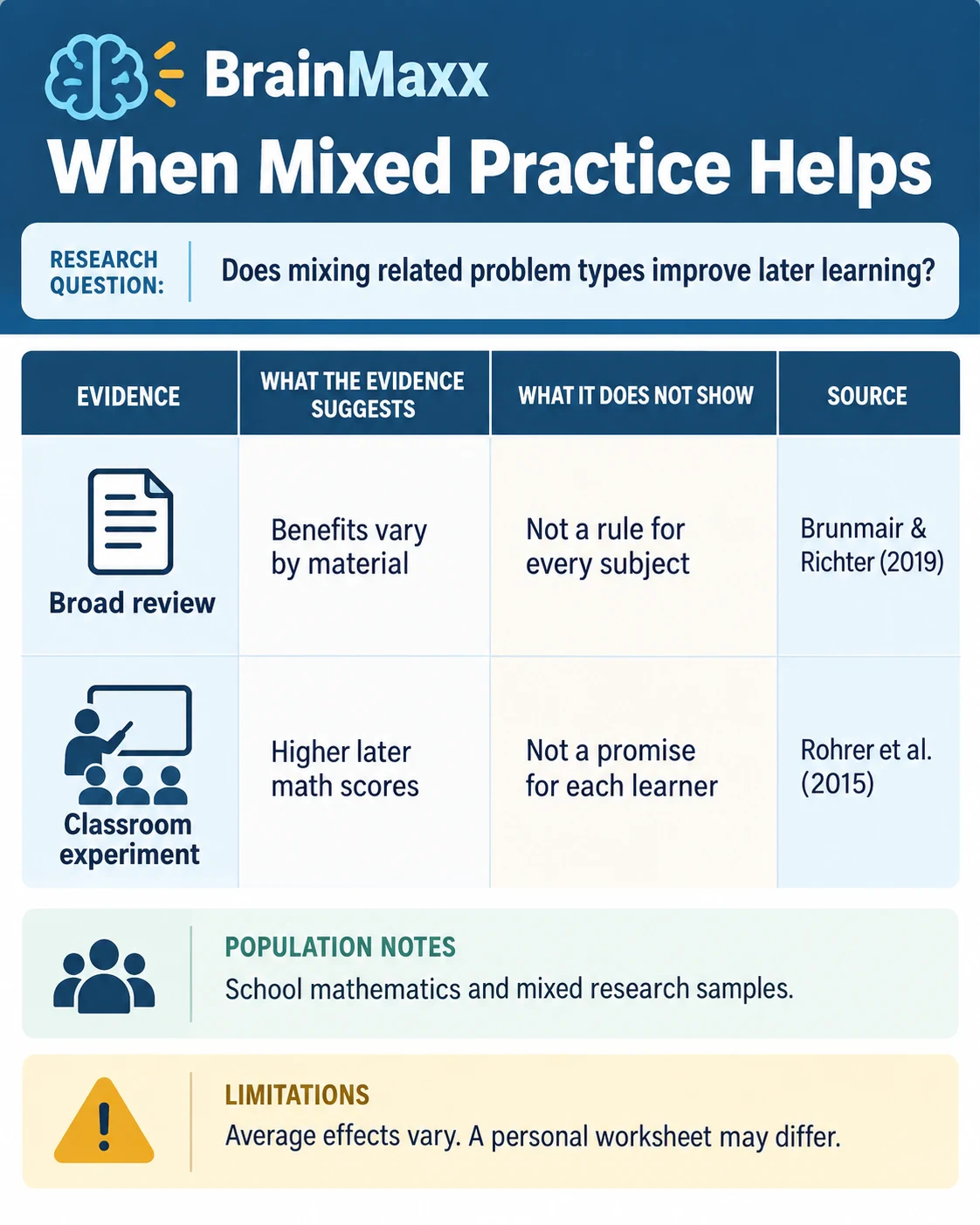
Brunmair and Richter’s 2019 meta-analysis combined 59 studies and found an overall benefit of Hedges’ g = 0.42. This standardized difference does not mean 42 percent higher marks. Materials mattered: the mathematics estimate was smaller, visual-category results were stronger, text results were uncertain, and word-based tasks favored blocking on average. [1]
Firth and colleagues’ 2021 systematic review focused on concept learning. Across 26 included studies, it examined both remembering studied examples and classifying new ones. Its interpretation emphasizes subtle distinctions between categories. That supports asking whether mixing helps with a specific distinction, rather than mixing everything. [2]
The reviews overlap with underlying studies; they are separate syntheses, not independent replications of each result. Their averages cannot establish equal benefits across every age, disability, subject, or setting.
Myth or Real?

Claim
Social paraphrase: Mixing topics or skills leads to better test performance than blocked practice.
Verdict
MIXED
Facts
Mixed practice can help, but its advantage depends on the material and task.
Some word-based tasks favored blocking; review averages do not predict every learner.
The social post presents a broad advantage for mixing. The research supports a conditional answer: materials and task demands change the result, and some categories favor blocking. MIXED applies to the broad claim, not to every carefully designed mixed practice set. Feeling a task become harder is not by itself evidence that learning improved.
Takeaway
Mix related methods deliberately and inspect later errors.
Sources
Claim discussion: Reddit study discussion: interleaving advice.
Evidence: Brunmair and Richter: interleaved-learning meta-analysis.
Checked 2026-10-16. Scope: Learning and practice schedules across heterogeneous research tasks; no individual gain, clinical treatment or unrelated-subject advantage is guaranteed.
Two studies that make the question concrete
Rohrer, Dedrick, and Stershic studied 126 seventh-grade students practicing mathematics over three months. The interleaved arrangement produced higher test scores one day and thirty days after review, with reported Cohen’s d values of 0.42 and 0.79. That comparison supports the schedule used in this setting; it does not promise the same gain from a personal worksheet. [3]
Kornell and Bjork studied university students learning to classify paintings by artist. Intermixed study helped later classification, although learners often thought grouped study worked better. The brief laboratory task does not establish a whole-course benefit, but it shows why perceived ease alone can mislead a learner choosing a schedule. [4]
These studies concern learning and performance. Finding a mixed set difficult cannot diagnose an attention disorder, a learning disability, or intelligence.

Why it might work
One explanation is discrimination: neighboring examples expose the difference between categories. Another is strategy selection: the worksheet no longer supplies the method through its heading or repeated pattern. Spacing may also contribute when examples of the same type are separated. The research does not assign these explanations the same role in every task. [1–4]
For practice design, ask what is currently going wrong. If you confuse related types, contrast may help. If you cannot perform one procedure even with a label, instruction may be the more useful next step. If the categories already look completely different, extra alternation may add little.
These are practical interpretations of the research, not a validated screening test. A teacher or learning-support professional can adapt practice to an actual curriculum and the learner’s existing support.
Match the evidence to your task
| Evidence | Learning task | What it cannot settle |
|---|---|---|
| Broad 2019 synthesis [1] | Multiple materials and practice designs | One best schedule for every subject |
| Concept-learning review [2] | Remembering and distinguishing categories | Equal benefits for unstudied populations |
| School experiment [3] | Seventh-grade mathematics over three months | An identical gain from a personal worksheet |
| Laboratory experiments [4] | Classifying unfamiliar paintings | Whole-course or everyday decision outcomes |
The table is a scope map, not a league table. Match your question to the task studied before borrowing a result. Evidence about choosing a mathematical method is more directly relevant to a mixed mathematics worksheet than to memorizing an unrelated list of words.
A worked example: same numbers, different job
Imagine you have learned area and perimeter for rectangles. Both of these invented questions use a rectangle five centimeters long and three centimeters wide:
- How much border is needed to go around its edge? Choose perimeter: 5 + 3 + 5 + 3 = 16 centimeters.
- How much surface does it cover? Choose area: 5 × 3 = 15 square centimeters.
On a sheet headed “Area,” you might multiply without reading the purpose. In a mixed set, the numbers alone cannot choose the operation. Explain whether the question concerns an edge or a surface, then calculate and check the units.
If you choose perimeter but add incorrectly, you need calculation feedback. If you confidently multiply when asked for a border, the selection needs attention. That distinction is the reason to record the explanation. This example demonstrates a practice design; it has not been separately tested as an intervention.
For the later check, change the dimensions and wording. Repeating these exact answers would mostly tell you whether you remembered this pair.

Try a small, supported mixed set
The following is an editorial study experiment, not a separately tested intervention package. It fits ordinary, low-stakes practice of related skills you have already been taught.
- Choose two or three types you confuse. Keep the scope small enough to explain what each asks.
- Find reliable worked examples and feedback. If you cannot attempt a type at all, obtain instruction before mixing it in.
- Make a short set in which each problem contains the information needed to choose its method. Remove unnecessary category headings, not essential information.
- Before calculating, write a reason for your choice. Solve one problem at a time; check the reasoning and the result.
- Later, attempt fresh examples without category labels. Separate errors of method choice, calculation, and question interpretation.
Put a later review on the calendar, but do not treat a particular delay or problem count as optimal for everyone. The purpose is to inspect learning after the immediate familiarity has faded, rather than count a completed sheet as success.
Read the errors before changing the schedule
Useful signals include choosing a defensible method, applying it to unfamiliar examples, and needing less prompting later. Speed may matter for a specific assessment, but timing alone can conceal a selection error.
A correct method followed by an arithmetic slip needs different attention from a correct calculation made with an unsuitable method. Separate those outcomes. A tiny practice-set percentage can hide the distinction.
Do not treat an informal before-and-after comparison as proof of causation. The later examples might be easier, you might remember them, or you might have received more teaching. For a personal trial, the outcome is a better next practice decision. A controlled experiment needs a more careful comparison.
When to simplify or get help
Reduce the mixture if you are guessing on almost every item, cannot explain a basic procedure, lack reliable feedback, or become too distressed to use corrections. Return to instruction and supported examples. Difficulty is information; by itself it does not prove that the method is working.
A study technique must not replace disability accommodations, an individualized education plan, or a teacher’s assessment requirements. The cited results do not establish treatment for ADHD, anxiety, dyslexia, or any other condition. This article is educational and is not a diagnosis or a substitute for assessment or treatment.
Persistent difficulty that impairs learning deserves qualified support from an educator, learning-support professional, or clinician as appropriate. Immediate danger calls for local emergency or crisis services; a study article is not crisis care.
Make the next practice decision specific
If the challenge is choosing among related methods, try a modest mixed set and examine the reasoning. If the challenge is learning a procedure for the first time, ensure instruction is in place. For vocabulary or extended reading, do not assume a result from mathematics or painting classification settles the question.
You do not have to make all practice mixed. Pick a distinction, practice it deliberately, and let the later errors show what deserves attention next.
Sources
- Brunmair, M., & Richter, T. (2019). Similarity matters: A meta-analysis of interleaved learning and its moderators. Psychological Bulletin, 145, 1029–1052. DOI: 10.1037/bul0000209.
- Firth, J., Rivers, I., & Boyle, J. (2021). A systematic review of interleaving as a concept learning strategy. Review of Education, 9, 642–684. DOI: 10.1002/rev3.3266.
- Rohrer, D., Dedrick, R. F., & Stershic, S. (2015). Interleaved practice improves mathematics learning. Journal of Educational Psychology, 107, 900–908. DOI: 10.1037/a0038271.
- Kornell, N., & Bjork, R. A. (2008). Learning concepts and categories: Is spacing the enemy of induction?. Psychological Science, 19, 585–592. DOI: 10.1111/j.1467-9280.2008.02127.x.
FAQ
Common questions
Is interleaving the same as spacing?
No. Spacing distributes practice across time; interleaving changes the category or method between examples. A session can include both.
Does interleaving always beat blocked practice?
No. Review findings vary by material and task; some word-based tasks favored blocking. Average benefits do not predict every learner.
How can I try mixed practice?
Choose related methods already taught, use reliable examples, explain the method before solving, and check fresh examples later. Simplify if you are guessing or distressed.
Topic hubs
Tags


