

“You can improve” can be an invitation. It can also become an accusation: if the grade did not rise, perhaps you did not believe or try hard enough.
Research on growth mindset supports the first use far more than the second. A growth mindset is the belief that abilities can develop. It is not the belief that everyone can reach any outcome, that effort always works, or that teaching and opportunity no longer matter.
Two major reviews disagree for understandable reasons
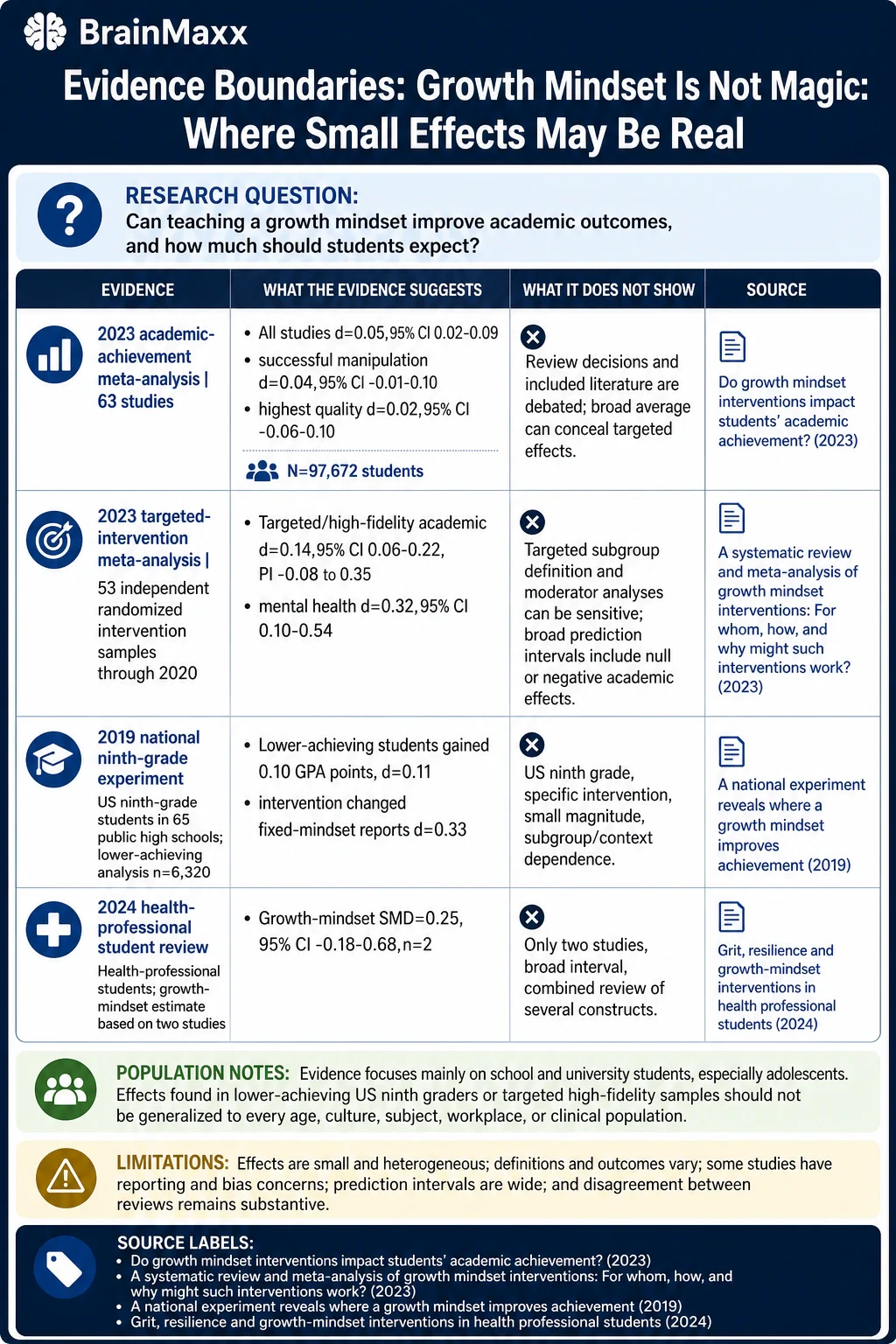
A 2023 meta-analysis covering 63 studies and 97,672 students found a tiny average achievement effect (d = 0.05). After correction for possible publication bias, it was no longer significant. Among studies where the message successfully changed mindset, the estimate was d = 0.04; among the six highest-quality studies, d = 0.02. Both confidence intervals included no effect.
The authors also identified design, reporting, and bias concerns. Researchers with a financial incentive to report positive findings published larger effects on average. That association does not prove any individual result was improper, but it raises the value of preregistration, independent analysis, and complete reporting.
A second 2023 meta-analysis took a different approach. It emphasized randomized interventions delivered with high fidelity to groups expected to benefit. For academic achievement, that targeted estimate was d = 0.14. Its 95% prediction interval ran from -0.08 to 0.35, meaning a future comparable study could plausibly find no benefit or a modest one.
These are not “science versus anti-science” conclusions. The reviews ask different aggregation questions. One asks what the literature shows broadly and after stricter quality checks. The other asks whether effects concentrate in targeted, well-implemented settings. Both point away from a large universal boost.
The national experiment found a small, contextual effect
In a preregistered national US experiment, ninth graders received two online sessions totaling less than an hour. Among lower-achieving students, assignment to the intervention increased core-course GPA by 0.10 grade points, or d = 0.11. Reported fixed-mindset beliefs changed more, by d = 0.33.
The intervention therefore changed the targeted belief more than it changed grades. School context mattered: effects were more favorable where peer norms supported challenge-seeking. Because students were randomized, the program can be credited for the average change in that studied subgroup. The moderator result is less definitive; schools were not randomly assigned to peer norms.
The population boundary is narrow but important: US ninth graders, a specific online program, lower-achieving students, and school-record grades. The result does not estimate effects for a professional retraining, a five-year-old learning to read, or a person facing inaccessible instruction.
Newer evidence stays mixed and specific
A 2024 review of health-professional students found only two growth-mindset intervention studies. Their pooled estimate for mindset itself was SMD 0.25, with a confidence interval from -0.18 to 0.68. That is too imprecise to establish a benefit.
A 2024 primary-school study in China reported stronger growth mindset at three months and changes in how students responded to failure, with some protection against declining achievement. It adds useful cultural and age-specific evidence. It does not settle the size of the average academic effect across other systems.
Belief is one link, not the whole chain
A mindset message might change how a setback is interpreted. That could influence whether a student seeks feedback, tries another strategy, or persists. Each “could” is a testable link, not a guaranteed mechanism.
Grades also depend on prior knowledge, instruction, practice quality, time, assessment, language, disability access, safety, discrimination, sleep, money, and family responsibilities. Telling a student to think differently while leaving a blocked environment unchanged is not an intervention on that environment.
Normal frustration or a fixed-sounding sentence does not diagnose a disorder or a permanent trait. Likewise, persistent academic difficulty is not proof of low motivation.
An evidence ladder for a contested field
The two meta-analyses provide the broadest but competing summaries. The national randomized experiment gives the cleanest causal estimate for one scalable program and subgroup. The smaller 2024 reviews and trials extend the map to other learners but cannot erase the main uncertainty. Finally, the two-week test below is an editorial translation of strategy-and-feedback principles; it is not the intervention tested in the national study and should not inherit its effect size.
Turn the message into a two-week strategy test
Use mindset as permission to test a better process, not as pressure to produce a result.
- Name one bounded skill: solving linear equations, not “being good at math.”
- Replace “I cannot do this” with “Which step breaks down?”
- Choose one new strategy, such as worked examples followed by one unaided problem.
- Schedule short practice that fits available energy and time.
- Get concrete feedback on errors.
- After two weeks, review both practice behavior and performance on the same task.
For example, Devon has begun saying, “I am just bad at spreadsheets.” The test does not ask him to chant the opposite. He chooses one task—building a pivot table—watches a worked example, completes four short practices, and asks a colleague to mark the first incorrect step. After two weeks, he starts the task faster but still mislabels calculated fields. The result supports continuing the successful setup practice and seeking targeted instruction on field logic. It does not prove a transformed mindset, limitless potential, or personal failure.
Stop if practice causes harm, escalating shame, exhaustion, or loss of needed rest. Do not use growth-mindset language to deny accommodations, blame a learner for structural barriers, or continue a failed method indefinitely.
Persistent impairment, severe distress, or suspected learning, attention, mood, health, or accessibility needs deserve qualified educational, clinical, or accessibility support. This exercise cannot diagnose or treat them.
The useful version is smaller
The evidence does not justify “believe and you will achieve.” It supports a more modest sentence: abilities are not always fixed, strategies and contexts can change, and a well-designed message may help some learners take the next useful action.
That is less magical. It is also more humane—and more faithful to the data.


Sources
- 2023 achievement meta-analysis and quality review
- 2023 targeted-sample and fidelity meta-analysis
- National Study of Learning Mindsets
- 2024 health-professional student review
- 2024 primary-school intervention in China
This article is educational and is not a diagnosis or treatment plan.
FAQ
Common questions
Does growth mindset reliably raise grades?
Not by itself. Average effects are small and heterogeneous, and findings depend on study quality, population, outcome, implementation, and whether the context supports effective action.
Is praising effort enough?
No. Effort without strategy, feedback, instruction, resources, or adjustment can repeat an ineffective approach. Feedback should connect effort with a useful process and next step.
When does growth-mindset language become harmful?
It is harmful when used to blame students, dismiss disability or discrimination, demand unsafe persistence, or withhold teaching, accommodation, rest, or professional care.
Topic hubs
Tags


