

The document is open, the calendar is full and the chat dot says busy. At the end of the afternoon, the thing you meant to finish still has an empty section. It can feel awkward to admit that a day contained plenty of activity without producing the particular result you had in mind. The awkwardness is not a useful measurement of what happened.
Taskmasking is a sharp word for appearing productive. It is also an easy label to throw at someone whose work you cannot see. A better question for an ordinary task of your own is more concrete: what would count as finished, and what evidence of that state exists? An availability signal, a long session and a completed result answer different questions.
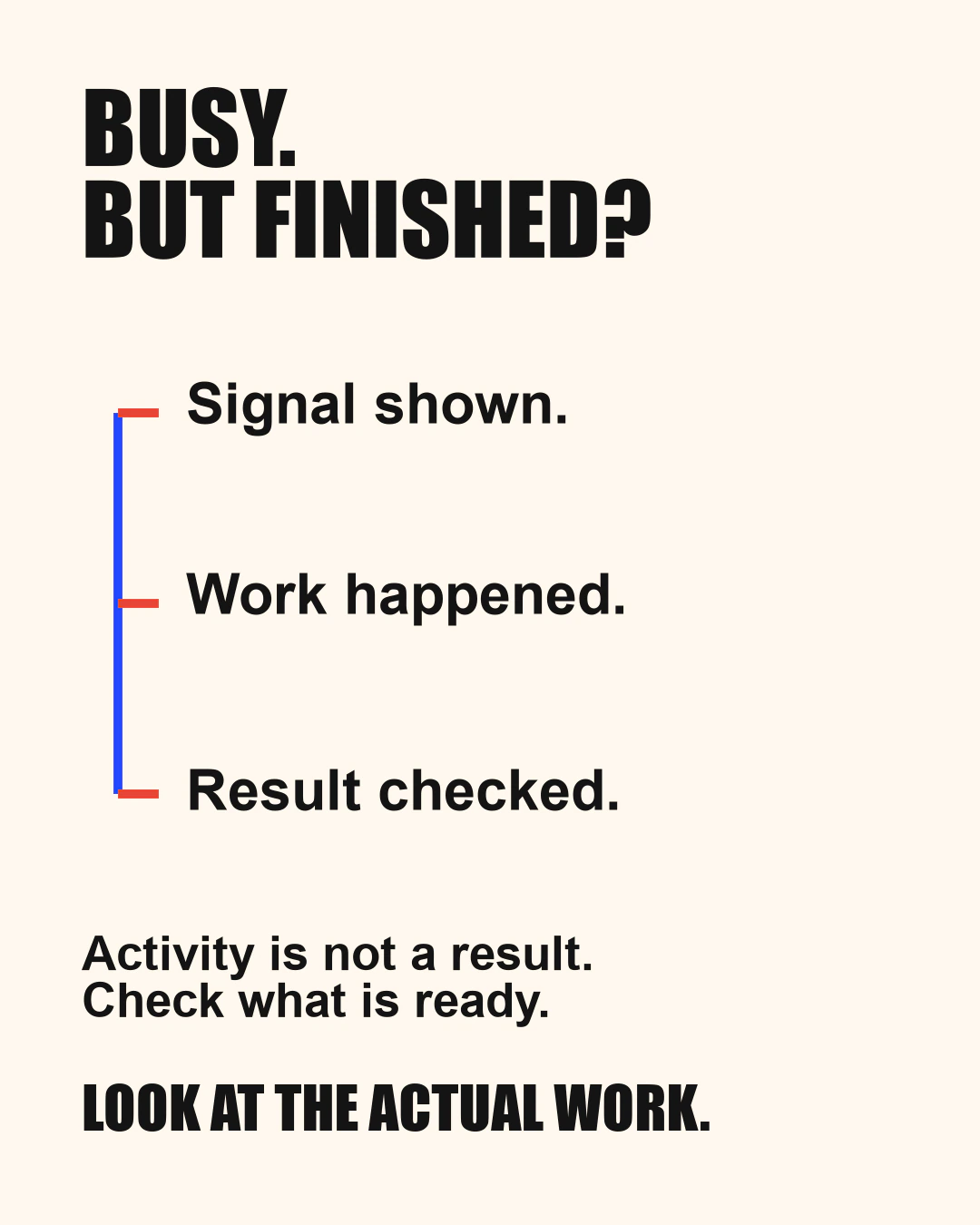
Graphic context — 01-article-hero: This original qualitative rail separates three questions: what a feature displays, which activity happened and what inspection shows about the selected result. Connectors organise descriptions, not a guaranteed sequence or an assessment of a worker.
Text equivalent: BUSY. BUT FINISHED? Signal shown. Work happened. Result checked. Activity is not a result. Check what is ready. LOOK AT THE ACTUAL WORK. A signal, an action and the state of an intended result are different descriptions. A check can find a result ready, incomplete or blocked by missing information. Thinking, coordination, useful preparation and rest can matter without an immediately visible artifact. No dot, elapsed time, message count or quiet interval is used to diagnose effort, dishonesty or character. Existing quality, review, safety and confidentiality requirements remain separate. Four actual primary publisher groups supply dated language context, one historical laboratory paper, commercial issuer help and an authored framework definition, not four trials of these original choices. No individual worker-intent or clinical detector, current growth/prevalence, quality certificate, measured saving or routine benefit. Selected framework sections and full main research reading have distinct scopes. Complete source versions, dates, limits and exact accessible text remain adjacent. There is no empirical routine-efficacy trial of these original choices.
Who this is for
This guide concerns a small task you can inspect yourself: a draft invitation, a repaired index in a personal folder or a short set of notes for a hobby project. It is not a system for grading employees, detecting dishonesty or deciding whether another person deserves a break. Thinking, coordination, necessary administration and rest can matter even when they produce no immediately visible document.
Cambridge’s July 2025 new-words blog discussed taskmasking as appearing busy while doing relatively little work. That is dated language context. The entry is a discussion of a proposed word, including a poll, rather than evidence that the behavior is growing now or that a particular person is doing it. Its quoted magazine commentary is not an independent study used here. [S1]
You do not need to adopt the label for yourself. The practical aim is to distinguish an activity you performed, a result you intended and a check that would establish whether that result is ready. This is a description exercise, not a character assessment or a promise to make every minute productive.
Before you start
Choose one ordinary task with a limited purpose. Avoid confidential work, someone else’s private activity or a high-stakes decision that requires a formal review. A fictional example works just as well. You need no timer, monitoring software, subscription, screenshot collection or change to your messaging account.
Keep existing responsibilities intact. Some roles require availability, documentation, supervision or a particular review process. This guide does not authorize ignoring those requirements, hiding activity or changing a status to create a misleading impression. A personal completion note is not a substitute for an approval, safety check or other required procedure.
Start with what the task is for. An invitation needs enough correct information for the intended reader to use it. A folder index needs to lead to the right files. A note for your own future use may need only a clear explanation of what you found. The appropriate check depends on the purpose, rather than on how impressive the activity looks.
If the task is exploratory, that is a legitimate starting condition. You may not know the final answer yet. In that case, distinguish the bounded piece of exploration you are doing from a finished overall solution. Do not invent certainty merely to make a box easy to tick.
Graphic context — 02-concept-model: Three pairs map a signal to its feature meaning, activity to an action and a selected result to its current readiness. Arrows map terms, not causes, probabilities or a test for identifying someone who is pretending to work.
Text equivalent: A BUSY DOT IS NOT A RESULT. Signal Available or busy. Activity Action taken. Result Ready or not. A status has a purpose. It is not a quality check. ASK THE RIGHT QUESTION. Microsoft’s own Teams help describes availability states and automatic or manual feature conditions. It does not inspect the quality or completion of a personal deliverable. The dated Cambridge vocabulary supplies language context, not current growth or proof of any individual’s intention. An activity can be genuine while an overall result remains unfinished. Communication or coordination may itself be the intended result; no universal visible-output rule applies. Four actual primary publisher groups supply dated language context, one historical laboratory paper, commercial issuer help and an authored framework definition, not four trials of these original choices. No individual worker-intent or clinical detector, current growth/prevalence, quality certificate, measured saving or routine benefit. Selected framework sections and full main research reading have distinct scopes. Complete source versions, dates, limits and exact accessible text remain adjacent. There is no empirical routine-efficacy trial of these original choices.
Three things the screen can show
A presence indicator concerns the service’s stated feature. Microsoft’s Teams help describes availability states and explains that some states can be set automatically from a meeting, call or device condition. Its documentation also describes manual choices. Those meanings do not turn the indicator into an inspection of your completed work. [S3]
An activity record concerns something that happened. You opened a file, answered a question or spent time comparing alternatives. That record can be accurate without establishing that the intended result is complete. Conversely, a quiet stretch with little visible interaction may contain reading, thinking or a necessary pause. The screen does not settle the value of every moment.
A completion condition concerns the result’s state. The official 2020 Scrum Guide uses a Definition of Done to describe the quality required for an Increment. That is a concept within its particular framework. Borrowing the ordinary question of what counts as complete does not make a personal checklist Scrum, certify your work or establish that the exercise improves performance. [S4]
These distinctions let you ask a narrower question without making an accusation. Was a feature displaying a status? Was an action performed? Is the selected result ready under the condition that applies to it? You might answer yes to one and no to another without any contradiction.
What the interruption study does and does not add
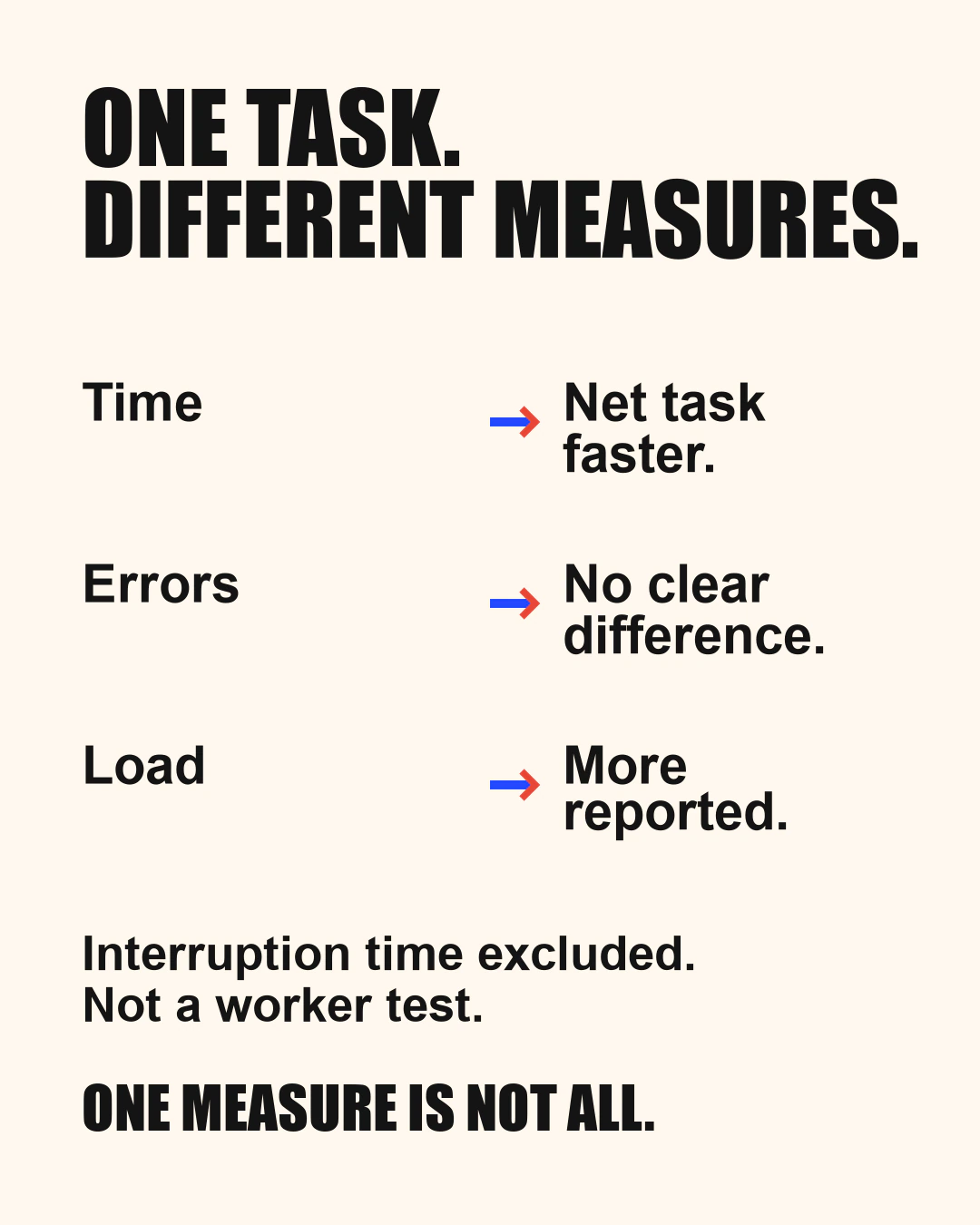
A 2008 laboratory experiment compared simulated email work under no interruption, related interruption and unrelated interruption conditions. The interrupted work was completed faster on the study’s task-time measure, while participants reported greater demands on several workload measures. Its error and politeness measures did not show significant differences across interruption conditions. [S2]
That does not make interruption a productivity prescription. The time measure subtracted time spent on interruptions, the task was brief and the sample was mostly university students in Germany. The authors discussed limits of the laboratory setting and uncertainty about coping over longer periods. This was not a study of taskmasking, modern chat indicators or the choices below. [S2]
The useful restraint is to avoid treating speed, visible activity, experienced effort and inspected output as interchangeable. A result on one measure cannot automatically answer a different question. No numerical return-to-focus rule, personality test or finding about an individual worker is adopted here.
Graphic context — 03-evidence-infographic: Three rows describe different measures within one historical laboratory email-task experiment. These qualitative descriptions do not encode a numerical effect, compare independent research teams or evaluate the article’s original personal task choices.
Text equivalent: ONE TASK. DIFFERENT MEASURES. Time Net task faster. Errors No clear difference. Load More reported. Interruption time excluded. Not a worker test. ONE MEASURE IS NOT ALL. In the CHI 2008 study the reported task-time calculation subtracted time spent in interruptions. Interrupted conditions had faster net task times. Error and politeness measures showed no significant differences across interruption conditions; this is not proof all output quality was identical. Several self-reported workload measures were higher. Most participants were German university students, working on a brief simulated email task. The authors discussed ecological validity and uncertainty about coping over longer periods. All four original paper pages were read, including main methods, results and discussion; underlying references and data were not independently read or reproduced. No 23-minute recovery rule, modern platform result, taskmasking prevalence, employee assessment or tested routine benefit is encoded. Four actual primary publisher groups supply dated language context, one historical laboratory paper, commercial issuer help and an authored framework definition, not four trials of these original choices. No individual worker-intent or clinical detector, current growth/prevalence, quality certificate, measured saving or routine benefit. Selected framework sections and full main research reading have distinct scopes. Complete source versions, dates, limits and exact accessible text remain adjacent. There is no empirical routine-efficacy trial of these original choices.
Actions in order
1. Name the result before naming the effort
Use an ordinary noun and a purpose. Instead of work on the invitation, try an invitation draft containing the actual place, date and response route. Instead of sort the folder, try an index that leads to the files you have chosen to keep. The description should make the result recognizable without requiring an account of your whole afternoon.
Keep the scope small enough to inspect. A complete personal draft and a sent invitation are different states. If sending requires another person’s approval, a draft can be ready for that review while remaining unsent. Calling one stage complete should not silently imply that every later stage has happened.
For open-ended thinking, a useful bounded result might be a short note distinguishing the alternatives and the question that remains unresolved. The larger problem can stay open. The point is to describe the piece you actually undertook, rather than rename uncertainty as either failure or a finished answer.
2. Choose a check that matches the purpose
Ask what you would look at to establish the stated condition. For an invitation draft, inspect the actual details against the information you already have. For the folder index, follow its links to the intended files. For an exploratory note, check that the alternatives and unresolved question are actually recorded.
Avoid replacing that check with a convenient proxy. Number of open tabs, message count or elapsed time may describe activity. They do not show that a date is correct or a link reaches the right file. A sophisticated dashboard cannot make a mismatched measure answer the right question.
The check also needs a boundary. You do not have to keep polishing after the stated condition is met. Nor should you shrink a real requirement merely to produce an easy success. If an external standard applies, retain it. If the task was poorly specified, describe that uncertainty before deciding what can honestly be called ready.
3. Describe the state you find
Use plain descriptions such as drafted but not checked, checked and ready for the next existing step, or blocked by missing information. These are editorial labels, not a validated scoring system. You can choose different wording if it fits your task more accurately.
An unfinished state does not erase useful work. Researching the venue may have resolved a real question even if the invitation lacks a response route. Describe both facts. That is more informative than either claiming the whole task is done or dismissing the entire session as fake productivity.
Missing information is also different from missing effort. If the venue has not confirmed the room, repeatedly opening the draft cannot confirm it. Use the appropriate existing process for the dependency, or leave the result marked as waiting. This exercise creates no obligation to contact someone, escalate a request or obtain information you should not access.
You may discover that the condition itself was mistaken. Describe the change openly: the original result was not established, and the revised task asks a different question. A new personal definition cannot retrospectively complete the old task, erase a required review or make an uncertain detail correct. Keep those distinctions visible when the scope changes.
4. Keep signals in their proper role
Leave a communication feature with the meaning its service gives it. You do not need to prove your task state by altering a dot, keeping a device awake or manufacturing visible activity. Do not use another person’s dot to decide whether they are lazy, available for extra work or being deceptive.
Some communication and coordination are themselves real outputs. If the actual task was to provide a necessary update, a suitable update may meet that task’s condition. It does not follow that every message is empty activity, or that only a polished file counts as work. Match the evidence to the particular result.
The same care applies to pauses. A break is not made illegitimate by lacking an artifact, and this guide does not decide when someone is entitled to one. It concerns the description of a selected ordinary task. It is not a workplace policy, a health assessment or a demand for continuous visible output.
5. End with one accurate sentence
Try a sentence that names the result, its current state and any relevant boundary. The invitation draft contains the confirmed details, but the response route has not been checked. Or: the index links to the selected files and is ready for my own use. You can keep that sentence privately without creating another tracking system.
If a further step is appropriate, make it the step the task actually needs. That may be a limited correction, an existing review or a decision to leave it unfinished for now. There is no required duration, daily quota or scientifically established number of checks in this original exercise.
Stop when you can describe the state accurately. Repeatedly inspecting the same evidence will not turn an unmet condition into a met one. If the exercise becomes another way of delaying the task or criticizing yourself, simplify it or stop using it.
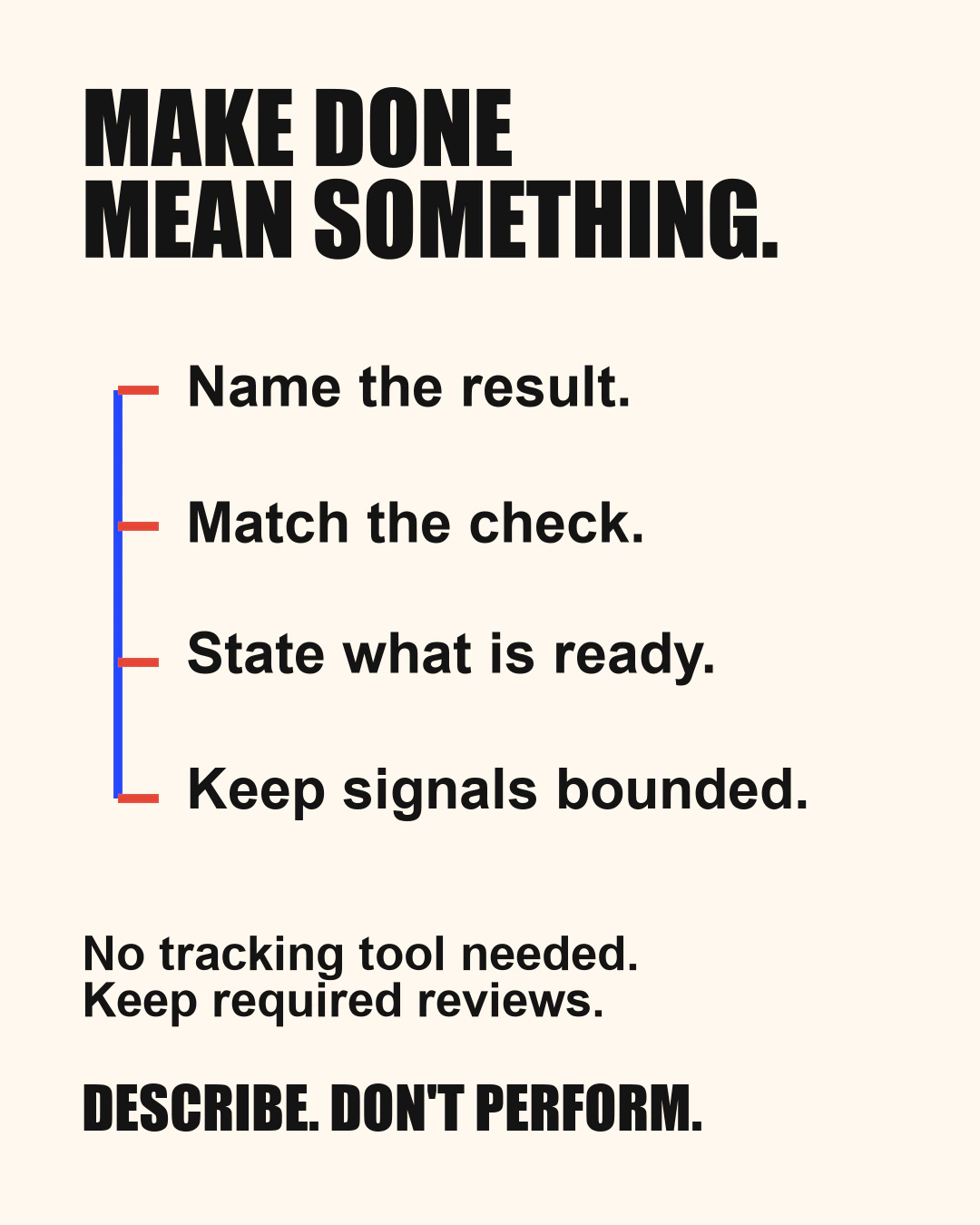
Graphic context — 04-practical-support: Four reminders condense five original optional choices: name a result, choose its purpose-matched check, describe its state, keep availability signals bounded and finish with an accurate sentence. They are not an evaluated intervention or a universal performance checklist.
Text equivalent: MAKE DONE MEAN SOMETHING. Name the result. Match the check. State what is ready. Keep signals bounded. No tracking tool needed. Keep required reviews. DESCRIBE. DON’T PERFORM. A revised completion condition cannot retrospectively establish the original result, make an uncertain detail correct or erase a required review. The authored 2020 Scrum definition concerns its own framework; this personal analogy is not Scrum implementation or certification. The Ellis invitation draft and changed-purpose counterexample are fictional, not observed outcomes. No worker grading, monitoring, status manipulation, device or permission change, compulsory contact or purchase is required. Keep necessary availability, approval, safety and confidentiality procedures intact. Stop repeated checking; do not delay urgent action, and use suitable qualified support for persistent distress or wider serious concerns. Four actual primary publisher groups supply dated language context, one historical laboratory paper, commercial issuer help and an authored framework definition, not four trials of these original choices. No individual worker-intent or clinical detector, current growth/prevalence, quality certificate, measured saving or routine benefit. Selected framework sections and full main research reading have distinct scopes. Complete source versions, dates, limits and exact accessible text remain adjacent. There is no empirical routine-efficacy trial of these original choices.
A draft that looks busy and a result that is ready
Imagine a fictional reader, Ellis, preparing a short invitation for a neighborhood sketch afternoon. Ellis rearranges headings, compares typefaces and keeps the document open. Those actions happened, but the invitation still names an unconfirmed location. The design work does not establish that the invitation is ready to send.
Ellis defines the current result as a draft for review, rather than a sent invitation. The check is whether the known details are recorded correctly and the uncertain location is clearly marked. Ellis keeps the uncertainty visible and leaves the existing confirmation process alone. No new message or account action is necessary for this illustration.
Now change the task. Suppose the required details are already correct and Ellis’s chosen purpose was simply a readable personal draft. A quiet final inspection may be enough to establish that state. It does not need an hour of visible activity to become legitimate, and further decoration may add nothing to the stated purpose.
Both versions are invented. Neither describes an observed participant or a measured improvement. They illustrate why the task’s purpose and completion condition matter more than a generic appearance of busyness. They do not show that design, communication or preparation is inherently wasteful.
Costs, risks and stop criteria
The cost is attention, and it varies with the task. There is no promised saving, performance increase or emotional benefit from this sequence. You can try the distinction mentally on a fictional task, without logging your workday or collecting personal data.
Do not extend it into a judgment about another person’s effort or intentions. Visible work is incomplete information. Work may involve private responsibilities, dependencies or activities you do not understand. The taskmasking label does not give you access to those facts, and the study supplies no method for identifying dishonest workers.
Do not bypass an established standard because your own sentence sounds clear. Required approvals, accessibility checks, confidentiality duties and safety procedures remain separate. A result can meet your personal drafting condition while still being unfit for external use. State that boundary instead of treating completion as a universal stamp.
This is not diagnosis or treatment for attention problems, burnout, anxiety or any other condition. Persistent distress or interference with daily life calls for appropriate qualified support. A concrete workplace problem may require its established route. An ordinary description exercise should not delay urgent action or replace a professional judgment.
How to assess the result
Ask whether you can distinguish the visible signal, the action performed and the state of the selected result. For Ellis, the document was open, design work happened and the location remained unconfirmed. Those three descriptions can coexist. The accurate outcome is a bounded draft, not a verdict about Ellis’s character.
Notice whether the check actually answered the question you named. If it only produced a longer list of activity, return to the result’s purpose. If it required private information or repeated monitoring, choose a simpler fictional example or stop. No self-worth score or comparison with someone else’s output is needed.
A busy status can remain an availability signal. Useful preparation can remain preparation. A finished task needs evidence appropriate to what you meant to finish. Keeping those descriptions separate is enough; you do not need to turn the distinction into another performance.
Myth or Real?

Claim
Social paraphrase: A busy status alone proves that the intended work is complete.
Verdict
FALSE
Facts
An availability indicator does not inspect a result against the quality or completion condition that applies to it.
FALSE rejects status alone as sufficient completion proof, not all feature information or the value of thinking and coordination.
An archived WFH original question asks why productivity is measured using Teams status. This card explicitly reframes that question as a claim that a status alone establishes completed work, not a quotation or false belief attributed to the questioner. Comments, anecdotes, accusations, votes, monitoring and status-manipulation advice are not evidence. Microsoft describes availability states and their feature conditions in its own Teams help. It does not inspect the quality or completeness of a deliverable. The authored 2020 Scrum Guide defines Done for an Increment within its framework. This personal completion question is an original bounded analogy, not Scrum implementation, certification or an empirical test. FALSE rejects the status alone as sufficient proof; it does not deny useful communication, thinking, preparation or rest, or establish anyone’s effort or intentions. Microsoft help is undated and was accessed October 26, 2026. The official Scrum HTML is a port of November 2020; its later footer is not a new guide publication. A personal condition cannot erase an applicable standard or required review. No worker grading, surveillance, status change, device or permission manipulation, account action, compulsory contact or purchase is needed. Existing safety, confidentiality and responsibility procedures remain separate. Do not delay urgent action for this optional reflection.
Takeaway
Name the selected result and its actual state; retain required standards and reviews.
Sources
Claim discussion: Archived question about Teams status and productivity measurement.
Evidence: Change your status in Microsoft Teams; The 2020 Scrum Guide, official HTML port.
Checked 2026-10-26. Scope: Availability versus completion sufficiency only. No employee effort, dishonesty or clinical assessment; no status, device, account or permission action.
Sources
- S1 — Cambridge Dictionary blog: New words – 7 July 2025. The publisher’s own taskmasking vocabulary is language context, not current growth or independent evidence for its quoted magazine commentary. The displayed earlier May timestamp is distinct from the July publication date.
- S2 — Mark, Gudith and Klocke: The Cost of Interrupted Work: More Speed and Stress, CHI 2008 author-hosted paper. All four pages, including main methods, results and discussion, were read; underlying references and data were not independently read or reproduced. Task-time, workload and output measures have different meanings.
- S3 — Microsoft Support: Change your status in Microsoft Teams, undated issuer help accessed October 26, 2026. Feature meanings and conditions only. No status, permission, device or account change is recommended or performed.
- S4 — Ken Schwaber and Jeff Sutherland: The 2020 Scrum Guide, official HTML port of the November 2020 guide. Its introduction, transparency framing, Increment and Definition of Done sections informed the bounded distinction. This personal exercise is not Scrum implementation, certification or an empirical test of the framework.
The ordered choices and Ellis example are original editorial applications. Four different publisher groups provide one historical laboratory paper, dated vocabulary, issuer feature help and framework definitions. They are not four trials of this guide.
Topic hubs
Tags


