

At 3:20 p.m., the same sentence has been reread three times. A timer says to stand up for two minutes. The break feels good. But did it restore attention, improve performance, or simply interrupt the task?
Those are different outcomes, and the research does not give them the same answer.
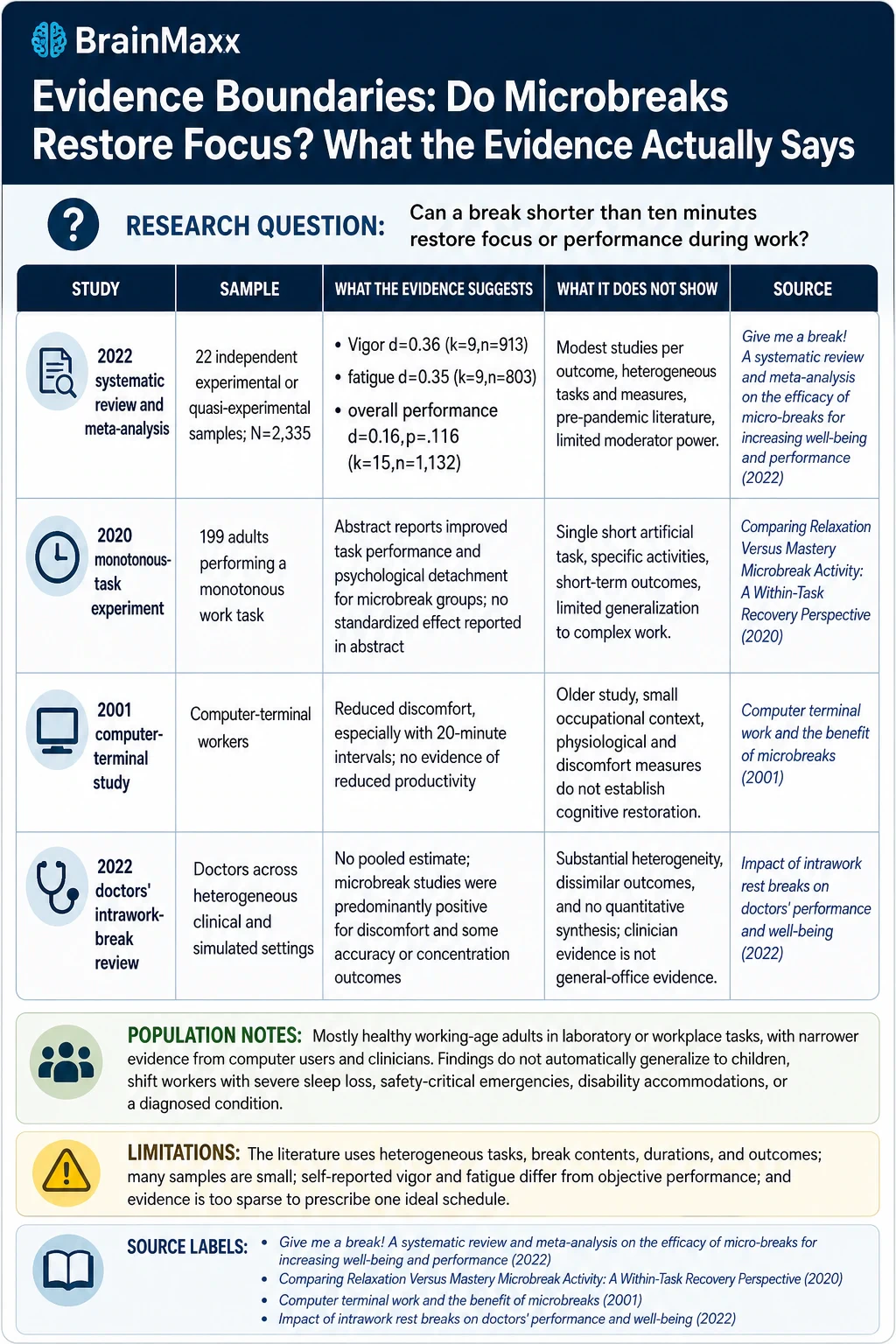
A microbreak is usually defined as a pause of less than ten minutes between work periods. Across experiments, these pauses modestly improve how energetic or fatigued people feel. Evidence that they improve performance overall is much less certain.
The strongest summary finds a split result
A 2022 systematic review and meta-analysis combined 22 independent samples with 2,335 participants. Microbreaks produced small average improvements in vigor (d = 0.36) and fatigue (d = 0.35). The pooled effect on overall performance was smaller and not statistically significant (d = 0.16, p = .116).
That pattern matters. Vigor and fatigue were mostly self-reported experiences. Performance covered task outcomes such as speed, accuracy, or output. Feeling better is valuable, but it does not prove that work improved.
The performance results also varied. Benefits appeared in less cognitively demanding tasks, such as some clerical or creative work, but not in highly demanding tasks. Longer breaks within the under-ten-minute range were associated with larger performance effects. That does not establish an ideal break length: only a modest number of studies contributed to each analysis, and task, activity, and measure differed substantially.
A 40-second break can help one task
In a randomized experiment with 199 participants doing a monotonous work task, researchers assigned a 40-second relaxation activity, a 40-second mastery activity, or no break. The microbreak groups performed better and reported more psychological detachment from the task. The mastery activity produced more detachment than relaxation, although detachment did not explain the performance difference.
This supports a narrow causal statement: those assigned breaks changed outcomes in that experiment. It does not show that 40 seconds is a universal dose, that every activity works, or that an interruption helps during complex flow.
Another experiment in computer-terminal work found that microbreak protocols reduced discomfort and did not show a productivity penalty. That result may reflect posture and muscle recovery rather than restored executive attention. A break can help the neck or wrist without changing decision quality.
Objective and subjective recovery can diverge
A sustained-attention experiment compared different mid-task breaks using behavior and EEG. Both break types transiently improved objective vigilance, while the subjective benefit persisted only after rest. The finding is useful because it demonstrates a mismatch: what a person reports and what a task records can move differently.
EEG does not turn this into a brain-reset claim. Electrical patterns are correlates measured during one laboratory task. They do not diagnose an attention problem or prove that the same mechanism determines performance in a meeting, surgery, classroom, or warehouse.
Context changes the answer
A systematic review of breaks among doctors found very heterogeneous interventions and outcomes, so the authors did not pool them. Some brief protocols improved discomfort, muscular fatigue, accuracy, concentration, or stress-related outcomes with little effect on procedure duration. But evidence from trained clinicians in simulated or surgical settings cannot simply be copied into every workplace.
Safety changes the decision too. A pause is not appropriate in the middle of a safety-critical step. Mandated rest, hydration, meals, sleep, and disability accommodations are not optional productivity hacks and should not be replaced by a timer experiment.
Read the evidence as a ladder
The meta-analysis is the broadest estimate and carries the most weight for the average vigor, fatigue, and performance claims. The 40-second randomized experiment is stronger for causation but much narrower: it tests assigned activities during one monotonous task. The computer and sustained-attention experiments add task-specific results, while the doctors’ review shows why occupational context can defeat a simple average. The proposed one-week comparison below is an evidence-informed self-observation tool; it has not itself been validated as a treatment or productivity intervention.
Across these sources, most participants were working-age adults in short laboratory or workplace protocols. Children, older adults with health conditions, people with severe sleep deprivation, and many shift or safety-critical roles were not represented well enough for a universal prescription. Even the largest synthesis had limited power to determine which activity, timing, or person benefits most.

Try a bounded one-week comparison
If you control your schedule and the task is low risk, treat a microbreak as a small experiment rather than a promise.
- Choose one repeatable task, such as editing routine records.
- Pick one transition where a pause is safe.
- Define the activity in advance: 60 to 180 seconds of standing, looking away, walking, or quiet rest.
- Rate fatigue before and after on a simple 0-to-10 scale.
- Track one relevant outcome separately, such as corrections per page or completed items.
- Review after one week. Keep the break only if recovery improves without more errors or disruption.
Do not change several variables at once. A new task, caffeine change, music, and a new break schedule would make the result hard to interpret.
Suppose Mina edits routine product descriptions. For three afternoons she works as usual; for the next three she takes a two-minute window break after each batch of ten. Her fatigue rating falls from 7 to 5 after most breaks, but corrections rise from one per batch to three because she loses her place. The result is not “breaks failed” or “Mina lacks focus.” It is two separate observations: the pause felt restorative, while that placement disrupted accuracy. She could move the break to the end of a complete section, try quiet rest instead of leaving the desk, or decide the improvement in fatigue is not worth the switching cost.
That example is not a diagnosis and does not estimate what another person will experience. It shows why one subjective signal and one task signal should be logged separately.
Stop if the timing creates risk, conflict, distress, pain, or more errors. Persistent concentration difficulty, severe fatigue, unplanned sleep episodes, pain, mood symptoms, medication effects, or impaired work deserve appropriate professional clinical or occupational support. A microbreak log cannot diagnose their cause or replace care.
The practical conclusion
Microbreaks are better supported as a modest aid for vigor and fatigue than as a guaranteed performance booster. Some specific tasks and people may benefit; demanding work may need a longer recovery period, a different workload, sleep, or another form of support.
The honest question is not “Do microbreaks work?” It is: Which outcome, after what task, with what kind of break, for whom?

Sources
- 2022 systematic review and meta-analysis
- Randomized 40-second microbreak experiment
- Computer-terminal microbreak experiment
- Systematic review of doctors’ intrawork breaks
- Sustained-attention break and EEG experiment
This article is educational and is not a diagnosis or treatment plan.
FAQ
Common questions
Do microbreaks always improve performance?
No. Average benefits are clearer for fatigue or vigor than for every objective performance measure, and results vary with task demands, timing, duration, and break activity.
How long should a microbreak be?
There is no universal duration. Use a feasible interval that does not interrupt safety-critical work, then compare a preselected outcome across similar work periods.
When should a microbreak experiment stop?
Stop if it increases errors, distress, pain, conflict, or impairment, and never use it to delay urgent care, mandated rest, food, hydration, sleep, or accessibility needs.
Topic hubs
Tags

