

You compare two photographs of the same desk and miss the mug that moved. Someone points to it, and the difference becomes obvious. The useful question is what the comparison required, rather than what that miss says about your character.
The short answer
Change blindness describes a missed change across views, even when the changed detail is visible. Display interruptions and the task can affect detection. [1, 2]
Missing a change does not establish that visual memory was empty. Simons and Rensink’s 2005 opinion review explains why that inference is too strong. [4]
For an ordinary photo comparison, keep the original views available, name the detail you want to check and describe the difference you can actually locate. That is a practical way to organize this comparison. It is not evidence that you have trained your attention generally.
Definitions and scope
The target is a difference across views, such as an object’s changed position, appearance or presence. Recognizing that object in one photograph is a different question. [1]
Keep change tasks separate from demonstrations about missing an unexpected object during another task. This guide concerns a difference across views. [4]
Detecting that something changed differs from identifying the changed item. Howe and Webb’s 2014 laboratory experiments tested those responses separately. [3]
None of these descriptions diagnoses a reader or establishes their eyesight, intelligence or reliability. An online demonstration also cannot tell you whether someone was inattentive, dishonest or careless in a particular real event. The activity below offers an ordinary comparison task, not an assessment of a person.

A schematic of presentation and response order, with no claim that it maps brain stages or guarantees detection.
First view, then next view, then a response. A response can miss the change. The arrows show illustrative task order; they are not causal neural pathways. The article separates detecting a difference from identifying the changed item.
How it works
In Rensink, O’Regan and Clark’s 1997 flicker experiments, original and altered scene photographs alternated with brief blank intervals. Observers had to find and describe the change. Removing the blanks or supplying a valid verbal cue made identification faster. These manipulated display conditions help establish a task-specific effect; they do not provide a home training schedule. [1]
Disruption does not have to sit directly over the changed detail. The primary authors’ abstract for their 1999 Nature report describes concurrent visual disturbances placed elsewhere in the image. It reports that substantial changes could still be missed. We use that limited finding here; we have not treated the short abstract as a full account of its methods or as a separate replication by a new team. [2]
The 2005 review distinguishes several possible failures: an earlier representation might fade, be inaccessible or be available without a successful comparison. The observed miss does not uniquely identify the underlying process. [4]
For a useful account of your own comparison, start with the observable response. Record which detail you identified, which you merely suspected and which you did not check. That leaves a clearer record than making a claim about what your brain must have stored.
What the evidence supports
The 1997 experiments had ten observers each and measured alternations before correct identification. Their small groups and selected photographs do not establish a universal percentage of everyday details missed. [1]
Howe and Webb’s 2014 experiments used small groups of adults with normal or corrected-to-normal vision. Participants first reported whether a change had occurred, then identified it. Catch trials and later simplified displays addressed alternative explanations. Their findings support the possibility of detecting some changes without identifying the changed item, under the conditions they tested. The pattern depended on the display; it was not evidence for an infallible feeling that something is wrong. [3]
Later work also examines variation between people within a task. A 2021 study analyzed thirty-nine participants using a change-detection task, eye-movement measurements and a computational model. Associations between gaze measures and task performance, together with the model’s fit, do not establish that deliberately copying a gaze pattern will improve everyday safety or attention. [5]
Read these evidence types separately. Ask what researchers changed, what they measured and what alternatives they considered. A measured association requires a different interpretation from an experimentally manipulated display condition. A proposed model should be evaluated as an explanation, with its assumptions visible. These distinctions prevent a practical suggestion from acquiring more authority than its evidence warrants.
The practical conclusion is modest: record what the task asked for and what the response actually shows. This guide adopts no universal detection rate, optimum viewing duration or expected improvement from practice. The earlier papers remain useful for defining the phenomenon, while their publication dates and task boundaries remain part of the evidence.
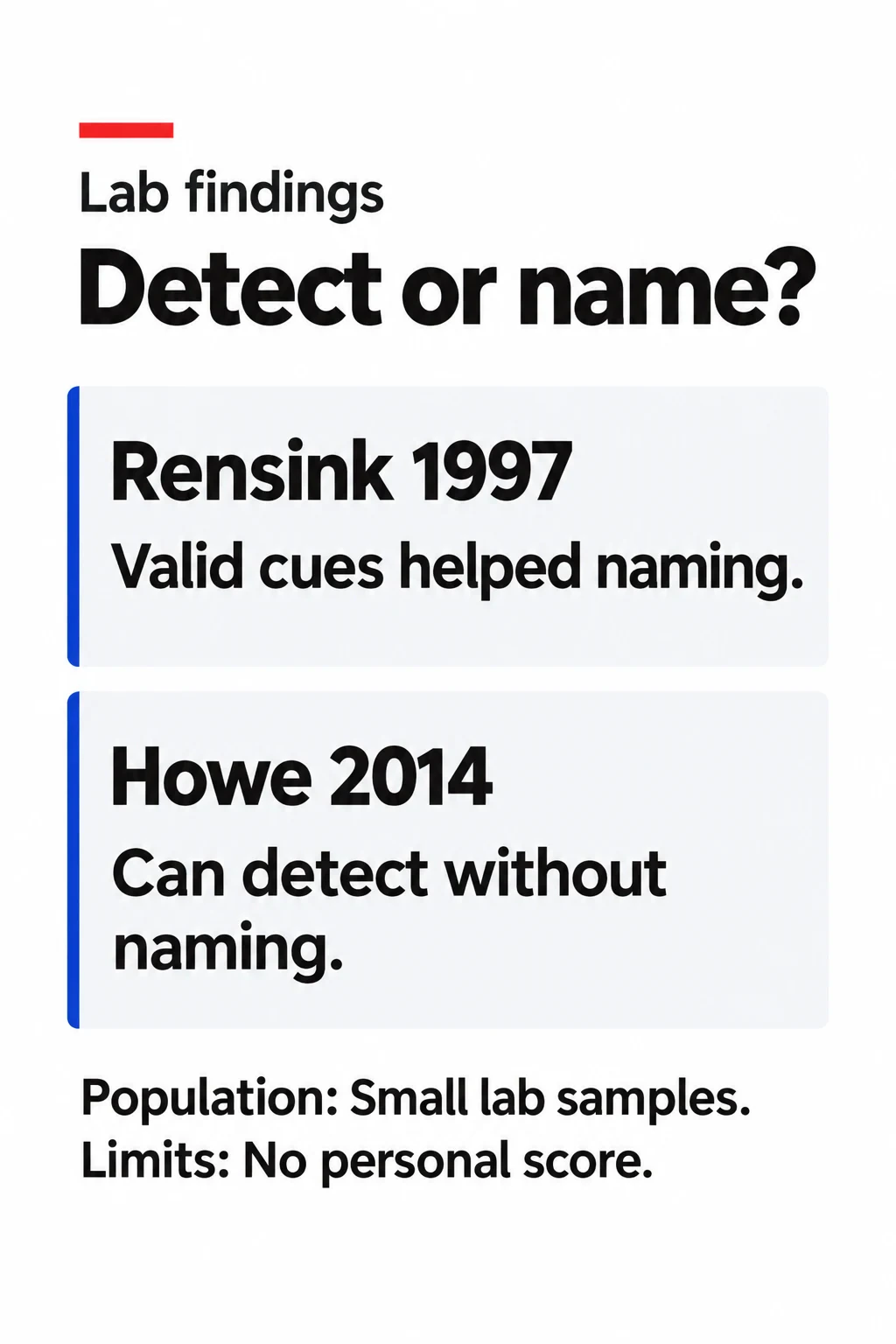
Small laboratory studies answer different questions; these findings do not provide a personal score.
Rensink and colleagues, 1997: valid cues helped identification in the tested flicker task. Howe and Webb, 2014: some tested conditions allowed detecting a change without identifying the changed item. The samples and displays were limited; no personal detection rate or training benefit follows.
Misconceptions and uncertainty
The review cautions against both extremes: a miss does not prove absent representations, and recognizing a difference later does not establish that all detail was continuously available to awareness. [4]
Another mistake is to merge detection and identification. A report that something changed can be meaningful while still leaving the specific change unresolved. Conversely, a person may feel that something is different and be mistaken. The no-change trials in Howe and Webb’s study helped evaluate that problem; a feeling alone was not treated as a verified answer. [3]
Keep study differences visible too. A portrait task, a changing scene photograph and a simplified display are not interchangeable tests. Familiarity with the material, the question asked, opportunities to compare and the response rule can differ. A result from one setup should not be turned into a personal rank or a prediction about a consequential real-world task.
The source set is selective rather than a new systematic review. Some foundational papers share authors. Multiple publisher names do not make them four independent research teams, and a narrative review does not add a new sample of participants. There is no basis here for selling a general attention-training promise or declaring one explanation of visual experience settled.
Myth or Real?

Claim
Social paraphrase: A change must be tiny to go unnoticed in change blindness.
Verdict
FALSE
Facts
Large visible changes can be missed under the particular display conditions used in change-blindness research.
The task and display matter. Selected laboratory findings do not establish a universal miss rate, absent memory or individual ability.
The 1997 flicker experiments alternated original and altered photographs with blank intervals. Their changes were chosen to be highly visible, yet identification could be difficult. The primary authors abstract for the 1999 mudsplash report also describes missed large changes during brief disturbances that did not cover the changed region. That abstract supports only this qualitative finding; it is not a full-method reading or an independent team. These counterexamples reject a tiny-change requirement. They do not establish that every large change is missed, that memory was empty, or that a particular person was careless.
Takeaway
Check the changed detail and the comparison conditions before explaining a miss.
Sources
Claim discussion: Discussion of a tiny-change explanation.
Evidence: To See or Not to See: The Need for Attention to Perceive Changes in Scenes; Change Blindness as a Result of Mudsplashes.
Checked 2026-10-25. Scope: Only the tiny-change requirement is tested. The original comment is paraphrased without adopting its audio analogy or merging change blindness with inattentional blindness. Shared authors do not make the two papers independent research teams.
Practical meaning and sources
Try a low-stakes comparison with a pair of static photographs you have permission to view. Keep both originals available. Avoid flashing displays and do not perform the activity while driving, using equipment or making a safety-critical decision.
First, state the question. Are you checking whether anything changed, or whether a particular object moved? Write that question before looking for an answer. Otherwise it is easy to switch between a broad impression and a specific identification without noticing the change in your own task.
Second, compare the relevant areas in both photographs. If you find a difference, describe its location and what differs. If you only suspect one, preserve that uncertainty. Do not turn a vague impression into a named change simply because a demonstration is expected to contain one.
Third, check the answer against the available originals or a known record of what changed. If there is no reliable answer record, describe what you can verify and what remains uncertain. A confident guess is still a guess.
A hypothetical desk-photo comparison
Suppose you have two photographs of your own desk. A plain mug sits to the left of a closed notebook in the first photograph and to its right in the second. Your contemporaneous note records moving the mug. The camera angle is not quite identical, so the notebook also appears slightly rotated.
Your first response is only, “Something looks different.” Keep that as a suspicion until you can locate a difference. With both originals available, you identify the mug’s changed position and check it against the note. You can now name one verified change. The notebook’s apparent rotation remains uncertain because the viewpoint differs; do not report another physical change without better evidence.
The useful record is brief: the question asked, the mug movement you verified and the notebook question you left unresolved. It should not read “I missed half the details” or become a score for your memory. You have neither a complete inventory of changes nor a standardized assessment.
For another comparison, you might keep the camera position stable or narrow the question to one object. That would improve the comparability of the photographs you are using, rather than establish a general attention gain. If the answer still cannot be verified, an unresolved result is an acceptable place to stop.
This example is invented to show how the record works. It is not a study result or a report that this routine was tested. The review signal is whether the answer now distinguishes verified, suspected and unchecked details. Repeating the activity until you get a pleasing score would answer a different question.
Stop if the activity becomes uncomfortable, frustrating or a repeated attempt to prove your worth. This article is not a diagnosis or an eyesight assessment. A concerning difficulty in everyday functioning belongs with an appropriate qualified professional, rather than a score from a picture activity. Keep workplace and other consequential checks within their established procedures.

An original organizer for ordinary static photographs, not a tested intervention or general attention training. Keep detection separate from identification and verify against available originals.
Name whether the question concerns detecting any change or identifying a specific changed item. Compare available static original views and describe what you can locate, keeping suspicion separate from verification. Check against the originals or a known record and retain uncertainty if evidence is missing. Use static views only; no flashing displays, driving, equipment or safety-critical task. Stop discomfort, frustration or repeated self-worth checking. Persistent daily-function difficulties need appropriate qualified help; this is not a diagnosis, eyesight or fitness assessment.
Sources
Sources checked 25 October 2026. The papers below concern specific visual tasks and interpretations. This guide reports no original experiment, pooled effect estimate or evaluated training program. It has no sponsor, affiliate product or paid attention-training recommendation.
- Rensink, O’Regan and Clark (1997), To See or Not to See: The Need for Attention to Perceive Changes in Scenes. Primary-author postprint of the Psychological Science article; small laboratory experiments with changed photographs.
- O’Regan, Rensink and Clark (1999), Change Blindness as a Result of Mudsplashes. Primary authors’ abstract of the Nature report; used only for its qualitative disruption finding. This is not a full-methods reading or independent new research team.
- Howe and Webb (2014), Detecting Unidentified Changes. Open primary report with small human experiments and display-dependent controls. One author disclosed a PLOS ONE academic-editor role.
- Simons and Rensink (2005), Change Blindness: Past, Present, and Future. Primary-author version of a Trends in Cognitive Sciences opinion review; used for inference limits, not as a meta-analysis.
- Jagatap and colleagues (2021), Neurally-constrained modeling of human gaze strategies in a change blindness task. Human task and model study, with data and code links. The authors disclosed one author’s research-consultant role at Google; no causal training benefit is adopted here.
FAQ
Common questions
Can a large change go unnoticed?
Yes. Selected laboratory research reports missed large changes under particular display conditions. A change does not have to be tiny.
Is detecting a change the same as identifying it?
No. Reporting that something changed and identifying the changed item are different responses; the evidence depends on the task and controls.
Does one miss show that my visual memory is empty?
No. Several explanations can produce a miss, and a casual picture task cannot diagnose memory, eyesight or everyday functioning.
Topic hubs
Tags

