

A seven-day logout can feel decisive. It also combines many possible changes: fewer notifications, less comparison, more free time—and perhaps less connection.
The best current evidence does not support one universal “detox” result. Outcomes differ, and stopping completely is not the same intervention as reducing one pattern.
A 2025 abstinence review found no average well-being benefit
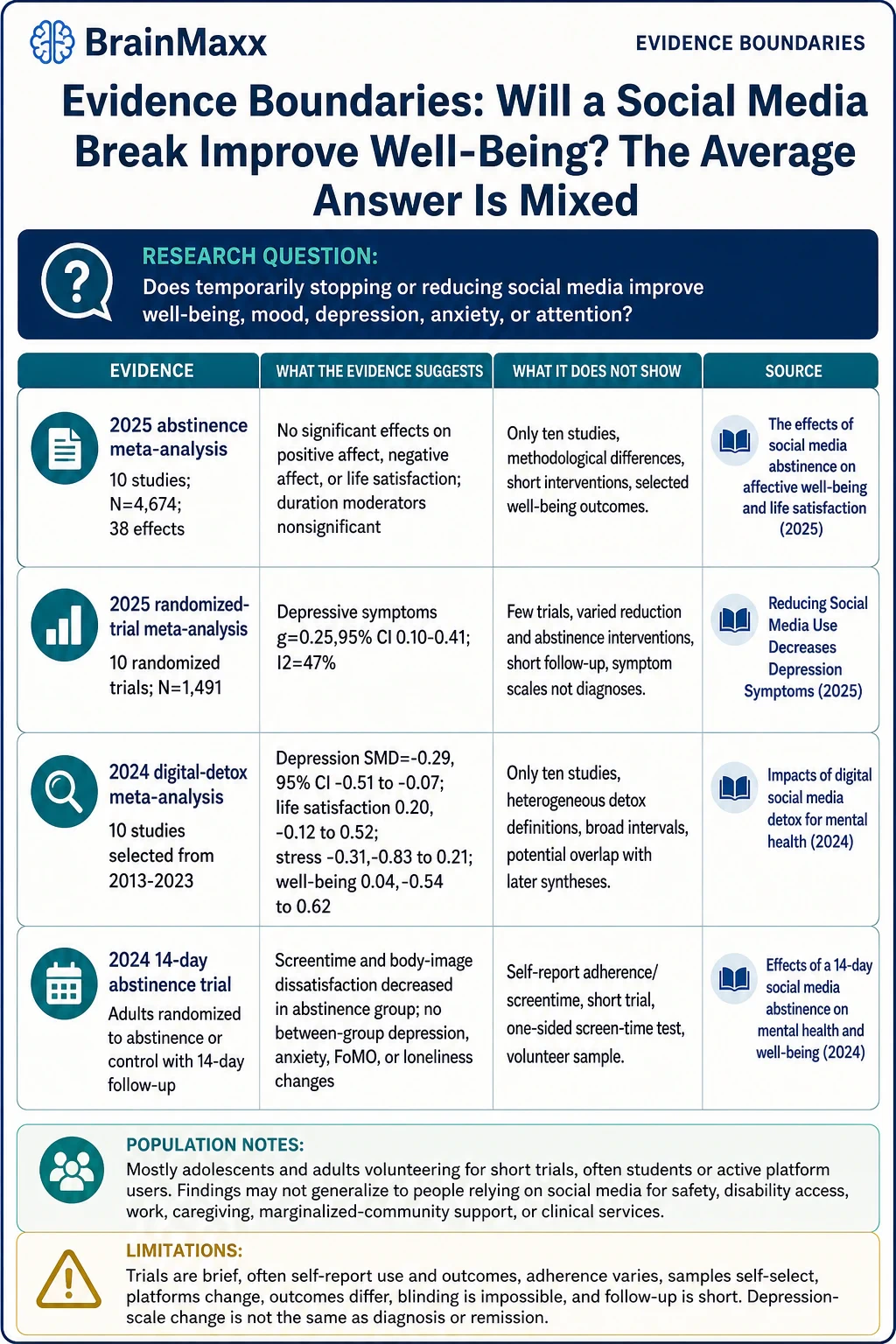
A preregistered systematic review and meta-analysis included ten studies, 4,674 participants, and 38 effect sizes. Temporary social-media abstinence did not significantly change positive affect, negative affect, or life satisfaction. Abstinence duration did not significantly explain those outcomes either.
That is evidence against promising a general happiness boost. It is not proof that nobody benefits. Ten studies used different platforms, durations, adherence methods, and samples, and an average can combine helpful and unhelpful experiences.
Depression scales give a different answer
Another 2025 meta-analysis focused on ten randomized controlled trials with 1,491 participants and a narrower outcome: depressive symptoms. Reducing or eliminating social media produced a small average improvement, g = 0.25 after adjustment for publication bias. Heterogeneity was moderate (I² = 47%).
A 2024 synthesis likewise found a small depression-scale effect (SMD = -0.29) but no significant pooled effects for life satisfaction, stress, or overall mental well-being.
These results can coexist with the null abstinence review. They use different inclusion rules, combine abstinence with reduction differently, and measure different outcomes. A depression questionnaire score is not the same thing as positive affect, life satisfaction, a clinical diagnosis, or remission.

Individual trials show why outcomes must stay separate
In a 2024 randomized 14-day study, the abstinence group reduced screen time and body-image dissatisfaction. Depression, anxiety, fear of missing out, and loneliness decreased over time, but not more in the abstinence group than in controls.
A seven-day trial comparing a 10% versus 50% reduction found no improvement in behavioral sustained attention or emotional well-being. Participants reported better attention even though task performance did not improve. Feeling more focused and performing better on an attention task are distinct.
Random assignment supports causal group comparisons for these specific instructions. It does not identify the active ingredient. Benefits could come from sleep, time replacement, fewer upsetting encounters, changed expectations, or another activity. Costs could come from lost support, work friction, or fear of missing out.
“Social media” is not one exposure
Messaging a close friend, watching short videos, seeking health information, promoting work, encountering harassment, and participating in a disability community all share a label but not a psychological function.
Active and passive use may differ. Content, time of day, notifications, platform design, and what replaces the time may matter more than total minutes. Observational links between heavy use and symptoms cannot establish whether use caused distress, distress increased use, or both followed a third factor.
Trials are usually short, participants know their assignment, adherence is imperfect, and platforms change quickly. Most do not establish effects for people who depend on these channels for safety, income, care, or community.
The evidence ladder depends on the outcome
The two 2025 meta-analyses are the strongest summaries, but one pools abstinence and broad well-being while the other pools randomized reduction or abstinence and depression scales. The 2024 synthesis supports the same outcome-specific caution. Individual randomized trials then show how screen time, body image, self-reported attention, behavioral attention, and symptoms can diverge. The seven-day plan below is a monitoring framework, not a treatment tested by those reviews.

Try targeted reduction, not disappearance
For one week, change one low-value pattern while protecting useful connection.
- Identify a specific pattern, such as feed scrolling after midnight.
- Record three baseline days of actual use and one relevant outcome, such as bedtime.
- List contacts or functions that must remain available.
- Change one cue: remove one notification, log out on one device, or set one no-feed window.
- Track actual use and the same outcome daily.
- Compare after seven days and keep, revise, or reverse the change.
For example, Aya notices that short-video scrolling pushes bedtime later. She keeps direct messages from family and her disability-support group, records three baseline nights, and removes only the short-video app from her bedroom phone for seven days. Scrolling drops, but bedtime changes on just two nights because work also runs late. The experiment identifies a real use change and a smaller-than-expected sleep result. It does not show that social media caused all of her fatigue or that full abstinence would work better.
Do not treat every uncomfortable feeling as withdrawal or addiction. Boredom, habit, social concern, and adjustment are normal possibilities. “Problematic use” is a research construct, not a diagnosis from a screen-time number.
Stop or revise if isolation, safety risk, severe distress, work or caregiving problems, or loss of accessibility, peer, or clinical support increases. Persistent depression, anxiety, sleep problems, compulsive use, self-harm thoughts, or impairment need qualified professional help. A media experiment cannot diagnose or replace treatment.
Ask what you are changing
The evidence does not say “delete every app” or “breaks never work.” It says the average effect depends on the intervention and outcome, and broad well-being promises exceed the data.
A better experiment names the unwanted pattern, preserves what matters, and measures the result that motivated the change.
Sources
- 2025 abstinence and well-being meta-analysis
- 2025 randomized-trial depression meta-analysis
- 2024 digital-detox meta-analysis
- 2024 14-day abstinence experiment
- Seven-day restriction RCT
This article is educational and is not a diagnosis or treatment plan.


