

Two people can spend the same hour online and have very different experiences. One exchanges support with friends; the other scrolls a polished stream of upward comparisons. Research increasingly finds that time alone is a weak description. Problematic patterns, comparison direction, interaction quality, platform, and the person using it all matter—and most of that evidence is still correlational.
The question underneath the habit
How does comparing yourself with others online relate to wellbeing, and why is total time a poor stand-alone explanation?
Online social comparison—especially upward comparison—is more strongly associated with depressive symptoms than time spent alone. Positive interaction and social support can relate to better outcomes, while causal direction and individual effects remain uncertain. That is the useful claim. It is narrower than a promise that one method always works, and it is more informative than judging a strategy by how smooth or difficult it feels in the moment.
Define the comparison before judging it
Social comparison is evaluating oneself relative to others. Upward comparison targets someone perceived as better off; downward comparison targets someone perceived as worse off. Passive use, active interaction, problematic use, and total time are distinct constructs.
This boundary prevents a common category error: treating two activities with different purposes as if one must replace the other. A sensible comparison holds the goal in view, asks what was actually measured, and checks whether the result survived a delay or a change in task.
What the evidence says
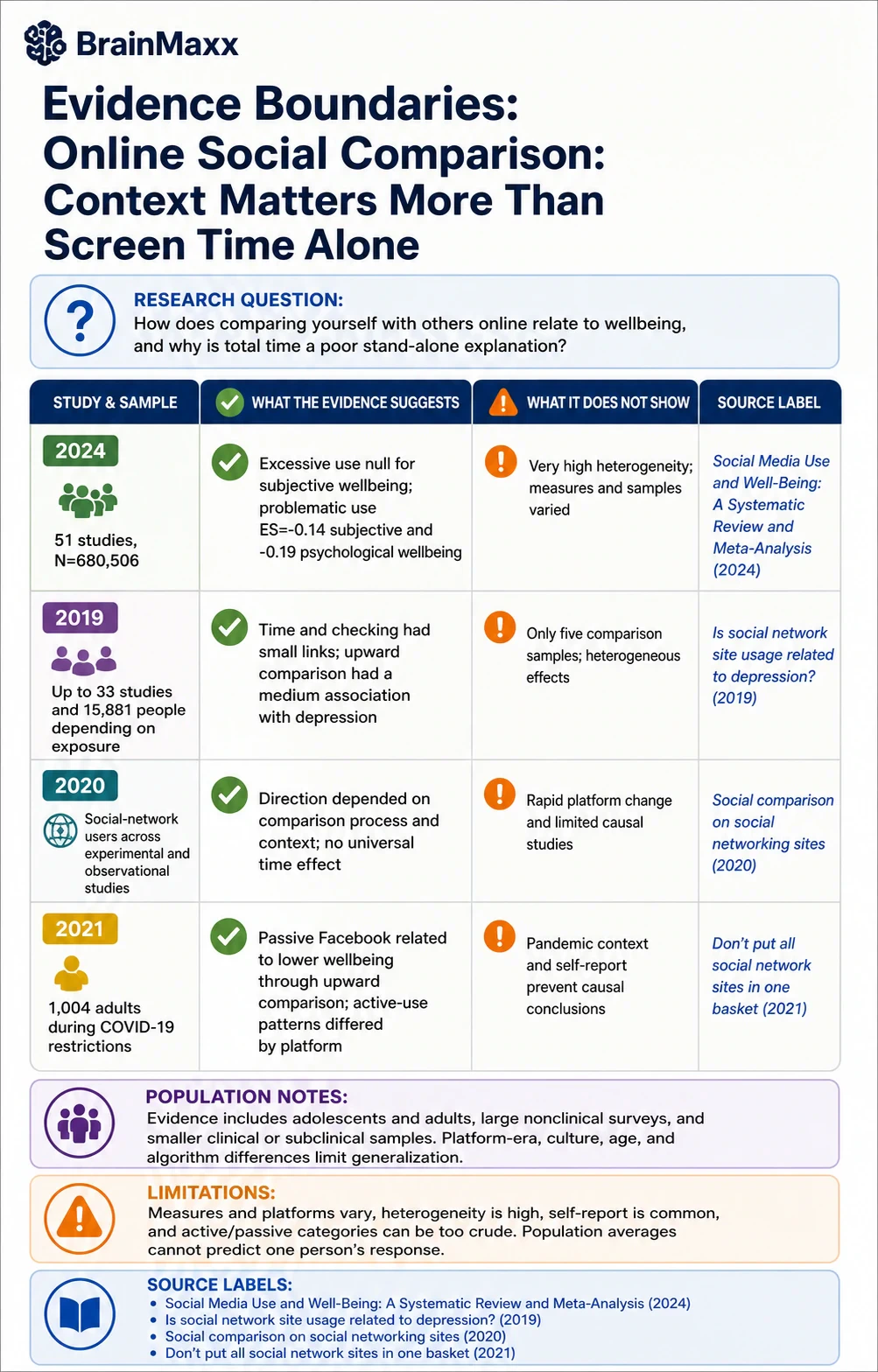
Social Media Use and Well-Being: A Systematic Review and Meta-Analysis (2024). 51 studies, N=680,506. Meta-analysis separating excessive and problematic use. The material result was: Excessive use null for subjective wellbeing; problematic use ES=-0.14 subjective and -0.19 psychological wellbeing. The inference boundary matters: Observational association synthesis. The main caution is Very high heterogeneity; measures and samples varied
Is social network site usage related to depression? (2019). Up to 33 studies and 15,881 people depending on exposure. Separate meta-analyses of time, checking, and comparison. The material result was: Time and checking had small links; upward comparison had a medium association with depression. The inference boundary matters: Cross-sectional association synthesis. The main caution is Only five comparison samples; heterogeneous effects
Social comparison on social networking sites (2020). Social-network users across experimental and observational studies. Review of antecedents, consequences, mediators, and moderators. The material result was: Direction depended on comparison process and context; no universal time effect. The inference boundary matters: Mixed evidence review. The main caution is Rapid platform change and limited causal studies
Don’t put all social network sites in one basket (2021). 1,004 adults during COVID-19 restrictions. Multi-platform survey and structural equation models. The material result was: Passive Facebook related to lower wellbeing through upward comparison; active-use patterns differed by platform. The inference boundary matters: Cross-sectional mediated associations. The main caution is Pandemic context and self-report prevent causal conclusions
Social Media and Depression Symptoms: a Meta-Analysis (2021). 62 studies, N=451,229. Meta-analysis separating time, intensity, and problematic use. The material result was: Time r=0.11; intensity r=0.09; problematic use r=0.29. The inference boundary matters: Observational association synthesis. The main caution is Causal direction unresolved; constructs and recruitment varied
Taken together, these sources do not collapse into one magic number. A 2024 wellbeing meta-analysis, a 2019 Facebook-depression meta-analysis, a 2020 focused review, a multi-platform survey, and a large depression meta-analysis. Across 62 studies and 451,229 people, depression related weakly to time r=0.11 and intensity r=0.09, but moderately to problematic use r=0.29. A 2024 review found excessive use unrelated to subjective wellbeing overall, while problematic use correlated negatively with subjective wellbeing ES=-0.14 and psychological wellbeing ES=-0.19. The direction and magnitude should therefore be read as an evidence pattern, not a personal forecast.
What the averages do not settle
Most estimates are cross-sectional correlations. A low mood may increase comparison and problematic use, comparison may worsen mood, or both may share other causes.
Effects may involve upward comparison, envy, social support, harassment, active versus passive use, selection of content, pre-existing symptoms, or offline context. Those explanations can coexist. The honest conclusion is that a result may support a method under tested conditions without proving why it worked in every participant.
Measures and platforms vary, heterogeneity is high, self-report is common, and active/passive categories can be too crude. Population averages cannot predict one person’s response. Individual experience can legitimately differ from an average because prior knowledge, task design, timing, sleep, stress, access, and feedback all change what a learner or reader can do.

A bounded way to try it
For one week, log the activity, comparison target, immediate mood, rumination, and support value after selected sessions. Change one feed or behavior while preserving useful connection, then compare the pattern.
Use the following sequence as a small experiment, not as a test of character:
- Name the activity
- Identify the comparison
- Record the immediate response
- Preserve useful support
- Change one feed or behavior
Keep the trial modest enough to reverse. If it fits, repeat it long enough to observe behavior rather than relying on one good or bad session. If it does not fit, change the conditions or choose a different tool.
Worked example
After a week of brief notes, Daniel sees that mood dips follow passive browsing of professional-success posts, not messaging close friends. He unfollows two comparison-heavy feeds, keeps the group chat that provides support, and checks mood plus rumination after use. The pattern may justify a feed change; it cannot prove that social comparison caused depression or that deleting every account is the right response.
The example is deliberately ordinary. It shows how the method can be adjusted using feedback while keeping uncertainty visible. It does not imply that one person’s result predicts another person’s outcome.
How to judge the result
Look for observable change at the next sensible review point:
- Rumination decreases
- Useful connection remains
- Mood response becomes more stable
Pause or redesign the experiment when any of these occur:
- Severe distress or self-harm thoughts appear
- Needed support is lost
- Harassment or impairment continues
The revision replaces a screen-time rule with a context audit: activity, comparison target, immediate response, and support value.
Safety and scope
Do not cut off emergency, disability, caregiving, work, community, or clinical support. Seek help if use is linked with severe distress, self-harm thoughts, harassment, sleep loss, or impairment.
An online comparison pattern cannot diagnose depression, anxiety, an eating disorder, or problematic use. Persistent or dangerous symptoms need qualified support and crisis care when immediate risk is present. Seek qualified support when the problem is persistent, impairing, new, or safety-relevant. This article is educational and does not diagnose a disorder or replace assessment, treatment, teaching support, or an established safety protocol. If a situation involves immediate danger or a crisis, use local emergency or crisis services rather than an article exercise.
Bottom line
Online social comparison—especially upward comparison—is more strongly associated with depressive symptoms than time spent alone. Positive interaction and social support can relate to better outcomes, while causal direction and individual effects remain uncertain. The most defensible use is a bounded test with feedback, a review point, and permission to stop.

Sources
- Social Media Use and Well-Being: A Systematic Review and Meta-Analysis (2024)
- Is social network site usage related to depression? (2019)
- Social comparison on social networking sites (2020)
- Don’t put all social network sites in one basket (2021)
- Social Media and Depression Symptoms: a Meta-Analysis (2021)


