

Writing about a painful event can feel clarifying, exhausting, or simply neutral. All three responses fit the evidence better than the claim that disclosure reliably heals. Reviews disagree because prompts, populations, controls, and outcomes differ. The safest practical use is brief, optional, and easy to stop—not a demand to excavate the worst experience on the page.
The question underneath the habit
Does writing privately about stressful experiences reliably improve psychological or physical health?
Expressive-writing effects are small or null on many broad health outcomes, with possible benefits in selected populations and protocols. Outcomes vary enough that writing should be framed as an optional exercise, not a treatment or required emotional disclosure. That is the useful claim. It is narrower than a promise that one method always works, and it is more informative than judging a strategy by how smooth or difficult it feels in the moment.
Define the comparison before judging it
Expressive writing usually asks for thoughts and feelings about a stressful event over several short sessions. Positive writing, neutral writing, therapist-supported writing, and evidence-based trauma-focused psychotherapy are different interventions.
This boundary prevents a common category error: treating two activities with different purposes as if one must replace the other. A sensible comparison holds the goal in view, asks what was actually measured, and checks whether the result survived a delay or a change in task.
What the evidence says
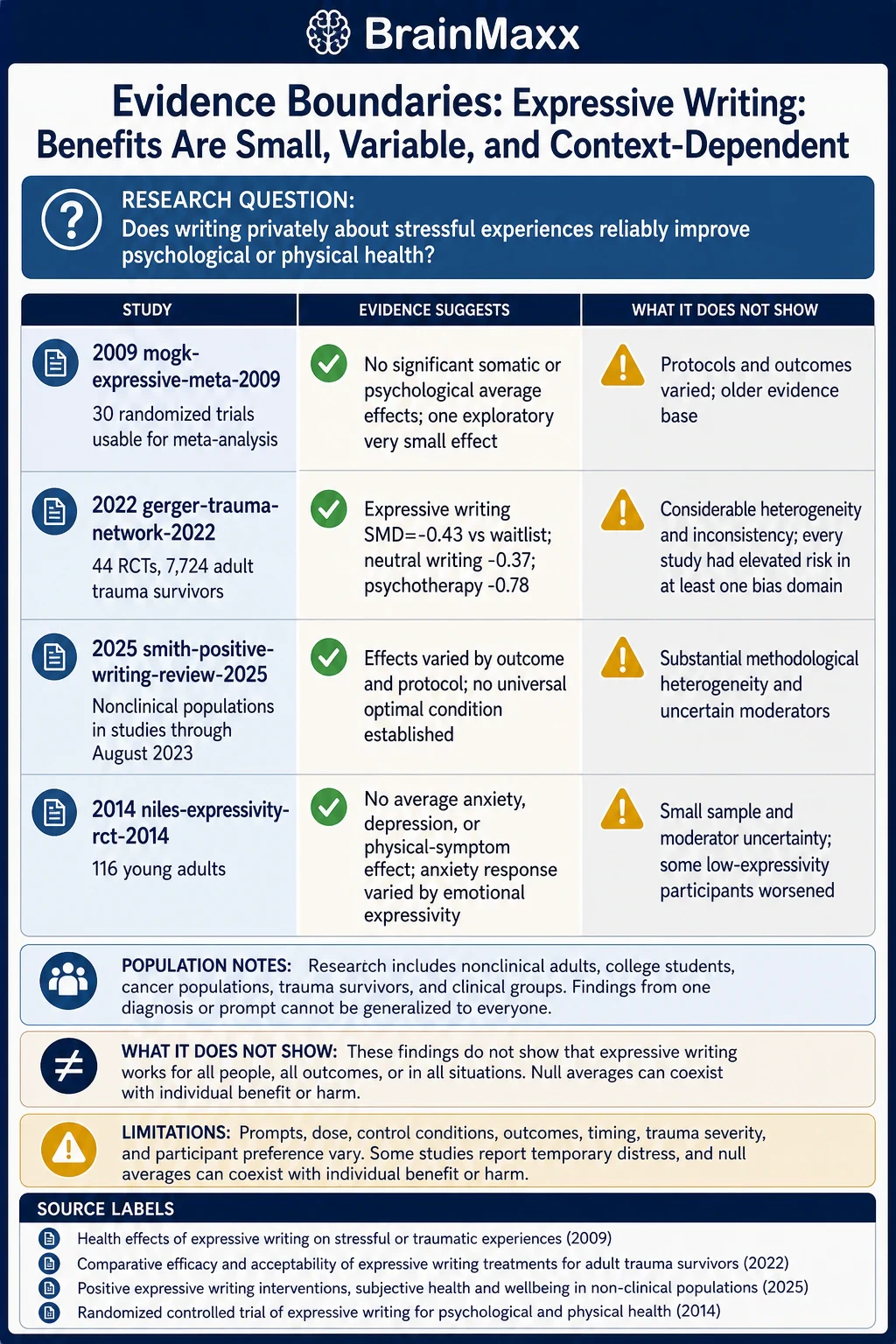
Health effects of expressive writing on stressful or traumatic experiences (2009). 30 randomized trials usable for meta-analysis. Updated randomized-trial meta-analysis. The material result was: No significant somatic or psychological average effects; one exploratory very small effect. The inference boundary matters: Randomized intervention synthesis. The main caution is Protocols and outcomes varied; older evidence base
Comparative efficacy and acceptability of expressive writing treatments for adult trauma survivors (2022). 44 RCTs, 7,724 adult trauma survivors. Network meta-analysis of writing, psychotherapy, neutral writing, and waitlist. The material result was: Expressive writing SMD=-0.43 vs waitlist; neutral writing -0.37; psychotherapy -0.78. The inference boundary matters: Randomized treatment-network synthesis. The main caution is Considerable heterogeneity and inconsistency; every study had elevated risk in at least one bias domain
Positive expressive writing interventions, subjective health and wellbeing in non-clinical populations (2025). Nonclinical populations in studies through August 2023. Systematic review of positive expressive-writing protocols. The material result was: Effects varied by outcome and protocol; no universal optimal condition established. The inference boundary matters: Mixed-design evidence synthesis. The main caution is Substantial methodological heterogeneity and uncertain moderators
Randomized controlled trial of expressive writing for psychological and physical health (2014). 116 young adults. Four 20-minute writing sessions vs control writing. The material result was: No average anxiety, depression, or physical-symptom effect; anxiety response varied by emotional expressivity. The inference boundary matters: Randomized protocol comparison; moderator exploratory. The main caution is Small sample and moderator uncertainty; some low-expressivity participants worsened
Taken together, these sources do not collapse into one magic number. A randomized-trial health meta-analysis, a trauma-treatment network meta-analysis, a recent positive-writing systematic review, and a randomized moderator study. One 30-trial health meta-analysis found no significant somatic or psychological average effects and concluded benefits were minor or absent. A trauma network meta-analysis found expressive writing SMD=-0.43 versus waitlist, but neutral writing also improved and all studies had elevated risk of bias in at least one domain. The direction and magnitude should therefore be read as an evidence pattern, not a personal forecast.
What the averages do not settle
Randomized studies support protocol-specific average comparisons. Moderator findings and subgroup patterns are uncertain and should not be treated as personalized prescriptions.
Writing may support exposure, meaning-making, organization, or emotional labeling; expectancy, repeated measurement, and attention from researchers may also contribute. Those explanations can coexist. The honest conclusion is that a result may support a method under tested conditions without proving why it worked in every participant.
Prompts, dose, control conditions, outcomes, timing, trauma severity, and participant preference vary. Some studies report temporary distress, and null averages can coexist with individual benefit or harm. Individual experience can legitimately differ from an average because prior knowledge, task design, timing, sleep, stress, access, and feedback all change what a learner or reader can do.

A bounded way to try it
Choose a manageable topic, write for ten minutes, keep the exercise private, notice distress before and after, and plan a grounding activity. Stop rather than push through escalating symptoms.
Use the following sequence as a small experiment, not as a test of character:
- Choose a manageable topic
- Set ten minutes
- Write without polishing
- Check distress
- Use a grounding activity
Keep the trial modest enough to reverse. If it fits, repeat it long enough to observe behavior rather than relying on one good or bad session. If it does not fit, change the conditions or choose a different tool.
Worked example
Eli is preoccupied with a tense work conflict. He chooses ten minutes to write about what happened, what he felt, and what remains under his control. He keeps the event moderately difficult rather than selecting his most traumatic memory. Afterward he rates distress and chooses a grounding activity. If distress remains elevated the next day, he stops the experiment and discusses the pattern with a qualified professional rather than forcing another session.
The example is deliberately ordinary. It shows how the method can be adjusted using feedback while keeping uncertainty visible. It does not imply that one person’s result predicts another person’s outcome.
How to judge the result
Look for observable change at the next sensible review point:
- Thoughts feel more organized
- Distress returns toward baseline
- Function remains intact
Pause or redesign the experiment when any of these occur:
- Panic or dissociation escalates
- Self-harm thoughts appear
- Sleep or daily function worsens
The revision replaces a universal disclosure recipe with choice of topic intensity, a short duration, post-writing monitoring, and a clear stop boundary.
Safety and scope
Do not use unsupervised writing for an overwhelming traumatic memory when you feel unsafe or destabilized. Stop for escalating panic, dissociation, self-harm thoughts, severe insomnia, or impaired functioning.
Expressive writing does not diagnose or treat PTSD, depression, anxiety, or trauma-related disorders. Severe or persistent symptoms need qualified care; immediate danger requires emergency or crisis support. Seek qualified support when the problem is persistent, impairing, new, or safety-relevant. This article is educational and does not diagnose a disorder or replace assessment, treatment, teaching support, or an established safety protocol. If a situation involves immediate danger or a crisis, use local emergency or crisis services rather than an article exercise.
Bottom line
Expressive-writing effects are small or null on many broad health outcomes, with possible benefits in selected populations and protocols. Outcomes vary enough that writing should be framed as an optional exercise, not a treatment or required emotional disclosure. The most defensible use is a bounded test with feedback, a review point, and permission to stop.

Sources
- Health effects of expressive writing on stressful or traumatic experiences (2009)
- Comparative efficacy and acceptability of expressive writing treatments for adult trauma survivors (2022)
- Positive expressive writing interventions, subjective health and wellbeing in non-clinical populations (2025)
- Randomized controlled trial of expressive writing for psychological and physical health (2014)


