

A different interpretation can soften an emotion. It can also become a polished excuse for not changing a solvable problem. Cognitive reappraisal is not positive thinking; it is deliberately changing how a situation is construed. Whether it helps depends on the person, the goal, and—crucially—whether the situation can be changed.
The question underneath the habit
When does changing the interpretation of an emotional situation help, and when can it interfere with needed action or acceptance?
Reappraisal can change short-term emotional experience and is associated with better outcomes in some contexts. It is not inherently adaptive: benefit depends on controllability, goals, timing, skill, and whether reframing suppresses valid information or action. That is the useful claim. It is narrower than a promise that one method always works, and it is more informative than judging a strategy by how smooth or difficult it feels in the moment.
Define the comparison before judging it
Reappraisal changes the meaning assigned to a situation. It differs from denying facts, forced positivity, suppression, acceptance, distraction, and problem solving. Habitual self-report, laboratory ability, and real-world use are different measures.
This boundary prevents a common category error: treating two activities with different purposes as if one must replace the other. A sensible comparison holds the goal in view, asks what was actually measured, and checks whether the result survived a delay or a change in task.
What the evidence says
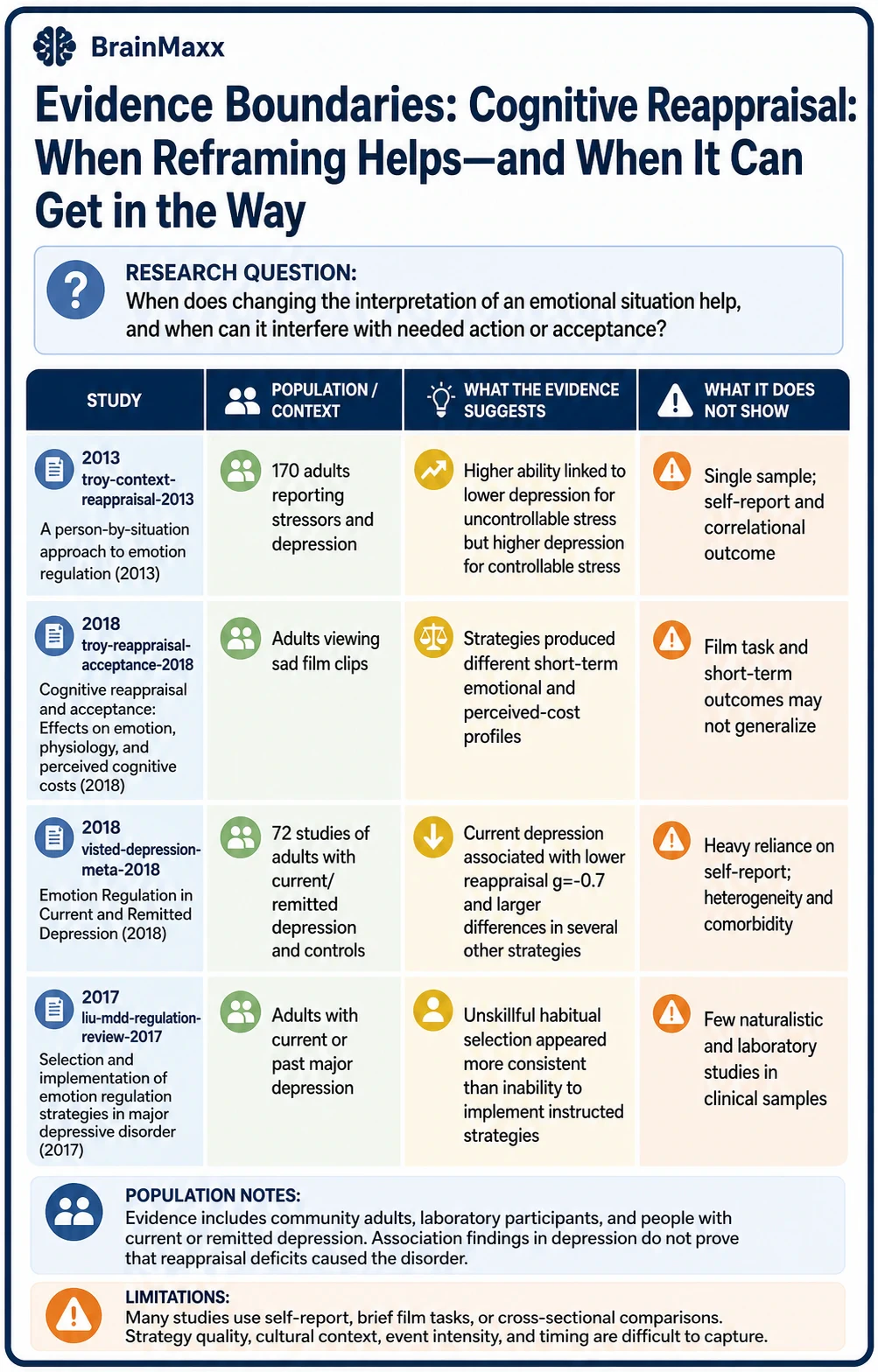
A person-by-situation approach to emotion regulation (2013). 170 adults reporting stressors and depression. Measured reappraisal ability, stress severity, controllability, and depression. The material result was: Higher ability linked to lower depression for uncontrollable stress but higher depression for controllable stress. The inference boundary matters: Observational moderator association. The main caution is Single sample; self-report and correlational outcome
Cognitive reappraisal and acceptance: Effects on emotion, physiology, and perceived cognitive costs (2018). Adults viewing sad film clips. Within-subject instruction to use reappraisal and acceptance. The material result was: Strategies produced different short-term emotional and perceived-cost profiles. The inference boundary matters: Experimental effects for brief laboratory emotion induction. The main caution is Film task and short-term outcomes may not generalize
Emotion Regulation in Current and Remitted Depression (2018). 72 studies of adults with current/remitted depression and controls. Meta-analysis of strategy use and regulation abilities. The material result was: Current depression associated with lower reappraisal g=-0.7 and larger differences in several other strategies. The inference boundary matters: Group association, not causal direction. The main caution is Heavy reliance on self-report; heterogeneity and comorbidity
Selection and implementation of emotion regulation strategies in major depressive disorder (2017). Adults with current or past major depression. Review of trait, spontaneous, instructed, and naturalistic strategy evidence. The material result was: Unskillful habitual selection appeared more consistent than inability to implement instructed strategies. The inference boundary matters: Mixed-design evidence synthesis. The main caution is Few naturalistic and laboratory studies in clinical samples
Taken together, these sources do not collapse into one magic number. A person-by-situation study, a laboratory comparison of reappraisal and acceptance, a depression meta-analysis, and an integrative review of emotion-regulation strategy selection and implementation. In 170 adults, greater reappraisal ability related to lower depression under uncontrollable stress but higher depression under controllable stress. A depression meta-analysis found lower self-reported reappraisal in current depression, g=-0.7, alongside larger differences in several other regulation measures. The direction and magnitude should therefore be read as an evidence pattern, not a personal forecast.
What the averages do not settle
Laboratory instruction can test immediate emotional effects, but observational links between habitual strategy use and depression cannot establish cause. Context-moderator findings require replication.
Reappraisal may work by shifting meaning, attention, or goals; acceptance may reduce struggle without changing meaning; problem solving may be better when the environment is controllable. Those explanations can coexist. The honest conclusion is that a result may support a method under tested conditions without proving why it worked in every participant.
Many studies use self-report, brief film tasks, or cross-sectional comparisons. Strategy quality, cultural context, event intensity, and timing are difficult to capture. Individual experience can legitimately differ from an average because prior knowledge, task design, timing, sleep, stress, access, and feedback all change what a learner or reader can do.

A bounded way to try it
Name the facts, rate how controllable the situation is, choose a truthful alternative interpretation, and decide whether the next step is reappraisal, acceptance, problem solving, or boundary setting.
Use the following sequence as a small experiment, not as a test of character:
- Name the facts
- Check controllability
- Try one truthful frame
- Choose action or acceptance
- Review the result
Keep the trial modest enough to reverse. If it fits, repeat it long enough to observe behavior rather than relying on one good or bad session. If it does not fit, change the conditions or choose a different tool.
Worked example
Priya receives blunt feedback on a draft. First she separates the facts from the story that she is incompetent. Reappraisal helps her see the message as information about one draft, reducing enough distress to read it carefully. Then she checks controllability: the wording and evidence are changeable, so action should follow. If the feedback were abusive rather than specific, reframing it as helpful would obscure a boundary problem rather than solve one.
The example is deliberately ordinary. It shows how the method can be adjusted using feedback while keeping uncertainty visible. It does not imply that one person’s result predicts another person’s outcome.
How to judge the result
Look for observable change at the next sensible review point:
- Emotion becomes workable
- Facts remain intact
- Needed action becomes clearer
Pause or redesign the experiment when any of these occur:
- Danger or abuse is minimized
- Self-blame rises
- Needed action is delayed
The revision adds a controllability check before reframing and keeps acceptance, problem solving, and boundary setting available as alternatives.
Safety and scope
Stop reframing when it requires denying danger, abuse, discrimination, grief, or a solvable problem; when it increases self-blame; or when emotions become more intense or confusing.
This exercise cannot diagnose or treat depression, anxiety, trauma, or another disorder. Persistent impairment, danger, or overwhelming emotion warrants qualified help. Seek qualified support when the problem is persistent, impairing, new, or safety-relevant. This article is educational and does not diagnose a disorder or replace assessment, treatment, teaching support, or an established safety protocol. If a situation involves immediate danger or a crisis, use local emergency or crisis services rather than an article exercise.
Bottom line
Reappraisal can change short-term emotional experience and is associated with better outcomes in some contexts. It is not inherently adaptive: benefit depends on controllability, goals, timing, skill, and whether reframing suppresses valid information or action. The most defensible use is a bounded test with feedback, a review point, and permission to stop.

Sources
- A person-by-situation approach to emotion regulation (2013)
- Cognitive reappraisal and acceptance: Effects on emotion, physiology, and perceived cognitive costs (2018)
- Emotion Regulation in Current and Remitted Depression (2018)
- Selection and implementation of emotion regulation strategies in major depressive disorder (2017)


