

You replay the conversation once because you want to understand what went wrong. Then again, because there must be a useful detail you missed. Twenty minutes later, you have produced three harsher interpretations of yourself, no new evidence, and no decision about what to do next.
It can still feel like work. That is what makes rumination hard to spot.
The useful distinction is not “thinking” versus “not thinking.” Repeated thought can help people prepare, learn, grieve, and make decisions. The better question is whether the thinking is changing the problem in a way you can use.
Productive problem-solving tends to become more specific. It generates options, selects a next step, and learns from what happens. Rumination tends to circle causes, meanings, threats, or self-judgments without creating fresh information or movement. Those are patterns, not personality types—and neither one can diagnose a mental health condition.
In one line: problem-solving produces an output; rumination demands more processing without a reliable stopping rule.
The quickest functional test
Ask what changed during the last few minutes of thinking:
- Did the problem become more specific?
- Did you learn anything genuinely new?
- Did you identify a decision, action, or piece of information to seek?
- Can you say when you will stop thinking and test the next step?
Several “yes” answers suggest that reflection is doing problem-solving work. Repeating the same question with rising distress and no new output suggests a loop.
This is a practical check, not a validated clinical test. A complex problem may require several rounds of thought. Grief may need repeated meaning-making. A person can also feel calm while avoiding action, or distressed while doing useful work. Judge the process by its function and fit, not by emotion alone.
| What to watch | More like problem-solving | More like rumination |
|---|---|---|
| Question | Specific enough to test | Global, self-evaluative, or impossible to settle |
| Information | New evidence can change the view | The same evidence is recycled |
| Options | Alternatives are generated and compared | One threat or interpretation dominates |
| Action | A feasible next step appears | Action is postponed until certainty arrives |
| Feedback | Results update the next move | Results are discounted or reinterpreted |
| Stopping rule | A decision or review time ends the round | “One more pass” keeps extending the round |
Temporary uncertainty does not make thinking unproductive. A useful round can end with “I do not know yet; I need one fact from tomorrow’s appointment.” That is still an output: the missing information and the next review point are clear.

Do not confuse the loop with every difficult form of thought
Rumination overlaps with several experiences without being interchangeable with them:
- Reflection looks back to understand or learn. It becomes productive when it remains specific, evidence-responsive, and able to end.
- Worry is usually more future-oriented—what might happen—while depressive rumination often leans toward past events, losses, causes, or meanings. Both can become repetitive negative thinking.
- Grief naturally revisits a loss. Repetition alone does not make grief pathological or call for a productivity fix.
- Intrusive thoughts or memories can arrive involuntarily. Their presence does not reveal intent, character, or diagnosis.
- Obsessive-compulsive processes may turn analysis, reassurance, or checking into a neutralizing ritual. A “solve it harder” exercise can feed that cycle.
- Moral repair may require responsibility, apology, restitution, or changed behavior. It is different from endless self-punishment.
If you cannot tell which process is happening—and especially if the thoughts feel intrusive, compulsive, trauma-linked, or severely impairing—an individualized assessment is more useful than forcing the article’s categories to fit.
Rumination and problem-solving can use the same subject
The content may look identical. The processing is different.
“Why do I always ruin things?” is broad, global, and difficult to test. “What did I say, what response did I observe, and is there a repair I want to make?” narrows the field.
“What if the presentation goes badly?” can produce another hour of imagined failure. “Which claim is least supported, and what evidence can I add in 15 minutes?” creates a testable task.
The American Psychological Association describes formal Problem-Solving Therapy as a sequence: approach and define the problem concretely, generate alternatives, evaluate them, implement one, and review the result. That is more structured than ordinary thought, and it is not the same thing as simply thinking hard (APA Dictionary of Psychology).
Rumination, meanwhile, is usually described as repetitive attention to distress, its causes, meanings, or consequences. It often uses abstract “why” questions and broad comparisons: why me, what does this say about me, why can’t I stop, what if this proves I am failing? Constructive reflection can also repeat, but it stays open to evidence and eventually changes what the person does.
Repetition itself is not the enemy
An influential review of repetitive thought found both constructive and unconstructive outcomes. Emotional tone mattered, but so did context and processing level—especially abstract versus concrete thought (Watkins, 2008). A second major review concluded that depressive rumination can intensify negative thinking, interfere with instrumental behavior, and impair problem-solving, while also warning that rumination is not identical to more adaptive reflection (Nolen-Hoeksema and colleagues, 2008).
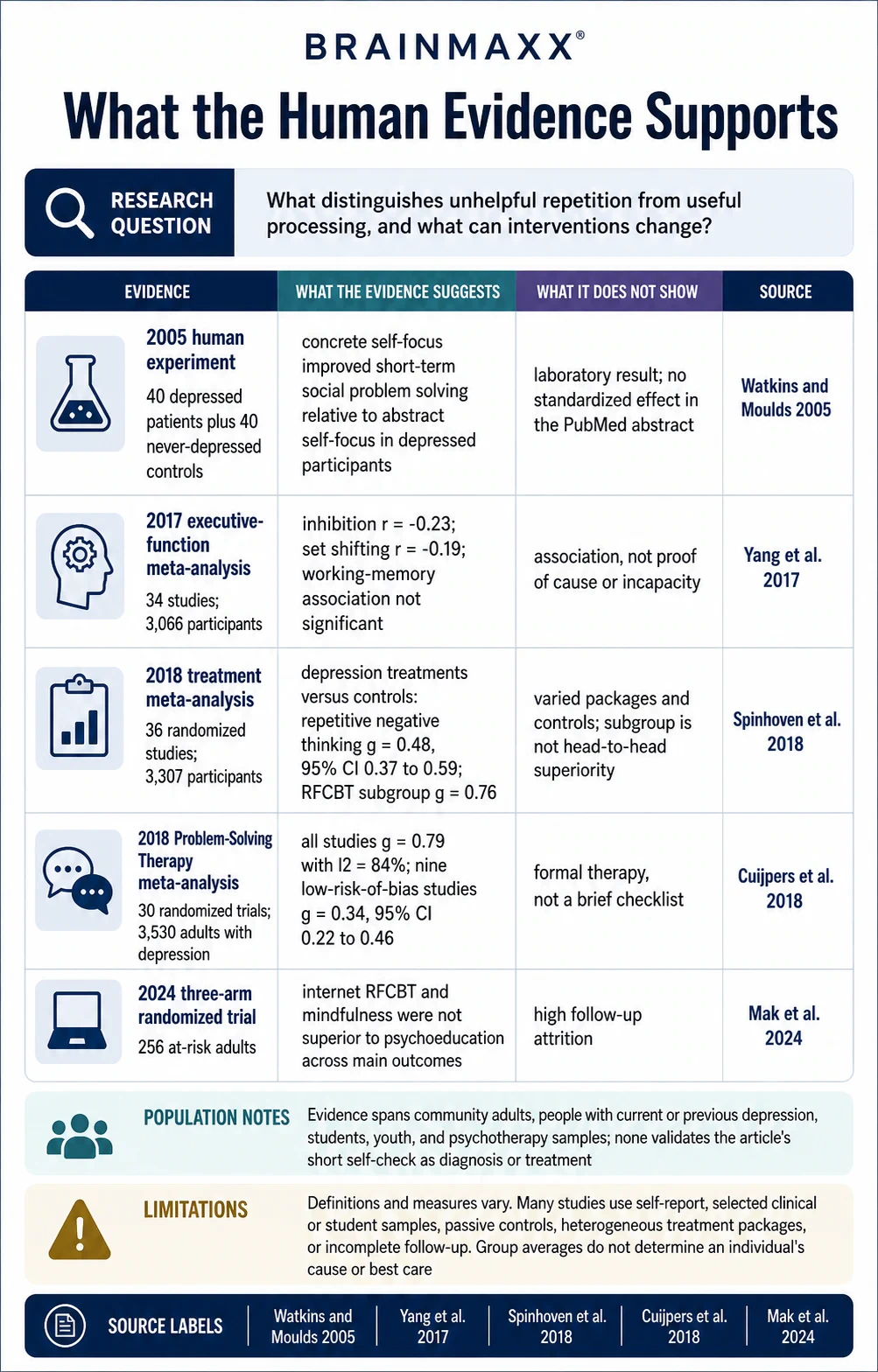
One small experiment made the abstract-versus-concrete distinction more tangible. Forty depressed patients and 40 never-depressed controls completed social problem-solving measures before and after different forms of symptom-focused thought. Among the depressed participants, concrete self-focus improved problem-solving relative to abstract self-focus (Watkins and Moulds, 2005). That supports the processing-mode idea in a laboratory setting. It does not prove that changing one question will stop an everyday loop or treat depression.
The broader cognitive evidence is modest, not catastrophic. A meta-analysis of 34 studies with 3,066 participants found correlations between rumination and poorer inhibition (r = -0.23) and set shifting (r = -0.19), but no significant relationship with working memory (Yang and colleagues, 2017). These are group-level associations. They do not mean that someone who ruminates has a damaged brain or lacks the capacity to reason.
Rumination and low mood can reinforce each other
A probability sample of 5,891 Australian adults measured rumination and depressive symptoms at baseline and four years later. Rumination predicted residual change in later depressive symptoms, and depressive symptoms predicted residual change in later rumination, even after adjustment for several covariates (Whisman and colleagues, 2020).
That result is consistent with a feedback loop. It is not proof that rumination alone causes depression. Two self-report snapshots four years apart cannot show the moment-to-moment direction of change, and the authors explicitly called for denser within-person research.
Other explanations can matter: grief, genuine danger, unresolved responsibility, perfectionism, trauma-related intrusions, obsessive-compulsive processes, anxiety, depression, pain, sleep loss, neurodivergence, or a problem that really is complex. A loop can be a response to distress as well as a contributor to it.
How strong is the evidence?
The evidence is strongest for three narrower conclusions:
- Processing mode matters in the short term. The abstract-versus-concrete experiment manipulated how people thought and measured immediate problem-solving. That supports a causal claim about that brief laboratory comparison, not about long-term recovery.
- Rumination and distress are associated over time. Meta-analytic and longitudinal evidence shows modest cognitive associations and a recursive relationship with depressive symptoms. That establishes neither a single cause nor an individual prognosis.
- Structured treatment packages can reduce repetitive negative thinking. Randomized trials and meta-analyses support average improvement in selected populations. They do not show that every component works alone or that the same effect applies to a brief self-guided exercise.
Who was studied matters. The evidence includes community adults, people with current or previous depression, university students, youth, and mixed-age psychotherapy samples. Many intervention trials selected participants for depression or elevated rumination; several used self-report outcomes, passive controls, or incomplete follow-up. The practical experiment below is therefore best treated as a low-stakes tool for an ordinary loop—not as a miniature version of clinical treatment.
What treatment studies do—and do not—show
The strongest causal evidence concerns structured interventions, not a one-page checklist.
A meta-analysis of 36 randomized studies with 3,307 participants found that depression treatments reduced repetitive negative thinking by a medium amount versus controls (g = 0.48, 95% CI 0.37 to 0.59). Rumination-focused CBT had a larger subgroup estimate (g = 0.76), but the authors called for stronger mediation and mechanism studies (Spinhoven and colleagues, 2018). Subgroup estimates across different trials and controls are not the same as a direct test proving one therapy superior.
A 2024 systematic review found 12 studies of rumination-focused CBT, 10 of them randomized, and described the evidence as preliminary (Li and Tang, 2024). The uncertainty is not academic. In a 2024 three-arm trial of 256 at-risk adults, internet rumination-focused CBT and a mindfulness intervention were not superior to psychoeducation across the main outcomes; follow-up attrition was high (Mak and colleagues, 2024). A 2025 wait-list trial in 44 university students with recurrent major depression reported large within-group symptom improvement and a 30% reduction in rumination after a multi-session group program, but its small sample and passive control limit generalization (Hasani and colleagues, 2025).
Formal Problem-Solving Therapy also has evidence, but the cautious estimate is more informative than the headline. Across 30 adult-depression trials with 3,530 participants, the overall effect against controls was g = 0.79 with very high heterogeneity. In the nine studies at low risk of bias, it was g = 0.34 (95% CI 0.22 to 0.46) with lower heterogeneity (Cuijpers and colleagues, 2018). That supports a small credible treatment effect in depressed adults—not a guarantee that every problem has a solution.
Mindfulness-based cognitive therapy is another package with relevant evidence. A 2025 meta-analysis of 29 randomized trials and 2,535 participants reported a reduction in rumination of SMD = -0.51 (95% CI -0.64 to -0.39) (systematic review and meta-analysis). Again, a multi-session program combines skills, practice, support, and context. Its average effect cannot be assigned to one attention-shifting instruction.
Put together, the treatment literature supports cautious optimism, not a winner. Rumination-focused CBT, broader CBT, mindfulness-based approaches, and formal Problem-Solving Therapy all have relevant evidence. Comparators, populations, intensity, adherence, and risk of bias change the estimates. The most honest translation is that repetitive thinking is modifiable for many people, while the appropriate method depends on what is maintaining it and what else is happening clinically.
A bounded experiment for an ordinary loop
Use this only for a low-stakes thought episode when you can pause safely.
- Name the process, not yourself. Try “I have been asking the same question for ten minutes” instead of “I am irrational.” The label should add distance, not shame.
- Write the question in one sentence. If the sentence keeps expanding, that is useful information: several problems may be fused together.
- Sort the question. Is it specific? Is any part under your current control? Could evidence or action answer it? “What does this prove about me?” usually fails this test. “Do I want to send a repair message?” can pass it.
- If it is solvable, choose one observable step. Ask for information, draft two options, schedule a conversation, or work for ten minutes. Pick a review time instead of demanding certainty first.
- If it is not solvable now, record a revisit point. Write what would make the question answerable—a response, appointment, deadline, or new fact. Then shift to a safe present activity. This is postponement, not pretending the concern is unimportant.
- Review the output. Did you gain information, make a decision, take action, or learn from feedback? If not, continuing the same mental move is unlikely to turn it into problem-solving.
The goal is not to force thoughts away. Thought suppression can itself become another struggle. The goal is to stop treating repetition as proof that more analysis is required.
A worked example
Suppose the loop is: “Why did my manager sound disappointed? Am I about to lose my job?”
Writing it down reveals two different questions. “Why did they sound disappointed?” may not be answerable from tone alone. “Is my job at risk?” is high stakes, but parts of it are testable.
A problem-solving round might look like this:
- Evidence already available: the manager requested two revisions and did not mention discipline or termination.
- Missing information: whether the work now meets the brief and whether expectations changed.
- Options: send a defensive explanation, keep replaying the call, or ask for a short expectations check.
- Chosen step: revise the two points, then send a concise message asking whether anything else is needed.
- Stopping rule: no more interpretation tonight; review after the manager replies tomorrow.
The outcome may still be uncomfortable. Productive does not mean reassuring. It means the next round will use new information instead of the same imagined evidence.
Signs that the experiment is helping
Look for behavioral change, not a promised feeling:
- the question is narrower than when you started;
- you can name what is known, unknown, and controllable;
- at least two options are visible;
- you chose or completed one observable step;
- feedback can change your view;
- you can stop at the planned review point, even without certainty.
If none of these changes after one bounded round, that is a signal to disengage from the current strategy—not evidence that you have failed.
If the loop returns five minutes later
Do not reopen the whole case automatically. Check the written plan.
If new information arrived, update the plan. If nothing changed, use a simple return statement: “This is the same question; the next review is tomorrow at 10.” Then choose a present activity that is safe and absorbing enough to compete for attention: a shower, meal, walk, routine chore, conversation, or the next item on your schedule.
That shift is not proof that the concern is unimportant. It is a decision to wait for the condition that can actually change the answer. If postponement turns into repeated checking, reassurance seeking, or a rigid ritual, stop using it as self-help and seek guidance.
When the exercise does not fit
Do not use a productivity-style interruption to process trauma, neutralize an obsession, override grief, or push through severe exhaustion. Do not rely on it for immediate danger, abuse, medical symptoms, legal jeopardy, or another high-stakes decision that requires expertise.
Stop if the exercise sharply increases panic, dissociation, compulsive checking, self-criticism, sleep loss, or impairment. Do not start, stop, or change medication based on an article.
The exercise also does not fit when urgent action is already obvious. If someone is unsafe, a medical symptom needs assessment, or a deadline requires a concrete response, take the appropriate real-world step instead of using reflection to delay it.
Persistent repetitive thinking can occur with depression, anxiety, post-traumatic stress, obsessive-compulsive problems, substance use, and other concerns, but the presence of a loop cannot identify which explanation applies. A qualified clinician can assess the pattern, the context, and the safest treatment options. Current NICE guidance emphasizes matching depression care to severity, needs, preferences, and context rather than treating one mental habit in isolation (NICE NG222).
When to get more support
Consider professional help when the thinking is hard to control, keeps returning for weeks, disrupts sleep or daily functioning, drives avoidance or compulsions, or arrives with persistent low mood, intense anxiety, trauma symptoms, substance use, or a major change in behavior. Seek help sooner when your own attempts repeatedly make things worse.
If you may harm yourself or someone else, or you are in immediate danger, use emergency or crisis support now. The World Health Organization advises contacting available emergency services or a crisis line in immediate self-harm danger (WHO depression guidance). In the United States, call or text 988 or use the 988 chat; call 911 for immediate harm or danger (988 Lifeline). Elsewhere, use your local emergency number or crisis service.
Useful thinking does not have to feel pleasant. It has to become accountable to reality: a clearer question, a decision, an action, or new evidence. When none of those arrives, the kindest next move may be to stop demanding an answer from the loop.


