

You finish dinner and think, I really should walk more. The thought is sincere. The next evening arrives, dinner ends, a message lights up your phone, and the walk never becomes a decision.
That gap is not proof of laziness or a broken mind. A goal such as “walk more” describes an outcome you value, but it leaves several decisions for the exact moment when attention is already occupied: When? Where? What counts? What happens first?
An implementation intention moves some of that decision-making earlier. Its simplest form is:
If a specific situation occurs, then I will perform a specific response.
“If I put my dinner plate in the dishwasher on Monday, Wednesday, or Friday, then I will put on my shoes and walk to the end of the block.”
Research suggests that this structure can improve follow-through. It is not magic, and it does not replace motivation, resources, skill, treatment, or a safe environment. Its narrower job is to make a chosen response easier to retrieve at a moment that matters.
A goal intention and an implementation intention do different jobs
A goal intention names a desired state: “I intend to be more active,” “I want to study consistently,” or “I plan to call my parents more often.” It answers what do I want?
An implementation intention adds a cue-response link: “If it is 7 p.m. on Tuesday, then I will open the course page and complete one practice problem.” It answers when this recognizable situation arrives, what will I do first?
The distinction is functional, not moral. People can care deeply about a goal and still miss the action window. A vague intention requires the person to notice the opportunity, remember the goal, choose an action, and begin it while other demands compete. An if-then plan preselects one response.
That does not make detailed project planning obsolete. Complex goals still require calendars, resources, coordination, learning, and revision. An if-then plan is best understood as a bridge to the next behavior, not as the whole road.
What the research actually shows
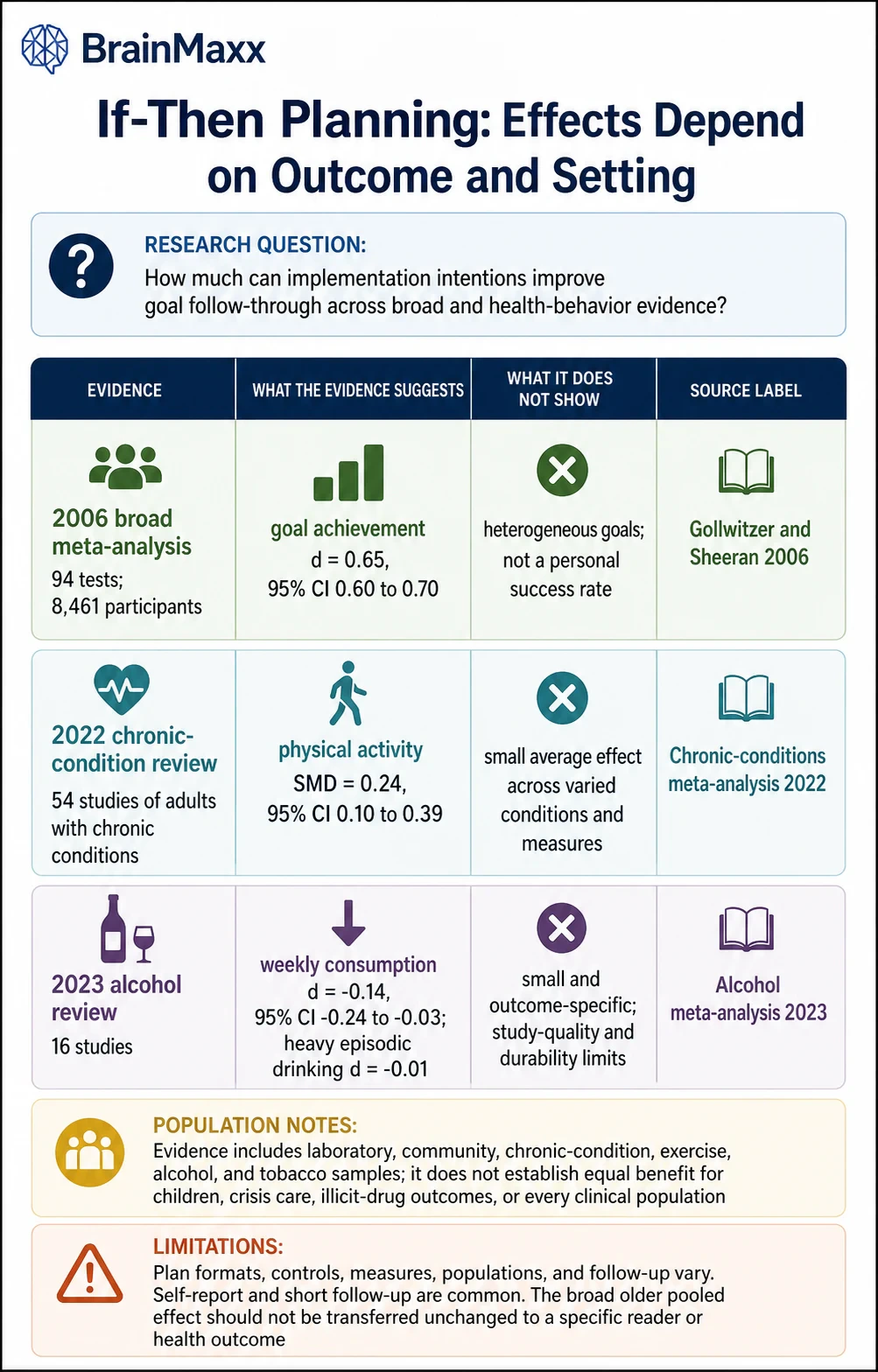
The broadest often-cited estimate comes from Peter Gollwitzer and Paschal Sheeran’s 2006 meta-analysis. Across 94 tests and 8,461 participants, implementation intentions had an average effect of d = 0.65 on goal achievement, with a 95% confidence interval from 0.60 to 0.70. In standardized-effect language, that is a moderate average difference across a highly varied set of studies—not a 65% success rate and not a promise for an individual goal.
Later reviews in specific health domains are more sobering and more useful for setting expectations:
- A 2022 review of 54 studies involving adults with chronic conditions found small effects for physical activity (SMD 0.24, 95% CI 0.10 to 0.39) and diet (SMD -0.25, 95% CI -0.34 to -0.15 in the review’s coding direction).
- A 2020 substance-use meta-analysis reported small average effects for alcohol and tobacco, both around g = 0.31. It found no eligible illicit-drug studies, so it cannot support claims about those substances.
- A 2023 alcohol review found a small reduction in weekly consumption (d = -0.14, 95% CI -0.24 to -0.03) but no clear effect on heavy episodic drinking (d = -0.01). Effects varied by sample, delivery, and plan format and appeared to diminish over time in parts of the evidence.
These are intervention findings: in many included studies, researchers assigned or guided planning and compared outcomes. That supports a causal conclusion about the intervention in those studied settings. It does not show that a single sentence is equally effective for every behavior, that stronger effects will occur in daily life without support, or that planning treats a disorder.
The difference between the older broad estimate and newer domain-specific estimates is not a reason to discard the idea. It is a reason to use the idea at the right scale. If-then planning is a small behavior-design tool. Health, dependence, and long-standing functional problems are usually larger systems.
An evidence ladder for this article
The strongest claim here is also the narrowest: assigning people to form implementation intentions can improve some measured behaviors compared with control conditions. That conclusion rests on intervention studies and their syntheses.
The next level is less certain. Reviews suggest that plan precision, initial commitment, and context may change the effect, but moderator results are not the same as randomized tests of each ingredient. They help generate better designs; they do not explain every person’s outcome.
The mechanism claim is narrower still. Cue accessibility and response retrieval are supported models, not a complete causal map of motivation or the brain. Finally, this article’s six-step exercise is an evidence-informed translation. It has not itself been tested as a branded package and must not inherit the effect size of a clinical or multi-component intervention.
Who was studied also matters. The literature includes students, community adults, and people managing chronic health conditions, plus alcohol and tobacco behavior-change samples. It does not provide equal evidence for children, people in acute crisis, illicit-drug outcomes, every psychiatric condition, or every culture and environment. Many studies use self-report, short follow-up, and different plan formats. Those boundaries are part of the result, not fine print.

The leading mechanism: make the cue easier to notice
The main explanatory model has two parts.
First, specifying the “if” situation may make that cue more mentally accessible. The person has already decided which moment matters. Second, linking the cue to one response may make that response easier to retrieve and start when the cue appears.
In plain language: the plan reduces the number of decisions required at the action point.
Experimental work summarized in the foundational review supports cue accessibility and stronger cue-response links. Still, “more automatic” should not be exaggerated into “unconscious,” “effortless,” or “hardwired.” People can ignore a cue, choose differently, encounter an obstacle, or discover that the plan was poorly designed. Mechanism evidence describes a likely process, not a complete account of every success or miss.

Specificity helps only when the plan is viable
“If I have time, I will work out” sounds structured, but “have time” is hard to observe. “Work out” still leaves many choices. A usable plan usually has:
- an observable cue;
- a response that can begin immediately;
- an action under the person’s control;
- enough flexibility to survive ordinary variation; and
- no conflict with safety, health, or a more important goal.
The National Cancer Institute’s archived research summary notes that underlying goal commitment and plan quality matter. Physical-activity reviews also identify possible moderators such as intention, self-efficacy, and whether the goal fits the person’s values. These are moderator findings, not a test of character. A plan can fail because the elevator was broken, a child needed care, pain flared, the cue never occurred, or the action was too large.
A useful question is not “Why didn’t I have enough discipline?” It is “Which part of the cue-response design did reality contradict?”
One safe way to build the plan
Use this as a small experiment for one low-risk behavior.
- Choose one action you already want. The method cannot manufacture a meaningful goal for you. Start with something that takes a few minutes, such as opening a document, filling a water bottle, or stepping outside.
- Name one cue you can observe. A time, place, or completed routine works better than a mood such as “when I feel motivated.”
- Write one response. “If I close my work laptop, then I will place tomorrow’s medication organizer beside my keys” is specific. Medication use itself should follow a clinician’s or pharmacist’s directions; the plan only supports an already-approved routine.
- Check feasibility. Do you control the response? Are the materials available? Could pain, fatigue, caregiving, work rules, or safety make it inappropriate?
- Rehearse once and remove friction. Picture the cue and first action. Put the shoes, document, or phone number where it will be available.
- Review real opportunities. After three to seven times the cue could have occurred, count cue detection and response initiation separately. Revise the cue or shrink the action if needed.
The outcome to watch is behavioral, not emotional. You do not need to feel inspired. Useful signals are noticing the cue sooner, beginning the first step with less negotiation, or completing the response more consistently across several opportunities.
One miss is weak evidence. A repeated pattern is information.
A worked repair: from “study more” to a testable plan
Suppose Maya wants to prepare for a certification exam. Her first plan is, “If I have free time after work, then I will study.” It repeatedly fails. That does not tell us that Maya lacks commitment. “Free time” has no clear boundary, and “study” contains too many possible first actions.
She checks the actual week. On Tuesday and Thursday she normally puts her dinner plate in the sink around 7:15 p.m. Her practice questions are available on her laptop. She rewrites the plan:
If I put my dinner plate in the sink on Tuesday or Thursday, then I will sit at the kitchen table and answer one practice question before opening social media.
The response is deliberately small. Answering one question is not the entire study session; it is the doorway. Maya also leaves the course page open and keeps the plan flexible when work runs late or family needs her.
After six real opportunities, she reviews three separate facts: Did the dinner cue occur? Did she notice it? Did she answer the first question? If the cue occurred but she never noticed it, she may need a more salient cue. If she noticed it but could not begin, the response or environment may still be too demanding. If the plan worked on ordinary evenings but failed during a family emergency, it may need no repair at all.
This is what “revise without self-blame” means in practice: diagnose the design, not the person.
When the method does not fit
If-then plans can become unhelpfully rigid. Do not use them to punish yourself, override pain or exhaustion, restrict food, force exercise through injury, remain in danger, or turn intrusive thoughts into a compulsive neutralizing ritual. Do not use an article to create or change a medication plan.
They are also not a stand-alone response to substance dependence, an eating disorder, severe depression, mania, trauma symptoms, obsessive-compulsive symptoms, or immediate safety concerns. Some behavior-change studies include clinical or health populations, but their planning components were embedded in particular research contexts. Their average effects do not transfer automatically to self-treatment.
Stop or loosen the exercise if it increases panic, compulsive checking, self-harm risk, sleep loss, disordered behavior, or meaningful impairment. A flexible plan serves the person. The person does not owe obedience to the plan.
Normal variation is not a diagnosis
Everyone forgets, postpones, encounters conflict, or changes priorities. Follow-through varies with sleep, stress, pain, opportunity, reward, skill, environment, and the number of demands competing for attention.
Persistent impairment can also occur with many conditions, including depression, anxiety, ADHD, trauma-related problems, substance use, sleep disorders, and medication effects. Whether an if-then plan helps cannot confirm or rule out any of them. Diagnoses require a broader history, context, duration, severity, and professional judgment.
If problems with starting, remembering, or completing necessary tasks are persistent, distressing, or interfering with health, work, school, finances, or relationships, consider speaking with a qualified clinician. If there is immediate danger of self-harm or harm to someone else, contact local emergency or crisis services.
The honest takeaway
Vague intentions are valuable because they point to what matters. They are often insufficient because they leave the action moment underspecified.
An if-then plan adds one modest advantage: it decides in advance which cue should call up which first response. Across controlled studies, that can improve follow-through, with effects ranging from moderate in a broad older synthesis to small and outcome-specific in several health-behavior reviews.
Use the method as a testable support, not a verdict. Make the cue visible, make the response small, watch what happens in real life, and revise the design before blaming the person.
Sources
- Gollwitzer & Sheeran (2006), implementation-intention meta-analysis
- National Cancer Institute: Implementation Intentions (archived construct summary)
- 2022 systematic review in adults with chronic conditions
- 2020 meta-analysis of implementation intentions and substance use
- 2023 systematic review and meta-analysis of alcohol consumption
- 2020 systematic review of physical activity
This article is educational and is not a diagnosis or a substitute for individualized medical or mental-health care.


