

You open the document, feel a small surge of dread, and check one message first. Ten minutes later, you are reorganizing a folder that did not need reorganizing. The important task is still there—but for a moment, you feel better.
That moment matters. Procrastination is often described as a scheduling failure or a lack of discipline. Sometimes it is better understood as short-term mood repair: stepping away from an uncomfortable task changes how you feel now, even when you expect the delay to cost you later.
This is not a diagnosis, and it is not the only explanation. Fatigue, unclear priorities, unrealistic workloads, depression, anxiety, ADHD, perfectionism, low task value, and ordinary strategic delay can all look similar from the outside. But when immediate relief keeps winning against a goal you genuinely want to pursue, the mood-repair model gives you something useful to work with.
The relief is real—and temporary
Procrastination usually means voluntarily delaying an intended action despite expecting that delay to make things worse. That definition excludes a lot of sensible behavior. Resting when you are depleted is not procrastination. Dropping a low-value task is not procrastination. Waiting because new information will improve a decision is not procrastination.
The troublesome loop has a different shape:
- A task triggers discomfort—boredom, uncertainty, resentment, fear of failure, or fear that success will raise expectations.
- You move toward an easier or more rewarding activity.
- The discomfort drops, at least briefly.
- Your brain learns that escape works.
- The delayed task returns with less time, more pressure, and often more shame.
This is a plausible learning loop, not proof that every delay is caused by emotion. The important distinction is between what avoidance does immediately and what it does over time. In the moment, avoidance can work extremely well. Over time, it can train the exact pattern you are trying to stop.
What the research actually supports
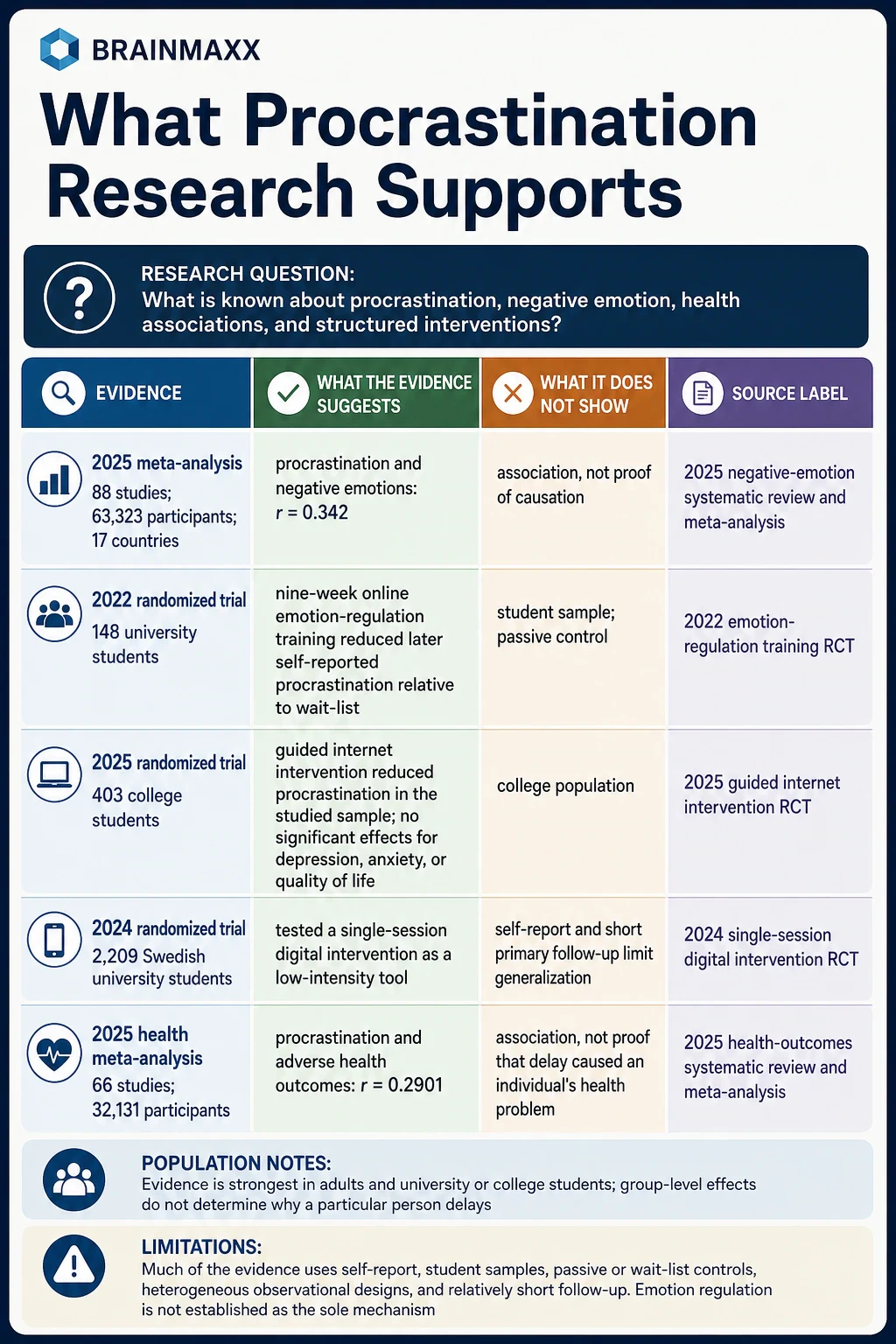
A 2025 systematic review and meta-analysis combined 88 studies involving 63,323 participants across 17 countries. The pooled correlation between procrastination and negative emotions was r = 0.342. That is a meaningful group-level association, but it is not a diagnosis and it does not establish that negative emotion causes procrastination. The review’s longitudinal evidence was compatible with influence in both directions: feeling bad may make delay more likely, and repeated delay may make people feel worse.
That bidirectionality fits ordinary experience. Anxiety can make starting harder; a missed deadline can then create more anxiety. Shame can prompt avoidance; avoidance can then produce more reasons for shame. The loop does not need one original cause to keep running.
Intervention studies add a cautious piece of causal evidence. In a randomized trial of 148 university students, a nine-week online emotion-regulation program reduced later self-reported procrastination relative to a wait-list group. A guided internet intervention with 403 college students also reduced procrastination in the studied sample, although it did not significantly improve depression, anxiety, or quality of life. And a large randomized trial involving 2,209 Swedish university students tested a single-session digital intervention as a low-intensity tool.
These trials make “skills can help” more defensible than “just try harder.” They do not show that emotion regulation is the sole mechanism. Much of the evidence comes from students, relies on self-report, uses short follow-up periods, or compares an active intervention with a passive control. An intervention can also contain several ingredients—planning, psychoeducation, exposure to discomfort, and accountability—so improvement does not tell us which ingredient did the work.
The health picture deserves the same restraint. A separate 2025 systematic review and meta-analysis found an association of r = 0.2901 between procrastination and adverse health outcomes across 66 studies and 32,131 participants. That result supports taking chronic procrastination seriously. It does not mean a delayed task directly caused a person’s health problem.

Emotion is one part of the system
The most useful model is not “procrastinators cannot regulate emotions.” It is “behavior follows the option that is easiest, most valuable, or most relieving in that moment.” Several forces can tilt that choice.
A cross-sectional study of 638 respondents modeled academic procrastination using emotion and motivation variables. Lack of value, delay discounting, and lack of perseverance were prominent contributors. Because the study measured variables at one period rather than manipulating them, it cannot tell us which factor caused which. What it does show is why single-cause stories are inadequate.
Consider four superficially identical delays:
- One person avoids a report because the next action is vague.
- Another knows the next action but fears producing mediocre work.
- A third is exhausted after an unrealistic week.
- A fourth consistently struggles to initiate, sequence, and sustain tasks across settings.
Calling all four people lazy hides the relevant difference. The first may need a clearer starting action. The second may need practice tolerating imperfect work. The third may need rest or a workload change. The fourth may benefit from professional assessment rather than another productivity trick.
The mood-repair model is useful when it predicts the next move: task discomfort rises, escape becomes attractive, and relief reinforces escape. If that pattern does not fit, choose a different explanation.
A six-step experiment for the next task
Treat this as an experiment, not a test of character. Pick one safe, ordinary task. Do not start with your entire backlog.
1. Name the feeling, not the identity
Complete this sentence: “When I think about starting, I notice ___.”
Use plain words: bored, confused, resentful, exposed, tired, afraid I will do it wrong. “I am lazy” is not an emotion and gives you no useful next action. Naming the state creates a little distance between the feeling and the response.
2. Make the first action physically startable
“Work on taxes” is a project. “Download last year’s return and open the income folder” is an action. “Write the presentation” is a project. “Create a slide titled ‘What changed this quarter?’” is an action.
If the step still invites negotiation, shrink it again. The goal is not to make the whole task painless. It is to remove ambiguity from the start.
3. Commit to ten minutes, not completion
Set a ten-minute timer and give yourself permission to stop when it ends. This is brief exposure to the task and its discomfort, not a promise to finish. If ten minutes feels unsafe or impossible, use two. If you continue afterward, that is optional.
The success measure is whether you began as planned, not whether you entered a perfect flow state.
4. Remove one escape route
Do not attempt to build a distraction-proof life. Change one piece of the immediate environment: put the phone across the room, close the inbox, block one site for fifteen minutes, or place the needed file on the screen before the scheduled start.
Environment matters because self-control is not the only variable. When escape takes one extra step and starting takes one fewer, you change the decision without needing a personality transplant.
5. Write an if-then return plan
Use a specific cue: “If I open a new tab to avoid the task, then I will close it, take one breath, and return to the next visible action.”
The return matters more than an unbroken streak. You are practicing recovery from avoidance, which is a more realistic skill than never feeling the urge to avoid.
6. Review behavior without a verdict
After the attempt, record four facts:
- What feeling showed up?
- What was the smallest action I completed?
- What escape did I use or want to use?
- What would make the next start easier?
Do not turn one trial into a global conclusion. “The first step was still too vague” is useful data. “I never follow through” is a verdict that cannot guide the next experiment.
How to tell whether the experiment is helping
Look for behavior change over several attempts, not a dramatic emotional transformation. Useful signals include starting closer to the planned time, returning sooner after distraction, producing a small visible unit of work, or needing less negotiation before the first action.
The discomfort may not disappear. In fact, waiting to feel motivated can preserve the loop. A better goal is learning that discomfort can be present while one small action still happens.
If the experiment repeatedly fails, inspect the model before increasing pressure. Is the task genuinely valuable? Is the deadline realistic? Is the next action clear? Are you sleeping enough? Is fear of evaluation central? Does the difficulty occur across many areas of life? Different answers call for different support.
When this is bigger than a productivity problem
Brief self-help strategies are not a substitute for assessment or treatment. Consider speaking with a qualified health or mental-health professional when task initiation or delay causes persistent impairment in work, education, finances, relationships, sleep, or basic care—especially when it appears alongside depression, severe anxiety, possible ADHD, trauma symptoms, substance use, or disordered eating.
Stop the experiment if it becomes a way to push through severe exhaustion, a health crisis, unsafe working conditions, or escalating distress. If you may harm yourself or someone else, contact local emergency services or a crisis service now.
Procrastination is behavior, not identity. The short-term relief makes sense; that is precisely why the pattern can become sticky. Breaking it does not require proving that you are disciplined. It starts with making the next action clear enough, small enough, and safe enough to practice staying present for it.
This article is educational and does not diagnose a condition or replace individualized medical or mental-health care.


