

Day 22 arrives. The new routine still requires effort. If the promise was “21 days to a habit,” the obvious conclusion is that you failed.
The research supports a different conclusion: the deadline was false.
A habit is not a streak or a personality trait. In contemporary behavior research, it usually means that a response becomes more automatically cued by a context. Formation is gradual, behavior-specific, and highly variable.
The newest review does not give one magic number
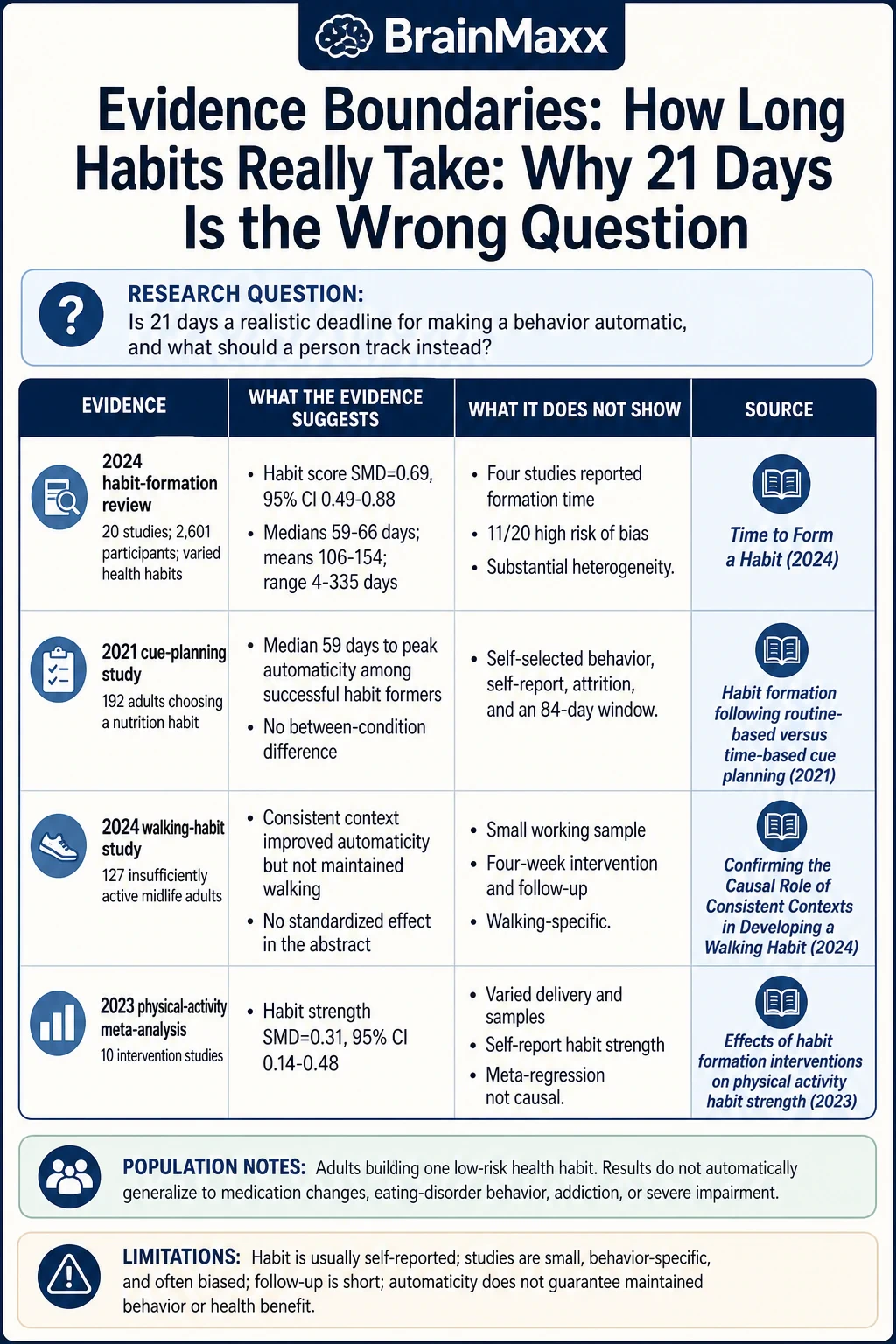
A 2024 systematic review included 20 studies and 2,601 participants. In the four studies that reported formation time, medians ranged from 59 to 66 days, means from 106 to 154 days, and individual times from 4 to 335 days.
Those figures do not mean “habits take 66 days.” They mean that averages hide large variation. Only four studies supplied time estimates, 11 of the 20 reviewed studies had high risk of bias, and behaviors ranged from flossing and drinking water to diet and physical activity.
The review also found a pre-post increase in habit scores (SMD 0.69, 95% CI 0.49 to 0.88). Pre-post change is not the same as a controlled treatment effect: time, measurement, participation, and other intervention components may contribute.
What an 84-day experiment found
In a randomized trial, 192 adults linked a chosen nutrition behavior either to a daily routine or to a clock time and reported behavior and automaticity for 84 days. Among participants who successfully formed habits, median peak automaticity was 59 days. Routine-based and time-based cues did not differ; repeated enactment predicted automaticity.
That supports consistent repetition, not a universal countdown. “Among successful habit formers” is an important population boundary. The estimate does not describe everyone who enrolled, every behavior, or what happens beyond 84 days.
Automatic does not mean maintained
A 2024 walking RCT randomized 127 insufficiently active working midlife adults to consistent-context, varied-context, or no required planning. Consistent-context planning produced stronger and maintained automaticity. Unexpectedly, it did not produce better maintenance of walking itself.
This is a useful causal distinction. The assigned context influenced how habitual walking felt, but the behavioral outcome did not move in lockstep. A person can experience an action as easier to start and still encounter schedule, health, weather, or motivation barriers.
A 2023 meta-analysis of ten physical-activity studies found a smaller controlled effect on habit strength (SMD 0.31, 95% CI 0.14 to 0.48). Studies with shorter follow-up showed larger effects, another reason not to confuse early gains with permanence.
An evidence ladder, not a countdown
The walking trial offers the clearest causal claim here: random assignment to consistent context changed automaticity in that sample. The cue trial causally compares routine and time cues, but its 59-day estimate describes successful formers rather than everyone randomized. The 2024 review gives the broadest range, while inheriting the bias and measurement limits of its studies. Moderator findings about timing, enjoyment, or follow-up are associations across people or studies, not proof of why one individual is slower.
The six-week log below is therefore an evidence-informed measurement aid. It has not been validated as a treatment or as a way to diagnose executive function.
Habit is not addiction, compulsion, or virtue
Automaticity is a psychological description, not a moral grade. A helpful behavior can become easier, and a harmful behavior can also become cue-linked. Repetition does not make an action wise.
Habit measures are usually self-reports about automaticity, identity, or lack of thought. They do not directly reveal a neural pathway. Observational links between stronger habits and health behavior cannot establish that habit strength caused the health outcome.
Clinical routines add another boundary. A diabetes review found positive observational associations for some self-management behaviors, but intervention studies did not consistently outperform controls. Medication timing and disease management should follow individualized clinical guidance, not a generic habit challenge.
Track opportunities, not a streak
For one safe, tiny behavior, try a six-week log without declaring that week six must be the finish line.
- Choose an action that can begin in under two minutes.
- Attach it to one stable context: after placing the mug in the sink, not “when I feel ready.”
- Mark whether the opportunity actually occurred.
- Mark completion separately.
- Rate how much deliberation starting required.
- Review weekly and remove one friction point.
That separation matters. Missing a day because the cue never occurred is different from noticing the cue and choosing not to act. Neither result diagnoses discipline.
For example, Luis chooses “After I start the kettle, I will floss one tooth.” During week two he misses four days. The log shows that on three of them he never made tea at home; the cue was absent. On the fourth, gum pain made flossing inappropriate. A streak counter would label four failures. The opportunity log identifies two design facts: he needs a cue that occurs on travel days, and pain requires dental guidance rather than more willpower.
The useful revision may be “after brushing at home, floss gently if pain-free,” with a separate plan to seek care if pain persists. The goal is safer repetition, not obedience to a number.
When to stop
Do not try to automate food restriction, compensatory exercise, medication changes, substance use, compulsive checking, unsafe exposure, or sleep deprivation. Stop for pain, injury, escalating rigidity, panic, self-punishment, or impairment.
Slow formation can reflect behavior complexity, context instability, fatigue, pain, caregiving, resources, or simple preference. Persistent difficulty completing necessary tasks can occur for many reasons, but habit speed cannot diagnose ADHD, depression, addiction, or any other condition. Qualified help is appropriate when difficulty or rigidity is impairing or dangerous.
The better question
“Has it been 21 days?” tells you almost nothing.
Ask whether the cue is stable, the action is feasible, repetitions are occurring, and initiation is becoming easier without causing harm. The evidence suggests that this can take weeks or months and varies enormously.
A calendar can measure time. It cannot declare that a person has failed.


Sources
- 2024 systematic review and meta-analysis of habit-formation time
- 84-day routine- versus time-cue RCT
- 2024 consistent-context walking RCT
- 2023 physical-activity habit meta-analysis
- 2023 diabetes habit review
This article is educational and is not a diagnosis or treatment plan.
FAQ
Common questions
Do habits really form in 21 days?
No universal threshold is supported. Observed timelines vary widely by behavior, person, context, repetition opportunities, and the definition of automaticity.
Does missing one day reset a habit?
A missed opportunity does not automatically erase prior learning. Return at the next suitable cue and evaluate the longer pattern rather than treating one miss as failure.
Which behaviors should not be automated this way?
Do not automate food restriction, compensatory exercise, medication changes, substance use, compulsive checking, sleep deprivation, or behavior that causes pain or impairment.
Topic hubs
Tags


