

“Write down three things you are grateful for” sounds harmless. Sometimes it is. Sometimes it becomes another task that a distressed person can supposedly fail: I listed the sunset, so why do I still feel awful?
Gratitude journaling has real experimental support, but the popular version often skips the most important findings. Effects vary by format, outcome, comparison activity, baseline distress, and population. A journal may shift attention or positive affect. It cannot make grief, injustice, illness, or depression unreal.
Gratitude is a response, not a command
The American Psychological Association defines gratitude as thankfulness and happiness in response to a gift, benefit, or fortunate event. A gratitude journal records moments that actually register that way.
That is different from forced positivity. Genuine gratitude can sit beside anger, fear, grief, or a demand for change. It does not require thanking someone who caused harm. It does not convert a benefit into a debt, and it does not prove that a difficult life is secretly fine.
What the broad review found
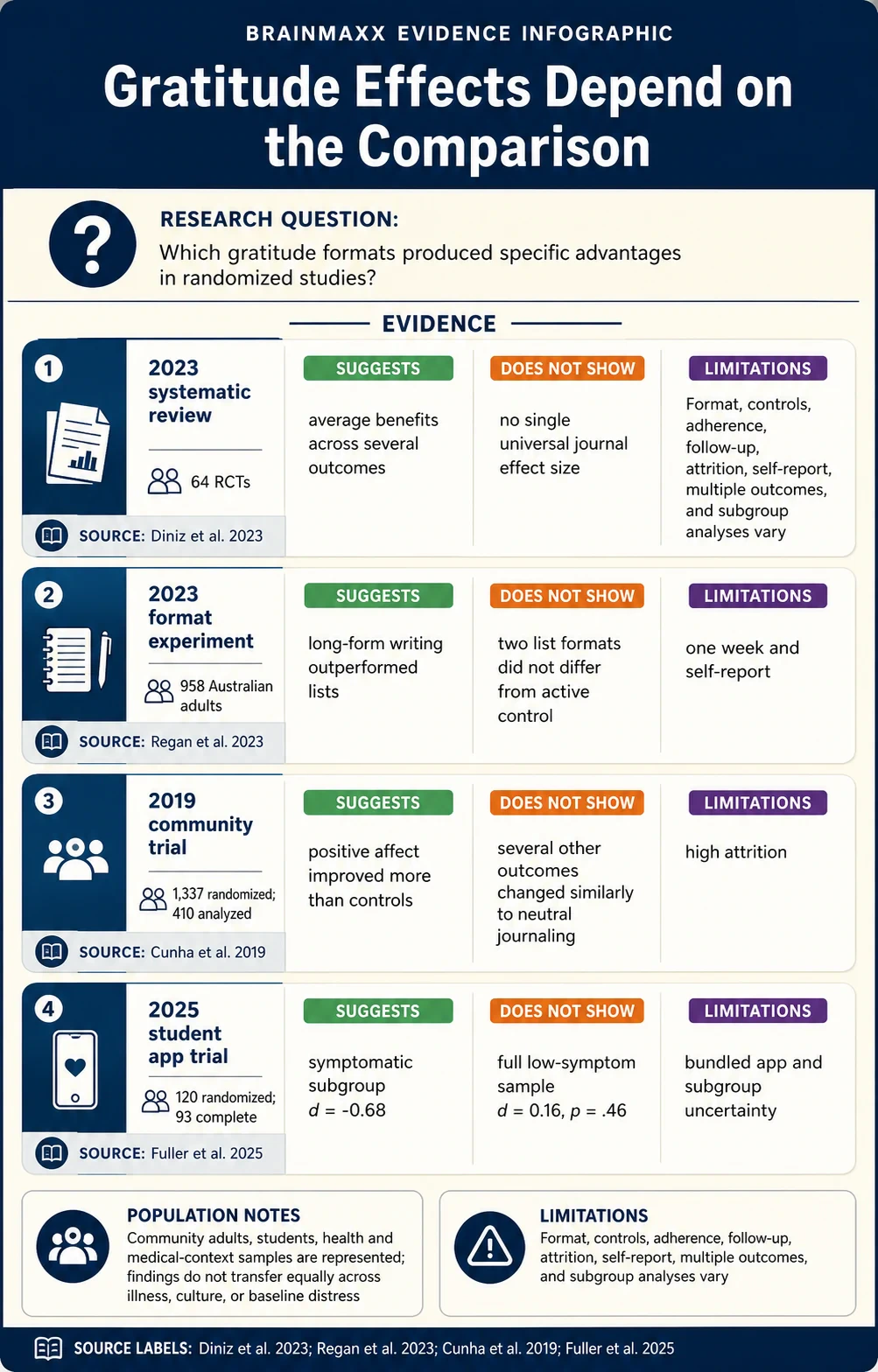
A 2023 systematic review and meta-analysis included 64 randomized clinical trials. Across varied interventions and populations, the authors reported improvements in gratitude, mental health, anxiety and depression symptoms, positive mood, and emotion.
That supports a causal claim about the included assigned interventions on average. It does not supply one effect size for “gratitude journaling” as a single uniform activity. Studies used different exercises, durations, controls, and outcomes. The review described gratitude as a possible therapeutic complement, but a self-guided list should not be presented as treatment.
The more useful question is not simply whether gratitude works. It is: which exercise, compared with what, for whom, on which outcome, and for how long?
A list is not the same as a letter
In a 2023 experiment, 958 Australian adults were assigned to five gratitude activities or an active daily-activity control for one week. Long-form essays and letters generally produced better well-being outcomes than lists. Two specified gratitude-list formats did not differ from the active control on any outcome. Unconstrained lists improved gratitude and positive affect, while letters to people also increased indebtedness.
Random assignment supports a short-term causal effect of those exact formats. It also shows why “three items every day” is too blunt a prescription. Longer reflection may create a different experience from list-making; social gratitude can carry obligation as well as warmth.
A three-month trial with 192 participants likewise found the strongest immediate changes when reflection was paired with expressing gratitude in existing relationships. Mediation analysis pointed toward expression as a pathway. Mediation is suggestive, however; it does not prove that expression caused every benefit.
Active controls shrink some claims
A community trial randomized 1,337 adults to gratitude, hassles, or neutral-events journals. Attrition left 410 people in the analysis. Positive affect improved more in the gratitude group, but changes on several other outcomes were similar in the gratitude and neutral-events groups.
That pattern matters. Writing regularly, reviewing the day, expectancy, and study participation can all affect self-report. An active neutral journal helps separate gratitude-specific effects from those shared ingredients.
Null findings belong in the picture too. In a three-arm trial of 234 women undergoing IVF or ICSI, the gratitude-journal intervention did not significantly improve the reported outcomes. That population and context are specific; the result does not disprove gratitude elsewhere. It does show that a demanding medical situation is not reliably improved by a generic journal.
Baseline distress is not a self-diagnosis
A 2025 randomized app trial enrolled 120 university students, with 93 providing complete data. In a subgroup with at least moderate baseline symptoms, the bundled three-week gratitude app was associated with lower depression, anxiety, and stress (d = -0.68, p = .04). In the full sample with low baseline symptoms, the estimate was d = 0.16, p = .46.
The subgroup result is interesting, but it is not a rule for deciding who has a disorder or who should receive treatment. The app combined journaling, photos, imagery, speech, and meditation, so the active ingredient is unclear. The sample was small, student-based, and had loss to follow-up.
Put the evidence in four boxes
The 64-trial synthesis provides the broadest intervention signal, but diversity between studies prevents one universal promise. Individual randomized trials answer narrower questions about one format, comparator, population, and follow-up. Their causal claims are stronger but less general.
Mediation and subgroup findings sit a step lower. They can suggest that expressing thanks or baseline distress changes an effect, but they are more vulnerable to instability and alternative explanations. Finally, the idea that gratitude “rewires attention” is a mechanism story unless a study directly tests that chain; it should not be presented as a measured brain fact.
The practical journal below is an evidence-informed adaptation. It has not been tested as a named six-step intervention, and it cannot inherit the symptom effects of a bundled app or a study in advanced illness.
A low-pressure seven-day trial
If the practice sounds useful, make it specific and optional.
- For seven days, write at most one concrete event that genuinely registered as appreciated.
- Describe what happened: “My neighbor brought in the bin during the rain,” not “people are good.”
- Add one sentence about why it mattered.
- Use “no entry” when nothing feels genuine.
- Let difficult emotion remain on the page. “I appreciated the call and still feel frightened” is allowed.
- At the end, review whether attention, connection, or behavior shifted. Do not demand happiness.
Useful signals are greater specificity, noticing small benefits without minimizing problems, or choosing to express thanks when it feels safe and freely chosen. No mood change is also a valid result.
A mixed-feelings example
Nora is caring for her father after surgery. A friend drops off dinner. Nora feels grateful for the meal, angry that other relatives have not helped, and frightened about the recovery.
A forced entry—“I am grateful for my wonderful support system”—would be inaccurate. A specific entry can hold the whole situation: “Leah brought lentil soup at 6 p.m. I appreciated not having to decide what to cook. I am still angry about carrying most of the care.”
Nothing in that entry requires Nora to improve her mood. It records one benefit and preserves the unmet need. If the practice helps her notice whom she can safely ask for help, that is a behavioral shift. If it makes her feel guilty for being angry, the honest response is to stop or change the exercise—not to try harder at gratitude.
When to stop
Stop if journaling increases guilt, indebtedness, trauma activation, compulsive positivity, or self-criticism. Do not use it to pressure gratitude toward an abusive person, suppress anger or grief, blame someone for continuing symptoms, or avoid a necessary boundary.
Gratitude practice is not a diagnosis and does not replace mental-health or medical care. Persistent depression, anxiety, trauma symptoms, disabling grief, or thoughts of self-harm deserve qualified support. Immediate danger requires local emergency or crisis services.
Keep the effect in proportion
Gratitude journaling can be a small attention practice. Randomized studies suggest that some formats improve some outcomes, while active controls, null trials, attrition, and subgroup differences narrow the promise.
The honest version is simple: notice what is genuinely good without making it cancel what is hard. If the practice helps, keep it light. If it becomes another demand, you are allowed to stop.


Sources
- APA Dictionary: gratitude
- 2023 systematic review and meta-analysis of gratitude interventions
- 2023 active-control experiment comparing gratitude formats
- 2017 social gratitude journal RCT
- 2019 community gratitude RCT
- 2025 student gratitude-app RCT
- 2019 infertility three-arm RCT
This article is educational and is not a diagnosis or a substitute for care.


