

You send a careless message, miss an obligation, or hurt someone you care about. Within seconds, the mind can turn a specific event into a total identity verdict: I am selfish. I always ruin things. I do not deserve to feel better.
That attack may feel like accountability because it is painful. Pain, however, is not the same as repair.
Self-compassion offers a different stance: face what happened without treating one action as the whole person. It does not require pretending the behavior was acceptable. It does not erase another person’s experience. Its practical question is whether less global self-condemnation can leave more room for accurate responsibility and useful change.
Compassion and accountability answer different questions
Accountability asks: What did I do? What was the impact? What can I repair? What consequence or boundary must I accept?
Self-compassion asks: Can I stay in contact with this painful information without turning it into humiliation, hopelessness, or an identity sentence?
Those questions can be asked together. “I interrupted her repeatedly, and that made the conversation unsafe for her” is specific. “I am a terrible human being” is global. The first statement can guide a repair. The second may produce withdrawal, defensiveness, reassurance seeking, or endless punishment without helping the affected person.
The American Psychological Association defines self-compassion as a construct involving a noncritical stance toward inadequacies and failures. That definition does not say the failure was imaginary. It changes how the person relates to it.
What experiments say about motivation
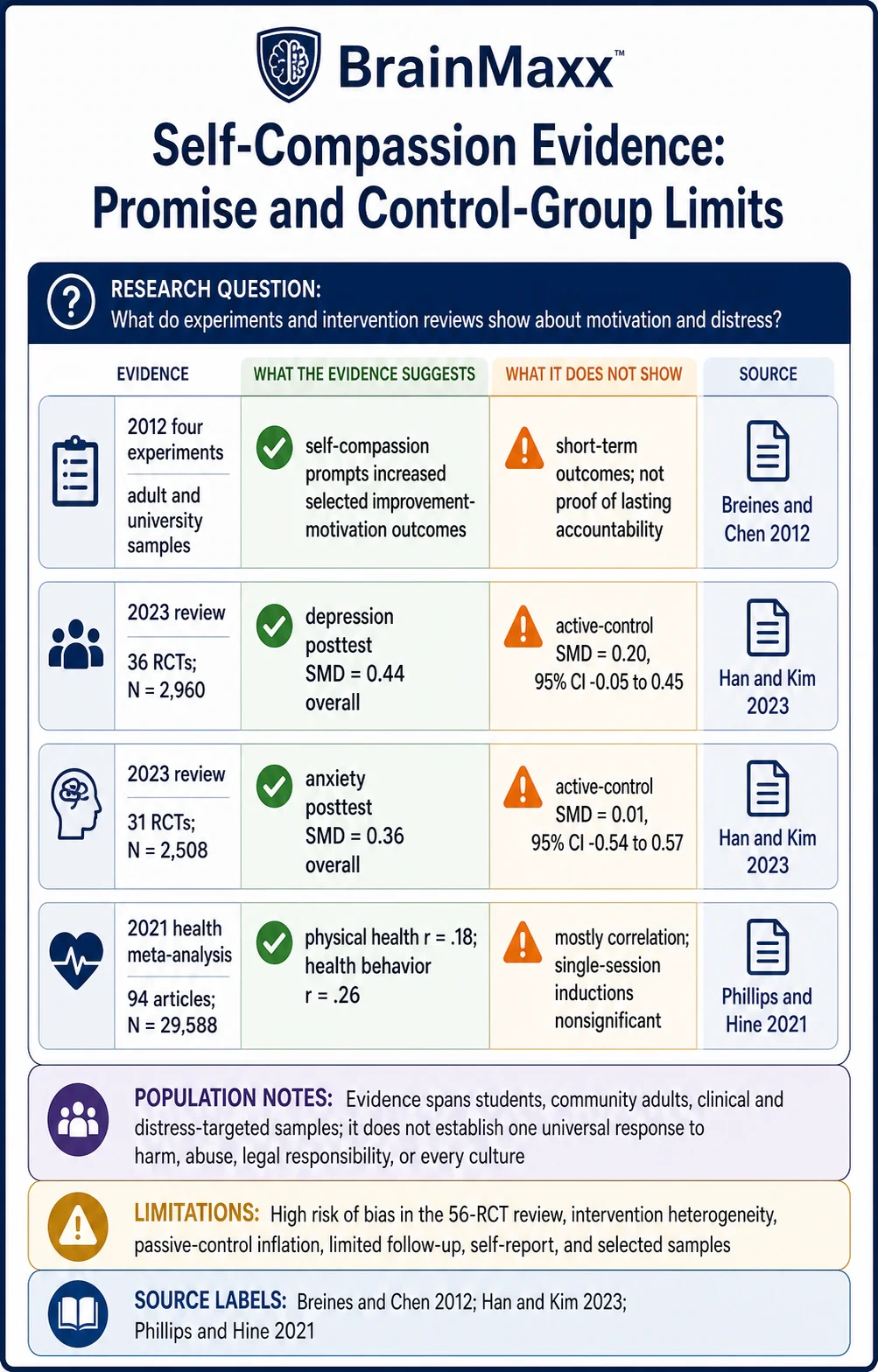
A common fear is that reducing self-criticism will reduce effort. Four experiments published by Juliana Breines and Serena Chen in 2012 tested that idea in selected contexts. Compared with self-esteem, positive-distraction, or no-intervention controls, participants assigned to self-compassion prompts reported greater motivation to improve a weakness, make amends after a recalled moral transgression, and avoid repeating it. In one study, participants spent more time studying for a difficult test after an initial failure.
Because participants were assigned to conditions, these experiments support a short-term causal effect of the prompts on the measured outcomes. They do not show that every compassionate response produces lasting behavior change. Some outcomes were intentions or time spent immediately after an experimental task; many participants were students; real harms and relationships are more complex.
The responsible conclusion is modest: self-compassion did not make people uniformly complacent in these studies. Under some conditions, it increased selected forms of improvement motivation.
Intervention evidence is promising, with a large asterisk
A 2023 meta-analysis included 56 randomized controlled trials of self-compassion-focused interventions. Across all controls, the immediate posttest effect on depressive symptoms was SMD 0.44. For anxiety it was SMD 0.36. Those are small-to-medium average effects.
Control groups changed the picture. For depression, the contrast with active controls was SMD 0.20, with a 95% confidence interval from -0.05 to 0.45. For anxiety, the active-control estimate was SMD 0.01, with a wide interval crossing no effect. The authors rated overall risk of bias as high and noted relatively few active-control studies.
This matters because a waitlist comparison cannot separate the specific ingredient of self-compassion from attention, expectation, group support, structured reflection, or simply doing something. Active controls are not perfect, but they ask a harder question.
Compassion-Focused Therapy studies also report promising changes in clinical samples. Yet that is a structured therapy package, often delivered over multiple sessions. A five-minute exercise in an article is not CFT and cannot borrow its clinical effect sizes.

Correlation is not a mechanism
A meta-analysis covering 94 articles and 29,588 participants found modest associations between self-compassion and physical health (r = .18) and health-promoting behavior (r = .26). Most of those relationships are correlational. People with better health, more resources, or lower distress may find self-compassion easier; a third factor may influence both.
The same review found that single-session inductions did not significantly improve the health outcomes it examined, while multi-session interventions showed some benefits. That difference warns against “one phrase changes your life” claims.
Researchers propose that lower self-attack may reduce threat and make flexible self-regulation easier. That is a plausible model, not a complete causal map. Expectancy, mindfulness, therapeutic attention, culture, and the fit between action and values may also matter.
How to rank the claims
The strongest evidence in this article concerns assigned interventions and short-term measured outcomes: randomized prompts changed selected motivation measures, and randomized intervention packages changed some distress outcomes. Confidence drops when the claim gets broader. The active-control results make it uncertain how much benefit belongs specifically to self-compassion rather than structured attention or another credible activity.
The health correlations are a different kind of evidence. They show that two variables travel together on average; they do not show which one moved first. The proposed threat and self-regulation pathways are models that can guide research, not facts that can be read off a person’s reaction.
The samples also set limits. University participants, mixed community samples, and treatment-seeking adults are represented. People responding to coercion, abuse, acute danger, major legal harm, or every cultural model of responsibility are not equivalently represented. The repair note below is an editorial translation for ordinary mistakes, not a tested treatment protocol.
Self-compassion is not reassurance
Reassurance says, “You did nothing wrong.” Self-compassion can say, “What you did was wrong, and you can remain a human being while facing it.”
Self-pity centers the self’s suffering and may lose sight of other people. Compassionate accountability keeps impact visible. Self-esteem asks whether the self is valuable or competent; self-compassion is intended for the moment when competence or approval feels threatened.
These boundaries matter most when someone else was harmed. The harmed person does not owe forgiveness, contact, or reassurance. A compassionate repair respects their autonomy and any safety boundary they set.
A four-part repair note
For an ordinary, safe-to-reflect-on mistake, try writing four short parts.
- Behavior and impact: Describe what happened without an identity label. Use observable language and include the likely or reported impact.
- Human difficulty: Name the feeling or circumstance without using it as an excuse. “I was embarrassed and became defensive” explains context; it does not erase impact.
- Repair boundary: Identify what can be repaired and what cannot. You can apologize, replace an item, correct misinformation, or change a process. You cannot force trust to return.
- Next action: Choose one proportionate step and a review point. The action should serve repair, not demand that another person soothe you.
Progress is not “I no longer feel guilty.” Useful signs are a more specific account, less repeated self-attack, one completed repair, and greater ability to tolerate consequences without chasing reassurance.
A worked example: the missed handoff
Andre promised a colleague he would send a data file by noon. He forgot, the colleague missed a review window, and Andre’s first thought is, “I am completely unreliable.” That sentence hurts, but it is too broad to guide the next hour.
His repair note becomes:
- Behavior and impact: “I did not send the file by noon. That cost Sam the scheduled review window.”
- Difficulty without excuse: “I was juggling two deadlines and did not put the handoff on my calendar. The workload explains the setup; it does not make the missed promise harmless.”
- Repair boundary: “I can send the file now, own the delay, and ask what timing is still useful. I cannot require Sam to say it is fine.”
- Next action: “I will send the file and a concise apology within ten minutes, then create a calendar checkpoint for future handoffs.”
If Andre sends five apologetic messages until Sam reassures him, the exercise has drifted into self-soothing at another person’s expense. If he completes the repair and accepts that Sam may remain annoyed, compassion and accountability are working together: the self is not annihilated, and the impact is not erased.
When this exercise is the wrong tool
Do not use self-compassion language to excuse ongoing harm, bypass safeguarding, pressure someone to forgive, avoid restitution, or stay in unsafe contact. It should not become a ritual for neutralizing obsessive guilt or a substitute for legal, medical, or clinical help.
Stop if the exercise increases compulsive confession, reassurance seeking, panic, dissociation, self-harm risk, disordered eating, or unsafe behavior. Severe self-criticism can occur with depression, trauma, obsessive-compulsive symptoms, eating disorders, and other conditions, but an article cannot diagnose the cause.
Persistent crushing shame, repeated harmful behavior, trauma reactions, compulsions, or thoughts of self-harm deserve qualified support. In immediate danger, contact local emergency or crisis services.
The accountable version of kindness
Self-condemnation can be intense without being useful. Self-compassion can be gentle without being evasive.
The evidence does not prove that kindness always creates change. It shows that brief self-compassion prompts can increase selected improvement motives, and that broader interventions may reduce distress—especially compared with passive controls—while bias and active-control results limit stronger claims.
The practical aim is not to feel innocent. It is to stay steady enough to see behavior clearly, make the repair that is yours to make, and accept what is not yours to control.

Sources
- APA Dictionary: self-compassion
- Breines & Chen (2012), self-compassion and improvement motivation
- 2023 meta-analysis of self-compassion interventions
- 2023 review of Compassion-Focused Therapy in clinical populations
- 2021 meta-analysis of self-compassion, health, and health behavior
- Systematic review of self-compassion and health-behavior self-regulation
This article is educational and is not a diagnosis or a substitute for individualized mental-health care.


