

Mindfulness is often sold as a mental zoom lens. Controlled evidence is less cinematic. Some syntheses find small average cognitive benefits, while attention-specific estimates can be null and effects shrink against active controls. Practice can also be uncomfortable or destabilizing for a minority of people. A useful decision starts with a modest target and a clear exit.
The question underneath the habit
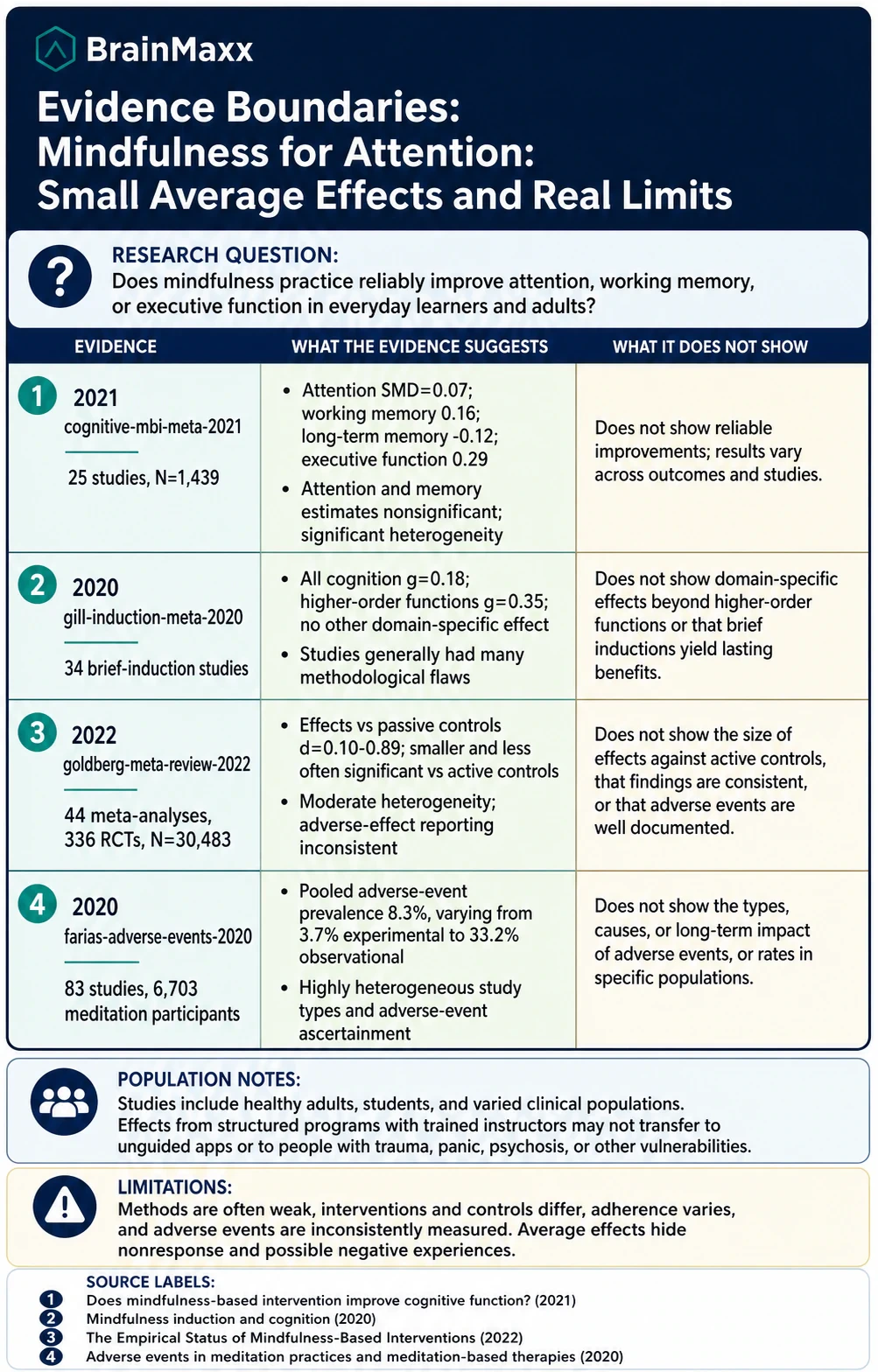
Does mindfulness practice reliably improve attention, working memory, or executive function in everyday learners and adults?
Mindfulness interventions show small average cognitive effects, with more consistent evidence for some higher-order or executive outcomes than for attention itself. Heterogeneity, active-control comparisons, and incomplete adverse-event reporting limit broad claims. That is the useful claim. It is narrower than a promise that one method always works, and it is more informative than judging a strategy by how smooth or difficult it feels in the moment.
Define the comparison before judging it
Mindfulness practices train present-moment attention with a particular stance. A brief induction, an eight-week program, meditation, and mindfulness-based clinical treatment are not interchangeable. This article is not a treatment protocol.
This boundary prevents a common category error: treating two activities with different purposes as if one must replace the other. A sensible comparison holds the goal in view, asks what was actually measured, and checks whether the result survived a delay or a change in task.
What the evidence says
Does mindfulness-based intervention improve cognitive function? (2021). 25 studies, N=1,439. Meta-analysis across four cognitive domains. The material result was: Attention SMD=0.07; working memory 0.16; long-term memory -0.12; executive function 0.29. The inference boundary matters: Controlled intervention synthesis. The main caution is Attention and memory estimates nonsignificant; significant heterogeneity
Mindfulness induction and cognition (2020). 34 brief-induction studies. Preregistered meta-analysis by cognitive domain. The material result was: All cognition g=0.18; higher-order functions g=0.35; no other domain-specific effect. The inference boundary matters: Brief experimental-induction synthesis. The main caution is Studies generally had many methodological flaws
The Empirical Status of Mindfulness-Based Interventions (2022). 44 meta-analyses, 336 RCTs, N=30,483. Review of randomized-trial meta-analyses. The material result was: Effects vs passive controls d=0.10-0.89; smaller and less often significant vs active controls. The inference boundary matters: High-level randomized evidence synthesis. The main caution is Moderate heterogeneity; adverse-effect reporting inconsistent
Adverse events in meditation practices and meditation-based therapies (2020). 83 studies, 6,703 meditation participants. Systematic review of experimental, observational, and case reports. The material result was: Pooled adverse-event prevalence 8.3%, varying from 3.7% experimental to 33.2% observational. The inference boundary matters: Safety signal synthesis, not proof meditation caused every event. The main caution is Highly heterogeneous study types and adverse-event ascertainment
Taken together, these sources do not collapse into one magic number. Two cognitive meta-analyses, a systematic review of 44 meta-analyses of randomized trials, and a systematic review of meditation-related adverse events. A 25-study meta-analysis found attention SMD=0.07, working memory SMD=0.16, long-term memory SMD=-0.12, all nonsignificant, and executive function SMD=0.29. A brief-induction synthesis found g=0.18 across cognition and g=0.35 only for higher-order functions. The direction and magnitude should therefore be read as an evidence pattern, not a personal forecast.
What the averages do not settle
Randomized comparisons support small average effects for specific interventions and outcomes. They do not show that mindfulness is the mechanism for every observed change or that an app will reproduce an instructor-led program.
Benefits may reflect attention training, expectancy, instructor contact, stress reduction, or repeated task exposure. Active controls help separate these influences. Those explanations can coexist. The honest conclusion is that a result may support a method under tested conditions without proving why it worked in every participant.
Methods are often weak, interventions and controls differ, adherence varies, and adverse events are inconsistently measured. Average effects hide nonresponse and possible negative experiences. Individual experience can legitimately differ from an average because prior knowledge, task design, timing, sleep, stress, access, and feedback all change what a learner or reader can do.

A bounded way to try it
Pick one modest attention behavior, use a brief low-intensity practice, track an observable outcome, and compare with a simple environmental support. Increase duration only if the practice is tolerable and useful.
Use the following sequence as a small experiment, not as a test of character:
- Choose one attention target
- Practice briefly
- Do the target task
- Record one outcome
- Review tolerability
Keep the trial modest enough to reverse. If it fits, repeat it long enough to observe behavior rather than relying on one good or bad session. If it does not fit, change the conditions or choose a different tool.
Worked example
Noor wants fewer automatic phone checks during reading. For one week she practices three minutes of noticing breath and sound before a 20-minute reading block, then records completed pages and intrusive-checking episodes. She does not score calmness as success. After several days the practice increases agitation, so she stops and uses a simpler environmental cue—phone in another room—while discussing persistent anxiety with a clinician.
The example is deliberately ordinary. It shows how the method can be adjusted using feedback while keeping uncertainty visible. It does not imply that one person’s result predicts another person’s outcome.
How to judge the result
Look for observable change at the next sensible review point:
- Fewer unplanned switches
- Target task advances
- Practice remains tolerable
Pause or redesign the experiment when any of these occur:
- Panic or dissociation increases
- Traumatic intrusions or severe insomnia appear
- Function worsens
The revision turns a vague promise of focus into one bounded attention target, an observable outcome, and an adverse-experience stop rule.
Safety and scope
Stop and seek support if practice triggers escalating panic, dissociation, traumatic intrusions, severe insomnia, mania-like activation, or suicidal thoughts. Do not use it to replace needed treatment.
Mindfulness response cannot diagnose or treat an attention or mental-health disorder. Severe or persistent symptoms require qualified care; immediate danger requires local emergency or crisis services. Seek qualified support when the problem is persistent, impairing, new, or safety-relevant. This article is educational and does not diagnose a disorder or replace assessment, treatment, teaching support, or an established safety protocol. If a situation involves immediate danger or a crisis, use local emergency or crisis services rather than an article exercise.
Bottom line
Mindfulness interventions show small average cognitive effects, with more consistent evidence for some higher-order or executive outcomes than for attention itself. Heterogeneity, active-control comparisons, and incomplete adverse-event reporting limit broad claims. The most defensible use is a bounded test with feedback, a review point, and permission to stop.


