

Two slightly different tones, one in each ear, create the perception of a third rhythmic beat. That auditory illusion is real. The claim that it reliably entrains the brain into better focus is much less settled. Meta-analyses report moderate pooled estimates, yet systematic reviews find conflicting tasks, frequencies, protocols, and physiological evidence. This is a case for a cautious personal preference test, not a cognitive upgrade promise.
The question underneath the habit
Do binaural beats reliably improve focus, attention, or memory beyond expectancy and ordinary audio?
Some meta-analyses report moderate pooled cognitive effects, but study-level results and physiological entrainment evidence are mixed. Protocol differences and small samples prevent a universal focus claim. That is the useful claim. It is narrower than a promise that one method always works, and it is more informative than judging a strategy by how smooth or difficult it feels in the moment.
Define the comparison before judging it
A binaural beat is perceived when each ear receives a slightly different tone through stereo headphones. Hearing the beat is not proof that brain rhythms entrained, and cognitive effects are not treatment effects.
This boundary prevents a common category error: treating two activities with different purposes as if one must replace the other. A sensible comparison holds the goal in view, asks what was actually measured, and checks whether the result survived a delay or a change in task.
What the evidence says
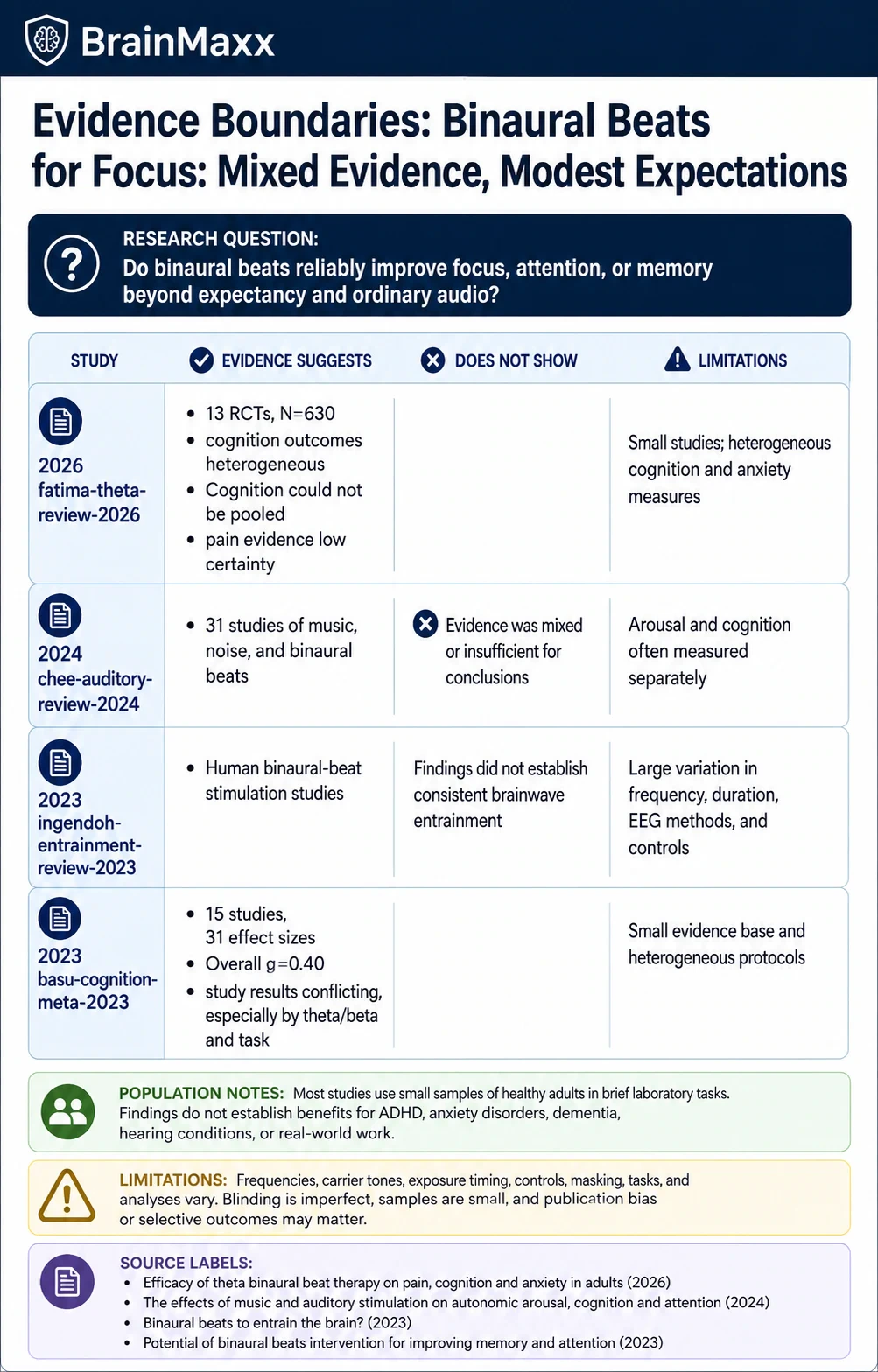
Efficacy of theta binaural beat therapy on pain, cognition and anxiety in adults (2026). 13 RCTs, N=630; cognition outcomes heterogeneous. Systematic review with GRADE and limited quantitative pooling. The material result was: Cognition could not be pooled; pain evidence low certainty. The inference boundary matters: Randomized-trial synthesis for protocol-specific outcomes. The main caution is Small studies; heterogeneous cognition and anxiety measures
The effects of music and auditory stimulation on autonomic arousal, cognition and attention (2024). 31 studies of music, noise, and binaural beats. Systematic review linking autonomic measures with cognition. The material result was: Evidence was mixed or insufficient for conclusions. The inference boundary matters: Mixed experimental evidence review. The main caution is Arousal and cognition often measured separately
Binaural beats to entrain the brain? (2023). Human binaural-beat stimulation studies. Systematic review of oscillatory brain activity and psychological outcomes. The material result was: Findings did not establish consistent brainwave entrainment. The inference boundary matters: Protocol-specific experimental evidence. The main caution is Large variation in frequency, duration, EEG methods, and controls
Potential of binaural beats intervention for improving memory and attention (2023). 15 studies, 31 effect sizes. Meta-analysis plus systematic review. The material result was: Overall g=0.40; study results conflicting, especially by theta/beta and task. The inference boundary matters: Mixed controlled-study synthesis. The main caution is Small evidence base and heterogeneous protocols
Taken together, these sources do not collapse into one magic number. A 2026 theta-beat randomized-trial review, a 2024 psychophysiology systematic review, a 2023 entrainment systematic review, and a 2023 attention-and-memory meta-analysis. The 2023 cognitive meta-analysis pooled 31 effects from 15 studies and reported g=0.40, while also describing conflicting theta and beta findings. A 2026 theta review included 13 RCTs but could not pool cognition because outcomes were too heterogeneous. The direction and magnitude should therefore be read as an evidence pattern, not a personal forecast.
What the averages do not settle
Randomized laboratory studies can test specific audio protocols on specific tasks. Pooled effects do not prove the proposed brainwave mechanism or predict individual response.
Any change could reflect rhythmic stimulation, masking of distractions, arousal, mood, preference, expectancy, or ordinary music effects. Physiological measures do not yet cleanly distinguish these accounts. Those explanations can coexist. The honest conclusion is that a result may support a method under tested conditions without proving why it worked in every participant.
Frequencies, carrier tones, exposure timing, controls, masking, tasks, and analyses vary. Blinding is imperfect, samples are small, and publication bias or selective outcomes may matter. Individual experience can legitimately differ from an average because prior knowledge, task design, timing, sleep, stress, access, and feedback all change what a learner or reader can do.

A bounded way to try it
If you enjoy the sound, test it at a comfortable volume on one low-risk task, compare it with neutral audio, and track an observable outcome rather than subjective hype.
Use the following sequence as a small experiment, not as a test of character:
- Choose one ordinary task
- Set a comfortable volume
- Compare with neutral audio
- Track one outcome
- Stop for symptoms
Keep the trial modest enough to reverse. If it fits, repeat it long enough to observe behavior rather than relying on one good or bad session. If it does not fit, change the conditions or choose a different tool.
Worked example
Sam likes low-volume binaural audio while doing routine proofreading. He compares three 20-minute sessions with the beats and three with ordinary neutral audio, keeps volume and task difficulty similar, and records errors plus distraction. The result is preference, not treatment evidence. If headaches, ringing, dizziness, or worse concentration appear, he stops. He never uses headphones where environmental awareness is necessary.
The example is deliberately ordinary. It shows how the method can be adjusted using feedback while keeping uncertainty visible. It does not imply that one person’s result predicts another person’s outcome.
How to judge the result
Look for observable change at the next sensible review point:
- Errors decrease consistently
- Distraction decreases
- No hearing or comfort symptoms
Pause or redesign the experiment when any of these occur:
- Tinnitus, pain, or dizziness appears
- Agitation or performance worsens
- Environmental awareness is required
The revision separates a real perceptual phenomenon from the unproven entrainment mechanism and adds volume, tinnitus, and situational-awareness boundaries.
Safety and scope
Stop for pain, headache, dizziness, tinnitus, agitation, or worse performance. Do not use headphones while driving, cycling in traffic, operating machinery, or when you need environmental awareness.
Binaural audio cannot diagnose or treat ADHD, anxiety, pain, hearing loss, or another condition. Hearing symptoms or persistent cognitive concerns warrant qualified care. Seek qualified support when the problem is persistent, impairing, new, or safety-relevant. This article is educational and does not diagnose a disorder or replace assessment, treatment, teaching support, or an established safety protocol. If a situation involves immediate danger or a crisis, use local emergency or crisis services rather than an article exercise.
Bottom line
Some meta-analyses report moderate pooled cognitive effects, but study-level results and physiological entrainment evidence are mixed. Protocol differences and small samples prevent a universal focus claim. The most defensible use is a bounded test with feedback, a review point, and permission to stop.

Sources
- Efficacy of theta binaural beat therapy on pain, cognition and anxiety in adults (2026)
- The effects of music and auditory stimulation on autonomic arousal, cognition and attention (2024)
- Binaural beats to entrain the brain? (2023)
- Potential of binaural beats intervention for improving memory and attention (2023)


