

A page can feel familiar after the third read and still be hard to reconstruct with the book closed. That gap matters. Rereading mainly gives the learner another exposure; retrieval practice asks the learner to bring an answer back without looking, then check it. The comparison is not between working hard and taking shortcuts. It is between two different learning events, with different evidence behind them.
The question underneath the habit
Does trying to recall studied material improve later learning more than reading the same material again?
Across laboratory and classroom syntheses, practice testing usually improves delayed retention more than restudy or rereading, especially when retrieval is effortful and feedback is available. The size of benefit varies with test format, materials, delay, and implementation. That is the useful claim. It is narrower than a promise that one method always works, and it is more informative than judging a strategy by how smooth or difficult it feels in the moment.
Define the comparison before judging it
Retrieval practice means attempting to recall or generate an answer before checking it. It is a learning activity, not merely a high-stakes exam. Rereading is another exposure to the material. Retrieval does not replace first-pass comprehension, worked examples, feedback, or practice in the form required by the real task.
This boundary prevents a common category error: treating two activities with different purposes as if one must replace the other. A sensible comparison holds the goal in view, asks what was actually measured, and checks whether the result survived a delay or a change in task.
What the evidence says
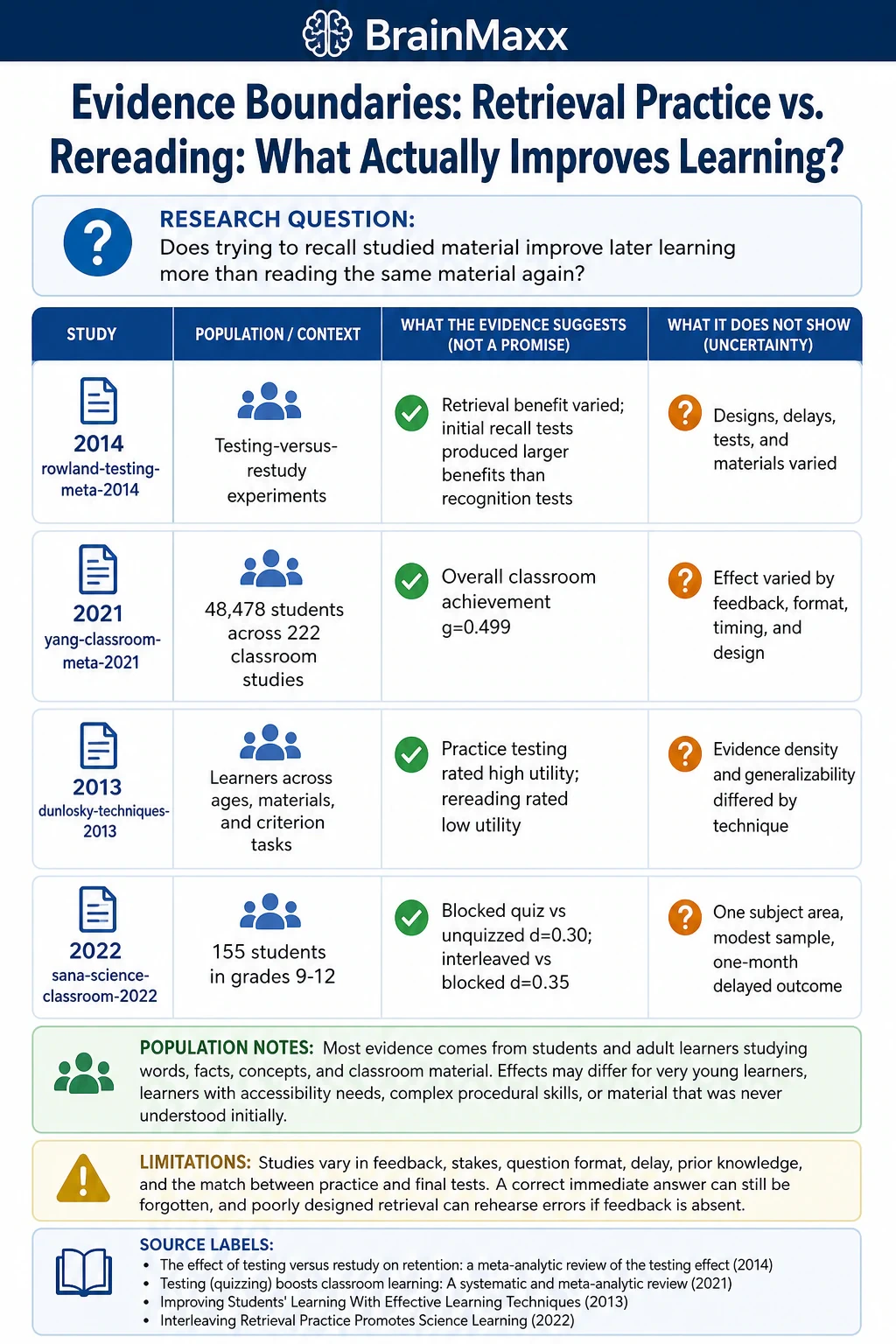
The effect of testing versus restudy on retention: a meta-analytic review of the testing effect (2014). Testing-versus-restudy experiments. Meta-analysis of delayed-retention studies. The material result was: Retrieval benefit varied; initial recall tests produced larger benefits than recognition tests. The inference boundary matters: Synthesis of experimental comparisons. The main caution is Designs, delays, tests, and materials varied
Testing (quizzing) boosts classroom learning: A systematic and meta-analytic review (2021). 48,478 students across 222 classroom studies. Systematic review and meta-analysis. The material result was: Overall classroom achievement g=0.499. The inference boundary matters: Mostly experimental and quasi-experimental classroom evidence. The main caution is Effect varied by feedback, format, timing, and design
Improving Students’ Learning With Effective Learning Techniques (2013). Learners across ages, materials, and criterion tasks. Broad evidence review of ten learning techniques. The material result was: Practice testing rated high utility; rereading rated low utility. The inference boundary matters: Review-based comparative judgment. The main caution is Evidence density and generalizability differed by technique
Interleaving Retrieval Practice Promotes Science Learning (2022). 155 students in grades 9-12. Four-week classroom quiz experiment with delayed test. The material result was: Blocked quiz vs unquizzed d=0.30; interleaved vs blocked d=0.35. The inference boundary matters: Experimental classroom comparison. The main caution is One subject area, modest sample, one-month delayed outcome
Taken together, these sources do not collapse into one magic number. A meta-analysis of testing versus restudy, a 222-study classroom meta-analysis, a broad review of ten learning techniques, and a secondary-school classroom experiment. The classroom meta-analysis covered 48,478 students and estimated g=0.499. In a high-school science experiment, blocked quiz items beat unquizzed items by d=0.30 and interleaved quiz items beat blocked items by d=0.35. Other reviews report robust direction but no single universal effect. The direction and magnitude should therefore be read as an evidence pattern, not a personal forecast.
What the averages do not settle
Randomized experiments support causal effects of the tested retrieval conditions on later test performance. Meta-analytic averages do not prove that every quiz format or every learner will benefit equally.
Benefits may reflect effortful retrieval, extra exposure, transfer-appropriate processing, feedback, motivation, and richer retrieval cues. The evidence does not isolate one mechanism across all settings. Those explanations can coexist. The honest conclusion is that a result may support a method under tested conditions without proving why it worked in every participant.
Studies vary in feedback, stakes, question format, delay, prior knowledge, and the match between practice and final tests. A correct immediate answer can still be forgotten, and poorly designed retrieval can rehearse errors if feedback is absent. Individual experience can legitimately differ from an average because prior knowledge, task design, timing, sleep, stress, access, and feedback all change what a learner or reader can do.

A bounded way to try it
After one comprehension pass, close the source, answer a small set of questions from memory, check every answer, correct errors, and repeat after a delay. Include application questions when the real goal is application rather than fact recall.
Use the following sequence as a small experiment, not as a test of character:
- Study for understanding
- Close the source
- Retrieve without cues
- Check and correct
- Repeat after a delay
Keep the trial modest enough to reverse. If it fits, repeat it long enough to observe behavior rather than relying on one good or bad session. If it does not fit, change the conditions or choose a different tool.
Worked example
Mina has a biology quiz in six days. On day one she reads a section once, closes the book, and writes five questions from the headings. On days two and four she answers those questions from memory, marks uncertainty, and checks every answer against the text. A missed answer becomes a cue for another retrieval round, not a verdict on ability. On day five she mixes old and new questions. Her score on the practice questions can guide what to revisit; it cannot guarantee transfer to every exam format.
The example is deliberately ordinary. It shows how the method can be adjusted using feedback while keeping uncertainty visible. It does not imply that one person’s result predicts another person’s outcome.
How to judge the result
Look for observable change at the next sensible review point:
- More correct delayed recall
- Fewer repeated errors
- Better explanation without notes
Pause or redesign the experiment when any of these occur:
- Uncorrected errors accumulate
- Anxiety or sleep loss increases
- The material was not understood initially
The revision makes the comparison actionable: retrieve after initial study, use feedback, space repeated attempts, and judge progress with delayed recall rather than immediate familiarity.
Safety and scope
Stop treating retrieval as productive difficulty when repeated attempts produce only uncorrected errors, panic, sleep loss, or avoidance. Restore source review, reduce difficulty, obtain feedback, or seek teaching support.
This learning method cannot diagnose attention, memory, or learning disorders. Persistent impairment despite appropriate instruction warrants qualified educational or clinical assessment. Seek qualified support when the problem is persistent, impairing, new, or safety-relevant. This article is educational and does not diagnose a disorder or replace assessment, treatment, teaching support, or an established safety protocol. If a situation involves immediate danger or a crisis, use local emergency or crisis services rather than an article exercise.
Bottom line
Across laboratory and classroom syntheses, practice testing usually improves delayed retention more than restudy or rereading, especially when retrieval is effortful and feedback is available. The size of benefit varies with test format, materials, delay, and implementation. The most defensible use is a bounded test with feedback, a review point, and permission to stop.

Sources
- The effect of testing versus restudy on retention: a meta-analytic review of the testing effect (2014)
- Testing (quizzing) boosts classroom learning: A systematic and meta-analytic review (2021)
- Improving Students’ Learning With Effective Learning Techniques (2013)
- Interleaving Retrieval Practice Promotes Science Learning (2022)
FAQ
Common questions
Does trying to recall studied material improve later learning more than reading the same material again?
Across laboratory and classroom syntheses, practice testing usually improves delayed retention more than restudy or rereading, especially when retrieval is effortful and feedback is available. The size of benefit varies with test format, materials, delay, and implementation.
What is the safest way to try this?
After one comprehension pass, close the source, answer a small set of questions from memory, check every answer, correct errors, and repeat after a delay. Include application questions when the real goal is application rather than fact recall.
When should I stop or seek help?
Stop treating retrieval as productive difficulty when repeated attempts produce only uncorrected errors, panic, sleep loss, or avoidance. Restore source review, reduce difficulty, obtain feedback, or seek teaching support. This learning method cannot diagnose attention, memory, or learning disorders. Persistent impairment despite appropriate instruction warrants qualified educational or clinical assessment.
Topic hubs
Tags


