

Cramming can raise tomorrow’s score while leaving next month’s recall fragile. Spaced practice changes the timing rather than the total promise: study episodes are separated so that some forgetting—and therefore some reconstruction—can occur. The evidence favors spacing for delayed retention, but it does not supply one perfect calendar for every subject or deadline.
The question underneath the habit
Does spreading study over time improve durable learning compared with doing the same work in one massed session?
Distributed practice generally improves delayed retention relative to massed practice. The useful gap depends on how long the learner needs to retain the material, what is being learned, and whether each session includes successful processing. That is the useful claim. It is narrower than a promise that one method always works, and it is more informative than judging a strategy by how smooth or difficult it feels in the moment.
Define the comparison before judging it
Spacing separates learning episodes; cramming concentrates them. Spaced repetition apps often combine spacing with retrieval, so their effects cannot always be assigned to spacing alone. Spacing does not mean arbitrary delay, and it cannot rescue material that was never encoded or understood.
This boundary prevents a common category error: treating two activities with different purposes as if one must replace the other. A sensible comparison holds the goal in view, asks what was actually measured, and checks whether the result survived a delay or a change in task.
What the evidence says
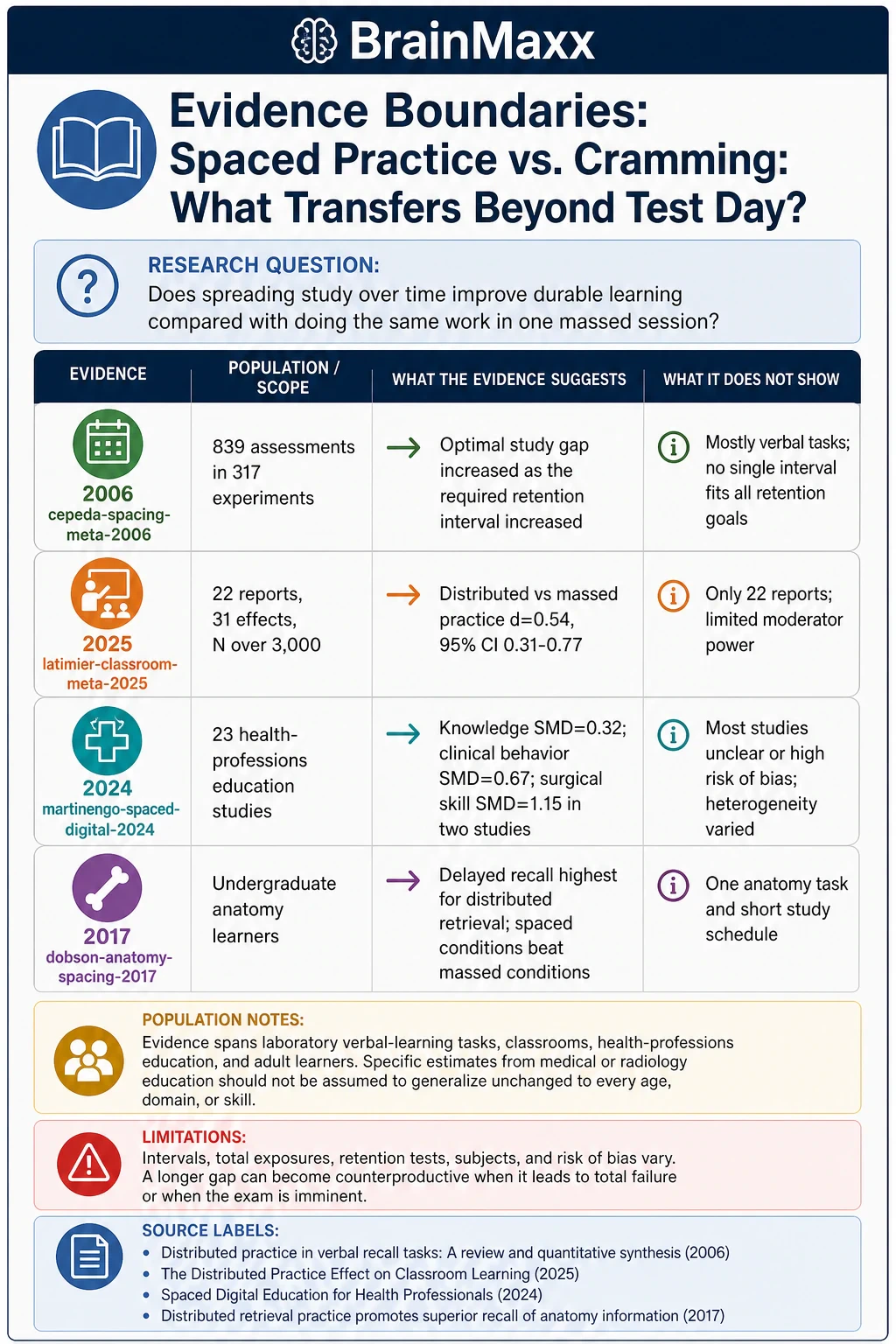
Distributed practice in verbal recall tasks: A review and quantitative synthesis (2006). 839 assessments in 317 experiments. Quantitative synthesis of spacing and lag. The material result was: Optimal study gap increased as the required retention interval increased. The inference boundary matters: Synthesis of experimental learning studies. The main caution is Mostly verbal tasks; no single interval fits all retention goals
The Distributed Practice Effect on Classroom Learning (2025). 22 reports, 31 effects, N over 3,000. Applied classroom systematic review and meta-analysis. The material result was: Distributed vs massed practice d=0.54, 95% CI 0.31-0.77. The inference boundary matters: Applied experimental and quasi-experimental synthesis. The main caution is Only 22 reports; limited moderator power
Spaced Digital Education for Health Professionals (2024). 23 health-professions education studies. Randomized and quasi-randomized meta-analysis. The material result was: Knowledge SMD=0.32; clinical behavior SMD=0.67; surgical skill SMD=1.15 in two studies. The inference boundary matters: Intervention synthesis in health-professions education. The main caution is Most studies unclear or high risk of bias; heterogeneity varied
Distributed retrieval practice promotes superior recall of anatomy information (2017). Undergraduate anatomy learners. Equal-time comparison of massed/spaced study and retrieval. The material result was: Delayed recall highest for distributed retrieval; spaced conditions beat massed conditions. The inference boundary matters: Controlled experimental comparison. The main caution is One anatomy task and short study schedule
Taken together, these sources do not collapse into one magic number. A classic quantitative synthesis of 317 experiments, a 2025 classroom meta-analysis, a 2024 health-professions digital-education meta-analysis, and an anatomy learning experiment. The classroom review found d=0.54 in 22 reports with more than 3,000 learners. Spaced digital education showed knowledge SMD=0.32 and clinical behavior SMD=0.67 in health professionals. An anatomy experiment found the best delayed recall when spacing and retrieval were combined. The direction and magnitude should therefore be read as an evidence pattern, not a personal forecast.
What the averages do not settle
Experimental and quasi-experimental comparisons support a causal average advantage for tested schedules. Moderator patterns do not establish a universal optimal interval.
Spacing may promote effortful reconstruction, contextual variability, and reduced short-term fluency. Retrieval and feedback often co-occur, so timing is only one active ingredient. Those explanations can coexist. The honest conclusion is that a result may support a method under tested conditions without proving why it worked in every participant.
Intervals, total exposures, retention tests, subjects, and risk of bias vary. A longer gap can become counterproductive when it leads to total failure or when the exam is imminent. Individual experience can legitimately differ from an average because prior knowledge, task design, timing, sleep, stress, access, and feedback all change what a learner or reader can do.

A bounded way to try it
Choose the date when knowledge must still be usable, schedule at least three separated sessions before it, begin each session with recall, and adjust the next gap using actual performance rather than a fixed internet formula.
Use the following sequence as a small experiment, not as a test of character:
- Name the retention date
- Split total study time
- Retrieve at each return
- Check and repair gaps
- Adjust the next interval
Keep the trial modest enough to reverse. If it fits, repeat it long enough to observe behavior rather than relying on one good or bad session. If it does not fit, change the conditions or choose a different tool.
Worked example
Jon has twelve days to learn a statistics unit. He divides four hours into four one-hour sessions on days one, three, seven, and ten. Each session begins with a short no-notes retrieval check, then targeted review and two new problems. He keeps the final session far enough from the exam to reveal weak spots. If a topic is still opaque, he uses instruction and worked examples rather than merely increasing the interval.
The example is deliberately ordinary. It shows how the method can be adjusted using feedback while keeping uncertainty visible. It does not imply that one person’s result predicts another person’s outcome.
How to judge the result
Look for observable change at the next sensible review point:
- Recall survives longer gaps
- Practice errors decrease
- Performance transfers to new questions
Pause or redesign the experiment when any of these occur:
- Near-total failure at every return
- Missing prerequisite knowledge
- Spacing displaces sleep or instruction
The revision ties spacing to the retention horizon: spread practice across multiple days, revisit with retrieval, and shorten intervals when understanding is unstable.
Safety and scope
Do not extend gaps when each session begins with near-total failure, when prerequisites are missing, or when the schedule crowds out sleep and instruction. Shorten the interval and rebuild understanding.
Spacing is a study design, not a test for a memory or learning disorder. Persistent difficulty across supported settings deserves qualified educational or clinical help. Seek qualified support when the problem is persistent, impairing, new, or safety-relevant. This article is educational and does not diagnose a disorder or replace assessment, treatment, teaching support, or an established safety protocol. If a situation involves immediate danger or a crisis, use local emergency or crisis services rather than an article exercise.
Bottom line
Distributed practice generally improves delayed retention relative to massed practice. The useful gap depends on how long the learner needs to retain the material, what is being learned, and whether each session includes successful processing. The most defensible use is a bounded test with feedback, a review point, and permission to stop.


