

Brain-training scores can rise quickly. The harder question is whether those gains travel to reading, mathematics, reasoning, or everyday functioning. Research distinguishes improvement on the trained task, transfer to similar tasks, and far transfer to meaningfully different abilities. Marketing often compresses those three outcomes into one claim; the evidence does not.
The question underneath the habit
Does computerized working-memory training improve broad intelligence, academic skills, or everyday cognition beyond the trained exercises?
Working-memory training reliably improves trained tasks and can produce small or moderate near-transfer effects. High-quality comparisons provide little convincing evidence for broad far transfer to intelligence, reading, arithmetic, or other real-world skills. That is the useful claim. It is narrower than a promise that one method always works, and it is more informative than judging a strategy by how smooth or difficult it feels in the moment.
Define the comparison before judging it
Working memory is the limited ability to hold and manipulate information over short periods. Training gain, near transfer, and far transfer are different outcomes. A higher game score is not evidence of higher intelligence or treatment of a disorder.
This boundary prevents a common category error: treating two activities with different purposes as if one must replace the other. A sensible comparison holds the goal in view, asks what was actually measured, and checks whether the result survived a delay or a change in task.
What the evidence says
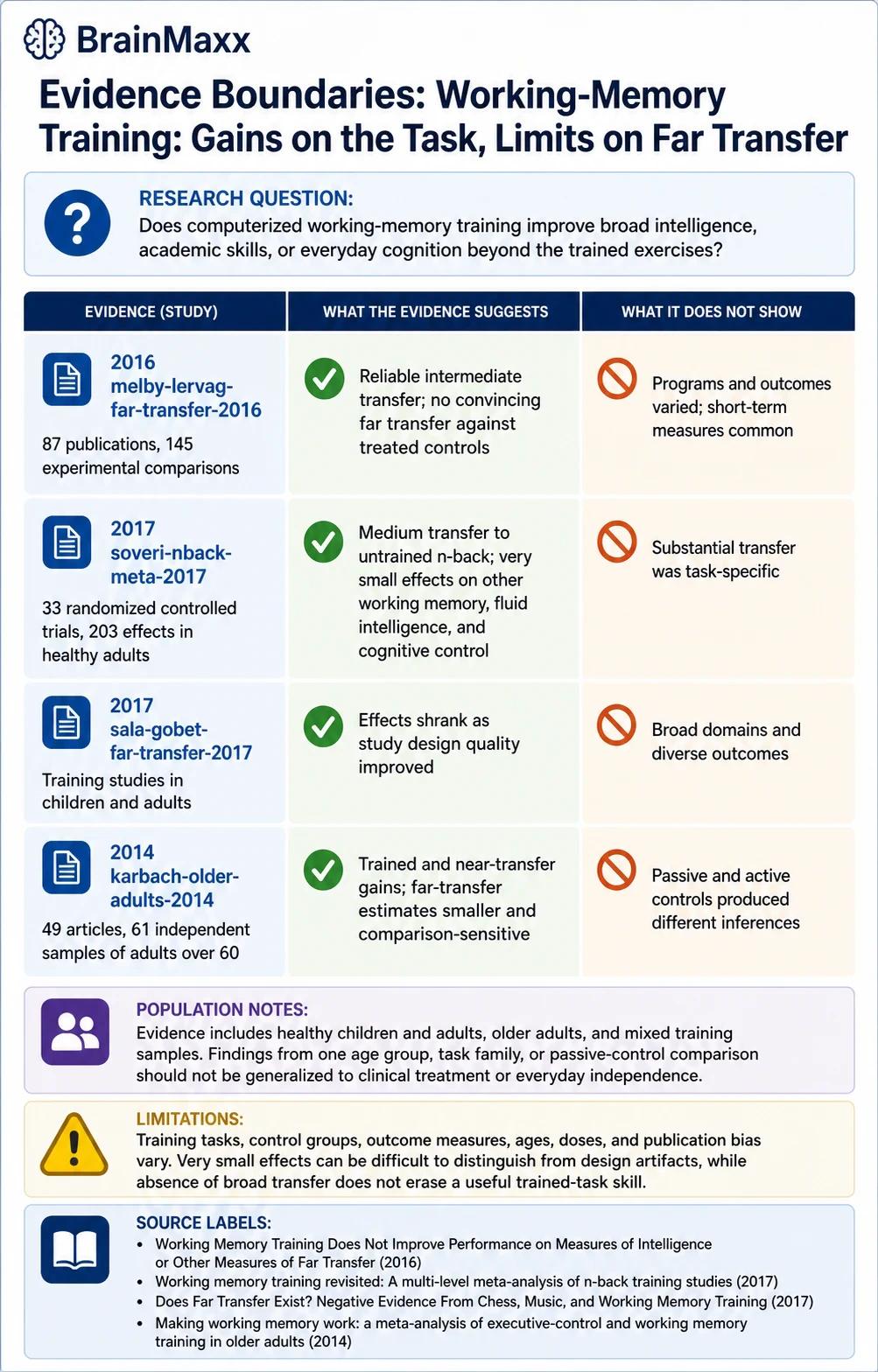
Working Memory Training Does Not Improve Performance on Measures of Intelligence or Other Measures of Far Transfer (2016). 87 publications, 145 experimental comparisons. Pretest-posttest meta-analysis with control groups. The material result was: Reliable intermediate transfer; no convincing far transfer against treated controls. The inference boundary matters: Controlled training synthesis. The main caution is Programs and outcomes varied; short-term measures common
Working memory training revisited: A multi-level meta-analysis of n-back training studies (2017). 33 randomized controlled trials, 203 effects in healthy adults. Multilevel meta-analysis separating task-specific and broader transfer. The material result was: Medium transfer to untrained n-back; very small effects on other working memory, fluid intelligence, and cognitive control. The inference boundary matters: Randomized controlled synthesis. The main caution is Substantial transfer was task-specific
Does Far Transfer Exist? Negative Evidence From Chess, Music, and Working Memory Training (2017). Training studies in children and adults. Three meta-analyses with design-quality comparisons. The material result was: Effects shrank as study design quality improved. The inference boundary matters: Cross-domain training synthesis. The main caution is Broad domains and diverse outcomes
Making working memory work: a meta-analysis of executive-control and working memory training in older adults (2014). 49 articles, 61 independent samples of adults over 60. Meta-analysis of executive and working-memory training. The material result was: Trained and near-transfer gains; far-transfer estimates smaller and comparison-sensitive. The inference boundary matters: Controlled training synthesis. The main caution is Passive and active controls produced different inferences
Taken together, these sources do not collapse into one magic number. A comprehensive 2016 meta-analysis, a 2017 n-back multilevel meta-analysis, a far-transfer review spanning chess, music, and working memory, and an older-adult meta-analysis. The 2016 review included 87 publications and 145 comparisons: intermediate transfer appeared, but treated-control comparisons showed no convincing far transfer. The n-back synthesis found a medium effect on untrained n-back tasks and very small effects on other working-memory, fluid-intelligence, and cognitive-control measures. The direction and magnitude should therefore be read as an evidence pattern, not a personal forecast.
What the averages do not settle
Randomized training studies can identify effects of a program on measured outcomes. Passive controls inflate expectation and contact differences; active-control evidence is more informative for far-transfer claims.
Improvement may reflect strategy learning, task familiarity, motivation, or practice with shared features rather than growth in a general cognitive capacity. Those explanations can coexist. The honest conclusion is that a result may support a method under tested conditions without proving why it worked in every participant.
Training tasks, control groups, outcome measures, ages, doses, and publication bias vary. Very small effects can be difficult to distinguish from design artifacts, while absence of broad transfer does not erase a useful trained-task skill. Individual experience can legitimately differ from an average because prior knowledge, task design, timing, sleep, stress, access, and feedback all change what a learner or reader can do.

A bounded way to try it
Start with the real ability you want to improve, select direct practice for that ability, and treat any brain-training app as optional. Preselect one untrained outcome and one real-world outcome before training, then compare them with baseline.
Use the following sequence as a small experiment, not as a test of character:
- Name the real target
- Record a baseline
- Track the trained task
- Test an untrained task
- Check real-world function
Keep the trial modest enough to reverse. If it fits, repeat it long enough to observe behavior rather than relying on one good or bad session. If it does not fit, change the conditions or choose a different tool.
Worked example
Andre uses an n-back program for three weeks and his n-back score rises. He records that as a trained-task gain. Before concluding that his general memory improved, he checks a separate task he did not practice and one real goal, such as following a multi-step work procedure. If those outcomes do not change, the honest conclusion is not failure or low intelligence—it is specific learning without demonstrated far transfer.
The example is deliberately ordinary. It shows how the method can be adjusted using feedback while keeping uncertainty visible. It does not imply that one person’s result predicts another person’s outcome.
How to judge the result
Look for observable change at the next sensible review point:
- Untrained outcome improves
- Real-world target improves
- Benefit persists after training
Pause or redesign the experiment when any of these occur:
- Only the game score changes
- Fatigue or frustration increases
- Direct practice or care is displaced
The revision gives readers a three-level ledger: trained task, similar untrained task, and real-world target, each measured separately.
Safety and scope
Stop paying or increasing training time when only the game score moves, fatigue rises, or direct practice and needed care are displaced. Do not change medication or treatment based on app performance.
A training score cannot diagnose ADHD, dementia, brain injury, or a learning disorder. Cognitive concerns that are new, worsening, or impairing need qualified assessment. Seek qualified support when the problem is persistent, impairing, new, or safety-relevant. This article is educational and does not diagnose a disorder or replace assessment, treatment, teaching support, or an established safety protocol. If a situation involves immediate danger or a crisis, use local emergency or crisis services rather than an article exercise.
Bottom line
Working-memory training reliably improves trained tasks and can produce small or moderate near-transfer effects. High-quality comparisons provide little convincing evidence for broad far transfer to intelligence, reading, arithmetic, or other real-world skills. The most defensible use is a bounded test with feedback, a review point, and permission to stop.

Sources
- Working Memory Training Does Not Improve Performance on Measures of Intelligence or Other Measures of Far Transfer (2016)
- Working memory training revisited: A multi-level meta-analysis of n-back training studies (2017)
- Does Far Transfer Exist? Negative Evidence From Chess, Music, and Working Memory Training (2017)
- Making working memory work: a meta-analysis of executive-control and working memory training in older adults (2014)


