

Twenty-five minutes on, five minutes off is memorable because it removes a decision: when should I pause? That can make starting easier. It does not follow that the ratio is a universal law of attention. Direct comparisons are still limited, and the best recent authentic-study evidence found no productivity, task-completion, or flow advantage over self-regulated breaks.
The question underneath the habit
Does the 25-minute Pomodoro schedule improve focus and productivity better than self-regulated work and breaks?
Pomodoro can function as an implementation scaffold that makes starting, stopping, and break-taking explicit. Direct evidence does not establish that 25/5 intervals universally improve productivity, completion, flow, or learning. That is the useful claim. It is narrower than a promise that one method always works, and it is more informative than judging a strategy by how smooth or difficult it feels in the moment.
Define the comparison before judging it
The Pomodoro technique is a fixed work-break schedule, commonly 25 minutes of work and five minutes of break. It is not a treatment for attention disorders, proof of optimal attention span, or a substitute for task design, sleep, workload changes, or accessibility supports.
This boundary prevents a common category error: treating two activities with different purposes as if one must replace the other. A sensible comparison holds the goal in view, asks what was actually measured, and checks whether the result survived a delay or a change in task.
What the evidence says
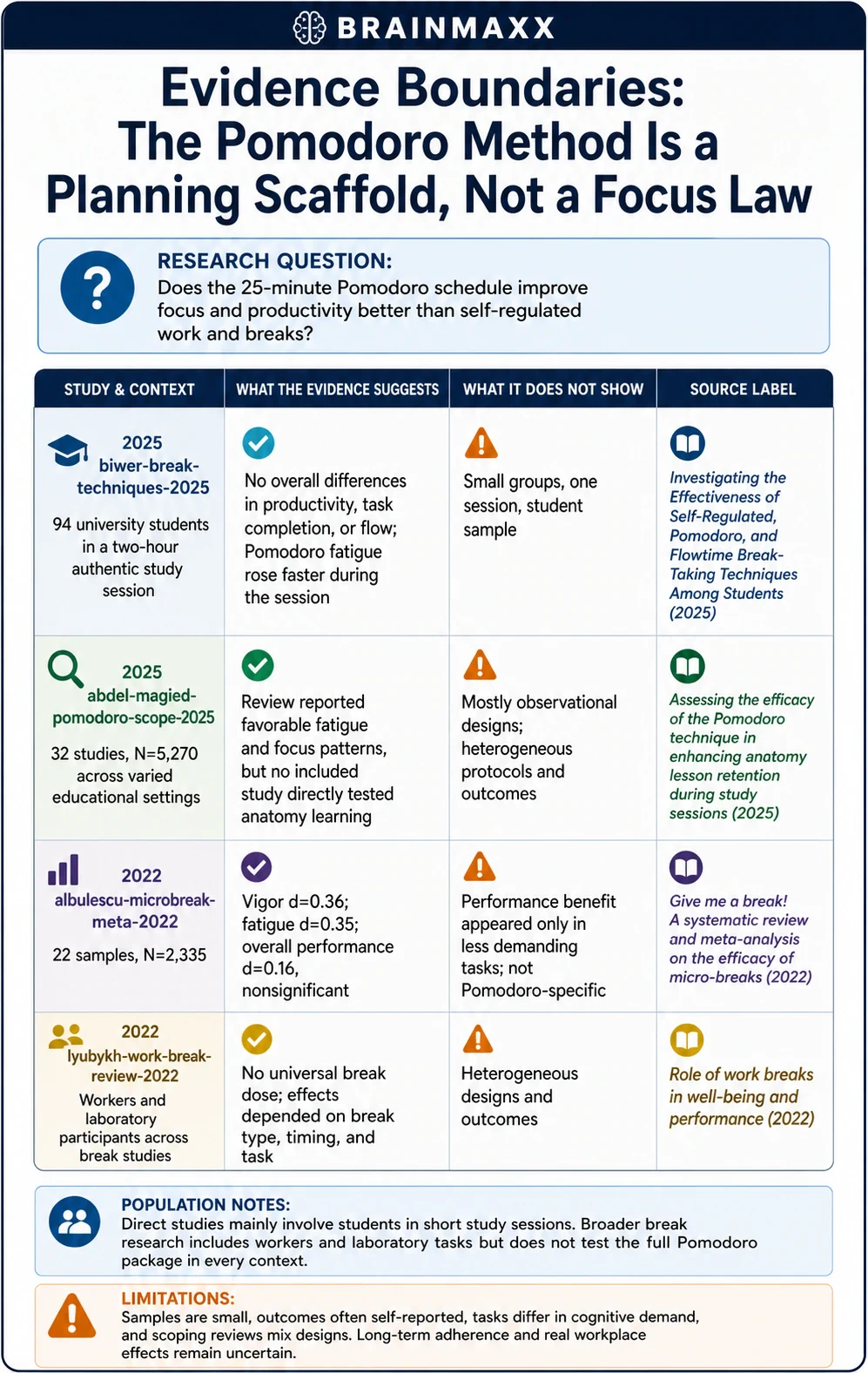
Investigating the Effectiveness of Self-Regulated, Pomodoro, and Flowtime Break-Taking Techniques Among Students (2025). 94 university students in a two-hour authentic study session. Three-condition intervention comparison. The material result was: No overall differences in productivity, task completion, or flow; Pomodoro fatigue rose faster during the session. The inference boundary matters: Experimental comparison for the tested session. The main caution is Small groups, one session, student sample
Assessing the efficacy of the Pomodoro technique in enhancing anatomy lesson retention during study sessions (2025). 32 studies, N=5,270 across varied educational settings. Scoping review with three RCTs and mixed designs. The material result was: Review reported favorable fatigue and focus patterns, but no included study directly tested anatomy learning. The inference boundary matters: Evidence map, not one pooled causal estimate. The main caution is Mostly observational designs; heterogeneous protocols and outcomes
Give me a break! A systematic review and meta-analysis on the efficacy of micro-breaks (2022). 22 samples, N=2,335. Experimental and quasi-experimental microbreak meta-analysis. The material result was: Vigor d=0.36; fatigue d=0.35; overall performance d=0.16, nonsignificant. The inference boundary matters: Synthesis of varied short-break interventions. The main caution is Performance benefit appeared only in less demanding tasks; not Pomodoro-specific
Role of work breaks in well-being and performance (2022). Workers and laboratory participants across break studies. Systematic multidisciplinary review. The material result was: No universal break dose; effects depended on break type, timing, and task. The inference boundary matters: Mixed evidence review. The main caution is Heterogeneous designs and outcomes
Taken together, these sources do not collapse into one magic number. A 2025 authentic student comparison, a 2025 scoping review, a 2022 microbreak meta-analysis, and a systematic review of work breaks. In 94 university students, Pomodoro, Flowtime, and self-regulated breaks did not differ overall in productivity, completion, or flow; fatigue rose faster in the Pomodoro condition during the session. Microbreaks showed small benefits for vigor d=0.36 and fatigue d=0.35, but overall performance d=0.16 was nonsignificant. The direction and magnitude should therefore be read as an evidence pattern, not a personal forecast.
What the averages do not settle
The direct comparison supports causal conclusions only for one two-hour student session. Broader break meta-analyses test varied break designs, not a universal 25/5 rule.
A timer may help through commitment, reduced decision load, interruption control, or permission to rest. It may hurt when the alarm breaks flow or when the task requires a longer uninterrupted setup. Those explanations can coexist. The honest conclusion is that a result may support a method under tested conditions without proving why it worked in every participant.
Samples are small, outcomes often self-reported, tasks differ in cognitive demand, and scoping reviews mix designs. Long-term adherence and real workplace effects remain uncertain. Individual experience can legitimately differ from an average because prior knowledge, task design, timing, sleep, stress, access, and feedback all change what a learner or reader can do.

A bounded way to try it
Use one or two timed cycles as a reversible test. Define the next visible action, protect the interval from notifications, use the break for actual recovery, and compare task progress and fatigue with a self-regulated session.
Use the following sequence as a small experiment, not as a test of character:
- Name one visible action
- Protect one work interval
- Take a real break
- Repeat once
- Compare progress and fatigue
Keep the trial modest enough to reverse. If it fits, repeat it long enough to observe behavior rather than relying on one good or bad session. If it does not fit, change the conditions or choose a different tool.
Worked example
Leah avoids starting a dense report. She uses one 25-minute interval only as an entry ramp, silences notifications, and writes down the next step before a five-minute break. After two cycles she notices that the timer interrupts complex reasoning, so she switches to 45-minute blocks with self-chosen pauses. The successful part was the explicit start and protected work period—not loyalty to one ratio.
The example is deliberately ordinary. It shows how the method can be adjusted using feedback while keeping uncertainty visible. It does not imply that one person’s result predicts another person’s outcome.
How to judge the result
Look for observable change at the next sensible review point:
- Starting takes less time
- Useful work advances
- Fatigue stays manageable
Pause or redesign the experiment when any of these occur:
- The timer breaks productive concentration
- Fatigue or distress rises
- The timer becomes avoidance
The revision separates start support from productivity claims and gives readers permission to adapt or abandon the timer when the task evidence says it is not helping.
Safety and scope
Change or stop the timer if it repeatedly interrupts useful concentration, increases fatigue, triggers distress, or becomes another avoidance ritual. Preserve medically or ergonomically necessary breaks.
Timer response cannot diagnose ADHD, anxiety, depression, burnout, or a sleep disorder. Persistent impairment deserves qualified support and workplace or educational accommodations where appropriate. Seek qualified support when the problem is persistent, impairing, new, or safety-relevant. This article is educational and does not diagnose a disorder or replace assessment, treatment, teaching support, or an established safety protocol. If a situation involves immediate danger or a crisis, use local emergency or crisis services rather than an article exercise.
Bottom line
Pomodoro can function as an implementation scaffold that makes starting, stopping, and break-taking explicit. Direct evidence does not establish that 25/5 intervals universally improve productivity, completion, flow, or learning. The most defensible use is a bounded test with feedback, a review point, and permission to stop.

Sources
- Investigating the Effectiveness of Self-Regulated, Pomodoro, and Flowtime Break-Taking Techniques Among Students (2025)
- Assessing the efficacy of the Pomodoro technique in enhancing anatomy lesson retention during study sessions (2025)
- Give me a break! A systematic review and meta-analysis on the efficacy of micro-breaks (2022)
- Role of work breaks in well-being and performance (2022)


