

Music can make studying feel easier without making performance better. It can also reduce mind-wandering during a dull task or interfere with language-heavy reading. The evidence does not support one ideal focus playlist. Effects change with lyrics, task demand, musical complexity, listening habit, and what outcome is measured.
The question underneath the habit
Does background music improve focus and learning, or does it distract from tasks such as reading, recall, and sustained attention?
Background music has task- and listener-dependent effects. Preferred music may improve reported task focus on a low-demand vigilance task without significantly improving reaction time, while lyrics can reduce reading comprehension, especially when lyrics and text use the same language. That is the useful claim. It is narrower than a promise that one method always works, and it is more informative than judging a strategy by how smooth or difficult it feels in the moment.
Define the comparison before judging it
Background music is audio played while another task is primary. Preferred music, instrumental music, lyrical music, white noise, and binaural beats are distinct. Feeling focused, enjoying a task, completing it quickly, and performing accurately are different outcomes.
This boundary prevents a common category error: treating two activities with different purposes as if one must replace the other. A sensible comparison holds the goal in view, asks what was actually measured, and checks whether the result survived a delay or a change in task.
What the evidence says
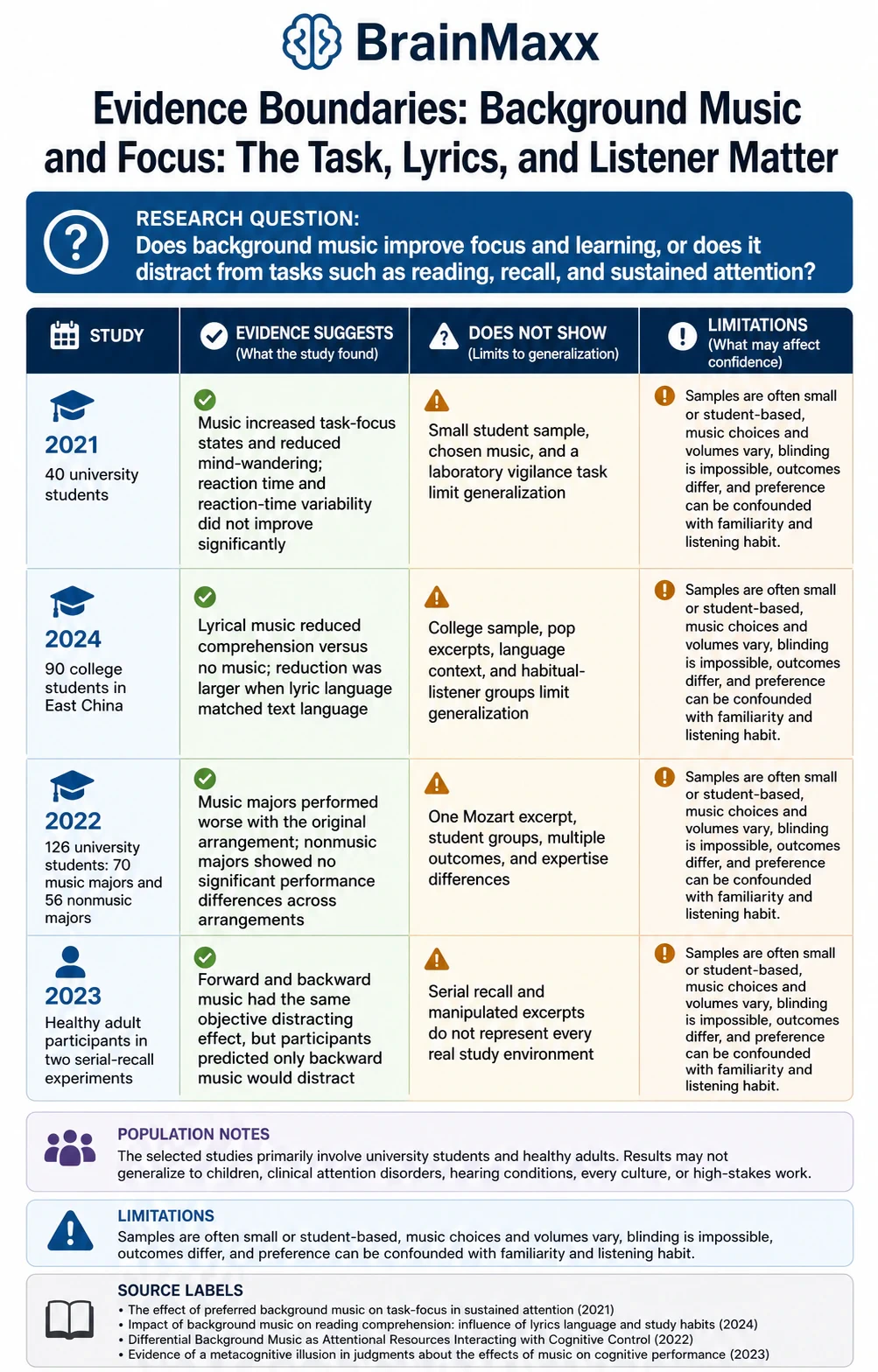
The effect of preferred background music on task-focus in sustained attention (2021). 40 university students. Sustained-attention task in silence and preferred-music conditions with thought probes and reaction-time outcomes. The material result was: Music increased task-focus states and reduced mind-wandering; reaction time and reaction-time variability did not improve significantly. The inference boundary matters: Within-person experimental comparison for a low-demand vigilance task. The main caution is Small student sample, chosen music, and a laboratory vigilance task limit generalization
Impact of background music on reading comprehension: influence of lyrics language and study habits (2024). 90 college students in East China. Listeners and non-listeners assigned to Mandarin lyrics, English lyrics, or no music while reading L1 and L2 texts. The material result was: Lyrical music reduced comprehension versus no music; reduction was larger when lyric language matched text language. The inference boundary matters: Assigned audio-condition effects for the tested reading tasks. The main caution is College sample, pop excerpts, language context, and habitual-listener groups limit generalization
Differential Background Music as Attentional Resources Interacting with Cognitive Control (2022). 126 university students: 70 music majors and 56 nonmusic majors. Rhythm-only, melody, original-music, and no-music comparisons controlling no-music performance and perceived arousal. The material result was: Music majors performed worse with the original arrangement; nonmusic majors showed no significant performance differences across arrangements. The inference boundary matters: Condition comparison with measured listener-group moderation. The main caution is One Mozart excerpt, student groups, multiple outcomes, and expertise differences
Evidence of a metacognitive illusion in judgments about the effects of music on cognitive performance (2023). Healthy adult participants in two serial-recall experiments. Forward and reversed piano or Mozart excerpts with prospective and retrospective distraction judgments. The material result was: Forward and backward music had the same objective distracting effect, but participants predicted only backward music would distract. The inference boundary matters: Experimental evidence for task-specific auditory distraction and judgment error. The main caution is Serial recall and manipulated excerpts do not represent every real study environment
Taken together, these sources do not collapse into one magic number. A laboratory sustained-attention experiment, a 90-student reading experiment, a 126-student music-arrangement study, and two experiments on metacognitive judgments of auditory distraction. In 40 students, preferred music increased reported task-focus and reduced mind-wandering but did not significantly improve reaction time or its variability. In 90 students, lyrical music reduced reading comprehension versus silence, with the largest reduction when lyric and text language matched. The direction and magnitude should therefore be read as an evidence pattern, not a personal forecast.
What the averages do not settle
Within-person and assigned-condition experiments can support effects for their specific tasks and audio. They do not establish a universal playlist or a stable music-responsive learner type.
Music may alter arousal, mood, boredom, cognitive load, verbal interference, expectancy, or perceived fluency. The same sound can help an under-stimulating task yet compete with language processing. Those explanations can coexist. The honest conclusion is that a result may support a method under tested conditions without proving why it worked in every participant.
Samples are often small or student-based, music choices and volumes vary, blinding is impossible, outcomes differ, and preference can be confounded with familiarity and listening habit. Individual experience can legitimately differ from an average because prior knowledge, task design, timing, sleep, stress, access, and feedback all change what a learner or reader can do.

A bounded way to try it
Choose one real task and one outcome, compare matched blocks in quiet and with music, keep volume and task difficulty stable, test lyrics separately, and preserve enjoyment as a separate outcome.
Use the following sequence as a small experiment, not as a test of character:
- Choose one matched task
- Define one outcome
- Compare quiet and music
- Test lyrics separately
- Keep the useful condition
Keep the trial modest enough to reverse. If it fits, repeat it long enough to observe behavior rather than relying on one good or bad session. If it does not fit, change the conditions or choose a different tool.
Worked example
Ari likes studying with familiar songs and feels more focused. For two comparable reading blocks, he uses the same text difficulty, duration, and quiz: one in quiet and one with instrumental music at a comfortable volume. He then repeats the comparison with lyrical music. He records quiz accuracy, time, and mind-wandering separately. Enjoyment can remain a valid reason to choose music, but it is not substituted for the performance check.
The example is deliberately ordinary. It shows how the method can be adjusted using feedback while keeping uncertainty visible. It does not imply that one person’s result predicts another person’s outcome.
How to judge the result
Look for observable change at the next sensible review point:
- Accuracy stays stable or improves
- Rereading does not increase
- Subjective focus matches performance
Pause or redesign the experiment when any of these occur:
- Accuracy or comprehension drops
- Hearing discomfort appears
- Situational awareness is required
The revision separates subjective focus from task performance and compares quiet, instrumental, and lyrical conditions on one matched outcome.
Safety and scope
Stop or change the audio if accuracy drops, rereading rises, environmental awareness is needed, volume causes discomfort, or music increases agitation. Do not use headphones when situational hearing is safety-critical.
A music-response pattern cannot diagnose or treat ADHD, anxiety, a learning disorder, or a hearing condition. Persistent impairment or hearing symptoms warrant qualified assessment. Seek qualified support when the problem is persistent, impairing, new, or safety-relevant. This article is educational and does not diagnose a disorder or replace assessment, treatment, teaching support, or an established safety protocol. If a situation involves immediate danger or a crisis, use local emergency or crisis services rather than an article exercise.
Bottom line
Background music has task- and listener-dependent effects. Preferred music may improve reported task focus on a low-demand vigilance task without significantly improving reaction time, while lyrics can reduce reading comprehension, especially when lyrics and text use the same language. The most defensible use is a bounded test with feedback, a review point, and permission to stop.

Sources
- The effect of preferred background music on task-focus in sustained attention (2021)
- Impact of background music on reading comprehension: influence of lyrics language and study habits (2024)
- Differential Background Music as Attentional Resources Interacting with Cognitive Control (2022)
- Evidence of a metacognitive illusion in judgments about the effects of music on cognitive performance (2023)


