

Going to bed later than intended is easy to moralize: lazy, undisciplined, addicted to the phone. The research supports a more useful description. Bedtime procrastination is a behavior pattern shaped by self-regulation, chronotype, reward, emotion, environment, and competing needs. Associations with shorter and poorer sleep are real, but the label does not explain every late night or diagnose a sleep disorder.
The question underneath the habit
Why do people delay sleep despite intending to go to bed, and what can they change without turning the pattern into a moral label?
Bedtime procrastination is defined as delaying intended bedtime without an external reason. It is moderately associated with shorter duration, poorer quality, and greater fatigue, while causal pathways and best interventions remain under study. That is the useful claim. It is narrower than a promise that one method always works, and it is more informative than judging a strategy by how smooth or difficult it feels in the moment.
Define the comparison before judging it
The construct excludes delays caused by shift work, caregiving, unsafe housing, pain, insomnia symptoms, or other external constraints. It is not laziness, smartphone addiction, or a diagnosis.
This boundary prevents a common category error: treating two activities with different purposes as if one must replace the other. A sensible comparison holds the goal in view, asks what was actually measured, and checks whether the result survived a delay or a change in task.
What the evidence says
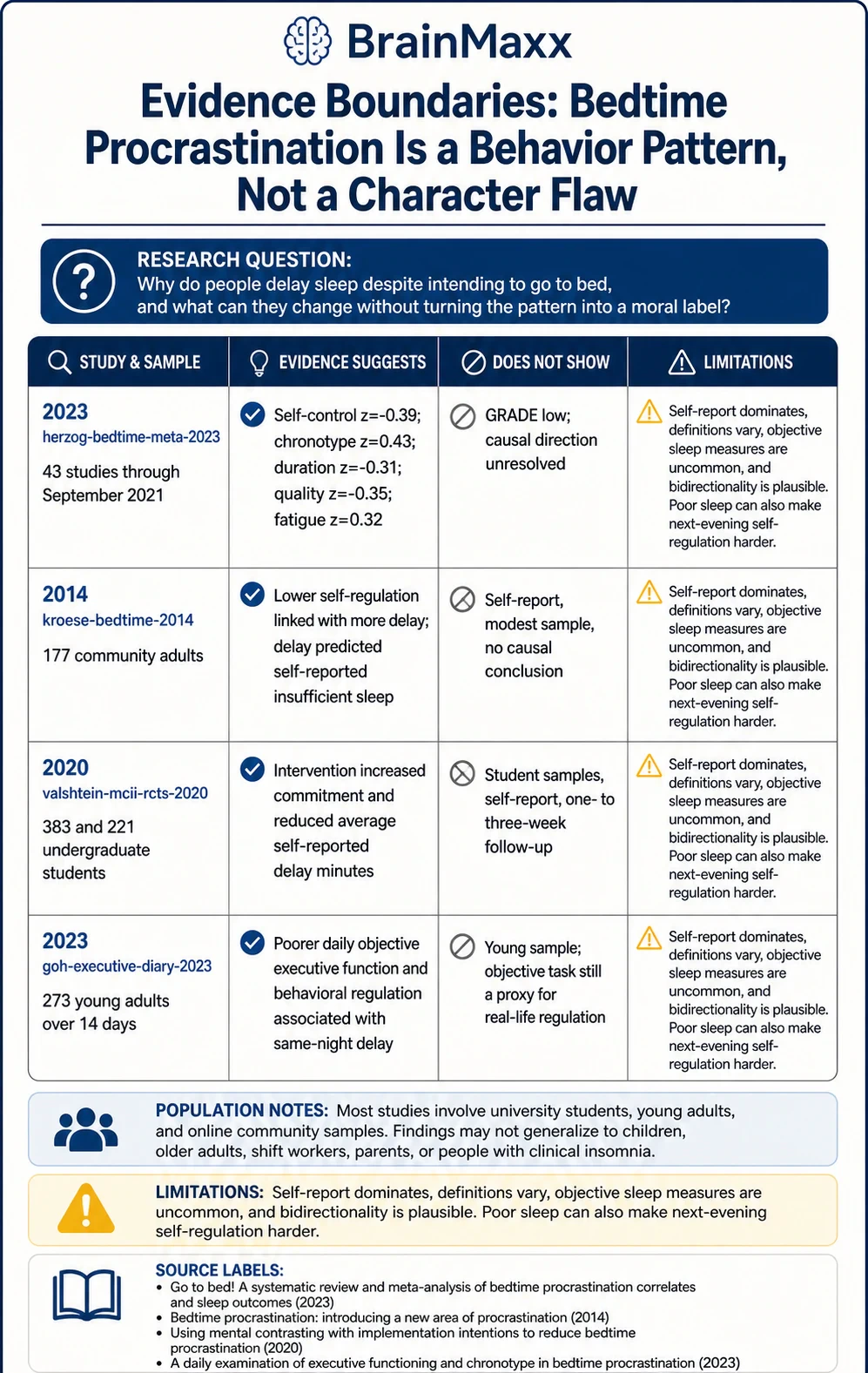
Go to bed! A systematic review and meta-analysis of bedtime procrastination correlates and sleep outcomes (2023). 43 studies through September 2021. Systematic review and meta-analysis. The material result was: Self-control z=-0.39; chronotype z=0.43; duration z=-0.31; quality z=-0.35; fatigue z=0.32. The inference boundary matters: Mostly correlational synthesis. The main caution is GRADE low; causal direction unresolved
Bedtime procrastination: introducing a new area of procrastination (2014). 177 community adults. Online survey defining bedtime procrastination and sleep associations. The material result was: Lower self-regulation linked with more delay; delay predicted self-reported insufficient sleep. The inference boundary matters: Cross-sectional association. The main caution is Self-report, modest sample, no causal conclusion
Using mental contrasting with implementation intentions to reduce bedtime procrastination (2020). 383 and 221 undergraduate students. Online self-regulation exercise vs motivational or sleep-hygiene controls. The material result was: Intervention increased commitment and reduced average self-reported delay minutes. The inference boundary matters: Randomized effects for the tested exercise. The main caution is Student samples, self-report, one- to three-week follow-up
A daily examination of executive functioning and chronotype in bedtime procrastination (2023). 273 young adults over 14 days. Daily objective and self-reported executive-function measures. The material result was: Poorer daily objective executive function and behavioral regulation associated with same-night delay. The inference boundary matters: Within-person association, not randomized causation. The main caution is Young sample; objective task still a proxy for real-life regulation
Taken together, these sources do not collapse into one magic number. A 43-study meta-analysis, the original community study defining the construct, two randomized self-regulation trials, and a 14-day daily study of executive function and chronotype. The meta-analysis found associations with self-control z=-0.39, evening chronotype z=0.43, sleep duration z=-0.31, sleep quality z=-0.35, and daytime fatigue z=0.32; evidence certainty was low. Two randomized trials found mental contrasting with implementation intentions reduced self-reported delay versus controls. The direction and magnitude should therefore be read as an evidence pattern, not a personal forecast.
What the averages do not settle
Most sleep-outcome evidence is correlational. Randomized trials support effects of one brief self-regulation exercise on self-reported delay, not proof that the method treats insomnia or every cause.
Delay may serve immediate leisure, autonomy, reward, emotion regulation, or avoidance; late chronotype, executive fatigue, phone cues, and unrealistic bedtime intentions can also contribute. Those explanations can coexist. The honest conclusion is that a result may support a method under tested conditions without proving why it worked in every participant.
Self-report dominates, definitions vary, objective sleep measures are uncommon, and bidirectionality is plausible. Poor sleep can also make next-evening self-regulation harder. Individual experience can legitimately differ from an average because prior knowledge, task design, timing, sleep, stress, access, and feedback all change what a learner or reader can do.

A bounded way to try it
Track intended bedtime, actual bedtime, external constraints, activity, and immediate payoff for three nights. Choose one repeated cue, create a specific if-then plan, and protect needed leisure earlier rather than removing it without replacement.
Use the following sequence as a small experiment, not as a test of character:
- Track three nights
- Separate external constraints
- Name the immediate payoff
- Choose one cue
- Use one if-then plan
Keep the trial modest enough to reverse. If it fits, repeat it long enough to observe behavior rather than relying on one good or bad session. If it does not fit, change the conditions or choose a different tool.
Worked example
After three evenings of notes, Rosa sees that the delay starts when she finishes caregiving and wants unscheduled leisure—not simply when she opens her phone. She protects twenty minutes of deliberate leisure earlier, sets a cue to begin the bedtime routine, and uses an if-then plan: if the episode ends, then the phone charges outside the bedroom. She tracks intended and actual bedtime for one week. Persistent insomnia would call for clinical assessment, not harsher self-criticism.
The example is deliberately ordinary. It shows how the method can be adjusted using feedback while keeping uncertainty visible. It does not imply that one person’s result predicts another person’s outcome.
How to judge the result
Look for observable change at the next sensible review point:
- Delay minutes decrease
- Sleep opportunity increases
- Needed leisure remains protected
Pause or redesign the experiment when any of these occur:
- Dangerous sleepiness occurs
- Insomnia persists despite opportunity
- Mood or functioning worsens
The revision begins with function rather than blame, distinguishes external constraints from procrastination, and uses an if-then plan without promising to cure insomnia.
Safety and scope
Do not label externally constrained or insomnia-driven wakefulness as procrastination. Seek help for dangerous sleepiness, persistent insomnia, breathing pauses, mania-like reduced sleep need, or worsening mood.
This behavior log cannot diagnose insomnia, a circadian disorder, depression, ADHD, or another condition. Persistent or risky sleep problems need qualified care. Seek qualified support when the problem is persistent, impairing, new, or safety-relevant. This article is educational and does not diagnose a disorder or replace assessment, treatment, teaching support, or an established safety protocol. If a situation involves immediate danger or a crisis, use local emergency or crisis services rather than an article exercise.
Bottom line
Bedtime procrastination is defined as delaying intended bedtime without an external reason. It is moderately associated with shorter duration, poorer quality, and greater fatigue, while causal pathways and best interventions remain under study. The most defensible use is a bounded test with feedback, a review point, and permission to stop.

Sources
- Go to bed! A systematic review and meta-analysis of bedtime procrastination correlates and sleep outcomes (2023)
- Bedtime procrastination: introducing a new area of procrastination (2014)
- Using mental contrasting with implementation intentions to reduce bedtime procrastination (2020)
- A daily examination of executive functioning and chronotype in bedtime procrastination (2023)


