

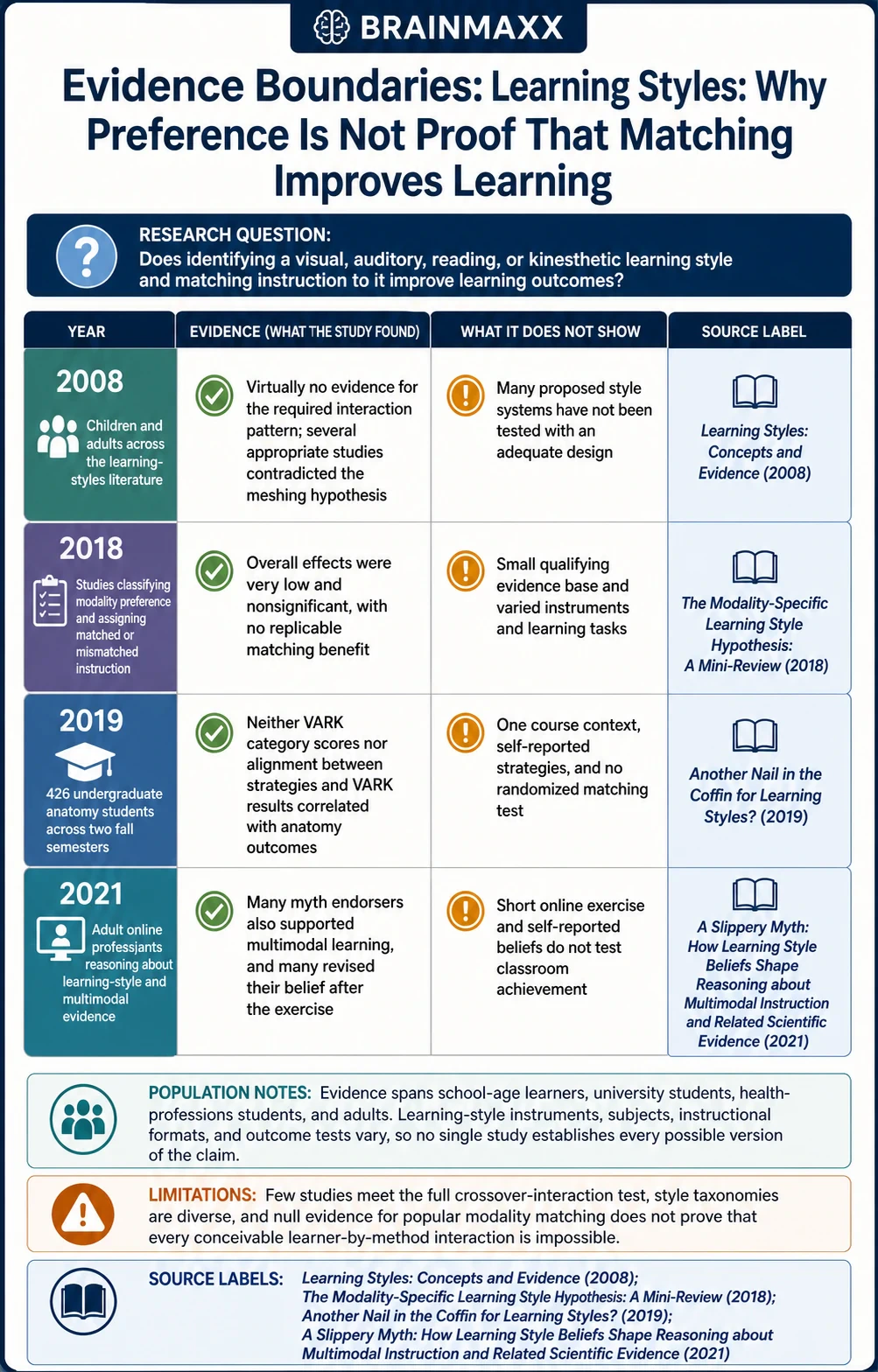
Calling yourself a visual or auditory learner can describe a genuine preference. It does not establish that you learn more when teaching matches that label. The key claim is an interaction: different groups must learn best from different matched methods on the same outcome test. Reviews find that this decisive pattern is not reliably supported, even though preferences and specific abilities certainly differ.
The question underneath the habit
Does identifying a visual, auditory, reading, or kinesthetic learning style and matching instruction to it improve learning outcomes?
People report presentation preferences and differ in abilities, but those facts do not validate the meshing hypothesis. Evidence meeting the required crossover-interaction design has not shown a reliable learning benefit from matching instruction to a modality label. That is the useful claim. It is narrower than a promise that one method always works, and it is more informative than judging a strategy by how smooth or difficult it feels in the moment.
Define the comparison before judging it
A preference is a format someone likes; an aptitude is a measured capability; a learning strategy is an action used to study; and the meshing hypothesis predicts superior outcomes from matching instruction to a classified style. These are not interchangeable.
This boundary prevents a common category error: treating two activities with different purposes as if one must replace the other. A sensible comparison holds the goal in view, asks what was actually measured, and checks whether the result survived a delay or a change in task.
What the evidence says
Learning Styles: Concepts and Evidence (2008). Children and adults across the learning-styles literature. Review defining the randomized crossover interaction required to validate matching. The material result was: Virtually no evidence for the required interaction pattern; several appropriate studies contradicted the meshing hypothesis. The inference boundary matters: Methodological and evidence review, not a new experiment. The main caution is Many proposed style systems have not been tested with an adequate design
The Modality-Specific Learning Style Hypothesis: A Mini-Review (2018). Studies classifying modality preference and assigning matched or mismatched instruction. Review limited to studies using screening, assignment, a common test, and crossover interaction analysis. The material result was: Overall effects were very low and nonsignificant, with no replicable matching benefit. The inference boundary matters: Synthesis of experiments capable of testing the matching claim. The main caution is Small qualifying evidence base and varied instruments and learning tasks
Another Nail in the Coffin for Learning Styles? (2019). 426 undergraduate anatomy students across two fall semesters. VARK questionnaire, study-strategy survey, and course-outcome associations. The material result was: Neither VARK category scores nor alignment between strategies and VARK results correlated with anatomy outcomes. The inference boundary matters: Observational association study; cannot prove methods caused grades. The main caution is One course context, self-reported strategies, and no randomized matching test
A Slippery Myth: How Learning Style Beliefs Shape Reasoning about Multimodal Instruction and Related Scientific Evidence (2021). Adult online participants reasoning about learning-style and multimodal evidence. Short online evidence-reasoning exercise examining beliefs and belief revision. The material result was: Many myth endorsers also supported multimodal learning, and many revised their belief after the exercise. The inference boundary matters: Experiment on reasoning and belief revision, not instructional learning outcomes. The main caution is Short online exercise and self-reported beliefs do not test classroom achievement
Taken together, these sources do not collapse into one magic number. A major concepts-and-evidence review, a modality-specific mini-review applying explicit design criteria, an anatomy-student outcome study, and an experiment on how people reason about learning-style evidence. The modality-specific review found very low, nonsignificant effects across studies meeting rigorous matching criteria. In 426 anatomy students, VARK category scores and matching study strategies were not associated with course outcomes, while some task-specific strategies were. The direction and magnitude should therefore be read as an evidence pattern, not a personal forecast.
What the averages do not settle
Random assignment to matched and mismatched instruction with a common outcome can test the meshing claim. Preference surveys and correlations with grades cannot establish that matching caused better learning.
Apparent benefits may reflect comfort, motivation, prior knowledge, task demands, quality of instruction, specific aptitudes, or using complementary representations rather than matching a stable learner type. Those explanations can coexist. The honest conclusion is that a result may support a method under tested conditions without proving why it worked in every participant.
Few studies meet the full crossover-interaction test, style taxonomies are diverse, and null evidence for popular modality matching does not prove that every conceivable learner-by-method interaction is impossible. Individual experience can legitimately differ from an average because prior knowledge, task design, timing, sleep, stress, access, and feedback all change what a learner or reader can do.

A bounded way to try it
Define the learning outcome, choose representations that fit the material, combine words and visuals when they add complementary information, retrieve or apply the knowledge, and compare performance on the same objective check.
Use the following sequence as a small experiment, not as a test of character:
- Define the outcome
- Identify task demands
- Use complementary formats
- Retrieve or apply
- Check the same outcome
Keep the trial modest enough to reverse. If it fits, repeat it long enough to observe behavior rather than relying on one good or bad session. If it does not fit, change the conditions or choose a different tool.
Worked example
Mina prefers diagrams and worries that a text-heavy statistics lesson cannot work for her. Instead of treating a questionnaire as a prescription, she identifies what the task demands: reading definitions, interpreting graphs, and solving problems. She uses words to state each rule, diagrams to show relationships, and retrieval questions to test what she can produce without support. Her score on the same practice test, not the comfort of one format, guides the next revision.
The example is deliberately ordinary. It shows how the method can be adjusted using feedback while keeping uncertainty visible. It does not imply that one person’s result predicts another person’s outcome.
How to judge the result
Look for observable change at the next sensible review point:
- Recall improves without cues
- Errors become more specific
- Skills transfer to new examples
Pause or redesign the experiment when any of these occur:
- A label blocks useful practice
- Comfort replaces outcome checking
- Access needs remain unmet
The revision separates preference from learning outcome and replaces style matching with task-aligned, multimodal study plus a common performance check.
Safety and scope
Stop using a style label when it narrows access to useful formats, excuses avoiding required skills, or substitutes comfort for measured learning. Seek accessibility support when sensory, language, or disability needs affect access.
A learning-style questionnaire cannot diagnose a learning disability, ADHD, dyslexia, sensory impairment, or another condition. Persistent educational difficulty may warrant qualified assessment and formal accommodations. Seek qualified support when the problem is persistent, impairing, new, or safety-relevant. This article is educational and does not diagnose a disorder or replace assessment, treatment, teaching support, or an established safety protocol. If a situation involves immediate danger or a crisis, use local emergency or crisis services rather than an article exercise.
Bottom line
People report presentation preferences and differ in abilities, but those facts do not validate the meshing hypothesis. Evidence meeting the required crossover-interaction design has not shown a reliable learning benefit from matching instruction to a modality label. The most defensible use is a bounded test with feedback, a review point, and permission to stop.


