

A memory palace can make an arbitrary list dramatically easier to retrieve. That does not make memory photographic, improve every cognitive skill, or remove the work of building vivid associations. Reviews support a meaningful recall benefit, while also rating much of the evidence low quality and finding that gains may stay close to the trained material.
The question underneath the habit
How well does the method of loci improve recall, and do its benefits transfer beyond material practiced with a memory palace?
The method of loci can produce medium-to-large gains in immediate serial recall compared with rehearsal, but evidence quality is limited and broad transfer is not established. Proficiency varies with practice, age, material, and the ability to form distinctive location-image associations. That is the useful claim. It is narrower than a promise that one method always works, and it is more informative than judging a strategy by how smooth or difficult it feels in the moment.
Define the comparison before judging it
The method of loci assigns items to ordered locations along a familiar mental route. It is a mnemonic strategy, not photographic memory, a general intelligence intervention, a diagnosis, or proof of permanent brain enhancement.
This boundary prevents a common category error: treating two activities with different purposes as if one must replace the other. A sensible comparison holds the goal in view, asks what was actually measured, and checks whether the result survived a delay or a change in task.
What the evidence says
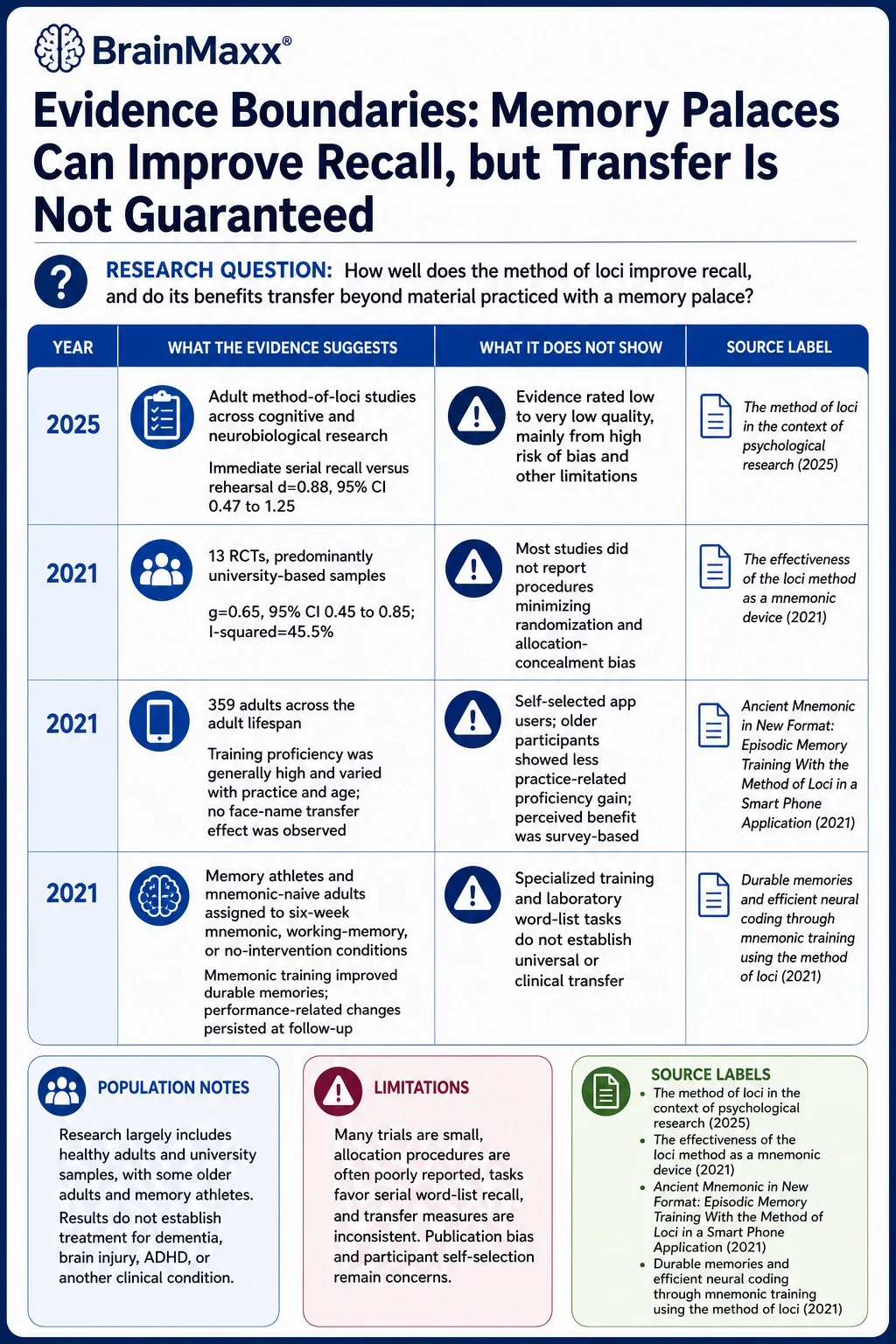
The method of loci in the context of psychological research (2025). Adult method-of-loci studies across cognitive and neurobiological research. Systematic review, meta-analysis, risk-of-bias assessment, and GRADE evaluation. The material result was: Immediate serial recall versus rehearsal d=0.88, 95% CI 0.47 to 1.25. The inference boundary matters: Synthesis includes controlled task-specific comparisons. The main caution is Evidence rated low to very low quality, mainly from high risk of bias and other limitations
The effectiveness of the loci method as a mnemonic device (2021). 13 RCTs, predominantly university-based samples. Meta-analysis with publication-bias, influence, setting, control, and outlier sensitivity analyses. The material result was: g=0.65, 95% CI 0.45 to 0.85; I-squared=45.5%. The inference boundary matters: Randomized task-specific mnemonic comparisons. The main caution is Most studies did not report procedures minimizing randomization and allocation-concealment bias
Ancient Mnemonic in New Format: Episodic Memory Training With the Method of Loci in a Smart Phone Application (2021). 359 adults across the adult lifespan. App-delivered loci training, proficiency tracking, face-name transfer test, and surveys. The material result was: Training proficiency was generally high and varied with practice and age; no face-name transfer effect was observed. The inference boundary matters: Training and transfer observation without proof of broad cognitive change. The main caution is Self-selected app users; older participants showed less practice-related proficiency gain; perceived benefit was survey-based
Durable memories and efficient neural coding through mnemonic training using the method of loci (2021). Memory athletes and mnemonic-naive adults assigned to six-week mnemonic, working-memory, or no-intervention conditions. Behavioral recall, MRI, 24-hour delay, and follow-up up to four months. The material result was: Mnemonic training improved durable memories; performance-related changes persisted at follow-up. The inference boundary matters: Controlled training effects for tested recall; athlete comparisons remain observational. The main caution is Specialized training and laboratory word-list tasks do not establish universal or clinical transfer
Taken together, these sources do not collapse into one magic number. Two systematic meta-analyses, a 359-person lifespan app study with a transfer test, and a controlled six-week mnemonic-training study with delayed follow-up and comparison groups. A 2021 meta-analysis of 13 mostly university-based RCTs estimated g=0.65, 95% CI 0.45 to 0.85, with I-squared 45.5%. A 2025 review estimated d=0.88, 95% CI 0.47 to 1.25, for immediate serial recall versus rehearsal, but rated the evidence low to very low quality. The direction and magnitude should therefore be read as an evidence pattern, not a personal forecast.
What the averages do not settle
Randomized comparisons support task-specific recall effects for the tested training and controls. Observations of memory athletes and brain-network differences do not by themselves show that training causes every difference.
Benefits may arise from elaboration, distinctive imagery, ordered retrieval cues, spatial organization, repeated practice, or a combination. The route can also impose setup time and imagery demands. Those explanations can coexist. The honest conclusion is that a result may support a method under tested conditions without proving why it worked in every participant.
Many trials are small, allocation procedures are often poorly reported, tasks favor serial word-list recall, and transfer measures are inconsistent. Publication bias and participant self-selection remain concerns. Individual experience can legitimately differ from an average because prior knowledge, task design, timing, sleep, stress, access, and feedback all change what a learner or reader can do.

A bounded way to try it
Use a familiar route for one ordered list, create one distinctive image per location, rehearse the route, test immediate and delayed recall, and separately test an untrained task before claiming transfer.
Use the following sequence as a small experiment, not as a test of character:
- Choose one familiar route
- Assign one vivid image
- Walk the route mentally
- Test delayed recall
- Check an untrained task
Keep the trial modest enough to reverse. If it fits, repeat it long enough to observe behavior rather than relying on one good or bad session. If it does not fit, change the conditions or choose a different tool.
Worked example
Jon needs to remember eight points for a short talk. He selects a familiar route through his apartment, places one vivid but respectful image at each location, and practices walking the route mentally. The next day he recalls the eight points in order, then tests a different task: remembering new names without the route. The first success supports this mnemonic for ordered material; it does not prove a broad memory upgrade.
The example is deliberately ordinary. It shows how the method can be adjusted using feedback while keeping uncertainty visible. It does not imply that one person’s result predicts another person’s outcome.
How to judge the result
Look for observable change at the next sensible review point:
- More target items are recalled
- Order errors decrease
- Recall persists after a delay
Pause or redesign the experiment when any of these occur:
- Imagery becomes distressing
- The route increases confusion
- No useful gain appears
The revision separates strong task-specific recall from unproven broad transfer and adds a same-material plus untrained-task check.
Safety and scope
Stop if imagery becomes distressing, the route creates more confusion than recall, setup time exceeds the task’s value, or repeated testing shows no useful gain. Use neutral images for sensitive material.
A memory-palace result cannot diagnose or treat dementia, a learning disorder, ADHD, brain injury, or another condition. New, worsening, or functionally significant memory problems warrant qualified assessment. Seek qualified support when the problem is persistent, impairing, new, or safety-relevant. This article is educational and does not diagnose a disorder or replace assessment, treatment, teaching support, or an established safety protocol. If a situation involves immediate danger or a crisis, use local emergency or crisis services rather than an article exercise.
Bottom line
The method of loci can produce medium-to-large gains in immediate serial recall compared with rehearsal, but evidence quality is limited and broad transfer is not established. Proficiency varies with practice, age, material, and the ability to form distinctive location-image associations. The most defensible use is a bounded test with feedback, a review point, and permission to stop.

Sources
- The method of loci in the context of psychological research (2025)
- The effectiveness of the loci method as a mnemonic device (2021)
- Ancient Mnemonic in New Format: Episodic Memory Training With the Method of Loci in a Smart Phone Application (2021)
- Durable memories and efficient neural coding through mnemonic training using the method of loci (2021)


