By Elias Grant
Imagine a committee choosing a room for an evening workshop. Three people say the library room is free. By the time somebody asks for a vote, the room feels booked. One person has the access notice open on their phone. The entrance code expires before the workshop ends. That is the fact the committee needs to hear.
Before anyone makes the case for their favorite option, give each person one turn to put a new, checkable fact on the table. Record it once. Then ask which option still holds up.
Who this is for
Use this for a small, reversible choice where people arrive with different pieces of information. Your group might be choosing a venue, trialing a schedule or deciding which part of a shared process to change first.
Researchers use hidden profile for a task where each person gets incomplete information. Putting the pieces together can reveal the option that best fits the study’s criteria. In a real meeting, the decision can also depend on values and on facts nobody has checked yet. Draw a line between what the room already knows and what just one or two people have seen. Stasser and Titus, 1985.

A repeated report can come from one source. Give a new observation a row of its own.
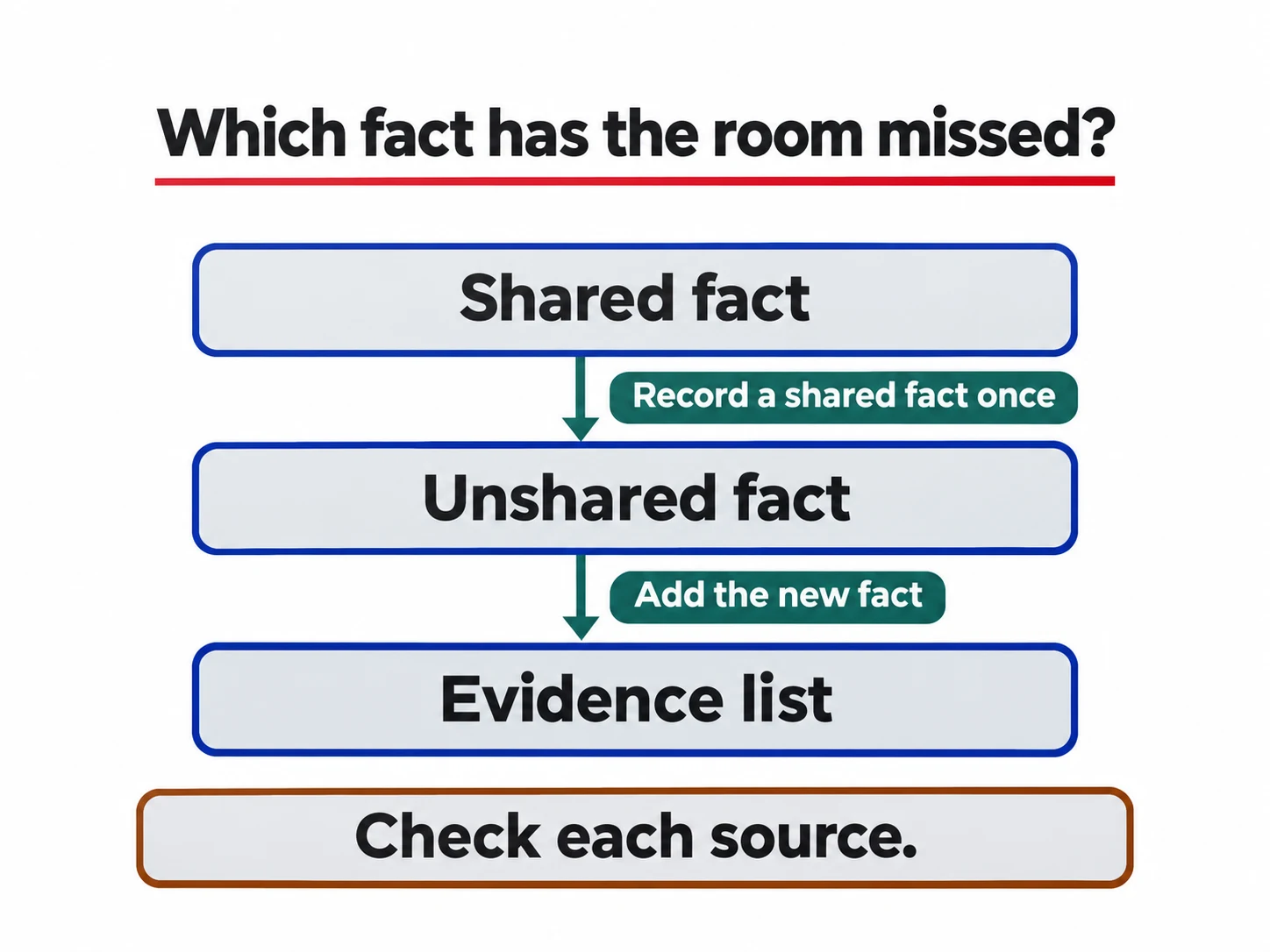
Record a shared fact once. Add the new fact. Check each source.
Three neutral panels distinguish an item all people already know, a new item that one person holds, and the combined decision list. The list groups reports of the same source and gives a genuinely distinct fact its own row.
Stasser and Titus · Mojzisch and colleagues
Before you start
Bring the options, a timer and a blank shared page. Agree on a requirement an option must meet. Write it as something a source can answer. “Participants can enter until 8 p.m.” is easier to check than “The venue is convenient.”
On your page, give each observation four fields. Name the option, the fact, the source and date, and the person who can check it. Give the checker a deadline if the source is still missing. Keep a separate line for the decision so nobody mistakes an unresolved fact for a commitment.
Ask each person to write one observation somebody else might have missed and where it came from. They can pass if they have no evidence to add. Give them a private way to flag a sensitive constraint. The shared page can record the requirement and who can confirm it without disclosing anyone’s personal details.
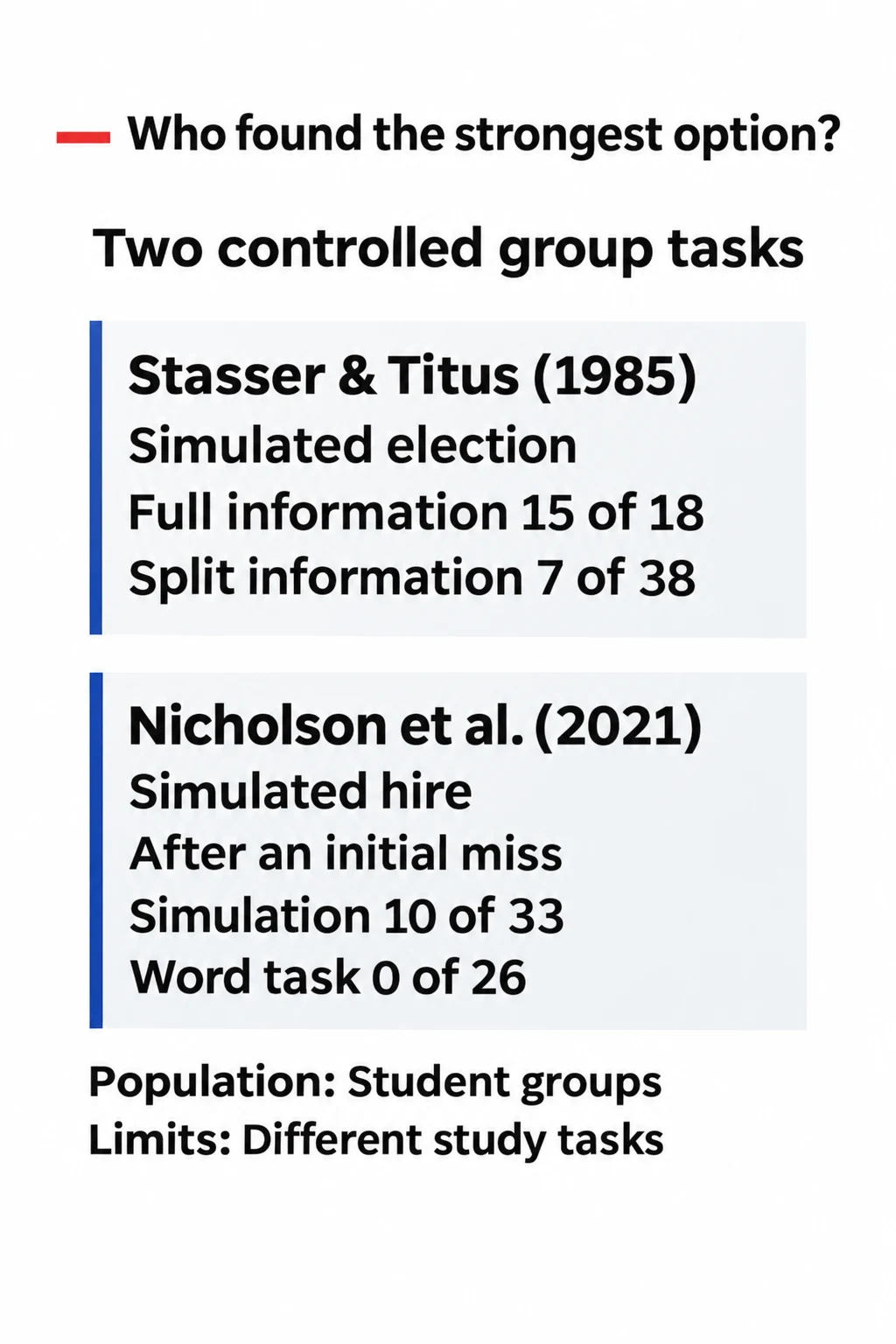
Stasser and Titus randomly assigned introductory psychology students to versions of a simulated election. The candidate with the strongest full profile won in 15 of 18 groups given complete information. That candidate won in 7 of 38 groups that reached a decision with information split among their members. One other group in the split-information conditions reached no decision. This is what unstructured discussion missed in that simulation. Stasser and Titus, 1985.
Actions in order
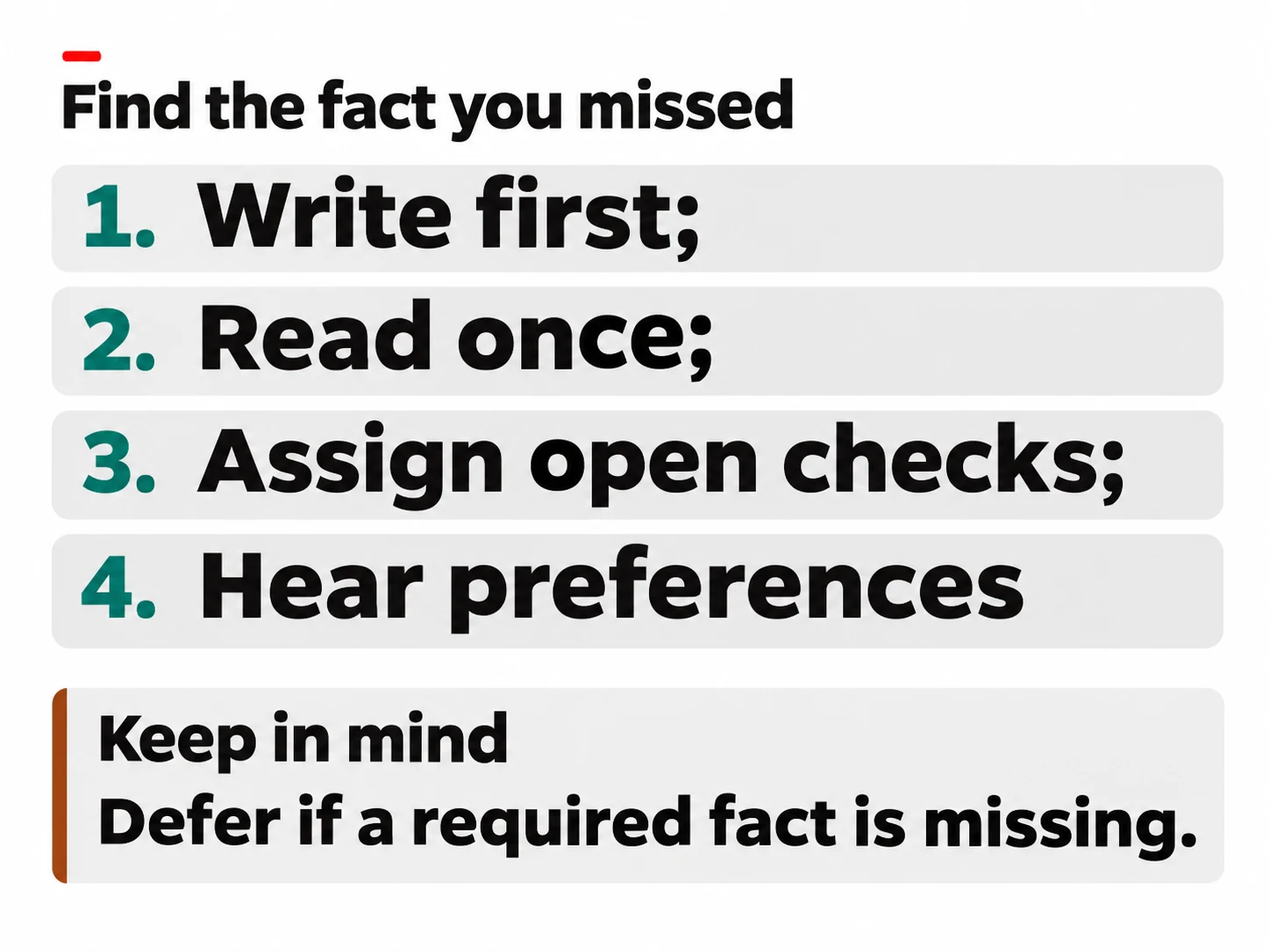
- Write first. Give everyone one quiet minute. Ask for one fact, its source and the option it affects. Keep preferences off the page for this round. If somebody cites a notice or message, write down which one and when it was issued.
- Read once. Go around the table. Give each person an uninterrupted turn to read a new observation or pass. When three people cite the same calendar entry, log the entry once. Add a second, independent confirmation to the same row.
- Mark what needs checking. Give each claim a verification status. Direct the next question to someone with access to the answer. Who can confirm which door stays open and when?
- Invite preferences after the evidence. Ask each person what they now favor and which fact matters most. Record the reason for the choice. Give any remaining check a person and a deadline.

Collect the facts first so you can see exactly what each option depends on.
Give everyone one minute to write one fact and its source. Read distinct facts once. Assign someone and a deadline to each open verification. Share preferences and name the source that supports the choice. Defer if a necessary fact is missing.
Stasser and Titus · Mojzisch and colleagues · Matsumura and Hashimoto · Nicholson and colleagues
Worked example. Write “Evening entry until 8 p.m.” above two venue names. Three people saw the same calendar entry for a free library room. A building notice adds a second fact. The code expires at 7 p.m. The community hall lists staffed entry until 8 p.m. Keep the library provisional while the organizer asks for written confirmation of a later code. Choose the community hall if the library cannot meet the entry requirement. The evidence list records which fact changed the choice.

A useful meeting note makes the open check obvious.
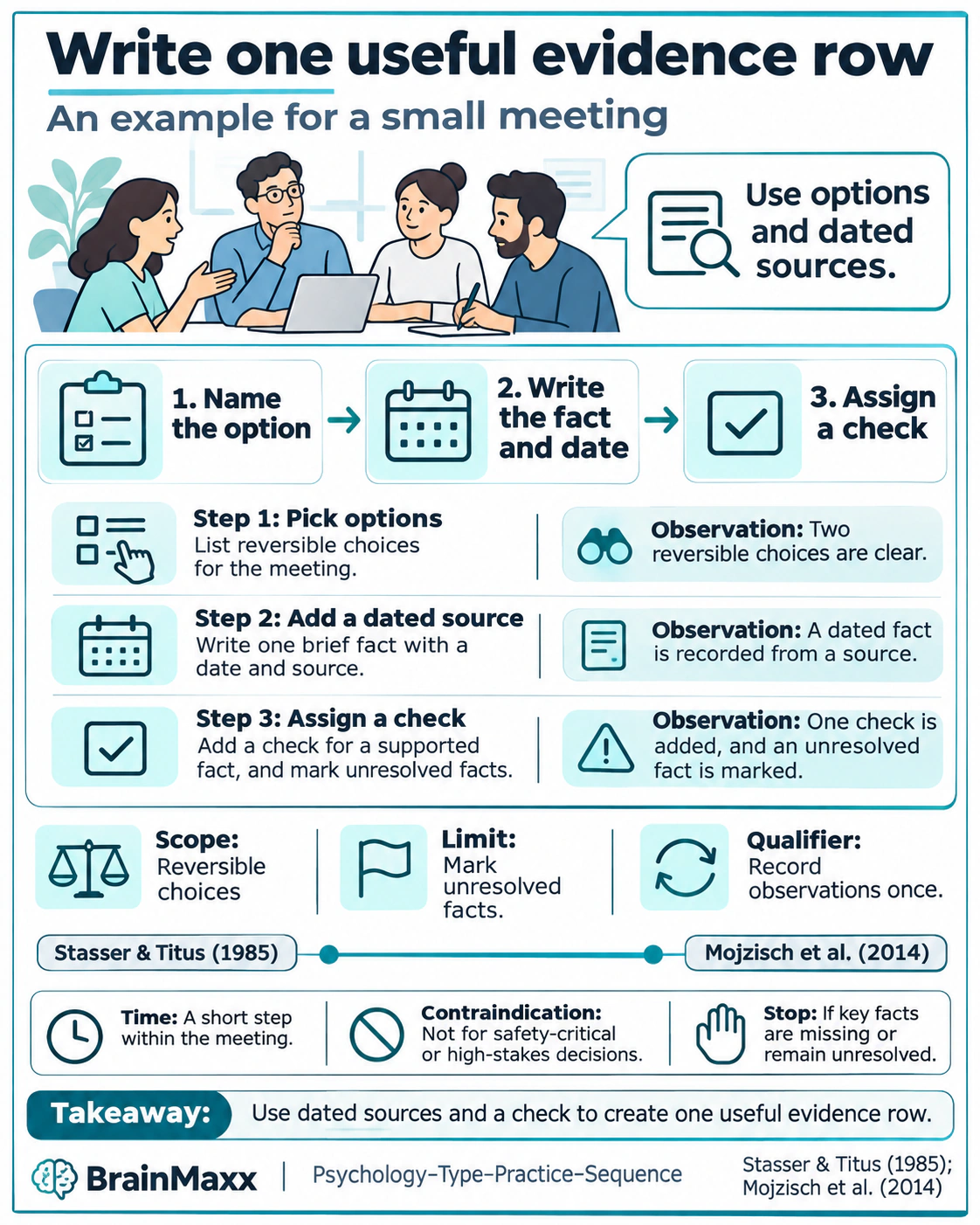
A small evidence row gives the option, the observation, its dated source and a person who can verify it. Combine repeated reports of the same source. Keep unresolved evidence visible beside the option it affects.
Write one useful evidence row An example for a small meeting Name the option Write the fact and date Assign a check Use options and dated sources. Mark unresolved facts. Record observations once. Reversible choices
Stasser and Titus · Mojzisch and colleagues
Familiar views can sound competent. In a simulated two-person task, Mojzisch and colleagues asked university students to rate their own and their supposed partner’s knowledge and competence. The combined ratings were higher when the partner’s information mostly supported the student’s existing preference. Use the evidence round to find out how a fact changes an option before letting a confident delivery settle the question. Mojzisch and colleagues, 2014.
Costs, risks and stop criteria
Set aside about ten minutes. The first turns can feel slow when a group is used to announcing preferences immediately. If everyone has seen the same current source and the choice is easy to reverse, close the round and move on.
If a favorite option still looks good, ask for one concrete reason it might fail. Matsumura and Hashimoto compared positive, negative and open discussion prompts in 39 groups of female Japanese university students. The authors reported different distributions of candidate choices across the prompts. Their results text and Table 1 give conflicting accounts of which prompt did best at finding the strongest candidate. Use the failure question to expose an unchecked fact; this study leaves the best prompt unsettled. Matsumura and Hashimoto, 2025.
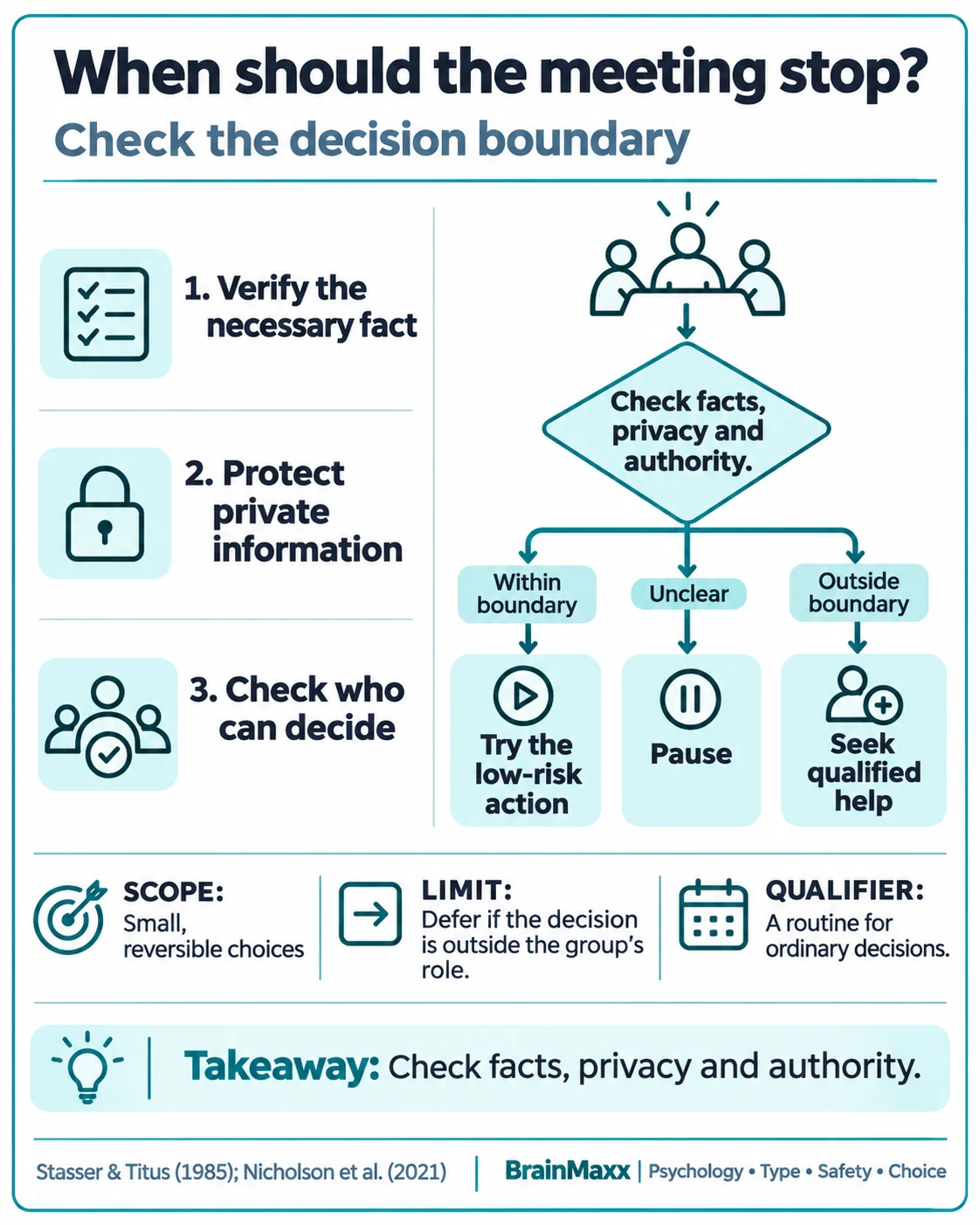
Stop and defer when a necessary fact is unavailable, somebody would have to expose private information, or your group lacks authority to decide. Get the fact from its owner or follow the appropriate review process. Disagreement in the room cannot diagnose a mental-health condition. A qualified health professional can help when difficulties persist across settings and interfere with daily life.

An essential gap changes the meeting’s next action.
For a decision outside the group’s role, defer and use the decision owner or appropriate review process.
Verify the necessary fact, protect privacy, and check who can decide. An unavailable fact, pressure to disclose private details or a decision outside the group’s authority is a reason to defer. The guide’s procedure is intended for small reversible decisions.
When should the meeting stop? Check the decision boundary Verify the necessary fact Protect private information Check who can decide Check facts, privacy and authority. Defer if the decision is outside the group’s role. A routine for ordinary decisions. Small, reversible choices
Stasser and Titus · Nicholson and colleagues
How to assess the result
Count the distinct, relevant observations with a traceable source on your page. Find one that ruled out an option, added a check or changed the decision. If the choice stayed the same, record which criterion it met after the check. If the round exposed a gap nobody could fill, bring in the person who can answer it or defer.
Nicholson and colleagues tried a different second pass. After a first decision, student teams in England and Portugal imagined a failed hire and considered remedies, or completed a word task. Among groups whose first choice was wrong, 10 of 33 in the simulation condition switched to the study-defined best candidate, compared with 0 of 26 in the word-task condition. The researchers found no reliable difference in participants’ reported awareness that group members had different information. That experiment used a second pass after a decision. Your evidence list shows what the group has surfaced before choosing. Nicholson and colleagues, 2021.
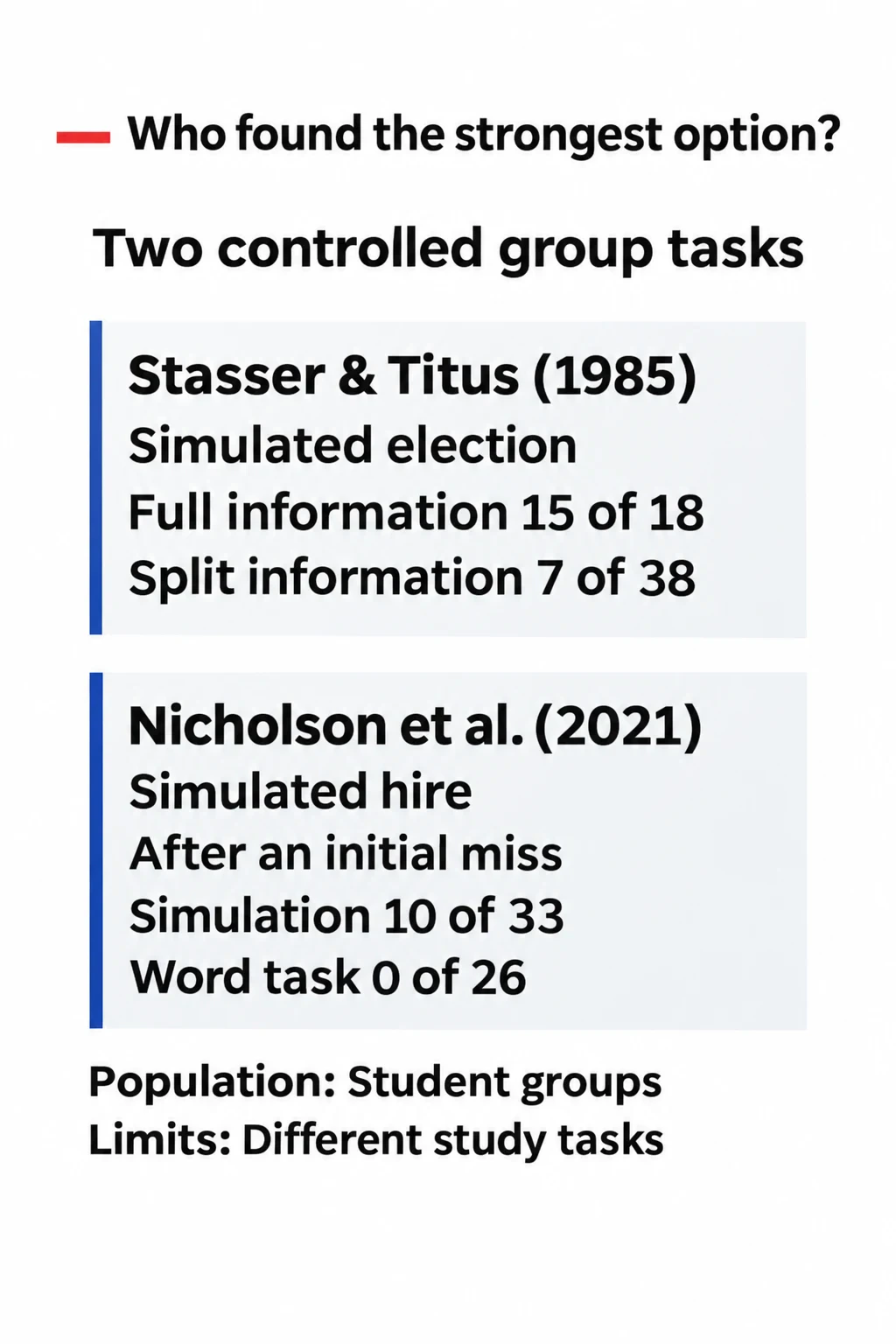
The experiments used different tasks and counted group decisions.
Stasser and Titus (1985) gave Miami University introductory psychology students full or split profiles for a simulated election. Of the groups that reached a decision, 15 of 18 with full information chose the strongest candidate, compared with 7 of 38 with split information. One more group in the split condition made no decision. In a separate simulated hiring task, Nicholson and colleagues (2021) studied only the groups that made an initially suboptimal choice for the cited analysis. On a second pass, 10 of 33 groups who imagined a failed hire and considered remedies switched to the study-defined best candidate, compared with 0 of 26 groups who did a word task. These experiments used different interventions and groups.
Stasser and Titus · Nicholson and colleagues
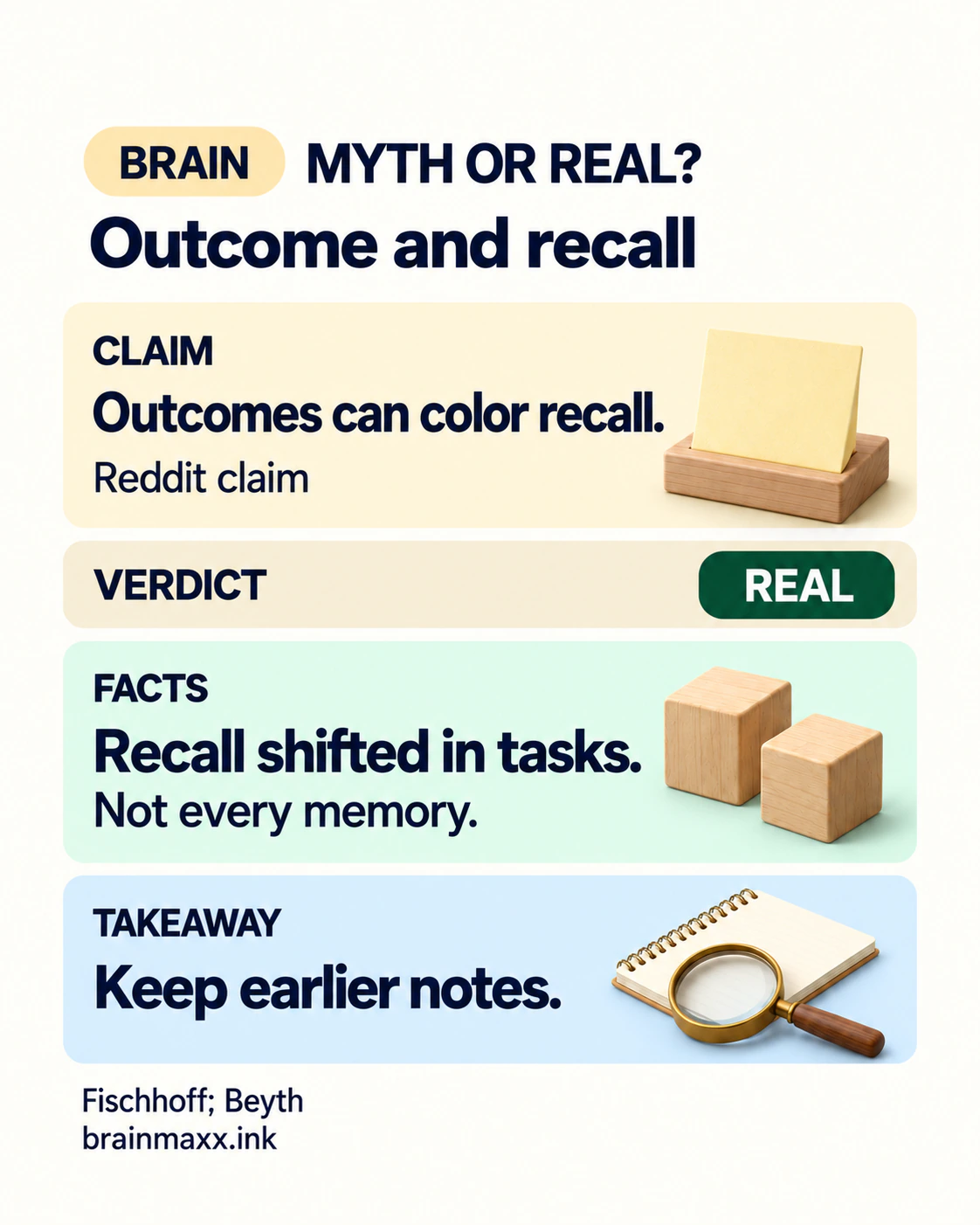
Myth or Real?

Claim
Social paraphrase: Giving different leads equal voice brings expertise into the discussion and leads to better decisions.
Verdict
MIXED
Facts
A group can miss important information held by a single member.
The experiment compared access to information in a simulated election.
The viewpoint values equal voice and distributed expertise. The independent experiment concerns information distribution in a simulated election. A group can still miss unshared evidence; this does not establish whether flat or hierarchical workplaces make better decisions.
Takeaway
Ask for one fact others may have missed.
Sources
Claim discussion: Product-management discussion.
Evidence: Stasser and Titus (1985).
Checked 2026-11-18. Scope: A simulated student election varied access to candidate facts; it did not compare organizational hierarchy or equal voice in real workplaces.
Sources
- Stasser and Titus (1985) varied the distribution of candidate information in groups of introductory psychology students. Original election experiment.
- Mojzisch and colleagues (2014) tested how preference agreement and sharedness influenced perceptions in dyads. Original communication experiments.
- Matsumura and Hashimoto (2025) varied the questions student groups heard before an election task. The results text and Table 1 give different accounts of the strongest candidate’s selection. Final journal version.
- Nicholson and colleagues (2021) tested a second-pass simulation in a group hiring task. Original paper.
FAQ
Common questions
What is a hidden profile?
In a hidden-profile study, each person sees part of the information. The full set of facts reveals the option that meets the study criteria best.
What should I write in the evidence list?
Record the option, the checkable fact, the dated source, and who can verify any open point. Put repeated reports of the same source in one row.
When should the meeting defer the decision?
Defer if a required fact is missing, if asking would expose sensitive details, or if the group lacks authority to decide.
Topic hubs
Tags