Before estimating a quantity, it helps to ask where the first number came from. Is it a relevant measurement, a previous result with useful similarities, or simply the number someone happened to mention? Anchoring research concerns the influence a starting value can have on a later numerical judgment. Recognising that possibility gives you a question to investigate; it does not tell you that every estimate is biased.
For ordinary estimates, make the basis visible. State what you are estimating, look for relevant records or measurements, and explain why those support your answer. If a reliable count is available, obtaining it may be more useful than adjusting a guess. The checking routine below is an editorial suggestion, not a validated programme for eliminating anchoring.
The short answer
An initial number can pull later estimates toward it, including in experiments where the number was not useful evidence about the answer. A higher estimate after a higher starting value is a pattern researchers can examine across conditions. It is not a diagnosis of a particular person’s reasoning, and it does not make every first number irrelevant.
The practical distinction is between a number’s presence and its evidential value. A measured dimension can be an excellent starting point. An unrelated suggestion can be a poor one. A previous event’s attendance may be informative only after you ask whether this event has the same audience, capacity and purpose. Replacing one unsupported number with another does not create better evidence.
Use this article for ordinary numerical questions, such as estimating supplies or a rough quantity for a small project. It does not provide a clinical assessment, negotiation strategy, valuation service or method for making consequential financial, legal or medical decisions.
Definitions and scope
An anchor is a starting or comparison value considered in making an estimate. An anchoring effect describes estimates shifting toward that value under the conditions being studied. Whether the answer is inaccurate is a further question: the true value, quality of the information and comparison design matter.
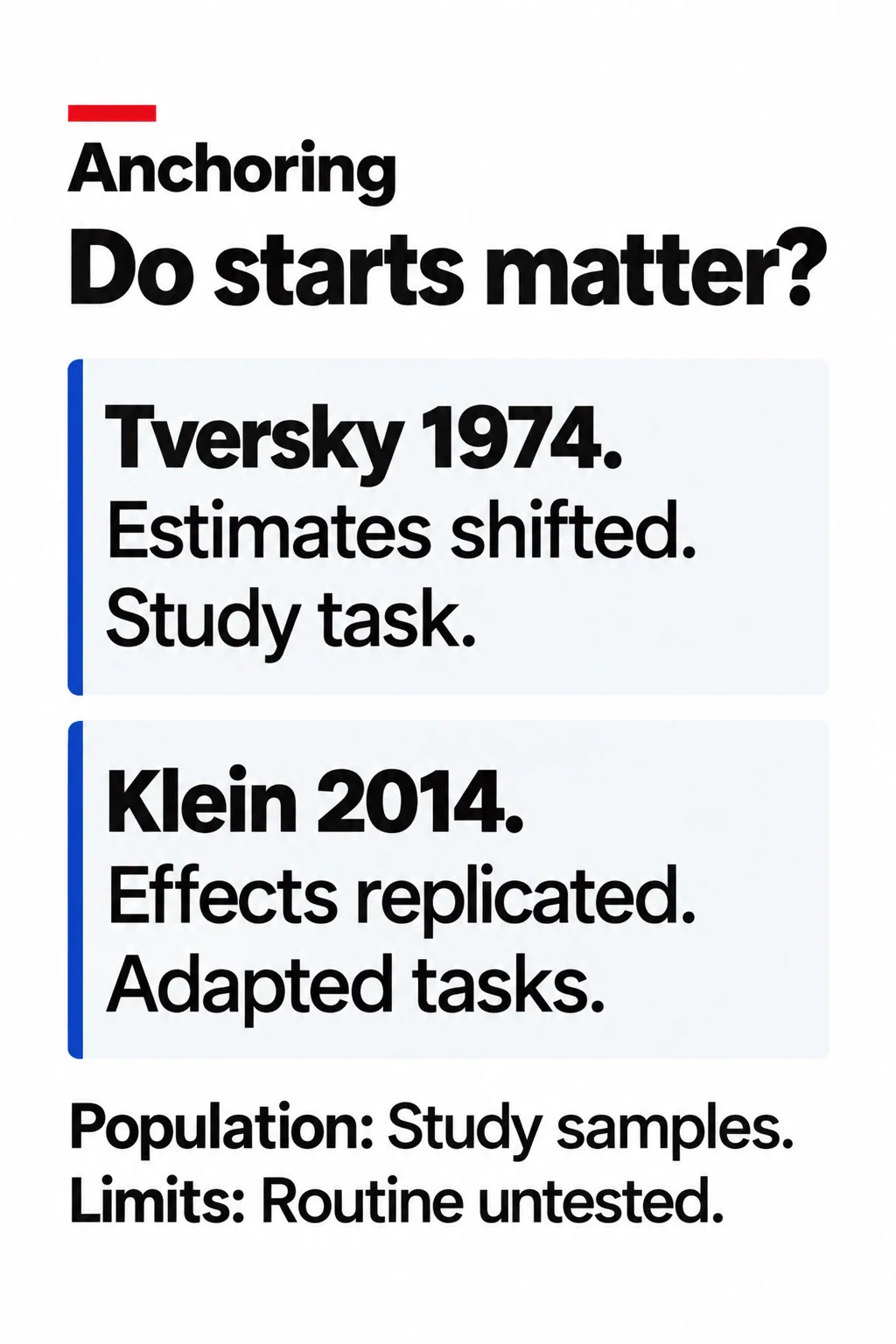
Tversky and Kahneman’s 1974 paper describes a classic demonstration using a wheel-generated number before a percentage estimate. Groups given different starting numbers produced different median estimates. The supplied value was not a measurement of the quantity being estimated. That matters more for understanding the demonstration than memorising the historical numbers. The paper discusses several judgment heuristics; its anchoring passage does not establish the prevalence of biased everyday choices. Tversky and Kahneman, 1974, printed page 1128.
A number can also be generated by the person estimating. You may recall a familiar reference and move away from it to answer a less familiar question. That differs from an experimenter supplying a comparison number. The distinction is useful because studies that share the word “anchoring” need not test the same process or practical remedy.
Keep this separate from disagreement. Two people may have different information, definitions or requirements. Before explaining their estimates through a bias, check whether they are answering the same question. A figure for boxes, individual items or complete sets can look inconsistent while each calculation is internally sensible.
How it works
Epley and Gilovich’s 2006 experiments examined adjustment from self-generated starting points. Their results were consistent with people sometimes stopping toward the anchor side of a range they considered plausible. The authors distinguished this adjustment account from accounts of supplied comparison anchors. Their study therefore does not justify describing every anchoring effect as the same sequence of consciously moving too little. Epley and Gilovich, 2006.
For a reader, the useful caution is that a plausible answer and a well-supported answer are different standards. A number may sound reasonable without being based on the relevant records. That observation does not reveal an individual’s hidden mental process. You can ask for the basis of an estimate without claiming to know how someone arrived at it.
Imagine an organiser suggesting a quantity for supplies before the group has checked the attendance list. You do not need to prove that the suggestion has anchored everyone before asking to inspect the list. The missing information is enough reason to check. Conversely, if the organiser’s number comes from a current confirmed count, moving away from it merely to resist influence would discard useful evidence.
The question is therefore not “How far should I move from this number?” It is “What information should determine this estimate?” Sometimes the answer stays the same. Sometimes it changes substantially. Either result needs reasons that can be assessed independently of whether the original suggestion was high or low.
What the evidence supports
Controlled comparisons make the influence testable
Jacowitz and Kahneman’s 1995 article describes a calibration group estimating uncertain quantities without the supplied anchors. Other participants first made a higher-or-lower judgment against a comparison value before estimating. The public abstract explains how the method relates anchored responses to the calibration distribution. That offers a way to study shifts across groups; it is not an individual’s self-test. Only the publisher’s abstract was available for this article’s direct reading of that paper, so detailed sample and result claims are withheld. Jacowitz and Kahneman, 1995.
In a personal decision, you usually lack a parallel group of otherwise comparable people who never encountered the number. You cannot reconstruct what you would have estimated by wishing the exposure away. A changed answer after reading this article also does not establish that a bias was present or removed.
Replication supports specific tasks
The 2014 Many Labs project repeated four estimation topics adapted from the Jacowitz and Kahneman work, within a broader multi-site replication study. Its results supported anchoring effects on those tasks. The replication used a modified question procedure and adjusted units where needed. Its overall participant total covers the broader project; item-specific analysed samples differ. These are repeated numerical tasks across study samples, rather than a survey of how often everyday decisions go wrong. Klein and colleagues, 2014, methods and results.
Replication strengthens confidence that the reported pattern was not confined to a single original demonstration. It does not make all quantities equally susceptible or establish how much a particular estimate will move. The study also does not validate the complete practical routine suggested below.
Mechanism and remedy require their own evidence
The 2006 adjustment studies used specific tasks, student participants and item-level inclusion rules. Their findings cannot simply be relabelled as proof that every supplied anchor can be overcome through extra effort. A reporting inconsistency in that paper’s sample description is retained in the research notes; this article does not publish an exact combined sample count or invent a correction. No personal probability of being anchored is calculated from these papers.
Misconceptions and uncertainty
“Ignore the first number.” Some first numbers are reliable evidence. Ask how a number was obtained, whether its units match and whether it answers the present question. Rejecting a relevant measurement because it arrived early is not the purpose of checking an estimate.
“Split the difference.” The midpoint of two suggestions is a calculation, not automatically an accurate answer. If neither suggestion has a useful basis, averaging them preserves that weakness. If one is a measurement and the other a guess about a different quantity, equal weighting needs justification.
“A different answer proves the check worked.” A revision might reflect new records, a changed requirement, a correction or another unsupported suggestion. Assess the evidence and assumptions behind it. A changed number alone is an inadequate measure of improvement.
“A range removes bias.” A range can communicate uncertainty, but its endpoints also need a basis. Do not label an informal low-to-high planning allowance a statistical confidence interval. Nor does writing two endpoints establish that the true value lies between them.
“Knowing the term makes me immune.” These papers do not establish that reading a definition prevents anchoring in all settings. Keep the practical ambition modest: make an estimate’s basis easier to inspect. Avoid turning the concept into a contest over who is rational.
“Someone else’s estimate reveals their motives.” A numerical disagreement does not establish manipulation, carelessness or a personality trait. Ask about information and requirements before applying an explanation. You can improve the shared question without labelling the person answering it.
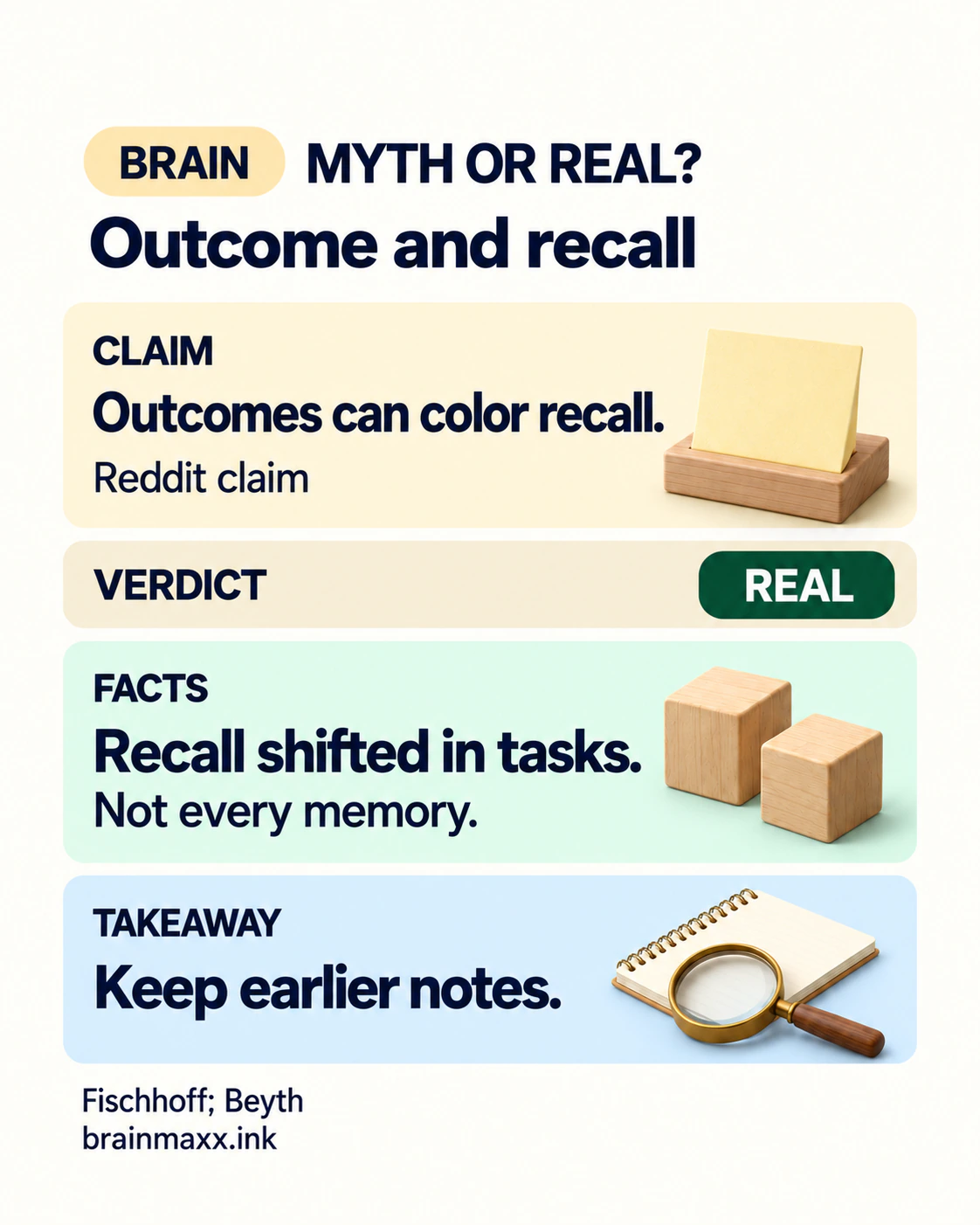
Myth or Real?

Claim
Social paraphrase: Once an anchor is set, all later estimates are pulled toward it.
Verdict
MIXED
Facts
Studies show shifts in particular estimation tasks, rather than control over every later decision.
Task effects do not diagnose an individual or validate the complete estimate-check routine.
MIXED recognises observed influence while rejecting the leap to universal control. The historical wheel demonstration and the later adapted estimation tasks support shifts under their studied conditions. They do not diagnose a particular reader or establish that every estimate after every starting number must move. Different tasks and sources of an anchor can involve different processes. A useful first measurement may deserve to be retained. Neither publication tests this complete estimate-check organiser or proves that changing an answer removes bias. These two papers are reused from the article; the public post adds no independent scientific evidence. For an ordinary reversible estimate, define the quantity, inspect relevant records and state what remains uncertain. A range needs a basis and is not automatically a statistical confidence interval. Stop checking proportionately; do not chase certainty through repetitive or distressing use. Consequential financial, legal or medical decisions require appropriate expertise, and persistent distress or interference can warrant suitable qualified support.
Takeaway
Check the starting figure against relevant measurements or records; retain useful evidence even if it came first.
Sources
Claim discussion: Public claim that starting figures control later estimates.
Evidence: Tversky and Kahneman: Judgment under Uncertainty; Klein and colleagues: Many Labs Replication Project.
Checked 2026-10-19. Scope: The public universal all-later-estimates framing, not a claim that numerical anchoring never occurs. Prices, personal experiences, financial/negotiation advice and proposed mechanisms in the post are outside scope.


Practical meaning and sources
An optional estimate-check routine
- Define the quantity. Write its units, date, population or project boundary. “Packets for confirmed attendees” differs from “materials for everyone who might arrive.” Decide which one the task requires.
- Record the starting value and its origin. Distinguish a current count, a dated record, a rough suggestion and a remembered benchmark. You need not assign a bias score to any of them.
- Look for relevant evidence. Use an available measurement or comparable record. Check whether repeated estimates trace back to the same original guess; repetition alone does not create independent support.
- Explain the answer and remaining uncertainty. State what changed, what remains unknown and what would prompt an update. Keep an informal range clearly labelled as an assumption-based planning range.
- Use a stopping rule appropriate to the task. For a small reversible choice, one adequate check may be enough. For a consequential decision, obtain the relevant expertise or required evidence rather than relying on this routine.
There is no fixed number of sources, minutes of reflection or amount of adjustment that this article can prescribe as an effective remedy. The routine is a way to organise an ordinary question. It has not been tested here as a complete intervention, and it does not promise a more accurate answer every time.
A completed example, with invented numbers
Suppose someone suggests preparing 120 packets for a small club event. The organiser checks the current list: 62 people are confirmed and six more may attend. Under the stated assumption of one packet per person and no other recipients, 62–68 packets is an informal planning range. The organiser records the attendance basis and asks whether staff or walk-in visitors also need packets before placing an order.
The original 120 might have come from an earlier, larger event. That history can be worth understanding without becoming the requirement for this one. The organiser does not split the difference between 120 and the current list, or claim that selecting a lower number proves immunity to anchoring. If additional recipients are expected, the estimate needs an explicit allowance or an updated count.
This is an invented illustration, not a tested intervention or observed customer outcome. Its range follows the stated attendance assumptions; it is not a statistical confidence interval or a guarantee about actual turnout. The useful change is making the basis and missing information visible.
| What you find | A useful response | What it does not prove |
|---|---|---|
| The starting number comes from a relevant current count | Use it with the correct units and scope | Every earlier suggestion was biased |
| Several estimates repeat one unsupported suggestion | Seek a separate basis | Their agreement supplies independent evidence |
| A previous event differs materially from this one | Explain the differences before using its figures | The old figure is always worthless |
| Important information remains unavailable | Retain explicit uncertainty or postpone a commitment | A narrow range is justified by confidence alone |
Keep any note proportionate to the decision. A short record of the question, evidence and assumptions can make a later update understandable. If you check again, do it because new information or the task’s consequences warrant it, rather than because certainty still feels incomplete. Stop if the exercise becomes repetitive or distressing. Persistent distress or interference with daily life deserves appropriate professional support; this article provides no clinical assessment or treatment.
The useful result is an estimate you can explain, including its limits. That may mean retaining the original figure because the evidence supports it. It may mean changing it, choosing a broader allowance or deciding that a measurement is needed before proceeding. Resistance to a first number is not itself the goal.
Sources
- Tversky and Kahneman, 1974: Judgment under Uncertainty. Historical demonstrations; selected printed pages 1128–1129 read as scan images.
- Jacowitz and Kahneman, 1995: Measures of Anchoring in Estimation Tasks. Publisher abstract only; detailed methods and sample claims are withheld.
- Epley and Gilovich, 2006: The Anchoring-and-Adjustment Heuristic. Selected methods and discussion; the reported sample-count inconsistency is not resolved here.
- Klein and colleagues, 2014: A Many Labs Replication Project. Adapted estimation tasks; question procedure, units and analysed samples qualify the comparison.
The four linked papers provide a historical demonstration, a measurement approach, a proposed adjustment account and multi-site replication evidence. Their questions and samples overlap in places; four citations are not four independent tests of the suggested routine. The 1974 scan was read through its relevant page images, the 1995 paper through its public abstract, and the 2006 and 2014 papers through selected full-paper methods and results. No brain scan, clinical diagnosis, current prevalence estimate or guaranteed debiasing benefit follows from this evidence.
FAQ
Common questions
Should I ignore the first number to avoid anchoring?
Some first numbers are reliable evidence. Ask how a number was obtained, whether its units match and whether it answers the present question. Rejecting a relevant measurement because it arrived early is not the purpose of checking an estimate.
Does a changed estimate prove that a bias was removed?
A revision might reflect new records, a changed requirement, a correction or another unsupported suggestion. Assess the evidence and assumptions behind it. A changed number alone is an inadequate measure of improvement.
Is the packet planning range a confidence interval?
Its range follows the stated attendance assumptions; it is not a statistical confidence interval or a guarantee about actual turnout. The useful change is making the basis and missing information visible.
Topic hubs
Tags