Finding an example that fits your explanation can feel like making progress. Sometimes it is. The question is whether the same example also fits another plausible explanation. If it does, collecting more of that kind of example may leave the central uncertainty untouched.
An ordinary alternative check starts with a specific claim, identifies a credible competing explanation and asks what observation would help distinguish them. That is more useful than deciding that every supportive result is worthless or that disagreement proves somebody else is biased. It also leaves room to keep the original explanation when the evidence supports it.
The short answer
Confirmation bias is a broad label for ways of seeking or interpreting evidence that favour a belief, expectation or hypothesis already in view. The label covers different patterns. It should not substitute for explaining what was selected, how it was interpreted and what relevant alternative was missed. Nickerson, 1998.
To give an alternative a fair test, ask what each explanation predicts and look for relevant evidence that could separate them. Judge the quality of that evidence using standards that you would also apply to your preferred explanation. You do not have to manufacture an equally credible opposing view for every well-supported fact.
This article offers an optional organising routine for ordinary questions, rather than a diagnostic test or a proven method for eliminating bias. It is not clinical treatment, professional investigation or a guarantee that an answer will become correct. For consequential medical, legal, financial or safety questions, use appropriate expertise and the evidence standards relevant to that decision.
Definitions and scope
It helps to separate three questions. Seeking concerns which evidence you look for or encounter. Testing concerns which cases or observations you choose to examine. Interpreting concerns how you evaluate what you find. A person can seek a useful case but explain away its unfavourable result; another can select a weak test while evaluating its outcome honestly. The same broad label need not describe the same process.
Nickerson’s historical review discusses a family of evidence-handling patterns, including cases where an existing belief is defended without deliberate intent. It does not give this article a way to infer a stranger’s motives, identify a personality trait or estimate how biased an individual is. A mistake and a disagreement are not, by themselves, proof of confirmation bias. Nickerson, 1998.
A positive test strategy is more specific: examining cases expected to have a property of interest, or cases already known to have it. That description does not mean that the test must return a favourable answer. The result may still conflict with the hypothesis. Whether the strategy is useful depends on the relationship between the hypothesis, the possible cases and the information available. Klayman and Ha, 1987.
Here, an alternative means a plausible explanation for the defined observation. It does not mean the exact verbal opposite, a speculative accusation or any imaginable possibility. An alternative can deserve consideration without deserving equal weight. The practical question remains what evidence bears on the alternatives, with what limits.
How it works
A confirming example can fit several rules
Wason’s 1960 experiment asked psychology undergraduates to discover a rule for number triples. Participants began with 2, 4, 6 and could propose other triples, receiving feedback on whether each fitted the rule. The intended rule was three numbers in increasing order. A narrower guess could repeatedly generate examples that also fitted that broader rule, leaving its unnecessary restrictions untested. Wason, 1960.
The point is about the structure of this task. Evidence compatible with a claim need not identify it uniquely. It does not follow that confirming evidence is always useless, that all human reasoning works like a number puzzle or that every everyday hypothesis has a simple decisive counterexample.
A negative-looking test is not automatically better
Klayman and Ha distinguish the aim of finding an error in a hypothesis from a rule that one should always test cases expected not to have the target property. Those are different ideas. Their analysis shows why the informativeness of a strategy depends on the task, including which cases are common and how the proposed and true rules relate. Klayman and Ha, 1987.
For an ordinary question, this suggests asking what you would learn from each possible outcome. A check that gives the same expected result under both explanations may have limited separating value. A supportive outcome can be informative if the alternative would have made it unlikely; an unfavourable outcome can be ambiguous if the observation is unreliable. These are reasoning questions, without a universal calculation of evidence strength supplied by this article.
Interpretation needs the same attention as search
Looking for an alternative is only part of the job. Notice whether you accept a preferred source’s weak method while demanding certainty from an inconvenient source. Also notice the reverse: rejecting sound evidence solely because it agrees with your first view would create another poor standard.
Source quality, relevance, measurement and uncertainty still matter. A repeated claim copied across several pages is not several independent observations. A result can deserve a limited interpretation without proving the whole explanation. These are editorial evidence-checking prompts; the four selected papers have not validated this complete everyday routine as an intervention.
What the evidence supports
The selected evidence serves different roles. Wason’s original rule-discovery experiment demonstrates a difficulty in a deliberately structured task. It used a small undergraduate sample and a known experimenter-held rule. It is not a population survey of everyday reasoning, and it provides no personal score for you. Wason, 1960.
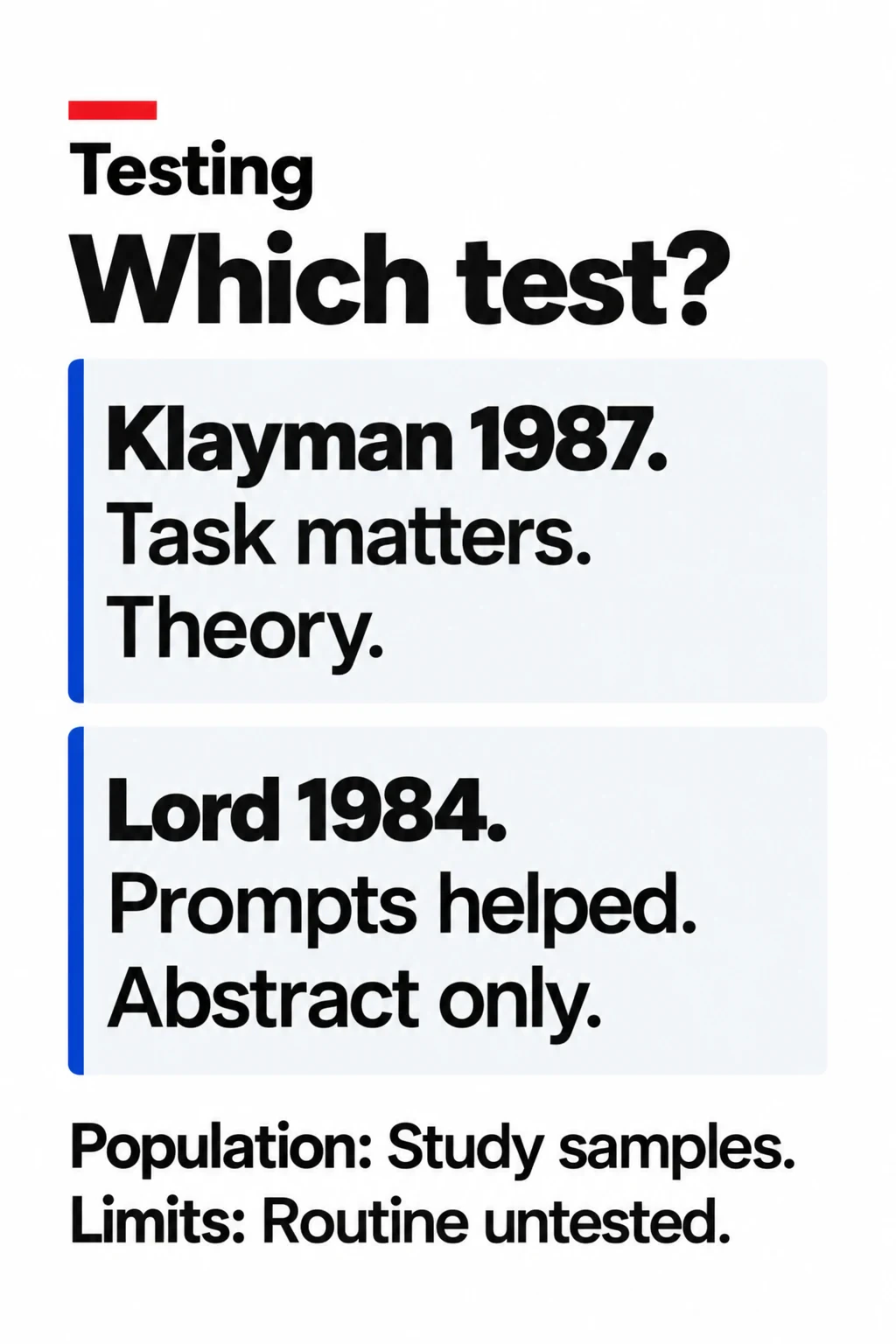
Klayman and Ha provide a theoretical analysis of hypothesis testing and information. Their argument cautions against treating every positive testing strategy as irrational. This is a distinction about strategy and task conditions, rather than a new trial showing that a particular everyday checklist works. Klayman and Ha, 1987.
Lord, Lepper and Preston’s 1984 abstract reports two experiments involving social-issue evidence and personality-impression testing. Instructions or materials that made opposite possibilities salient had more corrective effect in those tasks than instructions to be fair and unbiased. The abstract does not establish lasting everyday benefits, clinical effectiveness or a universal improvement rate. This article uses the abstract only, without claiming access to its full methods or results. Lord, Lepper and Preston, 1984.
Nickerson’s 1998 review organises a broader historical literature and discusses different explanations and manifestations. It overlaps research represented by the other sources. It is not an additional independent participant sample, a current systematic review of every intervention or a basis for pooling four effect sizes. Nickerson, 1998.
Together these documents support careful distinctions and bounded questions about evidence. They do not establish one mechanism for every instance, equal susceptibility across settings or immunity after learning the term. No pooled magnitude, everyday prevalence estimate or guaranteed accuracy benefit is claimed here.
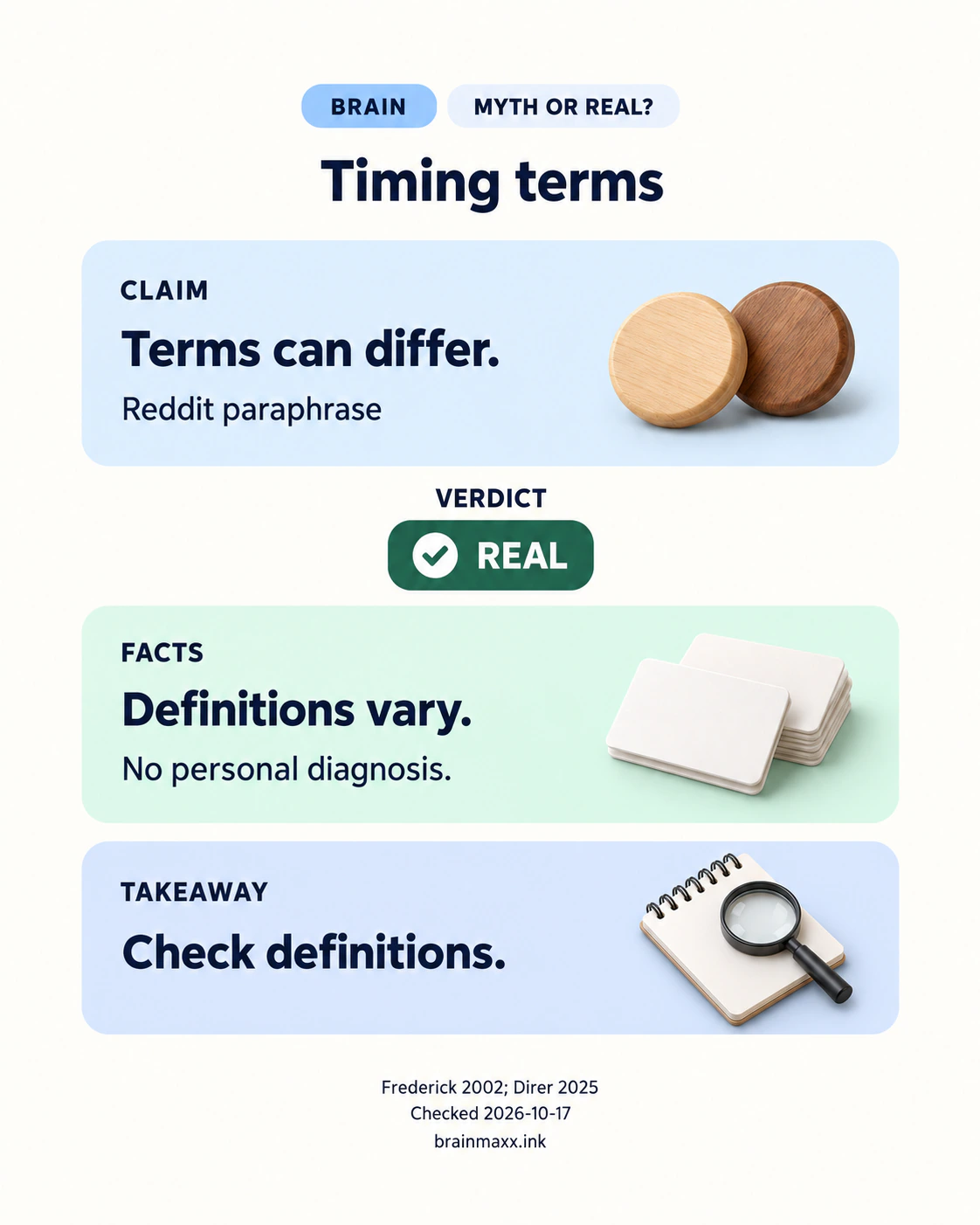
Myth or Real?

Claim
Social paraphrase: Considering an opposite possibility can help with biased judgment.
Verdict
REAL
Facts
The selected public abstract reports corrective effects from opposite prompts in experimental judgment tasks, compared with fairness instructions.
This supports a limited possibility, not lasting everyday benefits, equal weight for all views or proof of this complete routine.
REAL applies to a bounded can-help statement. Lord, Lepper and Preston report greater corrective effects from making opposite possibilities salient than from fairness instructions in selected social-judgment tasks. Only their public abstract was used, so detailed samples, methods, magnitudes and persistence are not claimed. Klayman and Ha provide task-sensitive theory, not an independent intervention trial: positive tests can be informative, and a negative-looking test is not always better. These reused main sources do not add to the four scholarly works. The social recommendation is not proof, and its complete exercise was not validated by these documents. A plausible competing explanation need not receive equal weight; retain sound supportive evidence and comparable quality standards. This optional everyday organiser cannot diagnose or treat a condition or guarantee accuracy. Stop repetitive/distressing checks, avoid covert or unsafe tests, use suitable expertise for consequential questions and qualified support for persistent interference.
Takeaway
Ask how relevant evidence bears on a plausible alternative, and keep the uncertainty visible.
Sources
Claim discussion: Public management discussion: How to Overcome Confirmation Bias.
Evidence: Lord, Lepper and Preston: Considering the Opposite, public abstract; Klayman and Ha: Confirmation, Disconfirmation, and Information in Hypothesis Testing.
Checked 2026-10-18. Scope: Only the general can-help proposition in a public opposite-argument recommendation. No verdict on its full flip-debate/advisor package, linked page or unrelated brain, intelligence, algorithm and backfire claims.
Misconceptions and uncertainty
“I found support, so my explanation is proved.” Ask whether the evidence also fits a credible alternative. Support can matter without settling the question.
“I must always look for the opposite.” Define a plausible competing explanation and consider the information each check could provide. A random contradiction may add noise rather than insight.
“Fairness means giving both views equal weight.” The quality and amount of evidence can differ substantially. Equal consideration of a relevant question does not require an equal verdict.
“Changing my mind proves I fixed the bias.” A change can follow weak evidence too. Retaining a well-supported view can be reasonable. Review the reasoning and source limits, rather than treating movement itself as success.
“Someone who disagrees is showing confirmation bias.” You may be missing evidence, using different definitions or addressing a different question. Describe the reasoning issue before attaching a label, and avoid claiming access to another person’s mental process.
“More searching will eventually make me certain.” Some questions remain uncertain, and repeated checking can become unhelpful. Proportionate stopping is part of the routine. Pause when further browsing repeats the same material, when the decision exceeds your expertise or when checking causes persistent distress.


Practical meaning and sources
An optional alternative-check routine
- Write one answerable claim. Include the relevant situation and outcome. Replace a sweeping character judgment with a concrete question you can investigate appropriately.
- Name a plausible alternative. Explain how it could account for the observation. Do not create a straw man or assume that every explanation has equal prior support.
- Describe a useful difference in predictions. Ask what each possible finding would mean. Avoid tests that cannot distinguish the explanations or that put people or equipment at risk.
- Check the evidence and interpretation. Use relevant records or reliable sources, note shared origins and apply comparable quality standards to supportive and inconvenient results.
- Record a bounded conclusion and stop. Keep, revise or leave the question open. State what remains unknown and when additional evidence would matter.
The sequence is an editorial translation of the source distinctions. It has no required number of sources, time limit or repeated checking schedule. It does not license covert tests of another person, disregard for expert evidence or delaying an important professional decision while seeking certainty.
| Situation | A useful next question |
|---|---|
| Several examples support the same claim | Do they also fit the plausible alternative? |
| A source challenges your view | Is its method relevant and reliable under the same standards? |
| Two pages repeat one report | Is there another observation, or only another copy? |
| A check gives an ambiguous result | What remains unresolved, and is further investigation worthwhile? |
| The question is consequential or checking becomes distressing | What appropriate expertise or support should replace more self-testing? |
A brief private note can hold the claim, alternative, observation and uncertainty. You do not need a bias score or an argument to win. If you involve another person, ask a clear, respectful question rather than using a psychological term to dismiss their answer.
Consider an explicitly invented reservation example. A person receives no confirmation email and concludes that their room reservation did not save. A plausible alternative is that a record exists but the email did not arrive. Repeating “there is still no email” does not separate those explanations very well.
They check their own reservation through the provider’s authorised confirmation page, using the correct account and date. In this fictional case, the page shows a record with the expected reference and date. They revise the limited claim: a matching record is visible, while the reason for the missing email remains unknown. They read any remaining status wording and contact the provider if they need clarification before relying on the booking. They do not conclude that every part of the reservation is guaranteed or diagnose an email fault. If no record had appeared, a wrong account or date could still have left uncertainty. The example illustrates a difference in useful questions, without reporting a customer outcome or validating the routine.
The useful outcome is a better specified question and an honest account of the evidence. It can include keeping your original explanation. For persistent distress or checking that interferes with daily life, seek suitable qualified support; this ordinary organiser cannot diagnose or treat a mental-health condition.
Sources
Sources are selected historical scholarly documents, with overlapping topics and no paid product or intervention endorsement:
- Wason, 1960, On the Failure to Eliminate Hypotheses in a Conceptual Task. Original rule-discovery experiment; selected substantive PDF passages read.
- Klayman and Ha, 1987, Confirmation, Disconfirmation, and Information in Hypothesis Testing. Task-sensitive theoretical analysis; positive testing is not automatically poor testing.
- Nickerson, 1998, Confirmation Bias: A Ubiquitous Phenomenon in Many Guises. Historical review, with selected definition and strategy passages read.
- Lord, Lepper and Preston, 1984, Considering the Opposite. Actual PubMed-hosted abstract read; full text and detailed methods were not used.
FAQ
Common questions
Is a positive test always confirmation bias?
No. Testing a case expected to have a property can still reveal an error or provide useful information. Its value depends on the hypothesis, possible observations and task conditions; the result need not favour the initial explanation.
Does fairness mean giving both explanations equal weight?
No. A competing explanation should be plausible and relevant, and the quality and amount of evidence can differ. Apply comparable quality standards without manufacturing equal support for an unsupported view.
Does considering the opposite cure confirmation bias?
No cure is established here. The selected public abstract reports corrective effects in particular judgment tasks, while the theoretical paper explains task conditions. These sources do not validate this complete everyday routine, provide a personal score or establish lasting benefits.
Topic hubs
Tags