A clear plan can describe how a task should unfold while giving a poor forecast of when it will finish. The planning fallacy concerns overly optimistic predictions that can persist despite experience of similar work taking longer. It does not mean every late task was predictable, every ambitious target is irrational or the person making an estimate has a disorder.
One useful starting point is to compare the current plan with recorded outcomes from genuinely comparable work. But “use the past” is not a guarantee of accuracy. Memories can be distorted, the chosen comparisons can be unsuitable, and removing an average optimistic bias can leave individual prediction errors just as large.
The short answer
Keep the plan and the forecast visible as different things. A plan describes the intended steps and arrangements. A forecast asks what completion is plausible given those arrangements, relevant past outcomes and remaining uncertainty. A deadline is a constraint or commitment; it is not evidence that the work will fit.
The practical approach in this article is an optional organiser for ordinary adult tasks. Define completion, look for usable records, compare like with like, explain material differences and retain uncertainty. It is an editorial translation of several research strands, rather than a validated complete intervention or a promise that your next estimate will be right.
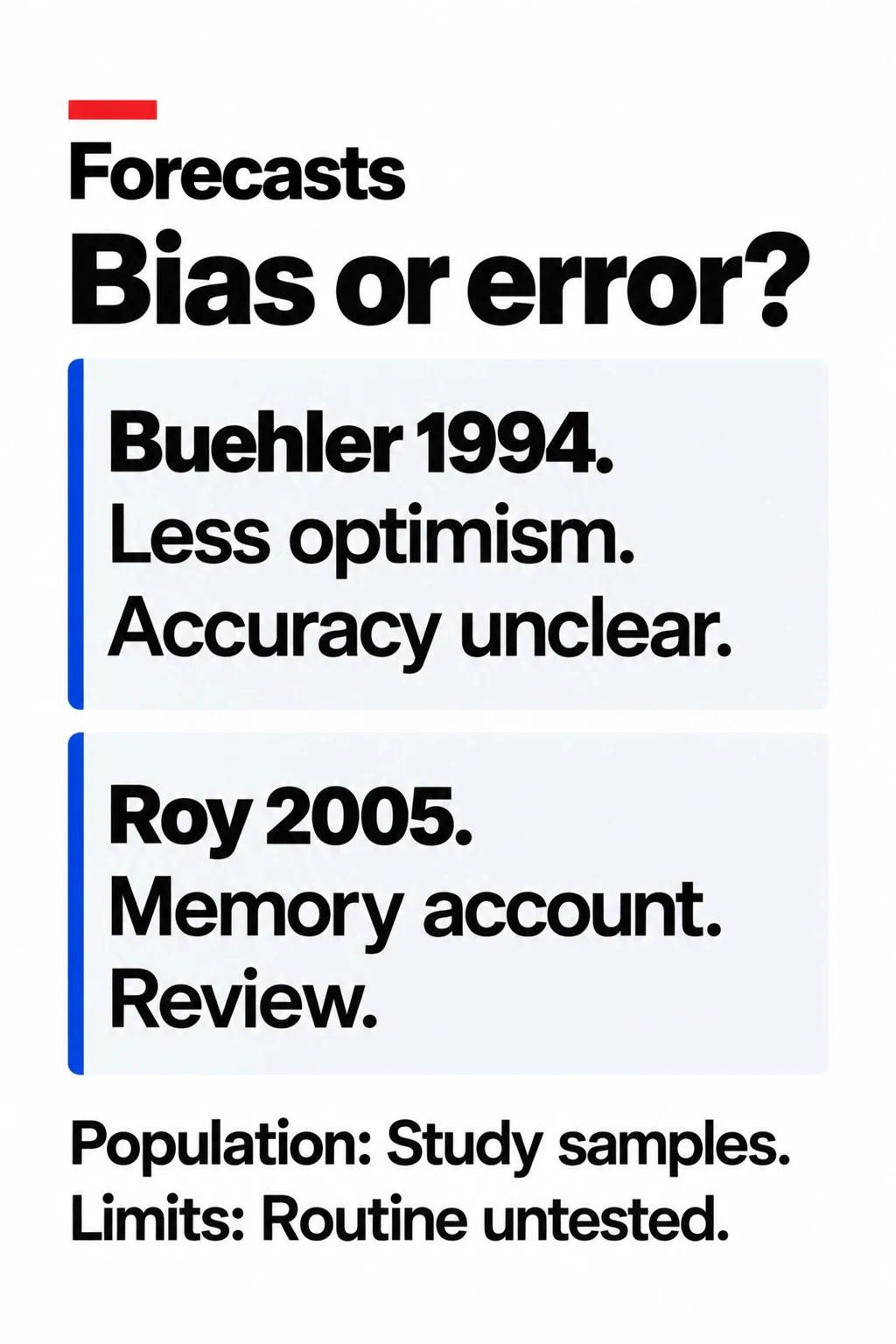
An important caution comes from Buehler, Griffin and Ross’s original experiments. In one study, relating past experiences to the current task reduced the average optimistic bias, without significantly improving absolute prediction error. A less biased group average and more accurate individual forecasts are different results. Buehler, Griffin and Ross, 1994.
Definitions and scope
Completion time needs a clear meaning
“Two hours of work” and “finished by Thursday” measure different things. Hands-on effort can fit into two hours while waiting for a reply, obtaining materials or finding an available work period spreads completion over several days. Record which quantity you are estimating before borrowing a number from another project.
The finishing point also matters. A first draft, a submitted file and an approved final version are different outcomes. If the current task includes review and the earlier example ended before review, their durations are not automatically comparable. Changing the definition halfway through can make both the original estimate and the eventual assessment hard to interpret.
Ordinary underestimation is not a diagnosis of ADHD, a personality trait, dishonesty or poor motivation. A missed date alone cannot identify its cause. Scope changes, unavailable resources and genuinely new conditions may alter the task. An assessment of a specific person’s health or circumstances needs appropriate evidence and expertise beyond this article.
An inside view and an outside view answer related questions
An inside view concentrates on the particular task: what must happen, what resources are available and how you intend to proceed. An outside view considers outcomes from a relevant set of previous tasks or projects. The original planning-fallacy paper discusses both kinds of information; it does not establish that the current task’s details should be discarded. Buehler and colleagues.
A reference class is the set chosen for comparison. Simply collecting a large list is insufficient if its members differ in important ways. A familiar task label can hide different finishing standards, equipment, staffing, interruptions or waiting periods. Those differences need examination rather than an automatic adjustment in the preferred direction.
How it works
A plausible sequence can leave out the experience around it
It is easy to picture successful steps: open the document, organise the sections, finish the edits and send the result. That sequence can be coherent while leaving little room for clarification, corrections or competing obligations. Describing a possible route does not establish how often work follows that route or how variable the duration has been.
Past delays can also become exceptions in memory. One project took longer because a response was late; another because the scope changed. Those explanations may be correct, but removing every inconvenient case can leave a comparison set that represents unusually smooth work. The editorial question is whether the earlier condition remains relevant, rather than whether it has an explanation.
This does not justify assuming that every delay will repeat. If an approval stage has genuinely been removed, record that difference. If it still exists but you hope it will be faster, retain it as uncertainty. The point is to make the reason for an adjustment inspectable.
The remembered past can itself be too short
Roy, Christenfeld and McKenzie’s review proposes that some future underestimation may arise from biased memories of past duration. That account can coexist with other explanations. Remembering a previous task as quick is therefore different from having a reliable start-and-finish record. Their review also describes mixed intervention findings; making an estimate longer does not necessarily reduce its error. Roy, Christenfeld and McKenzie, 2005.
For ordinary planning, using an existing calendar entry, submission record or dated task note may help clarify what was actually measured. This is a practical inference from the evidence, not a requirement to monitor yourself continuously. A record with a clear boundary can be more useful than a highly precise number whose meaning is uncertain.
What the evidence supports
The selected sources have different jobs. The 1994 paper reports task-completion experiments; the 2005 review evaluates explanations and earlier evidence. Flyvbjerg’s work develops reference-class forecasting in large-project planning. A newer critical review examines its applications and problems. They are not four independent trials of one everyday productivity routine.
Reduced optimism is not the same as reduced error
Study 4 of the original paper used a student computer assignment and compared different prompts about past experience. Merely recalling earlier work did not remove the optimistic tendency; explicitly connecting that experience to the current prediction had a different result. Crucially, the paper reports no corresponding significant improvement in absolute prediction accuracy, nor a change in actual completion times from that prompt. 1994 paper, Study 4.
This distinction matters outside a laboratory too. Estimates that are too short and too long can cancel in an average. That does not make each estimate close to its eventual outcome. When reviewing your own ordinary records, keep the direction of error separate from its size instead of treating “less optimistic” as a complete success measure.
The study does not establish a guaranteed benefit for every adult, workplace or task. Its task and participant context differ from a complex construction project or an unfamiliar household job. It also does not show that a reminder automatically makes work finish faster.
Reference-class forecasting has requirements and limits
Flyvbjerg’s 2008 paper describes reference-class forecasting in transport-project planning, including its relationship to optimistic forecasts and strategic misrepresentation. The latter means deliberate distortion to influence a decision; it is not interchangeable with an honest estimation mistake. This article uses the paper’s abstract for that broad context, without transferring a particular infrastructure cost uplift to your task. Flyvbjerg, 2008.
Cantarelli, Davis, Pinto and Turner’s critical review, published online in 2025 and in a 2026 journal issue, discusses both potential benefits and practical problems. The choice of comparable projects, interpretation of data and governance of the method remain consequential. The review concerns project forecasting, rather than a clinical or household scheduling intervention. Cantarelli and colleagues.
For an ordinary task, a few personal records do not become a reliable probability distribution simply because they are called a reference class. With limited evidence, describe the cases and their differences. Avoid attaching a confident percentage or percentile that the available observations cannot support.
Misconceptions and uncertainty
“Add a fixed buffer and the forecast is corrected.” A universal extra percentage has no justification in this selected evidence for all tasks. A contingency can be an explicit planning choice, but its presence does not prove a particular chance of finishing on time.
“The worst case is the accurate case.” A pessimistic scenario can still be wrong. Distinguish a possible disruption from a well-supported forecast, and do not equate frightening possibilities with likely outcomes. Longer estimates can exchange underestimation for overestimation.
“More details always solve the problem.” Task details are useful for organising work and identifying dependencies, but a detailed plan alone does not establish forecast accuracy. The 2005 review describes attempts that did not reliably improve predictions. A longer checklist is not a measurement of uncertainty. Roy and colleagues.
“Someone outside the task must know better.” An observer can lack relevant information or be overly pessimistic. Another person’s estimate is useful input when its evidence and assumptions are clear; their distance from the work is not itself a guarantee.
“A late outcome proves a biased or dishonest person.” Examine what was known, how completion was defined and what changed. An outcome can motivate a review without diagnosing intention or a stable personal defect. Consequential workplace, legal, safety or financial decisions need the relevant professional process.
Myth or Real?

Claim
Social paraphrase: Using similar past projects improves a completion forecast.
Verdict
MIXED
Facts
A student-task prompt reduced average optimism without significant absolute-error improvement; project comparisons also need skilled interpretation.
A less biased group average is not guaranteed individual accuracy. Few personal cases do not create a reliable probability distribution.
MIXED concerns what improvement means. In the student-task experiment, relating past experience to the current prediction reduced average optimism without significantly reducing absolute error or changing actual completion time. This does not show that relevant past evidence is useless, or prove a zero effect in every setting. The project review supports benefits of reference-class forecasting alongside requirements for skilled use, comparability, data interpretation and governance. It concerns project forecasting, not a trial of this complete everyday organiser. The two reused main papers add no publication or independent intervention count. The public recommendation supplies a claim to examine, not efficacy evidence; its full range/weekly method and numerical claims were not checked. Retain relevant task details, distinguish effort from elapsed completion, and explain what makes cases comparable. A few records are not an automatic probability distribution or guaranteed date. No diagnosis, treatment, universal buffer or personal accuracy score is supplied. Avoid covert colleague monitoring, stop disproportionate or distressing checking, and use suitable expertise for consequential decisions and qualified support for persistent interference.
Takeaway
Compare genuinely relevant records, explain differences and keep uncertainty visible.
Sources
Claim discussion: Public recommendation to anchor a forecast to similar past projects.
Evidence: Buehler, Griffin and Ross: Exploring the Planning Fallacy; Cantarelli, Davis, Pinto and Turner: Reference class forecasting, critical review.
Checked 2026-10-18. Scope: The broad improvement rationale in a recommendation to use similar past projects. Not a claim the poster promised universal accuracy, verification of personal success, its full range/weekly routine, numerical overrun statistics or unseen linked image.


Practical meaning and sources
Use a small record-based check
- Define the outcome and unit. Specify the finishing standard and whether the estimate concerns effort, elapsed time or a date. Keep any required review or approval visible.
- Find genuinely relevant records. Start with existing information from similar completed work. Do not create an elaborate tracking system just to produce a confident-looking estimate.
- Explain comparability before adjusting. Note differences in scope, available time, tools, experience and dependencies. Keep relevant difficult cases instead of retaining only the quickest examples.
- Write the forecast and its uncertainty. State what the records suggest, what remains different and what you do not know. A range is useful only when its meaning is honest; it is not automatically a confidence interval.
- Review proportionately after completion. Preserve the original estimate and definition, then compare with the actual result. Separate direction from size of error and note scope changes instead of rewriting the original forecast.
This is an optional editorial organiser, not a new tested debiasing programme. You may reasonably decide that the records are too weak to support a firm promise. The next action could be a bounded trial of an unfamiliar step or a conversation about available time, rather than declaring a precise completion date.
For an invented example, someone initially allows two hours to prepare and send a short club notice. Existing records show that similar notices involved roughly two hours of hands-on work but four elapsed days before a reviewer approved the wording. The next notice also needs that approval. The person records the distinction and asks about the reviewer’s availability instead of promising completion two hours after starting.
If the new task ends at a first draft, the old approval delay may fall outside its finishing standard. If it ends at approved wording, that delay remains relevant. The completed decision is to keep the boundary clear and leave the approval date uncertain until the dependency is understood. Four earlier elapsed days do not establish an exact four-day forecast, a probability of timely completion or a demonstrated improvement from this fictional exercise.
Keep the record proportionate to the decision. Do not secretly track colleagues or infer their motives from timing. If repeated checking becomes distressing or interferes with daily life, stop the exercise and seek suitable qualified support. This article does not provide assessment or treatment.
The aim is a forecast whose meaning and evidence you can explain, alongside a plan you can revise. That remains useful even when uncertainty persists or the eventual result differs from your estimate.
Sources
- Buehler, Griffin and Ross (1994), Exploring the “Planning Fallacy”. Original experiments; selected passages, including Study 4’s distinction between bias and absolute error.
- Roy, Christenfeld and McKenzie (2005), Underestimating the Duration of Future Events. Review and memory-bias account; overlapping earlier research and varied task methods.
- Flyvbjerg (2008), Reference Class Forecasting in Practice. Abstract-level access for historical large-project context; no detailed uplift or performance claim adopted.
- Cantarelli, Davis, Pinto and Turner (online 2025; issue 2026), Reference Class Forecasting. Selected author-posted review passages on method, comparability and implementation; no complete everyday intervention or universal accuracy benefit.
FAQ
Common questions
Is a detailed plan the same as a completion forecast?
No. A plan describes intended steps and arrangements; a forecast considers plausible completion given relevant evidence and uncertainty. A deadline is a constraint or commitment, not proof that the work will fit.
Does reducing optimism make an estimate more accurate?
Not automatically. In the cited student task, a relevant-past prompt reduced average optimism without significantly improving absolute prediction error or actual completion time. Group bias, individual error and speed are separate outcomes.
Should I add the same buffer to every task?
These selected sources do not justify a universal extra percentage for all tasks. A contingency can be an explicit planning choice, but it does not establish a probability of finishing on time. Define completion, check comparability and keep uncertainty visible.
Topic hubs
Tags