



Next week’s plan can look sensible until next week arrives. A task that seemed worth doing first now competes with an immediately available break. That change can raise a useful question about timing, but it does not establish that you are lazy, irrational or permanently bad at planning.
Present bias describes a particular way the present can receive extra weight. Understanding it starts with a distinction: wanting something sooner is not, by itself, evidence of present bias. The alternatives, circumstances and measurement all matter.
Decision in brief
Use impatience for the broad preference to receive a benefit sooner, other things equal. Reserve present bias for the more specific possibility that making an option immediate changes its weight relative to otherwise comparable future tradeoffs. These concepts overlap; they are not two mutually exclusive kinds of person. Choosing one description does not decide which reward you should take.
If you only know that someone chose a smaller reward sooner, the narrower label is not established. A reversal between a future choice and the corresponding immediate choice can be consistent with present bias, while changed needs, trust, costs or information can support another account. The useful comparison is between explanations under matched conditions, with uncertainty left visible. [S1, S4]
Present bias is an extra preference for outcomes available immediately relative to later outcomes, beyond a person’s otherwise comparable tradeoffs between future dates. One possible sign is a preference reversal: a person prefers a larger later reward while both options are in the future, then switches toward the smaller reward when it becomes available now.
That pattern is useful for describing a model, not for diagnosing an individual from one decision. The smaller immediate option may meet an urgent need, be more reliable, or involve fewer costs. A plan can also change sensibly because new information arrives.
Research supports taking timing seriously while resisting a universal explanation. Experiments can find different patterns for effort and money. Reviews also show why a payment choice is not a transparent reading of a person’s underlying patience. [S1, S2, S4]
Definitions and scope
A boundary around the term. This comparison uses the extra-immediacy account in the reviewed models. It does not treat reversal as a universal definition. In a November 2025 author manuscript, Alexis Direr proposes a narrower account centered on a discontinuity at the present and separates it from decreasing impatience and choice reversal. That is a theoretical proposal, not a new clinical test or a new trial showing how often the pattern occurs. It reinforces the practical limit here: state which definition and conditions are being used rather than converting one choice into a label. [S5]
Impatience is the broad preference for receiving a benefit sooner, other things equal. Someone can consistently prefer sooner rewards at every point without reversing their plans as an immediate option appears.
Present bias adds something more specific: immediacy changes the relative weighting. Dynamic inconsistency describes a conflict between choices made at different times when the relevant opportunities are otherwise comparable. Present bias can generate such inconsistency, but not every changed decision establishes that mechanism.
Consider an invented example involving voucher credits, with no real offer or financial recommendation. On day zero, Taylor chooses between ten credits on day 30 and twelve on day 37. Taylor prefers twelve. On day 30, the same two delivery dates are ten credits now or twelve in seven days; Taylor switches to ten. The gap between delivery dates remains seven days.
That is a stylized reversal consistent with present bias if the relevant conditions remain comparable. It is not proof. If Taylor now needs the credits for a time-sensitive purpose, doubts the later delivery, or has learned that the voucher will become less useful, the change needs a different interpretation. An example cannot hold someone’s real life constant merely by saying “other things equal.”
Frederick, Loewenstein and O’Donoghue’s 2002 review discusses declining impatience, preference reversals and alternative accounts. It emphasizes distinguishing time preference from the other influences on intertemporal decisions. It is a synthesis of earlier work, not a new population study or a test of Taylor’s fictional decision. [S1]
Tradeoffs by criterion
The table compares the information needed for each description. It does not rank people, recommend a payment or claim that either concept is a treatment. A “not established” result is a legitimate conclusion.
| Criterion | Impatience, broadly | Present bias, more specifically |
|---|---|---|
| What is being described? | Preference for a sooner benefit, other things equal. | Additional weight on an immediate outcome relative to comparable future tradeoffs. |
| Does a smaller-sooner choice settle it? | It may illustrate a sooner preference, but size, need and reliability still matter. | No. The choice alone does not isolate an immediacy effect. |
| What makes a comparison informative? | Record the actual alternatives and reasons, including what was not equal. | Compare future and immediate choices while keeping reward identity, delivery dates, date gap and relevant conditions comparable. |
| Must the person reverse a plan? | No. A sooner preference can remain consistent as time passes. | Not under every definition. A suitable reversal can fit common present-biased models, but it does not exclude competing explanations. |
| What can an ordinary note conclude? | It can describe a preference and its circumstances. | It can identify a pattern worth questioning; it cannot diagnose a trait or establish one mechanism. |
The broad-versus-specific distinction comes from the reviews and their modeling discussion. The rows are an editorial comparison of definitions and measurement needs, not a head-to-head trial of two interventions. [S1, S4]
In a simple constant-discounting model, moving both comparable outcomes closer by the same amount does not change their relative ranking solely because time passes. Present-biased models allow an additional difference between “now” and later. This helps describe why a future plan and a current choice might conflict.
The model should not be mistaken for a discovered switch inside the brain. A fitted discount parameter depends on assumptions about utility, uncertainty and the decision task. It does not directly measure willpower, moral worth, a disorder or a particular brain chemical.
There are several competing explanations for an apparent reversal. The future reward might seem less certain than a reward in hand. Collecting it might require another trip. Money received on a particular day may be spent on a different day. A change in available resources can also change what an immediate payment makes possible. These are matters to investigate, not excuses to dismiss.
Cohen and colleagues’ measurement review separates choices over financial flows from choices over dated consumption or effort. The version read here is their working paper revised in February 2019; the associated journal article appeared in 2020. The reviewed manuscript explains why converting “money earlier or later” choices into underlying preferences requires identifying assumptions. Its discussion does not establish that a person’s money, work and leisure choices share one fixed impatience score. [S4]
Comparable evidence
Effort can differ from money
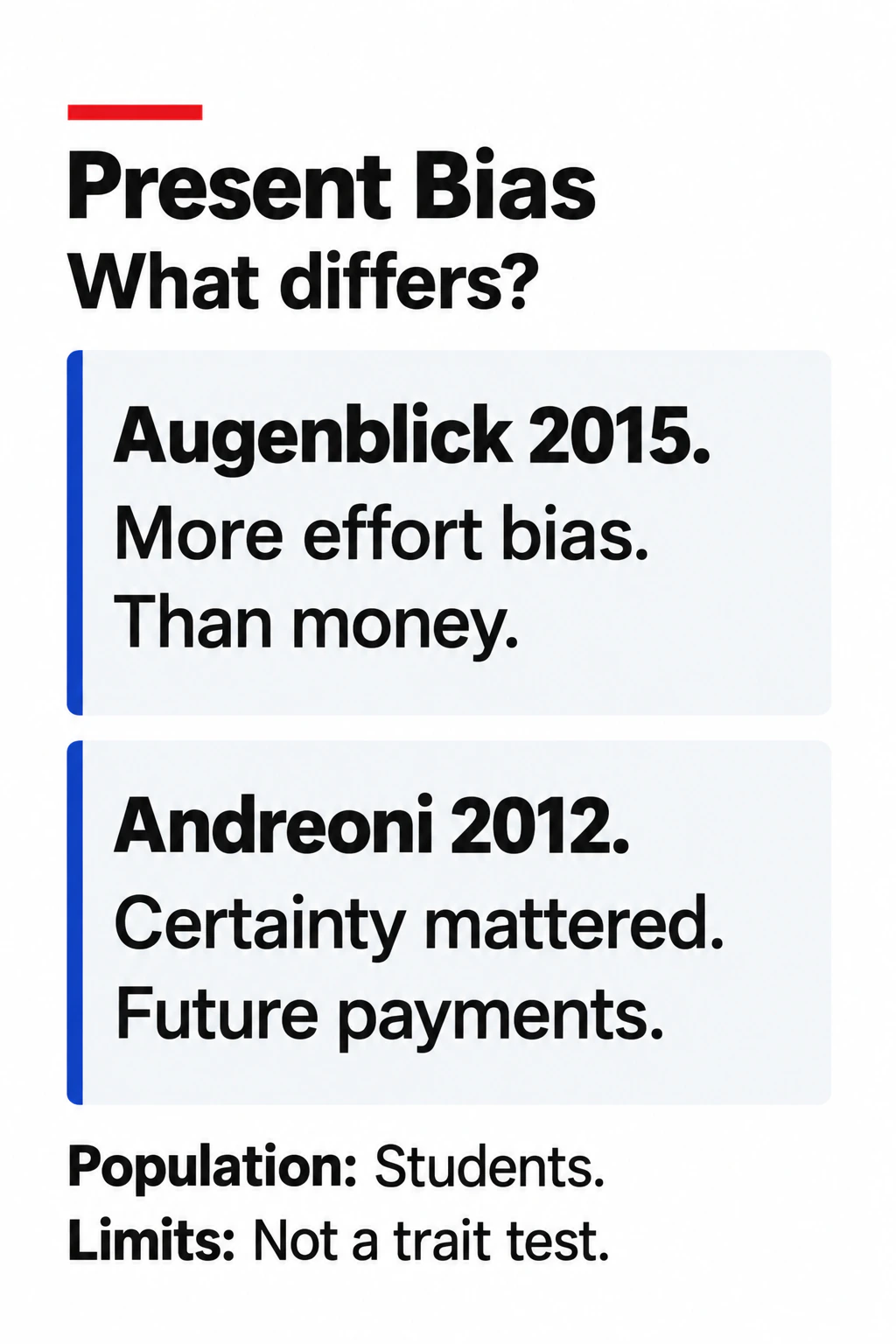
Augenblick, Niederle and Sprenger’s 2015 study asked UC Berkeley students to allocate transcription or Tetris tasks across work dates, first in advance and then when the earlier work date arrived. It recruited 102 people; the main effort analysis used 80 after completion, recording and response-variation restrictions. [S2]
Table II reports an average earlier-task budget share of 53.2% in advance and 48.2% at the immediate decision point: a difference of five percentage points across the study’s allocation choices. This concerns task allocation in that experiment, not the percentage of people with a disorder or a five-point improvement in productivity. The paper found substantially less present bias in its monetary choices and reported a second, separate student experiment supporting the contrast. Neither result supplies a guaranteed outcome for your work routine. [S2]
The study creates an informative comparison, but student participation, laboratory tasks and the analysis restrictions matter. It does not establish that every adult procrastinates for the same reason or that postponing a real task necessarily reflects a stable personal trait.
Certainty changes the interpretation
Andreoni and Sprenger’s 2012 experiment recruited 80 undergraduates at UC San Diego who lived on campus. Participants allocated payments across dates under six probability conditions; the earlier payment was seven days away, so this was not a direct “cash now” test. Procedures limited collection costs and unintended reliability differences. Certainty influenced allocations in ways that complicated interpreting apparent present bias as time preference alone. [S3]
Those were monetary allocation choices under controlled conditions, not observations of every reason people take smaller payments in daily life. The researchers manipulated payment risk; they did not establish that uncertainty explains every preference reversal. Their study also shares an author with the effort study, so these reports should not be described as two wholly independent research teams. [S2, S3]
The practical conclusion is modest. Timing can affect choices, and a task’s design can affect what the choice reveals. Understanding a change requires checking what became immediate and what else changed.
Myth or Real?
Claim
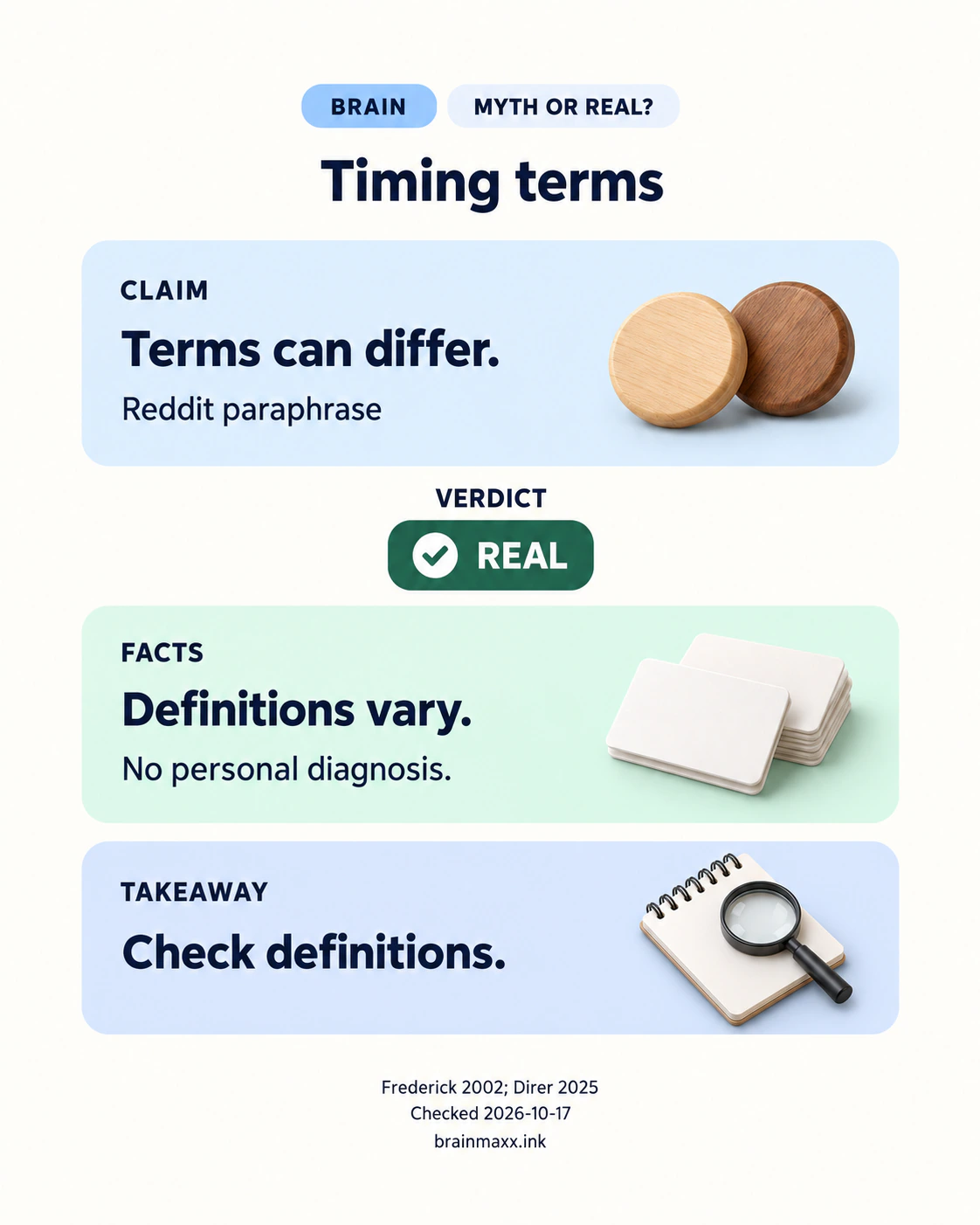
Social paraphrase: Present bias, hyperbolic discounting and delay discounting are related but not synonymous.
Verdict
REAL
Facts
The reviewed sources distinguish model forms and definitions of time preference. Present-bias definitions vary; the label alone does not identify a mechanism.
The scope is terminology under stated frameworks, not a personal diagnosis. Some authors use overlapping terms differently.
The discussion shares an explanation attributed by its poster to an AI tool; that attribution and the rest of the answer are not verified or endorsed. Independent reading supports the narrow point that these terms need not be interchangeable under the stated models. This does not settle every formal definition or identify why an individual made a choice.
Takeaway
Check the definition, what was measured and what else changed.
Sources
Claim discussion: Public discussion asking how discounting terms differ.
Evidence: Time Discounting and Time Preference: A Critical Review; Bringing Present Bias Back to the Present.
Checked 2026-10-17. Scope: General educational comparison of intertemporal-choice terminology. The social text is claim discovery only, not expert proof or evidence of popularity. No clinical, financial-return, prevalence or individual-trait conclusion.
Limitations and sources
“Choosing the smaller reward means poor self-control.” Not necessarily. A smaller payment that covers a necessary expense now can be more useful than a larger payment later. This article cannot assess an actual financial decision or turn unmet needs into a character judgment.
“One test reveals my true patience.” A single choice cannot separate every influence on it. Payment credibility, collection friction, the value of the reward and changed circumstances can alter the interpretation. A brief online quiz is not a diagnosis.
“If I changed a plan, the earlier plan must be better.” Plans can become outdated. Reconsidering a plan is not automatically a failure; neither is the latest preference automatically the best one. Compare the reasons and constraints instead of appointing either version of yourself as the unquestionable authority.
“The experiment proves I should lock myself into a commitment.” The effort paper examined demand for a particular commitment arrangement. It did not test every deadline, fee, app lockout or self-imposed penalty. A demand for commitment is also different from proof that your chosen tool will improve wellbeing or performance. Do not impose financial penalties, remove access to necessities, or prevent a sensible response to new information on the strength of this article.
“There is a universal effect size.” The five-percentage-point allocation difference above belongs to a particular study and outcome. It is not a population prevalence estimate, a trait score, or a forecast of how much any planning method will help you. The reviews likewise do not provide one personal discount rate that applies across all situations.
Choosing the appropriate description
If your only observation is a sooner choice, describe that choice and its reasons. Calling it present bias would add an explanation that the observation has not isolated. If you have corresponding future and immediate choices and the preference reverses, “consistent with present bias” keeps the model claim conditional. First check whether the alternatives, resources, trust, costs or information changed.
If an important circumstance changed, describe it directly rather than forcing either label to explain the whole decision. You can leave the psychological account unresolved. Neither description establishes that waiting is best, that the earlier plan was correct, or that a restrictive commitment will help. This is an educational choice between descriptions, not an individual assessment. [S1, S3, S4]
For a low-consequence, optional choice, a brief plan-and-revisit note can help you organize what happened. This is an editorial suggestion, not a validated intervention or a test that measures present bias.
- Record the original choice and its dates in ordinary language. Note what you expect each option to offer and why you currently prefer it.
- When the decision point arrives, check the alternatives again. Has an option become immediate? Have reliability, workload, needs, costs or information changed?
- Compare the reasons before deciding what to keep or revise. Preserve the earlier note rather than rewriting it to fit the latest choice.
Choose something you can reconsider without meaningful harm, such as the order of two optional hobby activities. Do not create deprivation, forced work, expensive commitments or an experiment with treatment, sleep, food or an essential payment. You do not need to manufacture a reversal to learn a useful distinction.
Keep the record short and optional. There is no required daily score or appearance of success to maintain. Stop if checking becomes distressing, repetitive or punitive. A note that distinguishes new information from an unchanged tradeoff can be useful even when you cannot assign a psychological explanation.
For an explicitly fictional example, Mina writes on Wednesday that she would like to spend Saturday’s optional hobby slot sketching before watching a short video. She expects a quiet 25-minute window. On Saturday, a changed household arrangement leaves ten minutes before she needs to leave. Mina chooses the video, notes the smaller time window, and leaves the drawing plan available for another suitable slot. She does not award herself an impatience score or compensate by taking time from sleep. Her choice changed, but so did a relevant constraint; this is not a matched test of present bias. If the original window had remained available and she simply wanted the video immediately, that would still be one observation with several possible explanations. The completed decision here is to keep an accurate record and a revisable option, not to claim that the note improved Mina’s self-control or productivity.
This is general educational material, not a diagnosis or a substitute for assessment, therapy or medication advice. Persistent difficulty that affects daily functioning may deserve qualified support. Consequential financial, legal, medical or safety decisions require appropriate help and the actual circumstances, not a label inferred from one choice.
Sources
Sources were checked on October 17, 2026. Five sources include a published critical review, two original human experiments, a later review manuscript and an author-hosted theoretical proposal. The reviews summarize overlapping literature; their references are not extra studies independently checked for this article. No personal experiment, treatment outcome, sponsorship or affiliate relationship is claimed.
-
S1: Frederick, Loewenstein and O’Donoghue — Time Discounting and Time Preference: A Critical Review, Journal of Economic Literature 40(2), 2002, 351–401. Author-hosted copy; the article occupies the first 51 PDF pages, followed by a citing-article list.
-
S2: Augenblick, Niederle and Sprenger — Working Over Time: Dynamic Inconsistency in Real Effort Tasks, Quarterly Journal of Economics, 2015, DOI 10.1093/qje/qjv020. Selected design, sample, allocation and replication sections, including Table II.
-
S3: Andreoni and Sprenger — Risk Preferences Are Not Time Preferences, American Economic Review 102(7), 2012, 3357–3376. Selected recruitment, probability design, payment procedure and results.
-
S4: Cohen, Ericson, Laibson and White — Measuring Time Preferences, NBER Working Paper 22455, July 2016, revised February 2019. This checked manuscript is distinct from verification of the final 2020 journal text.
-
S5: Alexis Direr — Bringing Present Bias Back to the Present, author manuscript dated November 7, 2025. Selected definition and conceptual-boundary discussion; no new participant cohort or validated personal test.
FAQ
Common questions
Does choosing the smaller reward sooner prove present bias?
No. A sooner choice alone does not isolate an explanation. Relevant needs, reliability, collection costs or information can change the decision. The article compares descriptions rather than assessing a person.
Does a changed plan mean the earlier plan was better?
No. Circumstances and information can change. Compare the original and current reasons rather than treating either version of the plan as automatically correct.
Can the optional planning note measure my present bias?
The note is an optional organiser for an ordinary low-consequence choice, not a validated test or intervention. Keep it brief and private; pause if checking becomes distressing, repetitive or punitive. Consequential decisions need appropriate help.
Topic hubs
Tags

