The phone vibrates. You keep typing. A moment later, you are still looking at the document, but part of your attention is on who might have messaged you. Ignoring an alert and remaining fully engaged with your task are different things.
The short answer
Phone notifications can disrupt performance on some attention tasks even when a person does not look at or handle the phone. That finding supports managing interruptions during demanding work. It does not establish a fixed cost for every notification, prove that phones cause an attention disorder, or guarantee that switching alerts off will reduce daily screen time.
The evidence becomes clearer when we separate three outcomes: performance on a laboratory task, people’s reports of everyday inattention, and objectively logged phone use. Studies of those outcomes do not all produce the same result.
Definitions and scope
A notification is an external cue, such as a sound, vibration or visible alert. Responding to it is a separate action. A laboratory can test the cue’s effect without requiring participants to open an app; a field study can ask what changes when people alter their notification settings over a week.
Attention is also a broad term. Making an incorrect response, responding more slowly, feeling distracted and checking a phone more often are different measurements. An apparent contradiction may reflect a change in the outcome being measured rather than an experiment disproving every earlier finding.
This explainer concerns ordinary adult study and work. The research discussed below does not diagnose an individual, establish that notification exposure causes ADHD, or test a treatment for persistent difficulties. It also does not establish the safest notification settings for a driver, emergency worker, caregiver or person relying on an assistive alert.
How it works
An alert can introduce another potential task before you physically switch activities. You might start wondering who contacted you or keep reminding yourself to check later. That is a plausible account of why a brief cue could have consequences beyond its sound. In the early notification experiment, however, that thought process was an explanation proposed by the researchers, not a directly measured mediator. Stothart, Mitchum and Yehnert
There are other possibilities to keep open. A familiar sound can capture attention; a person may deliberately slow down to maintain accuracy; the significance of a personal message may differ from a generic laboratory sound. A behavioural change does not by itself tell us which process produced it.
This is why a brain-response finding should not be translated into a claim that a notification damages the brain. Electrical-response measures describe activity during a particular task. They are not a scan of someone’s intelligence, character or permanent capacity to concentrate.
What the evidence supports
An alert can matter without a response
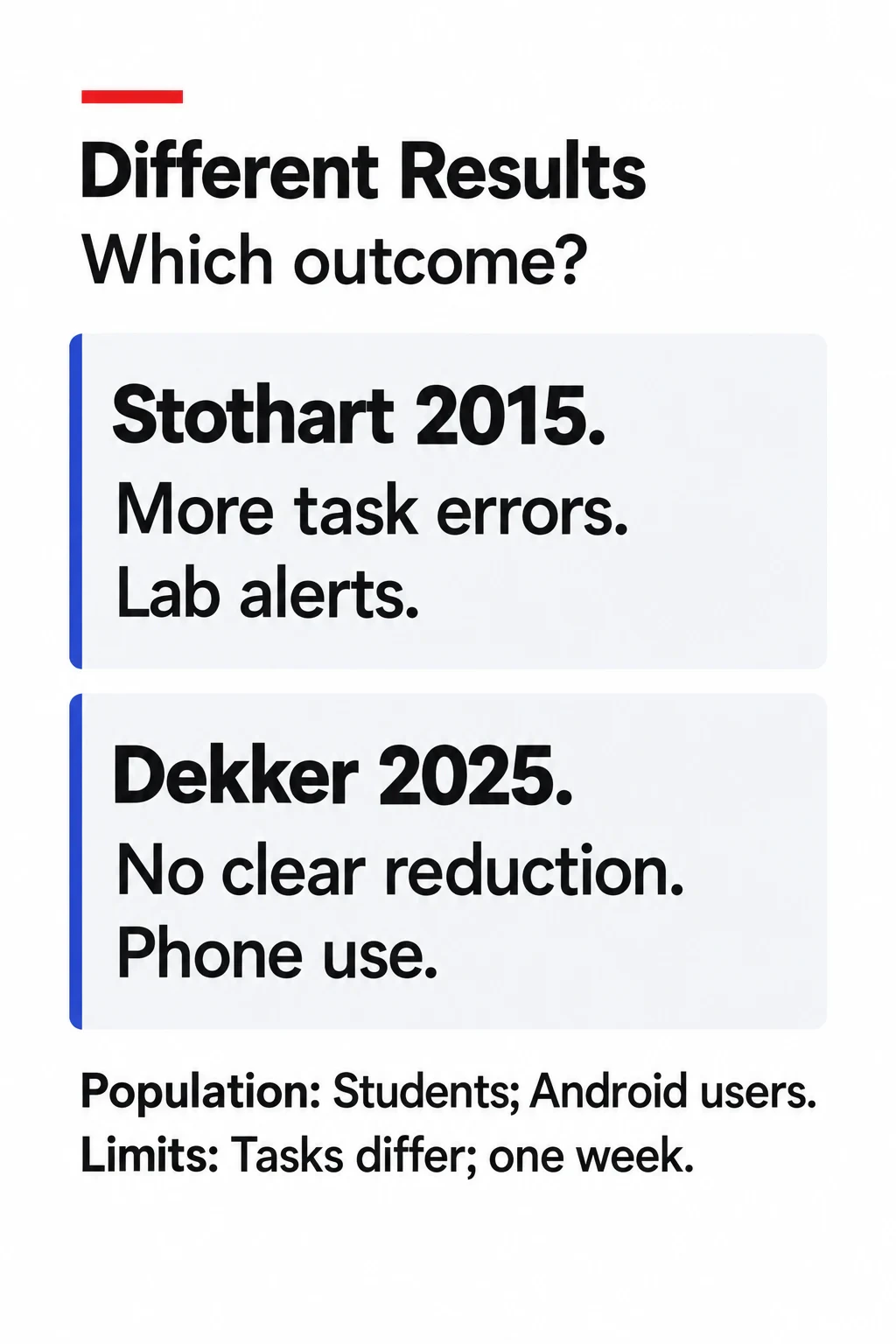
In a 2015 experiment, Stothart and colleagues randomly assigned undergraduates to receive calls, receive text messages, or receive no study notifications during an attention task. Their analysis excluded people observed looking at or handling their phones. The notification groups showed a greater increase in errors between task blocks than the control group. Original paper
That is direct evidence about receiving notifications under the tested conditions. It is not a measurement of hours lost during a workday. The text group also began with a lower error rate, making its larger change harder to interpret cleanly. The author’s current account explicitly acknowledges that starting-point difference. Neither the task nor a comparison with other studies supplies a personal driving-risk estimate. Author’s methods and limitations
Everyday self-report adds another perspective
Kushlev, Proulx and Dunn’s 2016 study compared weeks in which participants maximised interruptions with weeks in which they minimised them. The conditions changed both alert settings and whether phones were nearby. Participants reported more inattention and hyperactivity symptoms in the interruption condition. Those reports were not clinical diagnoses. Author-hosted paper
The bundled manipulation matters: it does not isolate the effect of the notification toggle from the effect of phone placement. Participants also knew which condition they were following, leaving room for expectations to influence reports. The paper reported no direct manipulation effect on productivity or psychological well-being; its indirect analyses should not become a promise that changing one setting improves either outcome.
Slower responses do not mean more errors
Upshaw and colleagues’ 2022 experiment paired a letter task with smartphone-notification sounds and control sounds while recording behavioural and electrical responses. Participants responded slightly more slowly on notification-sound trials, but error rates did not differ between sound conditions. A larger N2 response was interpreted as greater recruitment of cognitive control, rather than a simple finding that control had collapsed. PLOS ONE paper
This experiment used a generic sound rather than actual personal messages. It therefore tests a different situation from an unexpected call to your own phone. It supports a qualified conclusion about altered responding under distraction, not a rule that every alert makes every task both slower and less accurate. The behavioural and electrical measures also do not provide a clinical assessment of a reader.
Disabling notifications may leave phone use unchanged
Dekker and colleagues conducted a preregistered randomised trial with 205 participants, using logged phone activity and daily reports. A one-week notification-disabling intervention did not produce significant changes in checking frequency or screen time. Participants reported weaker checking habits, while fear of missing out increased. The final journal issue is dated 2025; the paper first appeared online in 2024. University-hosted final paper
The trial involved Android users and a short intervention period. Some subjective outcomes used single-item measures. Its null findings do not establish that disabling an alert can never help a particular work session. They do challenge the broader promise that turning notifications off automatically reduces phone use or improves daily experience.
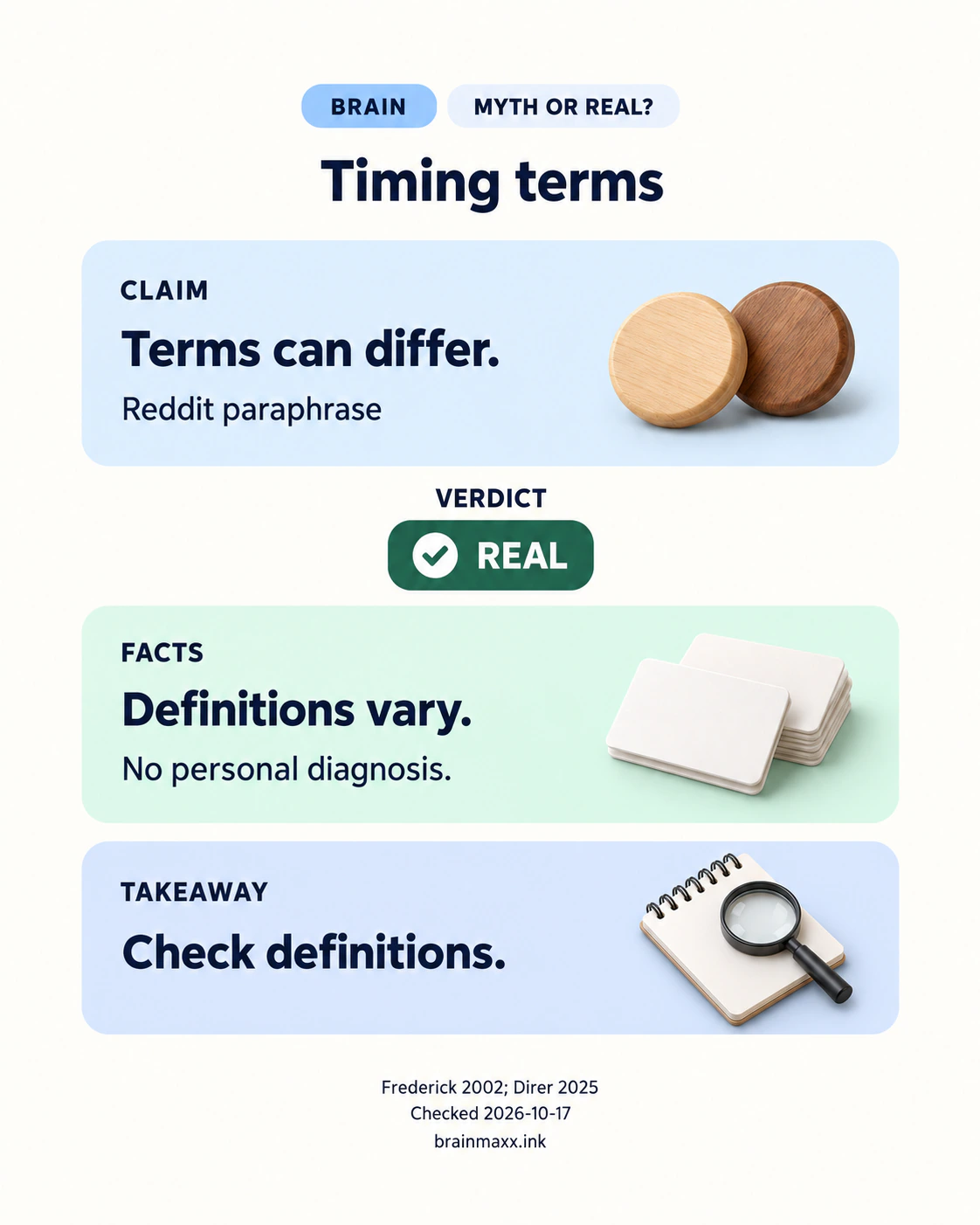
Myth or Real?

Claim
Social paraphrase: An ignored phone alert can affect attention even without checking.
Verdict
REAL
Facts
The checked laboratory studies found task effects without phone checking. They measured different outcomes: changed errors or slower responses, not a universal productivity cost.
These results do not establish effects for every person, task or alert, or verify the commenter’s particular conversation.
The selected comment says an ignored audible phone alert can still be distracting. This verdict checks that limited factual possibility, not whether the described conversation happened as stated or what either participant should do. Stothart and colleagues compared alerts during a sustained-attention task while excluding phone interactors; the text-group starting-point caveat remains. Upshaw and colleagues found slight slowing with generic notification sounds but no significant accuracy difference. These are different measures and tasks. Neither supplies a universal cost, verifies an individual or diagnoses a disorder. The optional article organiser is unproven; preserve essential alerts and accommodations, stop distressing or compulsive checking, and seek qualified assessment for persistent impairment.
Takeaway
Consider one nonessential alert for a defined task while preserving urgent contact, obligations and accessibility.
Sources
Claim discussion: Public comment discussing an ignored phone alert as a distraction.
Evidence: Stothart author account of the cell-phone notification experiment; Upshaw and colleagues: notification sounds and cognitive control.
Checked 2026-10-18. Scope: A scoped possibility of an alert-related effect in the checked laboratory attention tasks. The social personal experience is not verified. No universal size, every-alert effect, conversation outcome, driving-risk estimate, diagnosis, brain injury, treatment or guaranteed screen-time reduction.
Misconceptions and uncertainty
“If I did not touch the phone, it could not distract me.” Physical interaction is an incomplete measure of distraction. The early experiment directly tested notifications among people who left their phones alone. That does not mean every unnoticed alert had an effect or that a person should monitor their thoughts for evidence of damage.
“If alerts affect attention, disabling them must reduce screen time.” This changes the question. A cue’s immediate effect and a person’s total checking behaviour over a week are different outcomes. Someone can remove an external cue while continuing to check through habit, expectation or practical need.
“A questionnaire about inattention proves a disorder.” A symptom rating within a research condition cannot establish a diagnosis, its cause or the appropriate treatment. The everyday experiment is informative without making that leap.
“The studies give me a universal productivity percentage.” The tasks, samples, notification types and outcome measures differ. There is no defensible number here for how much work every reader will recover. A good personal decision can be smaller: whether one avoidable alert is making a specific activity harder to complete.


Practical meaning and sources
Try a bounded change in an ordinary task
Choose a low-stakes activity you already do, such as reading a short document or revising a paragraph. Decide what completing it means before changing settings. A finished paragraph with its claims checked is a more useful signal than the vague aim of being perfectly focused.
Identify one nonessential alert you can safely silence for that session. Check that urgent contacts, work obligations, accessibility functions and other necessary alerts still have a reliable route. Moving the phone and changing its alerts simultaneously may be practical, but it makes it harder to tell which change mattered. If you want to learn about one setting, change one thing.
After the task, note whether you completed the intended work, how often you deliberately checked the phone, and whether the change created worry or a missed obligation. Keep the note brief and private. You do not need to collect message contents, install a tracking app, or turn concentration into another performance score.
For example, imagine someone proofreading a page while a shopping app repeatedly sends promotional alerts. They could silence that app for the next comparable proofreading session while preserving calls from an important contact. Fewer interruptions would be useful even if their total daily screen time stayed the same. If they instead kept reopening the shopping app, the next question would concern that checking behaviour rather than the alert alone. This is an illustrative decision, not a validated protocol or a promised result.
Repeat only if the comparison remains useful. Different tasks, sleep, workload and message urgency can change the experience. A small personal comparison cannot isolate all those influences or overturn a study; it can help you decide whether a particular setting is worth keeping.
Stop the experiment if it interferes with essential communication, increases distress or encourages compulsive checking. Preserve accommodations. Persistent attention difficulties that impair daily life deserve assessment by a qualified professional rather than a diagnosis inferred from a notification setting. None of the findings here is a reason to change medication or replace care.
The practical conclusion is modest: managing an avoidable cue is worth considering for a defined activity, while checking whether the change actually serves your needs. The aim is a workable environment, not proof that you can ignore every interruption.
Sources
Sources refreshed October 17, 2026:
- Stothart, Mitchum and Yehnert (2015), The Attentional Cost of Receiving a Cell Phone Notification, with the author’s account of methods and limitations.
- Kushlev, Proulx and Dunn (2016), “Silence Your Phones”.
- Upshaw and colleagues (2022), The Hidden Cost of a Smartphone.
- Dekker and colleagues (online 2024; issue 2025), Beyond the Buzz.
FAQ
Common questions
Can an alert matter if I do not check the phone?
Some laboratory studies found effects under tested conditions without phone checking. Their tasks, samples and measures differ; this does not establish a universal cost or verify any individual experience.
Will turning alerts off reduce screen time?
A one-week preregistered Android trial found no significant reduction in checking frequency or screen time. That does not establish that an individual task cannot benefit; review the actual result rather than assuming lower use.
How can I consider a change while keeping essential contact?
Use an ordinary low-stakes task and only one safely nonessential alert. Preserve urgent, work, care and accessibility routes. The organiser is optional and unproven; stop distressing or compulsive checking and seek qualified assessment for persistent impairment.
Topic hubs
Tags