

Two people can have the same degree and very different paychecks. Put their relationship into an education chart and they look evenly matched. Put it into an earnings chart and one partner appears to be dating up. Neither chart tells you who makes dinner, who feels respected or why they chose each other.
That is the difficulty with hypergamy as an internet catchall. The word sounds like one explanation for attraction, but research uses several measures that answer different questions. A recent Swiss study makes the distinction especially useful: educational partnering changed substantially while income differences within couples remained more persistent.
The short answer
Hypergamy means partnering upward on a specified social or economic measure. In much of the different-sex couple research discussed here, female educational hypergamy describes a pairing in which the man has a higher education category than the woman. Change the measure to earnings and the classification can change too.
People do form relationships across education and income levels. What these studies do not establish is a universal motive, a rule that applies to every woman or man, or a dependable formula for choosing a partner. They describe particular populations and outcomes, using particular definitions.
The practical question to ask whenever you encounter the word is up on which measure? Education, annual earnings, wealth, occupation and attention on an app are different variables. Combining them into a single ladder hides the very differences that make the research informative.
Definitions and scope
Researchers studying educational pairings commonly distinguish three arrangements. Homogamy means partners fall in the same education category. Female hypergamy means the man falls in the higher category. Female hypogamy means the woman does. These labels describe relative education within a couple; they do not grade either person’s character or worth.
The categories themselves matter. A study that groups education into low, medium and high can place two people together despite differences in qualifications within the same group. Another study using more detailed categories may distinguish them. Before comparing two percentages, check whether both papers drew the boundaries in the same place.
Income adds another choice of measurement. Annual labor earnings differ from hourly pay, household income, savings and inherited assets. A person working fewer paid hours can have lower annual earnings without having a lower hourly rate. Equal credentials therefore do not imply equal earnings, and neither variable measures relationship quality.
This article focuses on selected research about different-sex adult couples and one older online dating dataset. It does not establish patterns for every sexual orientation, gender identity, country or age group. It also distinguishes existing partnerships from the earlier stages of contact, attraction and dating. A message sent is an expression of interest; a cohabiting household is a different observed outcome.
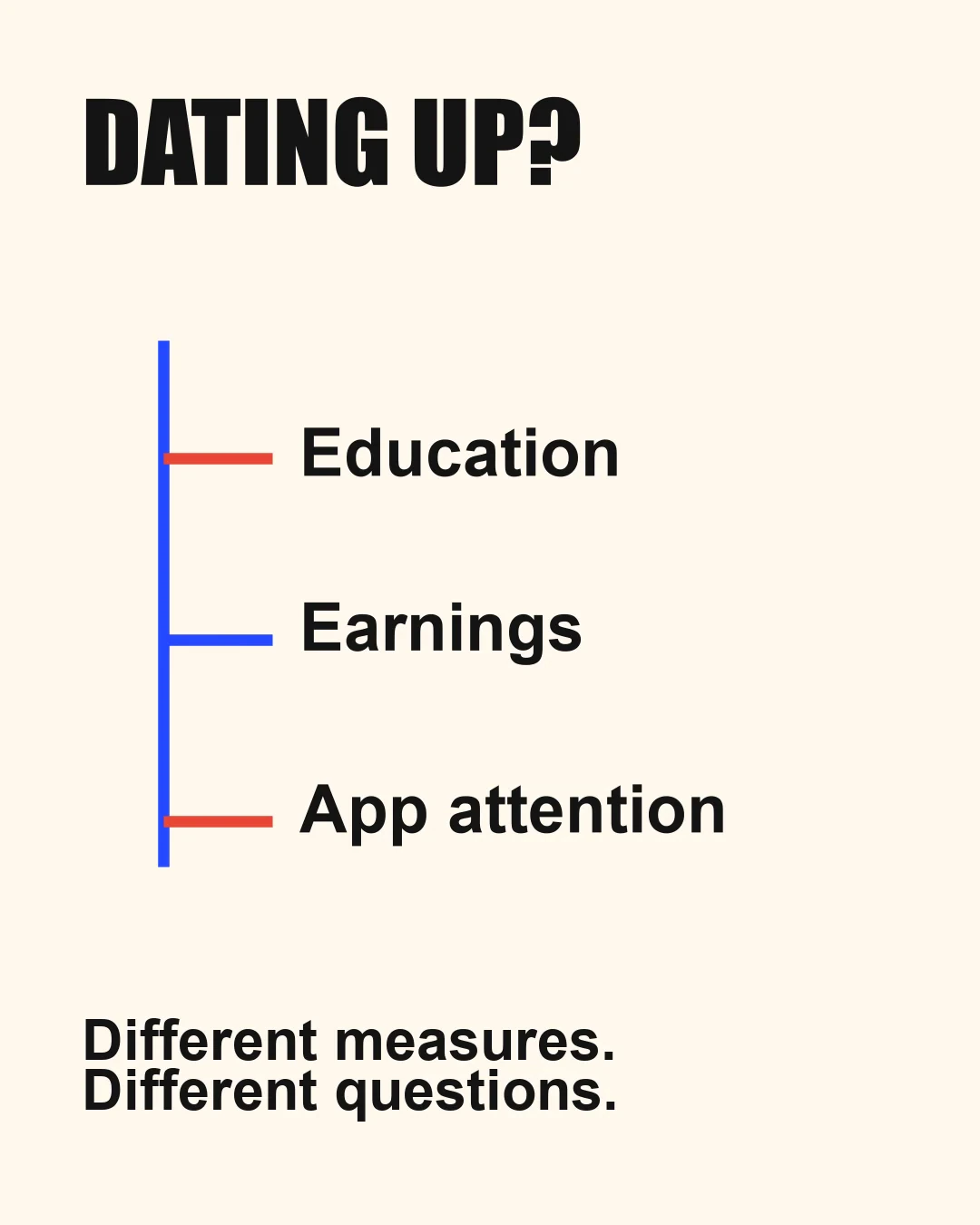
Operational measures differ. Education categories, annual labor earnings and a platform messaging-network rank do not form one interchangeable score.
Education means relative credential categories in a defined study; earnings means an explicitly defined period and income measure; app attention here means a historical website messaging-network ranking. The branches are different questions, not a causal chain, a common numerical scale or a ranking of people.
How it works
Partnering patterns can reflect preferences, opportunities and circumstances at the same time. Someone may prefer a partner with similar education, but the people they encounter also depend on where they live, study and work. The composition of the available population changes which pairings are possible.
This creates a problem for sweeping explanations. An increase in one type of couple does not, by itself, show that people’s preferences changed. A different mix of potential partners could produce a shift even if preferences stayed similar. Conversely, a stable overall proportion could conceal changes within education or age groups.
Couples are also selected twice: people enter relationships, and some relationships continue long enough to appear in a survey. A study of people currently living together cannot observe every rejected introduction, short relationship or unfulfilled preference. It is not a complete record of how everyone chooses.
Several explanations can therefore compete. Shared educational environments may increase opportunities to meet. Economic resources may matter to household decisions. Gender norms may influence paid and unpaid work. None of these possibilities gives an outside observer permission to infer a specific person’s motives from a diploma or salary difference.
For readers, the useful distinction is between a pattern and its explanation. The pattern is what the dataset records. The explanation is an argument about how it arose. Strong research works to distinguish alternatives; a viral headline often jumps straight from one to the other.
What the evidence supports
A recent Swiss study separates education from earnings
Giesselmann and colleagues’ 2026 study used Swiss Household Panel waves from 1999–2024, focusing on adults aged 30–40. Its educational analysis included 41,166 person-year observations: repeated observations are not 41,166 different people. Partnership meant marriage or cohabitation with a different-sex partner in the same household.
The study found no indication that highly educated women increasingly lacked partners as their numbers grew. Their partnered share remained above 80% across the period. Educational pairings adapted, especially among highly and medium-educated men, while income-based differences were more persistent.
That supports a narrower conclusion than either “hypergamy disappeared” or “nothing changed.” Education and income told different stories. The income analysis also used a more restricted sample, because it required earnings information. The authors examined this issue in robustness checks, but the two headline measures still should not be treated as interchangeable. These observational patterns do not reveal every participant’s preference or prove an individual motive.
A European comparison finds changing educational pairings
Erát’s 2021 analysis pooled nine European Social Survey waves from 2002–2018 and compared cohorts across 27 countries. Respondents were aged 25–55. The study considered the wider population when measuring educational composition, and people in marriage or cohabitation when classifying couples.
Women’s growing educational advantage was associated with declining female educational hypergamy across cohorts, with differences between countries. That is useful evidence against treating the pairing pattern as fixed everywhere. It is not a measurement of current app behavior, income differences or all relationships in 2026. Publication year and observation years answer different questions.
App attention is a different kind of ladder
Bruch and Newman’s 2018 paper examined messaging during January 2014 on one dating website in New York, Boston, Chicago and Seattle. It analyzed active heterosexual users seeking romantic relationships.
The researchers constructed a network ranking from messaging connections, rather than directly measuring salary, educational status or personal value. Both men and women tended to contact people above themselves in that ranking. Replies became less likely as the ranking gap increased.
The important boundary is the outcome: this was messaging, not demonstrated long-term partnership formation. The dataset also predates today’s app environment. It cannot support a claim that women alone pursue upward, that an algorithm knows someone’s worth, or that a particular messaging tactic guarantees a relationship. Its ranking is an analytical measure within that network.
Educational advantage does not settle household equality
Steiber and Siegert’s 2026 article examined 6,927 different-sex couples using Generations and Gender Survey data from Austria, Germany, France and Belgium. The observations came from 2005–2010; the newer publication date does not make them newly collected behavior.
After accounting for partners’ education levels, educational hypogamy was associated with a more equal division of paid work. The same straightforward pattern did not extend to household chores. The authors interpret the estimates as associations, with selection into different partnerships remaining relevant.
This matters because “who has more education?” and “who does more unpaid work?” are separate questions. A credential difference cannot stand in for every part of a relationship. The study does not establish that changing a couple’s educational pairing would cause equality at home.

Swiss Household Panel, 1999–2024, adults 30–40 in different-sex co-resident partnerships. Education and income use different measures and analytical samples; the patterns do not establish individual preferences or motives.
Giesselmann and colleagues 2026: the selected Swiss educational analysis comprised 41 166 person-year observations, not 41 166 unique people. Educational partnering adapted without increased partnerlessness among highly educated women; income-based patterns were more persistent. Income analysis used a restricted sample. This qualitative paired diagram does not encode a numerical effect size or causal mechanism.
Misconceptions and uncertainty
Does hypergamy mean someone is using a partner?
The research classification does not establish that. A difference in education or earnings can be observed without knowing the partners’ motives. Turning the category into an accusation adds a claim the classification never measured.
The same caution applies to flattering interpretations. Calling a pairing evidence of perfect compatibility also goes beyond these data. Respect, affection, reliability and agreement about daily life require their own information.
Can education and income findings be added together?
Usually there is no meaningful reason to do so. They can describe overlapping people with different definitions, years and analytical samples. A person can belong to one education category and another income category. Adding two percentages may double-count people or combine incompatible denominators.
Does a group average predict my relationship?
It does not give a personal forecast. None of these selected studies supplies a score for your attractiveness, compatibility or likelihood of finding a partner. They also do not establish that matching a demographic category will produce a happier relationship.
The evidence here is observational and geographically bounded. The studies use different outcomes, dates and methods; they are not four identical replications. A newer article can revisit older data, and an association can remain open to more than one explanation. Those limits should travel with the claim when it is shared.
Myth or Real?

Claim
Social paraphrase: Dating up is something women do and men do not.
Verdict
FALSE
Facts
Swiss educational pairing and historical US messaging both include men partnering or reaching upward on different measures.
Education and network rank differ. Selected observational samples do not reveal every person’s motives or preferences.
The Swiss study describes medium-educated men increasingly partnering with more-educated women. The US website study found upward contact by both sexes within its own messaging-network ranking. These are different measures and samples, and messaging does not prove lasting partnership. They provide counterexamples to a blanket women-only direction, not a claim that everyone has the same preferences, that rates are equal or that a particular person has a particular motive.
Takeaway
Ask which measure and outcome a dating-up claim actually uses.
Sources
Claim discussion: Discussion reporting a women-date-up/men-date-down slogan.
Evidence: Female Education Expansion in Switzerland and Marriage Market Dynamics: Attrition, Adaptation or Masked Hypergamy?; Aspirational pursuit of mates in online dating markets.
Checked 2026-10-25. Scope: Only the blanket gender-exclusive direction is assessed. The post reports and criticizes the slogan; it is not represented as endorsement. Educational pairing and network messaging are different outcomes. No claim about all preferences, majority patterns, universal motives or equal rates.
Practical meaning and sources
Use the research to ask clearer questions about a claim, rather than to rank people. A short reading check can help:
- Name the measure. Write down whether the claim concerns credentials, annual earnings, wealth, messaging or something else. Leave it unresolved if the source never says.
- Name the outcome. Distinguish contacting someone, receiving a reply, dating, cohabiting and remaining partnered. Check the population and observation years.
- Keep the limit. Record one conclusion the study supports and one it cannot establish. Do not turn the finding into a personal score or a verdict about a partner.
A worked reading note
Take the Swiss finding that highly educated women remained widely partnered. A useful note would read: Education categories; co-resident marriage or cohabitation; Swiss adults aged 30–40; observations from 1999–2024. The study did not find increasing partnerlessness in this group. Its educational analysis contains repeated person-year observations, and its earnings analysis uses a more restricted sample. Individual motives remain unresolved.
Now compare that with a claim about replies on a dating app. Even before checking the direction of either result, the outcomes differ: living with a partner and replying to a message are not substitutes. That difference is enough to reject a direct numerical comparison. It does not establish that either study is wrong.
Keep this short note alongside the source. If a post removes the definition, observation years or outcome, return to the original before sharing its headline. The useful result of the exercise is a more specific claim, rather than greater certainty about strangers’ motives.
For a conversation within a relationship, describe the concrete issue you want to understand: plans for paid work, household tasks, spending expectations or time together. A label cannot substitute for asking what each person wants and hearing the answer. This is an editorial suggestion for clearer conversation, not a tested relationship intervention.
Stop using the reading exercise if it becomes repeated checking of your own worth, fuels hostility or encourages monitoring someone else’s private information. It is not a diagnostic exercise, therapy or a compatibility assessment. If relationship distress persists or affects daily life, qualified professional support can help address that individual situation; these population studies cannot assess it.
The sources linked above provide the definitions, methods and findings used here. The central distinction is available without a ranking: the measure you choose changes what “dating up” can mean.

An optional source-reading organizer; no validated relationship intervention, compatibility score or assessment of someone else.
First identify the actual measure, such as education, annual earnings or message-network rank. Then distinguish contact, reply, dating and co-resident partnership and note observation years. Finally write one supported finding and one unsupported inference. Missing details stay unresolved. Pause if reading causes distress, self-worth checking, hostility or privacy intrusion; qualified support is appropriate for persistent relationship distress affecting daily life.
Sources
- Giesselmann et al., 2026: education and income pairing in Switzerland. Swiss Household Panel observations from 1999–2024; different-sex co-resident partnerships among adults aged 30–40.
- Erát, 2021: educational assortative mating in 27 European countries. European Social Survey waves from 2002–2018; adults aged 25–55.
- Bruch and Newman, 2018: aspirational pursuit in online dating. Active heterosexual users of one website in four US cities, January 2014; messaging and network ranking.
- Steiber and Siegert, 2026: educational hypogamy and gender equality. Four-country Generations and Gender Survey analysis using observations from 2005–2010, partnered adults aged 25–45.
This article is general research education, not a diagnosis or an individual relationship assessment.
FAQ
Common questions
Does hypergamy always mean income?
No. Studies may compare education, earnings or another explicitly defined measure. The meaning depends on that definition.
Does the research show that only women date up?
No. Selected education and messaging studies also include men partnering or reaching upward. These are different measures and outcomes, not proof that everyone has identical preferences.
Can these findings score my relationship?
No. The studies do not supply an individual compatibility or value score. The reading organizer is general research education, not an assessment or tested relationship intervention.
Topic hubs
Tags


