By Elias Grant
On Monday, you open the sketchbook you bought three months ago. You draw the outline of a chipped mug while your lunch cools. You can imagine the next twenty pages. On Tuesday, lunch ends with the sketchbook shut.
Before you close it on Monday, pick the next ordinary moment and the next mark you’ll make. Try “After I put my lunch plate in the sink tomorrow, I’ll draw one mug handle.” Then check Tuesday for a handle on the page. That mark tells you whether the plan made it to a second sitting.
Who this is for
Use this guide if a Monday, birthday or month change makes a personal project feel newly possible. Pick a project you can touch twice without rearranging your life. One sketch, one paragraph or one mended seam will do.
Researchers call dates that divide time into meaningful stretches temporal landmarks. A date can feel like the beginning of a new period because it opens a school term, marks a birthday or closes a difficult week. The fresh-start effect describes a rise in some signs of goal pursuit around such dates. Starting an activity, making a plan and returning to do it again are separate things to observe. Dai, Milkman and Riis, 2014 · Dai, Milkman and Riis, 2015

A landmark, a first action and a return are three separate observations.
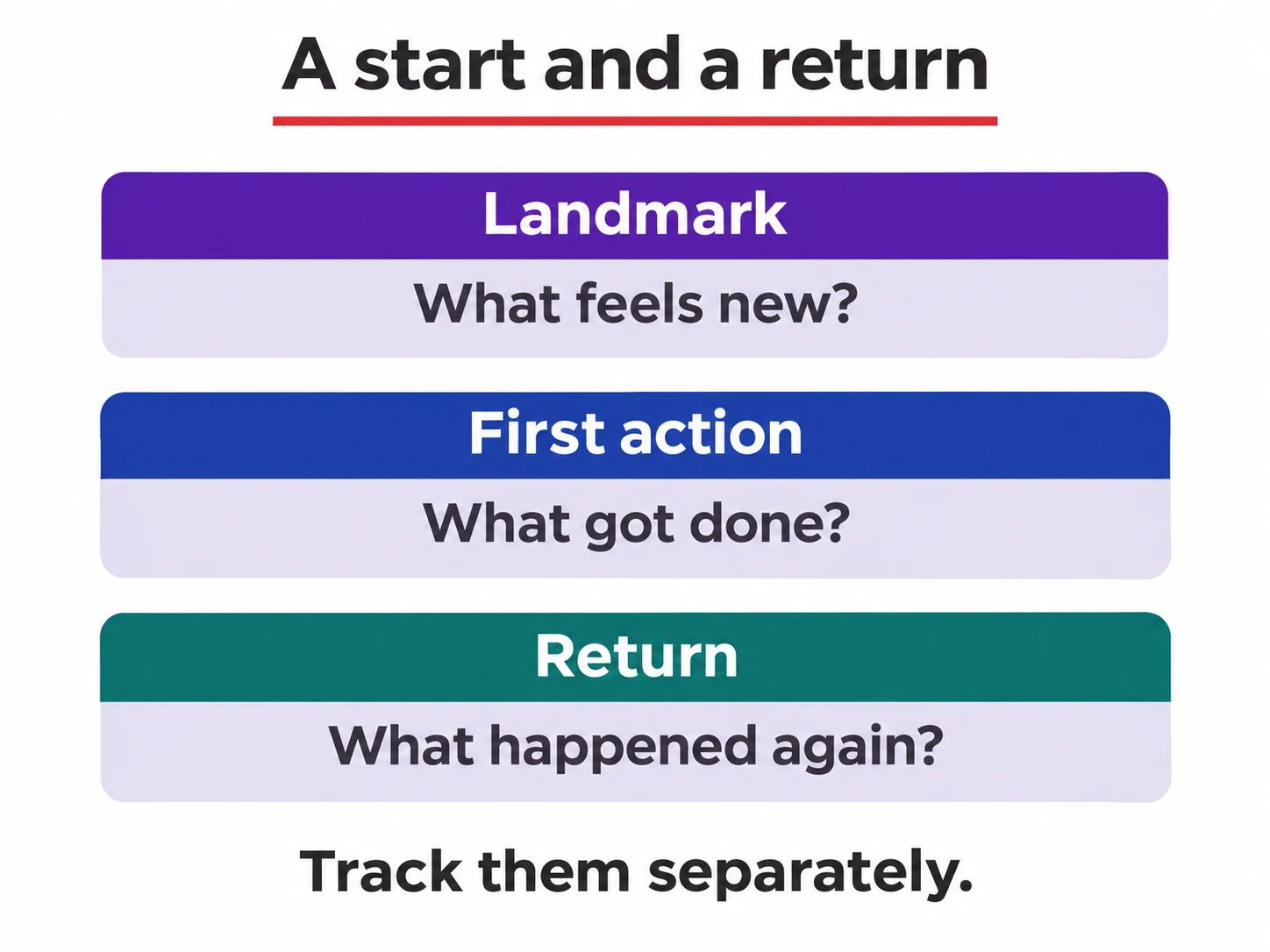
A start and a return. Landmark: What feels new? First action: What got done? Return: What happened again? Track them separately.
Ask which date feels new, what was actually made at the first opportunity, and what you made at a separate opportunity. Record those observations independently. Two attempts do not establish a habit.
Hengchen Dai, Katherine L. Milkman and Jason Riis · Hengchen Dai, Katherine L. Milkman and Jason Riis · Ben Singh and colleagues
Choose what you want to see by the end of the second sitting. “Become somebody who draws” gives you a direction. One new mark you can point to gives Tuesday a job.
Before you start
The Monday bump showed up in real activity. Dai and colleagues used campus gym records for 11,912 undergraduate members. Their statistical model estimated that the probability of a visit at the beginning of the week was 33.4% higher relative to the model’s baseline. That is a relative increase, and the records concern one campus fitness center. A visit counted attendance, with no requirement to establish a lasting exercise habit. Dai, Milkman and Riis, 2014, Study 2 and Table 2
Another study held the calendar date fixed and changed how people thought about it. In a randomized experiment with 216 participants who planned to pursue a previous goal again, people asked to reflect on why New Year’s felt personally meaningful visited an average of 0.62 goal-related websites. Those asked why the new year felt ordinary averaged 0.21. Most people in both groups visited zero. Reflecting on the same date changed an immediate preparatory behavior in that experiment. Completing the personal goal was a different outcome. Dai, Milkman and Riis, 2015, Study 2
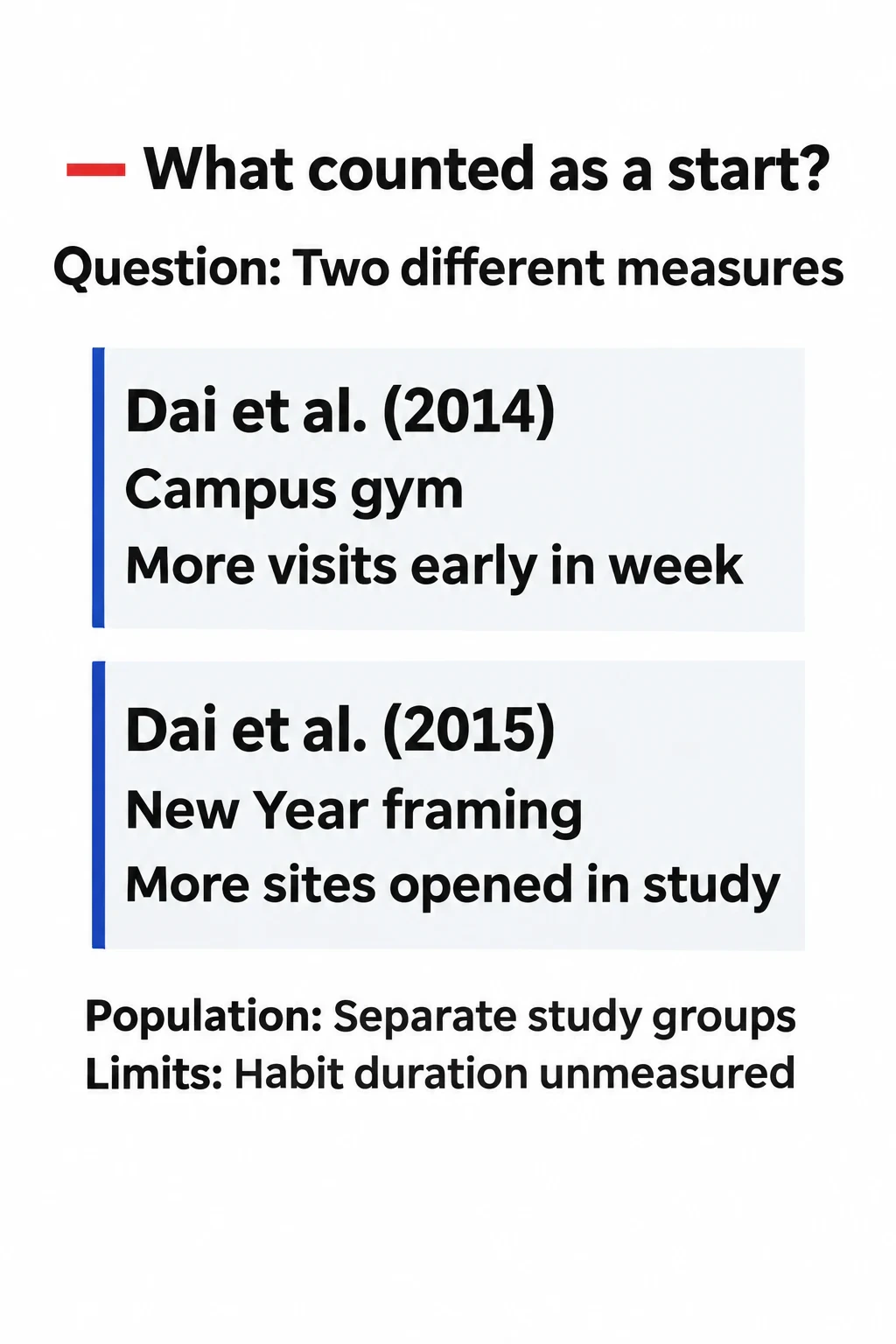
The field study measured attendance. The randomized study measured resource visits.
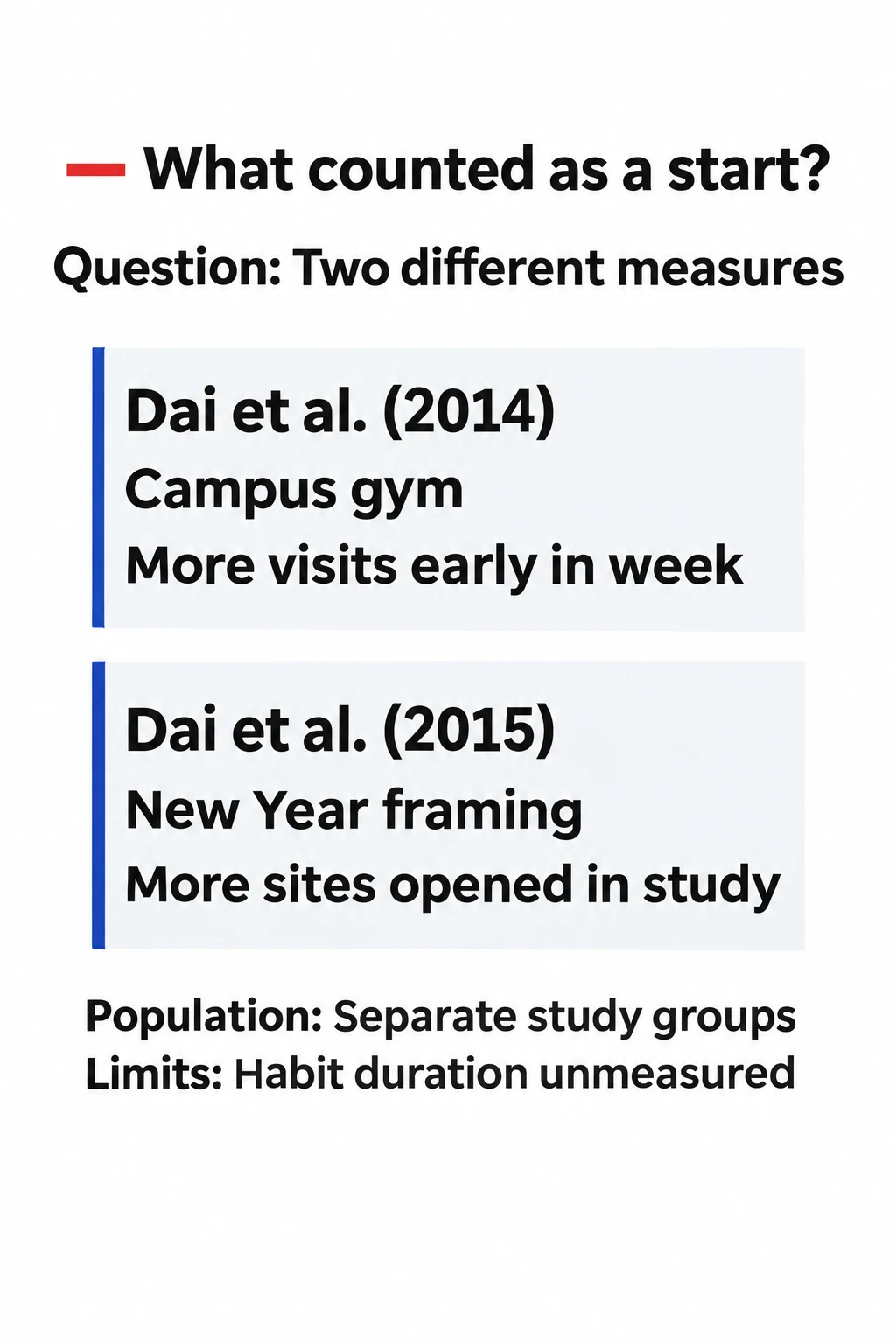
What counted as a start? Two different measures. Dai et al. (2014): Campus gym; more visits early in week. Dai et al. (2015): New Year framing; more sites opened in study. Population: Separate study groups. Limits: Habit duration unmeasured.
Dai and colleagues (2014), Study 2, modeled visits to a university gym. The probability of a visit at the beginning of the week was estimated 33.4% higher than the model’s baseline among 11,912 undergraduate members. Dai and colleagues (2015), Study 2, randomly framed the same New Year’s Day. The 216 participants averaged 0.62 goal-related website visits after meaningful framing and 0.21 after ordinary framing. Most visited zero in each group. The studies did not measure lasting habits.
Hengchen Dai, Katherine L. Milkman and Jason Riis · Hengchen Dai, Katherine L. Milkman and Jason Riis
Before you pick a day, look at your next two actual opportunities. If Monday is full, use the next short opening you already have. You need the project, an ordinary cue you expect to encounter twice or a different cue you can count on each day, and a scrap of paper or note on your phone. Leave the annual planner on the shelf.
Actions in order
- Make Monday’s first mark. Spend a few minutes making something you can see. In the sketch example, draw the mug’s outline. If you spend the whole slot picking a pencil or moving things around, write down what got in the way and use the next available opening for the mark itself.
- Name Tuesday’s cue and mark. Before you leave, finish this sentence in your own words. “After I put my lunch plate in the sink tomorrow, I’ll draw one mug handle.” Keep the cue observable and choose a mark you can finish during a normal day. If Tuesday lunch happens away from home, use an ordinary cue that actually fits Tuesday, such as putting down your keys when you get home.
- Try it at the next ordinary opening. When the event happens, make the mark. If you run out of time before finishing, record what happened. A missed cue, a missing sketchbook and a larger than expected drawing each point to a different adjustment.
- Check the page. Write “outline done” beside Monday and “handle done” or “handle missed” beside Tuesday. If Tuesday slips, change one thing for the next available opening. Replace a cue that rarely happens or shrink a step that overruns the time. You already have a first page. Keep working on it.

Decide what the return will leave on the page while the first sitting is still fresh.
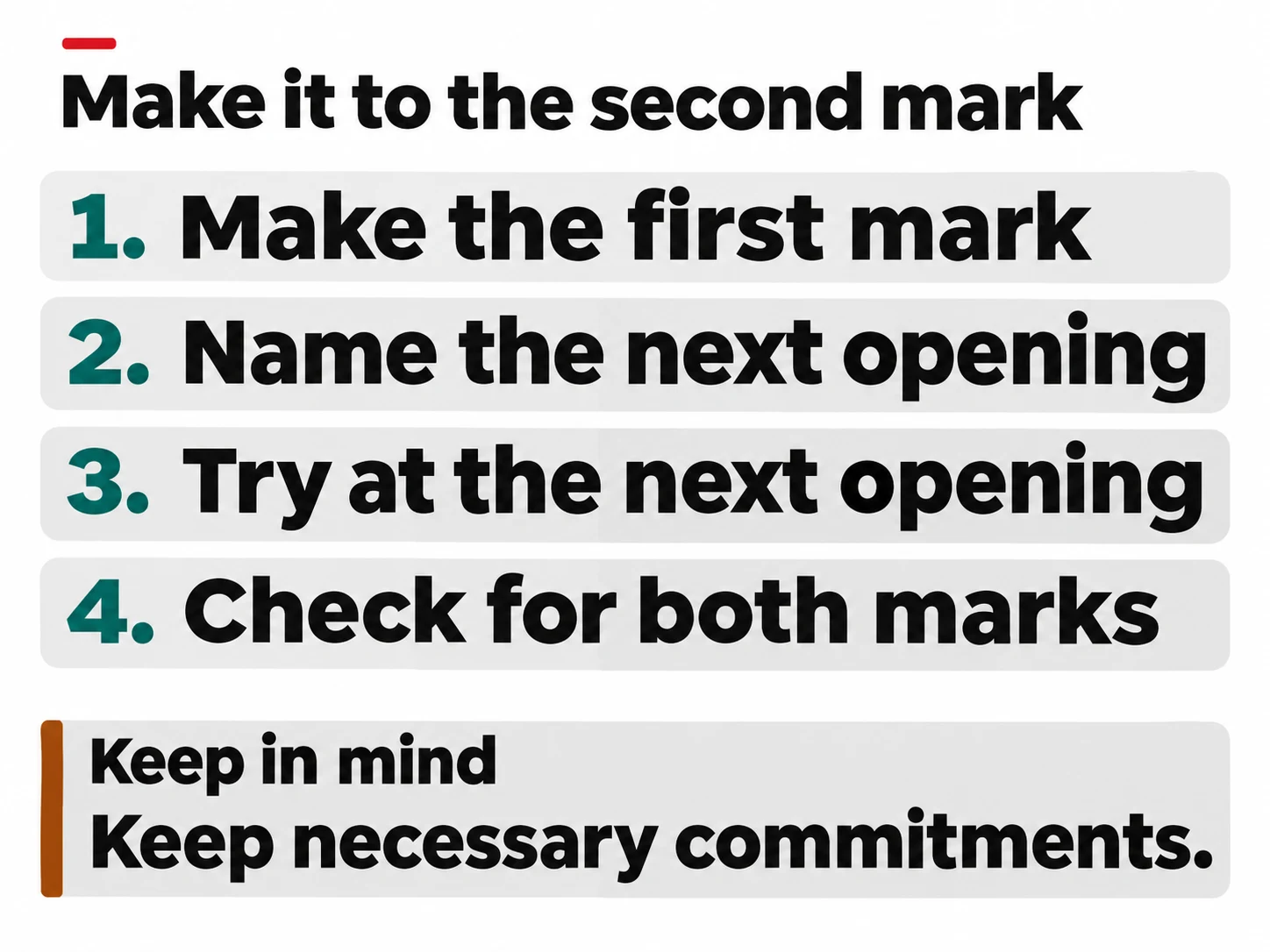
Make it to the second mark. 1. Make the first mark. 2. Name the next opening. 3. Try at the next opening. 4. Check for both marks. Keep in mind: Keep necessary commitments.
Make the first mark during the current opening. Name the next observable opening and choose a small mark. Try it when the identified event happens. Check for both marks, then adapt one obstacle if the second mark never made it to the page. Keep necessary commitments.
Hengchen Dai, Katherine L. Milkman and Jason Riis · Hengchen Dai, Katherine L. Milkman and Jason Riis · Peter M. Gollwitzer and Veronika Brandstätter · Ben Singh and colleagues
In a Christmas writing experiment, researchers randomly assigned 86 university volunteers to two groups. They asked everyone to write a report within two days after Christmas Eve. The planning group picked a time and place, wrote them down, pictured the opportunity and privately committed to it. Only 39 volunteers sent reports, and 36 returns had codes that identified the study group. Among those 36, 12 of 17 in the planning group and 6 of 19 in the comparison group wrote within the two days. The missing and uncoded returns leave the effect across all 86 volunteers uncertain. Gollwitzer and Brandstätter, 1997, Study 2

A real pencil mark verifies each sitting in the example.
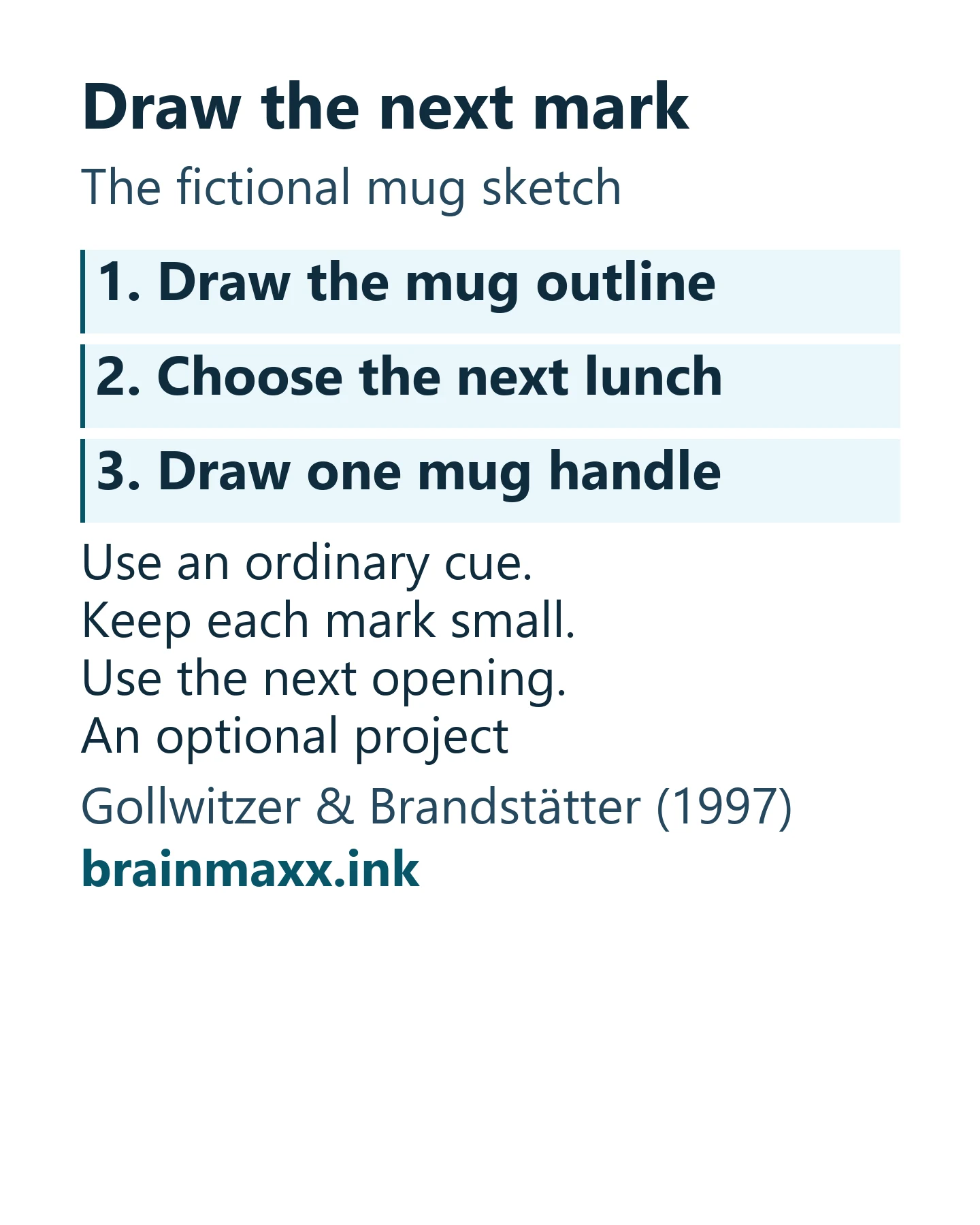
For the fictional sketch, draw the mug outline in the first sitting. Pick a time after the next ordinary lunch, then draw one handle. Use a cue that fits your day, and keep each mark small.
Peter M. Gollwitzer and Veronika Brandstätter
Costs, risks and stop criteria
Use supplies you have and keep the first two tries small enough for the time you can spare. If the second try would cost sleep or make you miss a commitment, use the next suitable opening. Drop the log if keeping it starts to take as long as the task. You can still look at the page.
This is a check for an optional personal project. Keep deadlines, required routines and any care plan in place. A two-day log cannot diagnose an attention problem. If persistent trouble getting through everyday tasks is affecting your life, take specific examples to a qualified professional.

The optional project can move when the rest of the day needs the time.
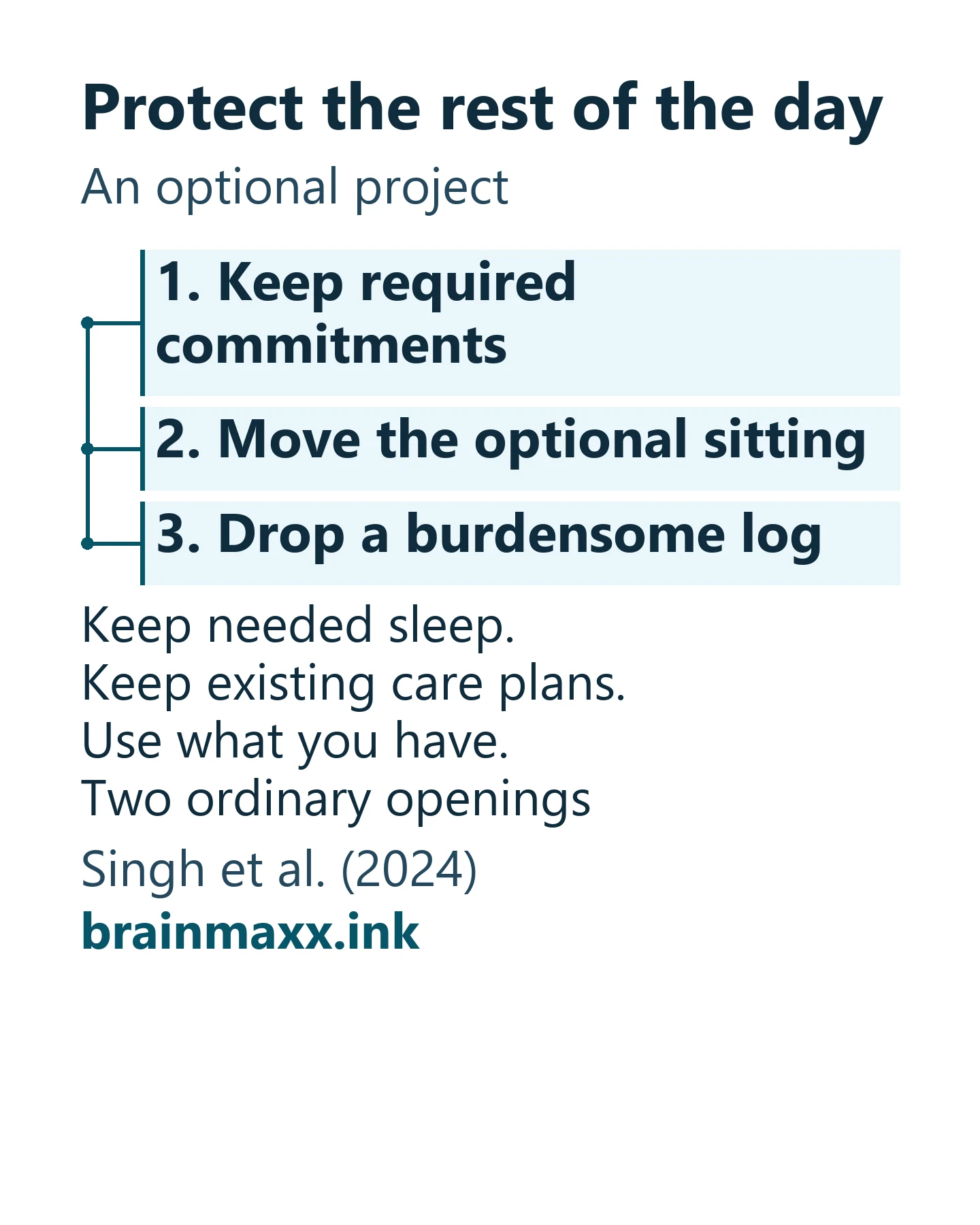
Use what you have. Keep required commitments, needed sleep and any existing care plan. Move the optional sitting to the next suitable opening. If logging takes over the activity, drop the log and check what the page shows.
How to assess the result
Two visible marks mean you did the action twice. If both are there, try the same cue on the next comparable day and see whether it still fits. If one is missing, check whether the cue occurred. A cue that showed up while your hands were full needs a different slot. A cue you noticed with time to spare, followed by an unfinished task, suggests checking the size of the step or the materials.
Repeating something once tells you little about whether it will become automatic. Singh and colleagues reviewed 20 studies of health habits with 2,601 participants. Only four reported how long it took to reach the study’s measure of a habit. The review flagged study-quality limitations, and its text and table gave different counts of low-risk studies. For the sketchbook, your first useful measure is the second mark. Singh et al., 2024
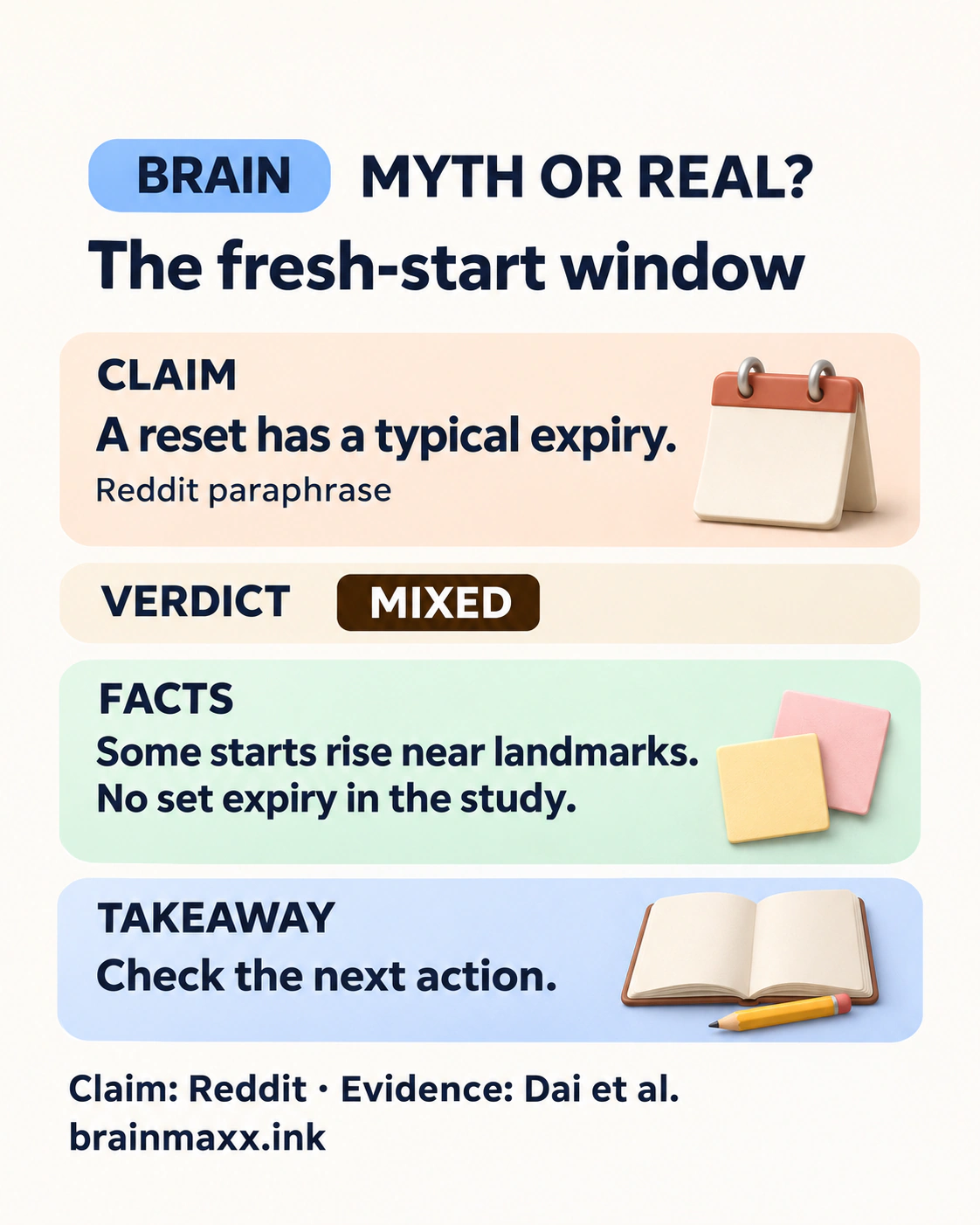
Myth or Real?

Claim
Social paraphrase: A fresh-start boost typically fades within one to three weeks.
Verdict
MIXED
Facts
Some starts rise near landmarks.
No set expiry in the study.
The field study recorded searches, university gym attendance and goal commitments around calendar landmarks. Its discussion describes declines over different calendar periods. Those group patterns do not establish a typical one-to-three-week expiry for an individual’s motivation. The fictional sketch exercise checks the next action; it does not measure habit formation or diagnose attention problems.
Takeaway
Check the next action.
Sources
Claim discussion: Reddit public post.
Evidence: Dai et al. (2014).
Checked 2026-11-19. Scope: Ordinary optional personal projects; observed group measures cannot set an individual motivational deadline.
Sources
- Hengchen Dai, Katherine L. Milkman and Jason Riis. The Fresh Start Effect, Management Science, 2014.
- Hengchen Dai, Katherine L. Milkman and Jason Riis. Put Your Imperfections Behind You, Psychological Science, 2015.
- Peter M. Gollwitzer and Veronika Brandstätter. Implementation Intentions and Effective Goal Pursuit, Journal of Personality and Social Psychology, 1997.
- Ben Singh and colleagues. Time to Form a Habit, Healthcare, 2024.
FAQ
Common questions
What is the fresh-start effect?
Some measures of goal pursuit rise near meaningful calendar dates, such as the beginning of a week or a new year. The measures can capture a visit or a preparatory action without establishing a lasting habit.
Do I have to wait until Monday to try again?
Use the next ordinary opening that fits a small concrete action, and judge the result by what you actually make.
Do two completed actions mean I formed a habit?
The two actions show that you returned once. Habit researchers use separate measures, such as how automatic the behavior feels over time.
Topic hubs
Tags