By Nora Vale
At a volunteer fair, four people look at a box of unused name badges. The first person says there are 80 left. Forty seconds later, everyone is working with 80. The last person to nod had been thinking 160. Now nobody can see what the others would have said on their own.
Next time, write down the first estimates privately. Then discuss what each estimate depends on, and collect a second private round. Keep both sets. If everyone moves toward the same number, you can tell whether they also moved toward the answer once you have a count.
Decision in brief
For an ordinary quantity you can verify later, start with independent estimates and keep them as your baseline. Add a second round if someone can contribute an observation or a different way to break down the problem. Ask for the reason before putting a number on the table. In the badge example, “I can see four unopened packs” gives the group something it can check.
An independent estimate here means you make your guess before seeing the others’ answers. It protects that first observation from immediate copying. Everyone can still start with the same misleading information. An estimate after discussion lets each person reconsider in light of what they heard. Keep that second response private as well, so anyone can keep their original number without arguing for it in front of the room.

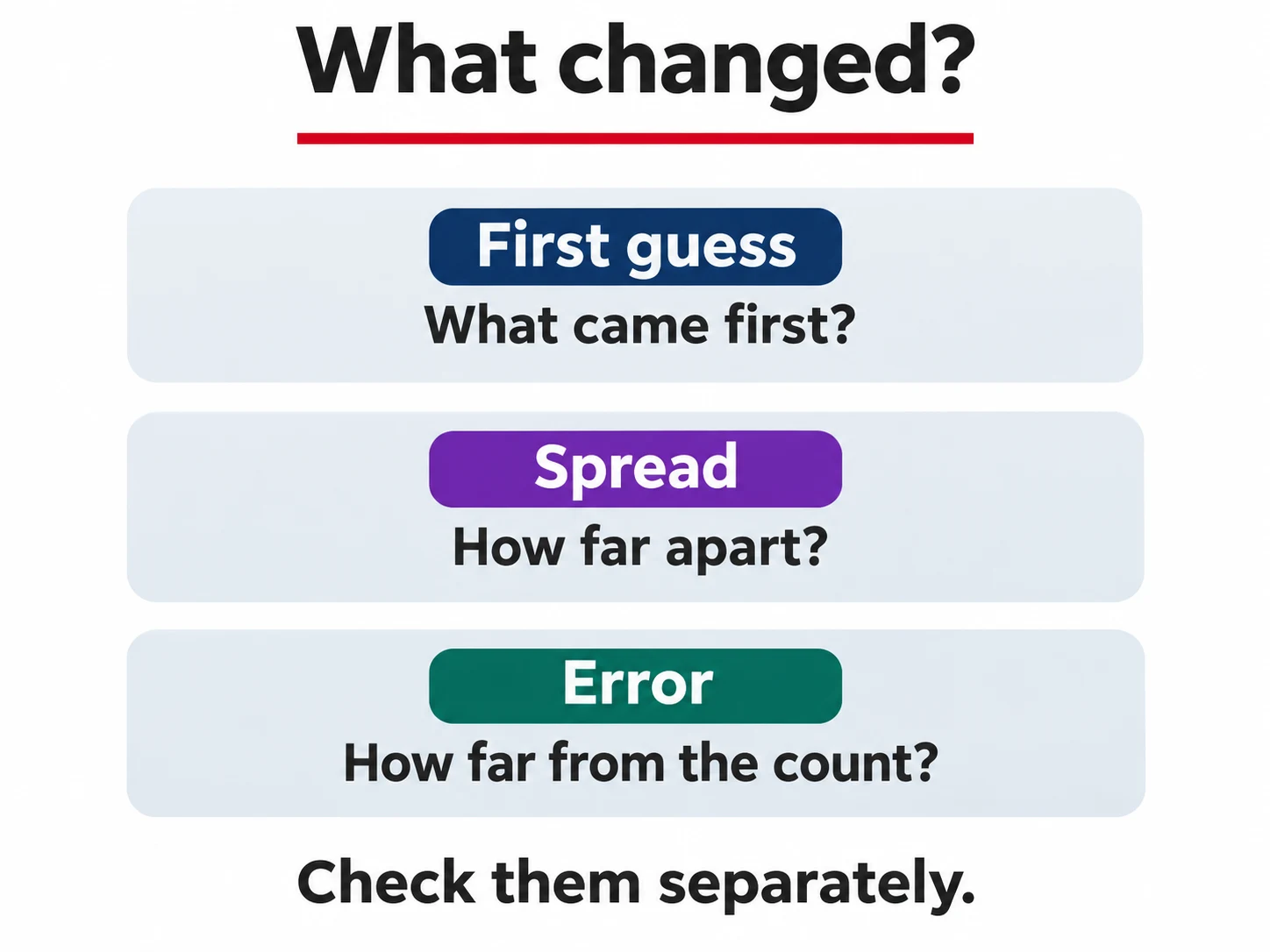
Estimates, spread and error track three different observations.
Keep the first private estimates. Check how far apart the answers are to measure spread. Compare your chosen group summary with the actual count to measure its error. An agreed answer can still have a large error.
Jan Lorenz, Heiko Rauhut, Frank Schweitzer and Dirk Helbing · Joshua Becker, Devon Brackbill and Damon Centola · Federico Barrera-Lemarchand and colleagues
Comparable evidence
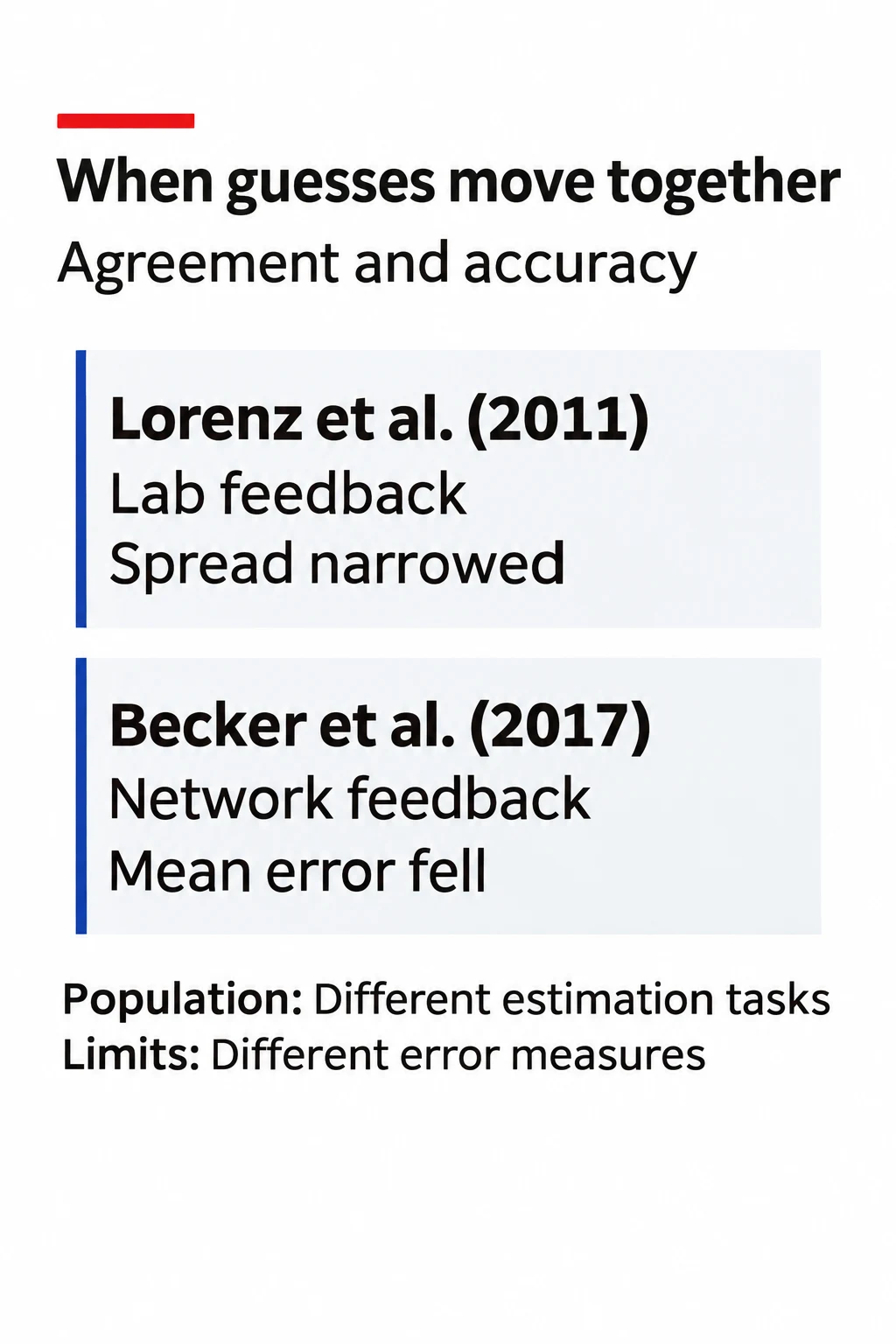
Seeing other numbers can narrow the spread. Lorenz and colleagues studied 144 participants answering six factual estimation questions over five rounds. Some saw a summary or a list of other estimates. The comparison condition received no other estimates. Numerical feedback narrowed the spread, while the researchers found no significant reduction in the collective error they measured. Participants also reported more confidence after seeing others’ estimates. The exchange consisted of numbers. People did not debate their reasons. Lorenz et al., 2011
A different feedback design can also improve a group estimate. Becker and colleagues recruited 1,360 people for online estimation tasks. Participants in network groups saw averages from connected peers before revising. In the 13 decentralized-network trials, where each person had equal connectivity, the spread measured by the standard deviation fell by 43% on average from the first to the third round. Over those same rounds, the normalized error of the group mean fell from 0.69 to 0.62 standard deviations, a change of about 10% within that network condition. A roomful of people discussing a number has different inputs. Becker, Brackbill and Centola, 2017
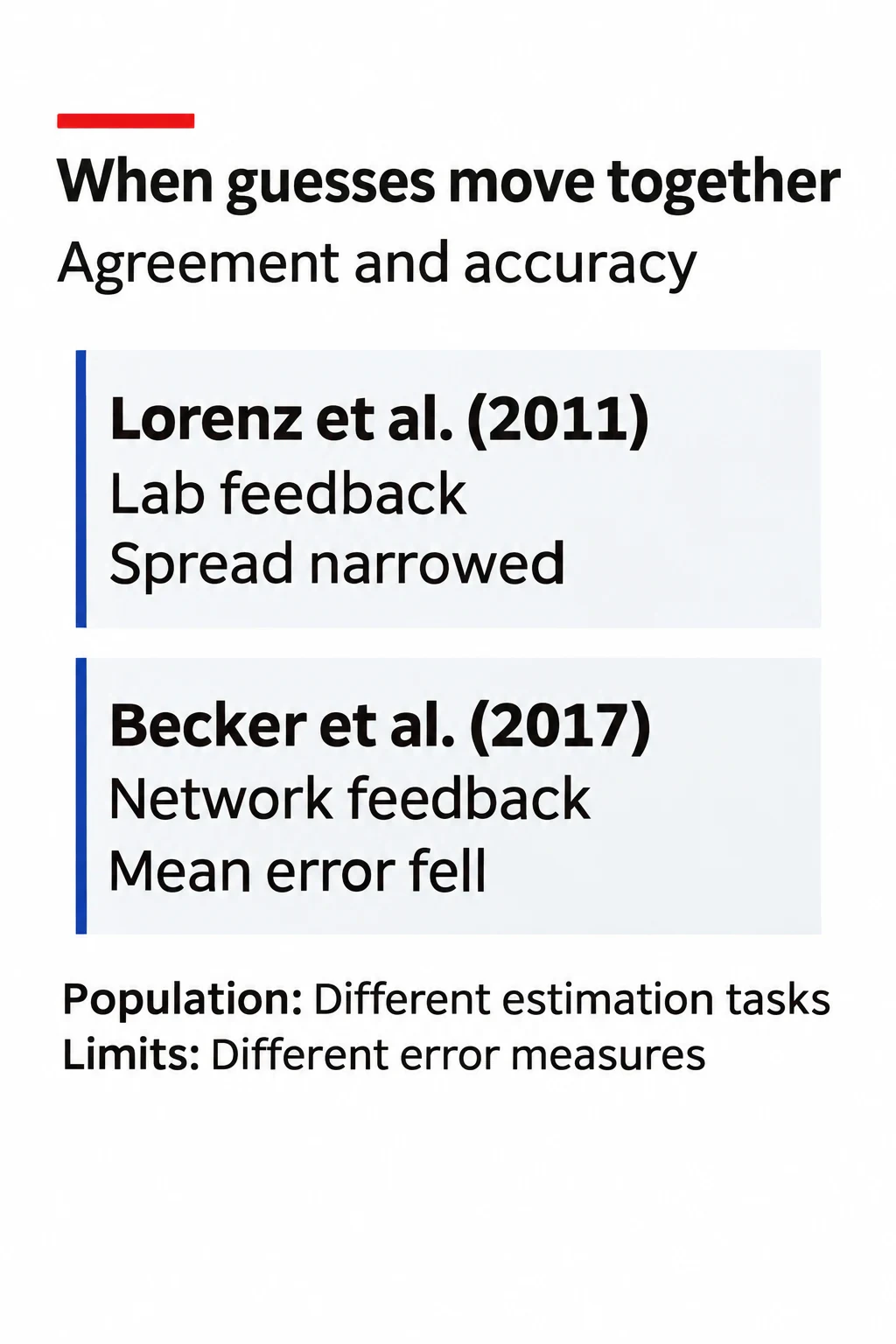
Estimates drew closer in both settings. Aggregate accuracy improved in the decentralized-network trials.
Lorenz et al. (2011) exposed participants to other estimates in a factual lab task. The spread narrowed without a significant reduction in the defined collective error. Becker et al. (2017) found that after two rounds of numerical feedback in 13 decentralized-network trials, average standard deviation fell 43% and normalized average group mean error fell about 10% compared with the first round. The studies used different tasks, designs and accuracy measures.
Jan Lorenz, Heiko Rauhut, Frank Schweitzer and Dirk Helbing · Joshua Becker, Devon Brackbill and Damon Centola
Discussion can give people something new to work with. Barrera-Lemarchand and colleagues randomly assigned 60 groups of four in Argentina to two discussion instructions after everyone made a private estimate. One instruction asked groups to share and combine their numbers. The other asked them to split the problem into smaller quantities and recalculate. After exclusions for extreme starting estimates and early departures, the rank test compared 69 conversations in the first condition and 60 in the second. It favored the second instruction. A separate 95% interval for the standardized difference included zero. The authors’ figure code also fits a model that accounts for differences between questions. It does not account for the same group answering multiple questions. Those repeated observations limit confidence in the comparison. Barrera-Lemarchand et al., 2026, Study 2 · Author’s analysis code
Mercier and Claidière ran a different kind of exercise with 1,958 science-fair participants. People first answered independently and then discussed the problem. More individuals correctly answered the logic and arithmetic problems during discussion. The average error across individual estimates also fell for both factual questions. For one of those questions, about World Cup goals, the group’s average stayed about as far from the correct answer. The individual and aggregate scores tell different stories. Mercier and Claidière, 2022
Tradeoffs by criterion
| What you need | First estimates in private | Private estimates after discussion |
|---|---|---|
| See how far apart people started | Keep the raw range and middle values. | Compare against the saved first range. |
| Learn a fact that someone else has | Record a short reason with each estimate. | Check the new fact, then let each person revise. |
| Check numerical accuracy | Calculate your chosen summary before sharing numbers. | Use the same summary and compare both with the actual quantity. |
| Keep disagreement easy | Ask for private slips with no names if individual tracking serves no purpose. | Let people retain their first answer and submit the second without a public vote. |

Keep a first baseline and review both rounds on the same criteria.
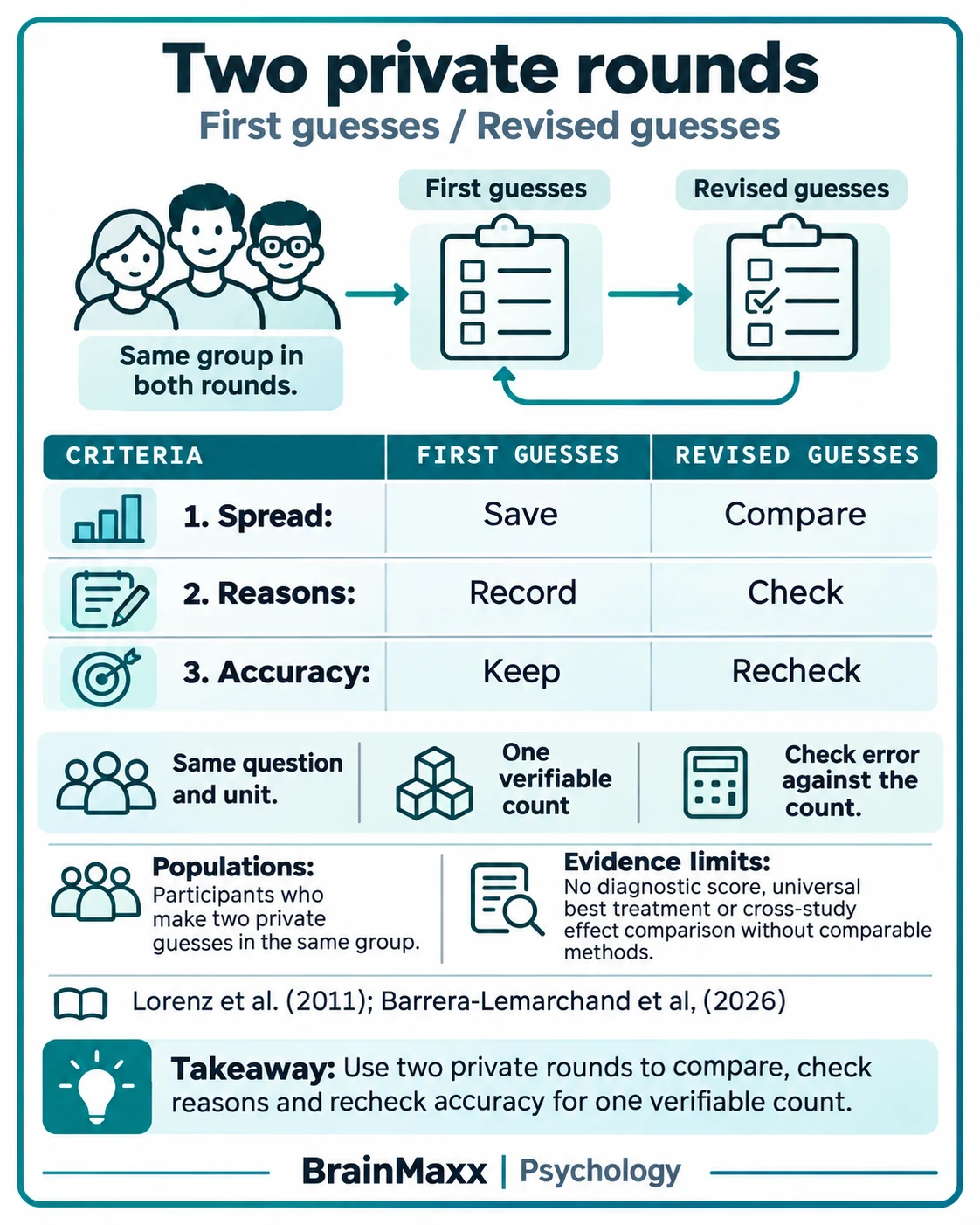
For a low-stakes quantity, ask the same people the same question both times. In round one save the spread, record reasons and keep the group summary. In round two compare the spread, check the reasons and recheck the summary when you have the actual count.
Jan Lorenz, Heiko Rauhut, Frank Schweitzer and Dirk Helbing · Federico Barrera-Lemarchand and colleagues
Here is the arithmetic for the fictional badge box. Four first estimates are 80, 90, 110 and 160. The mean is 110 and the range spans 80 badges. In the second round, suppose all four write 80. Now the mean is 80 and the range is zero. If counting shows 100 badges, the average estimate moved from 10 to 20 badges away. Everyone landed on one answer, and that answer moved further from the count.
You can run the check with paper slips. Write the exact question and unit first. Have the same people submit privately in both rounds. Compare reasons between rounds. Once you know the actual count, use the same measure for both rounds and note the absolute gap from the count.

Use the same question, people and summary across both rounds.
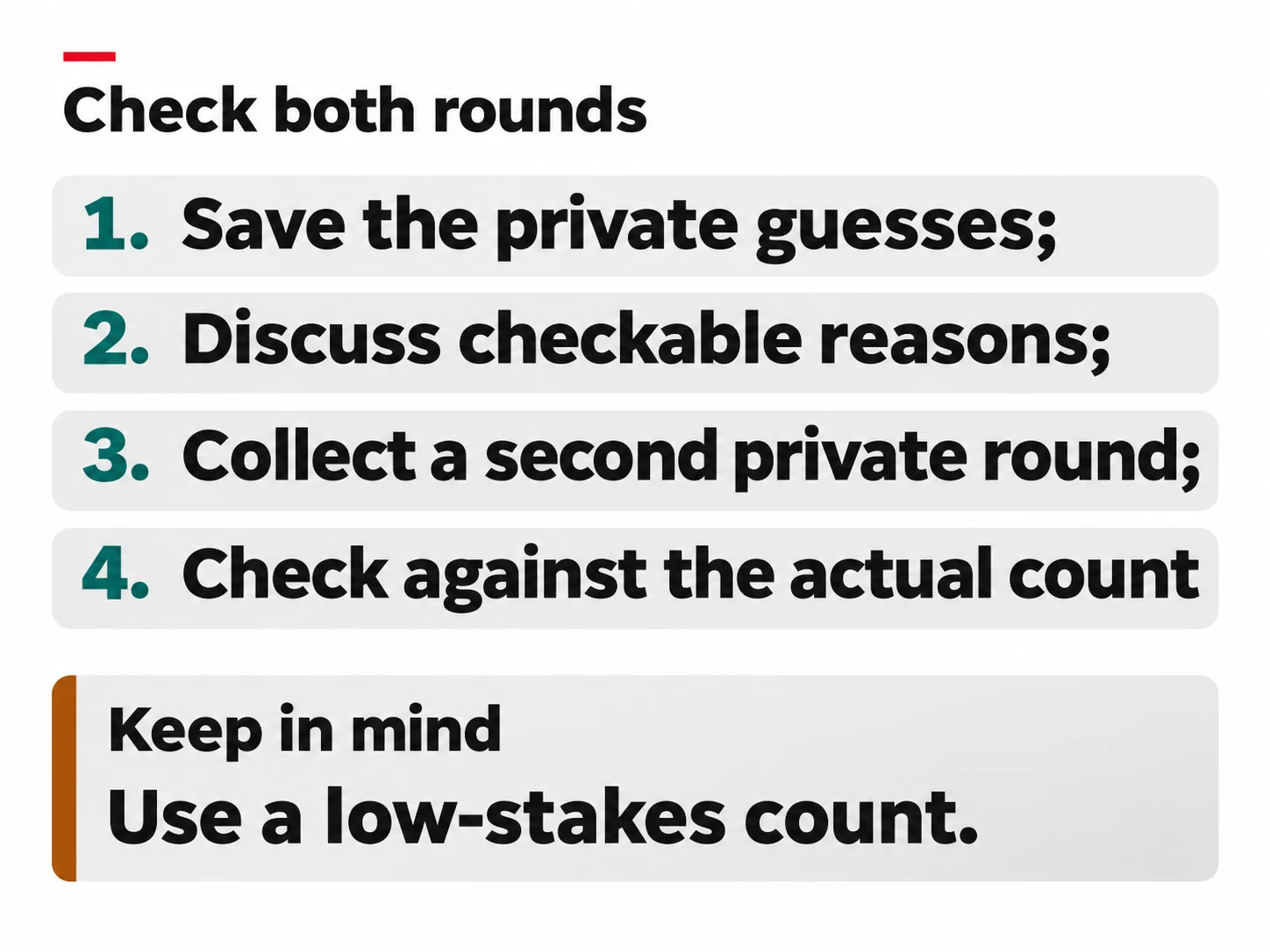
Save the private guesses under one question and unit. Discuss reasons and checkable evidence. Collect the second round privately and allow people to keep their first answers. After counting, compare the spread and the size of the error separately. Use a voluntary low-stakes task.
Jan Lorenz, Heiko Rauhut, Frank Schweitzer and Dirk Helbing · Joshua Becker, Devon Brackbill and Damon Centola · Federico Barrera-Lemarchand and colleagues · Hugo Mercier and Nicolas Claidière
If you need to match slips across rounds, ask each person to reuse a code they chose instead of writing their name. In a small group, distinctive answers can still be recognizable. Share the group summaries and discard the individual slips when you have finished checking them. If someone leaves, record the missing response before comparing the two rounds.
Who should choose each option
Use the first round alone when a quick baseline matters, time is short or nobody has a new observation to share. If the numbers are far apart, ask which assumption accounts for the difference. Check the assumption against the object or record before treating the aggregate as an answer.
Use both rounds when different people have different parts of the information. In the badge box, ask someone to check pack size while someone else checks the number of full packs and loose badges. When you can count every badge quickly, count them. Keep the estimates only if the point is to see how the group revised them.

A second round earns its time when someone can check a new piece of evidence.
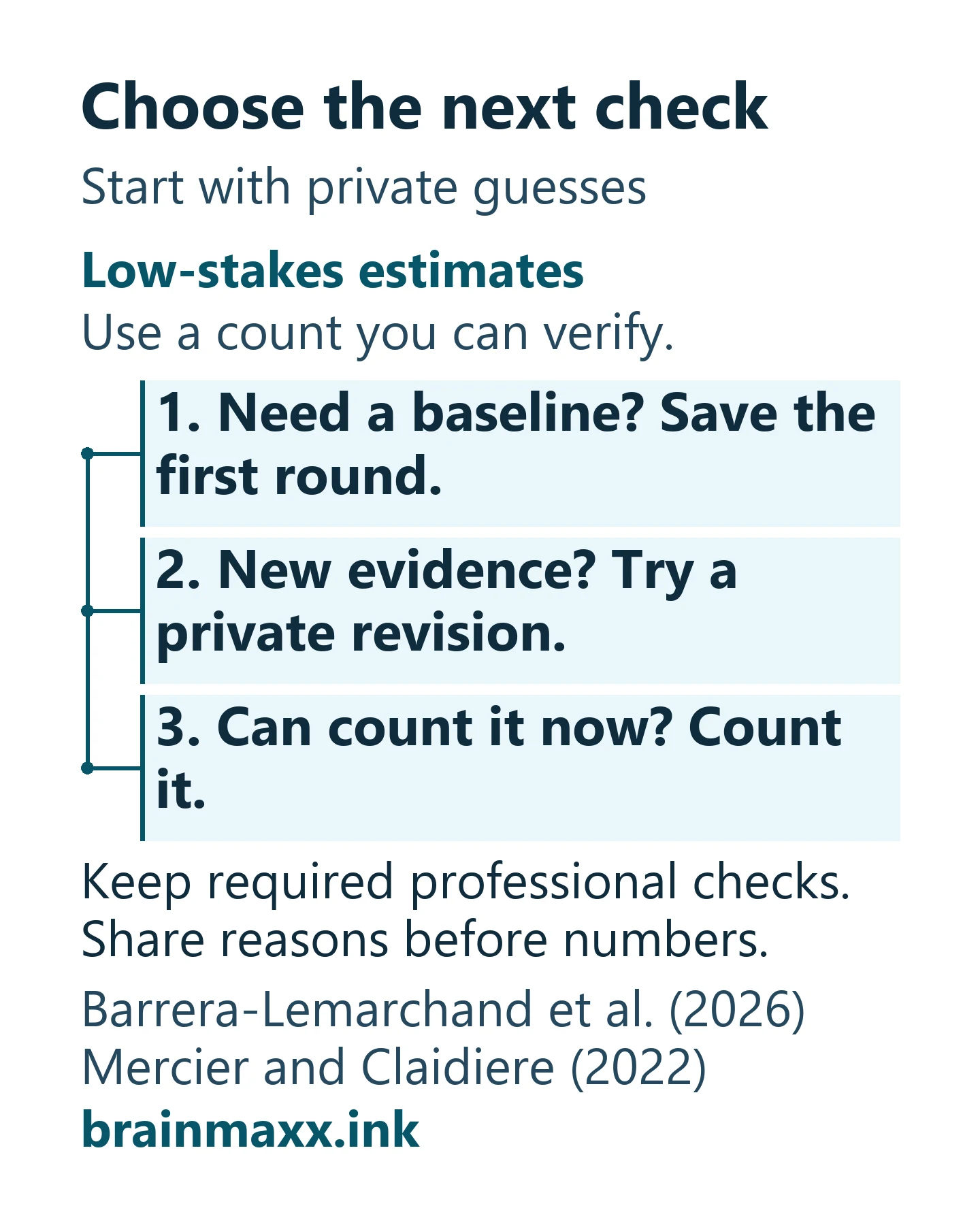
Start with a private baseline for a quantity you can verify. If you have new evidence, discuss the reasons and collect a private revision. If you can count the whole quantity now, count it. Keep required professional checks for consequential decisions.
Federico Barrera-Lemarchand and colleagues · Hugo Mercier and Nicolas Claidière
Limitations and sources
The studies used different tasks, feedback and definitions of accuracy. Their results support keeping agreement and accuracy separate. A small exercise can tell you what happened with that question and those people. Use it for an optional quantity you can verify, with permission and an easy way to decline. Follow any established professional checks for consequential decisions. Two rounds cannot diagnose a group member’s judgment or motives.
Myth or Real?

Claim
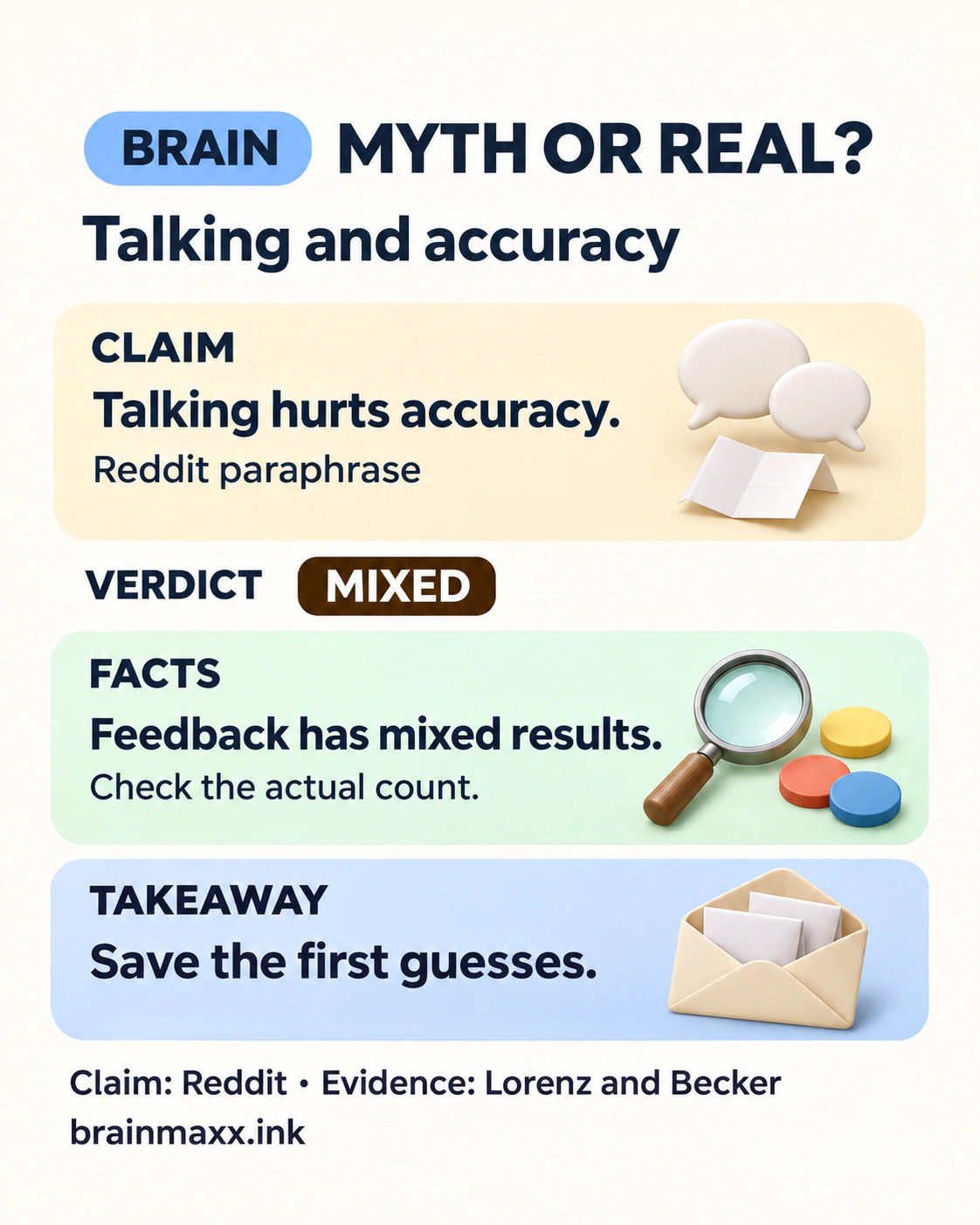
Social paraphrase: Communicating during a group estimation task can badly hurt the crowd’s accuracy.
Verdict
MIXED
Facts
Feedback has mixed results.
Check the actual count.
Seeing other estimates narrowed the spread without a clear improvement in one study. In a different network experiment it narrowed the spread and improved an aggregate estimate. The post leaves the jar experiment unidentified. The studies used different tasks, designs and accuracy measures.
Takeaway
Save the first guesses.
Sources
Claim discussion: Reddit discussion paraphrase.
Evidence: Lorenz et al. (2011); Becker et al. (2017).
Checked 2026-11-19. Scope: Low-stakes verifiable estimates; different numerical-feedback designs and error measures. The Reddit bean-jar experiment remains unidentified.
Sources
- Jan Lorenz, Heiko Rauhut, Frank Schweitzer and Dirk Helbing. How social influence can undermine the wisdom of crowd effect, PNAS, 2011.
- Joshua Becker, Devon Brackbill and Damon Centola. Network dynamics of social influence in the wisdom of crowds, PNAS, 2017.
- Hugo Mercier and Nicolas Claidière. Does discussion make crowds any wiser?, Cognition, 2022.
- Federico Barrera-Lemarchand and colleagues. Collective problem decomposition improves the wisdom of deliberative crowds, Nature Communications, 2026.
FAQ
Common questions
What counts as a private first estimate?
Each person records their own answer before seeing anyone else’s number.
Does agreement improve accuracy?
Check the group estimate against an actual count. Estimates can converge even while the average moves further from the answer.
When is a second round worth doing?
Add it when another person has a checkable observation or a useful way to break down the quantity.
Topic hubs
Tags