The answer has a tidy paragraph, a serious title and a link that actually opens. That can feel like the end of the checking. Then you read the original: it discusses a different group, asks a narrower question or never makes the claim beside the link.
A working citation gets you to something. It does not finish the job of connecting that thing to the sentence you want to use. This matters whether you are reading an AI summary, a social post or your own draft. A human can attach an unsuitable citation too.
The useful question is specific: does this original support this claim, with these qualifications? You can ask it without deciding who wrote the paragraph, declaring the entire source worthless or turning a casual reading session into an investigation.
Graphic context — 01-article-hero: This original qualitative sequence connects identifying an original, reading its scope and comparing the attached sentence. A genuine citation can lead to a genuine document while the sentence beside it claims something the document does not establish. The rail organizes checks; it is not a measured cognitive process.
Text equivalent: REAL LINK. WRONG CLAIM? Find the original. Read its scope. Match the sentence. A real citation alone does not prove support. CHECK WHAT IT SUPPORTS. NIST supplies selected advisory risk context, Anthropic commercial issuer help and Crossref its own metadata explanation. None independently tested this complete reading sequence. Citation existence, source identity, source quality and exact claim support are distinct. A support gap does not by itself prove a claim false, reveal writer intent or identify AI authorship. Reading can remain incomplete and the question unresolved. Four actual primary publisher groups with distinct dated language, voluntary advisory risk-profile, commercial issuer-help and metadata-explanation roles; no empirical routine-efficacy trial. No current growth, model benchmark, whole64-page report/linked reference/full journal reading, error prevalence, clinical diagnosis, authorship detector, writer-intent inference, legal rule or guaranteed accuracy.
Who this is for
This guide is for ordinary reading and drafting: a hobby explainer, a club newsletter, a general-interest post or a question you can leave unresolved. It offers a way to record what a citation establishes and what still needs checking. It is not an AI-authorship detector or a scoring system for people’s intelligence.
The cultural label has a date. The American Dialect Society announced slop as its 2025 Word of the Year on January 9, 2026, describing low-quality content produced in quantity, typically with generative AI. That announcement supplies language context. It does not measure how much such content is circulating now, and the label alone tells you little about a particular factual sentence. [S1]
You might dislike an article’s style and still find one supported claim. You might enjoy a polished explanation and find its central claim unsupported. Keep the evaluation attached to the claim you are checking rather than the person, platform or writing style.
This is not a diagnosis, a clinical exercise or a replacement for qualified advice. Medical, legal, financial and safety decisions need appropriate expertise and the relevant original information. A casual citation check does not authorize you to change treatment, ignore a procedure or act on consequential advice.
Before you start
Choose one sentence worth your attention. If the post is only an opinion or a creative idea, there may be no factual assertion to verify. If there is a claim, keep its qualifiers with it. Words such as causes, some, all, adults, students, during the task and over time can change what evidence would be needed.
Separate three questions. Does the cited object exist? Is it the object the writer identifies? Does its actual content support the sentence? An identifier or a matching title can help with the first two. You still need the original’s relevant content for the third.
Crossref’s own publication page explains that a DOI alone does not signal quality; associated metadata can supply trust signals. Its page is dated November 4, 2024 and describes an article in the December 2024 issue of Science Editor. Here, that explanation is the source being used. The linked full journal article has not been used as if it had also been read. [S4]
Metadata means information about the work: its title, authors, date and other recorded details. Those details help identify and investigate it. Their presence does not settle whether a particular paragraph supports your exact wording. A convincing bibliography can still leave that relationship unexamined.
If you cannot open enough of the original to inspect the relevant passage and its limits, say so. A search snippet, abstract or another summary may be useful for locating it. None should silently become a claim that you read the full work. You do not need a paid tool, a new subscription or somebody else’s private documents to mark a question unresolved.
Graphic context — 02-concept-model: The three pairs separate existence, identity and exact claim support. A DOI or matching title can help locate and identify a work. Reading its relevant content and limits is still necessary to assess the claim attached to it. Crossref says a DOI alone does not signal quality; its metadata explanation is context, not certification.
Text equivalent: CITATION IS NOT CLAIM SUPPORT. Exists? Locate it. Same work? Match it. Supports this? Read scope. An identifier helps. The passage matters. THREE DIFFERENT CHECKS. The arrows show different questions and their relevant checks, not causes or probabilities. Source quality and relevance are also separate: a real, serious document can answer a different question. If you have only a summary, abstract or landing page, do not report inaccessible methods as read. Crossref November4,2024 landing-page date and the linked December2024 volume remain distinct; the linked full ScienceEditor article was not read. Four actual primary publisher groups with distinct dated language, voluntary advisory risk-profile, commercial issuer-help and metadata-explanation roles; no empirical routine-efficacy trial. No current growth, model benchmark, whole64-page report/linked reference/full journal reading, error prevalence, clinical diagnosis, authorship detector, writer-intent inference, legal rule or guaranteed accuracy.
What the sources actually establish
NIST’s July 2024 Generative Artificial Intelligence Profile discusses confidently presented erroneous content, including misleading reasoning or citations. Its information-integrity discussion also emphasizes evidence, uncertainty and connection to original sources. These are risk descriptions and advisory context, not measurements of how often a particular tool fails today. [S2]
The profile also discusses excessive deference to automated systems. That is a possible risk, not a diagnosis of somebody who believed an answer. For this guide, the practical distinction is simpler: the answer’s confident presentation cannot do the work of reading its evidence.
Only selected NIST sections inform this article: the introduction and scope, confabulation, human–AI configuration, information integrity and relevant suggested-action context. The entire report and its underlying reference literature have not been reproduced or assessed here. NIST’s organizational suggestions are not presented as a validated personal checking intervention or a legal requirement. [S2]
Anthropic’s March 16, 2026 help page similarly tells users that its assistant can produce incorrect or misleading responses and that cited originals may contain context missing from a synthesis. That is commercial issuer guidance about its own service. It is not an independent benchmark, a comparison between models or a reason to buy a subscription. No model was tested for this article. [S3]
Together, these four sources supply dated language context, an advisory risk profile, issuer help and a metadata explanation. They are not four experiments showing that the routine below improves accuracy. No success percentage, expected time saving or personal cognitive benefit is being claimed.
Graphic context — 03-evidence-infographic: Four original publisher groups have different roles: ADS supplies dated language context; selected NIST sections describe risks and contextual suggested actions; Anthropic supplies commercial issuer help; Crossref explains metadata. This diagram encodes no numbers, prevalence, accuracy score, pooled finding or measured benefit.
Text equivalent: FOUR SOURCES. NO ROUTINE TRIAL. Language Dated. Risk profile Advisory only. Help / metadata Context only. No measured benefit. No model benchmark. KEEP SOURCE ROLES VISIBLE. The sources are not four effectiveness studies or independent model tests. ADS January9,2026 announces a2025 selection, not October2026 growth. NIST July2024 is a voluntary organisational risk profile; selected sections, not the whole64-page report or its reference literature, were read. Anthropic March16,2026 is issuer guidance, not an independent benchmark. Crossref own landing-page explanation was read, not the linked full journal article. The article’s five actions and fictional newsletter are original editorial applications, not tested interventions. Four actual primary publisher groups with distinct dated language, voluntary advisory risk-profile, commercial issuer-help and metadata-explanation roles; no empirical routine-efficacy trial. No current growth, model benchmark, whole64-page report/linked reference/full journal reading, error prevalence, clinical diagnosis, authorship detector, writer-intent inference, legal rule or guaranteed accuracy.
Actions in order
1. Put the claim beside the citation
Copy the sentence into a private note if that is useful and safe. Remove names or identifying details you do not need. Preserve the source link and the wording that matters. Avoid replacing a precise assertion with a much easier question such as whether the topic appears anywhere in the document.
For example, a statement that a particular activity improves long-term learning in everyone needs different support from a statement that a small group reported enjoying it. Both can mention learning. The shared keyword does not make the claims equivalent. This is an illustration of the distinction, not a report of a study.
2. Confirm which original you reached
Check title, author or organization, date and version against the reference. A link might lead to a publisher’s landing page, a correction, a product page or a different edition. Notice which one it is. If the page provides update information, read what that notice actually says before relying on older wording.
Finding a DOI or an official-looking page is useful identifying information. Do not turn that into a certificate for the claim. A real document can be irrelevant to your question; a relevant document can have important limitations. You can keep both facts in view.
If a reference identifies a journal paper but only a company’s summary is accessible, record that difference. You may decide the limited information is enough to stop reading for your casual purpose. It is not a basis for reporting methods you have not seen.
3. Locate the supporting passage and its boundaries
Find the passage that appears to do the supporting work. Read around it. Look for who or what was examined, the comparison, the outcome, the time period and the uncertainty. For a report or guidance page, check whether the passage is describing a risk, proposing an action or reporting an observation.
A document’s introduction may describe a hoped-for use. Its discussion may offer an interpretation. Neither automatically turns into a measured result. Where a claim depends on research design, you may need methods and results rather than a headline or a sentence announcing potential.
You do not have to become a specialist to notice that the original says something narrower. You do need to avoid filling a gap with a guess. If technical details exceed your knowledge, keep that limitation in your note instead of treating the citation as cleared.
4. Compare the wording directly
Set your sentence beside what you actually found. Does it change an association into a cause? Turn a possibility into a guarantee? Replace a particular group with everyone? Present an old result as a current rule? Treat an issuer’s explanation as an independent test?
These are questions to ask, not a detector that decides every case. Sometimes the original supports the wording well. Sometimes it supports a narrower sentence. Sometimes the passage is missing or you cannot judge it. Keep the evidence and your interpretation distinguishable.
Another AI response can suggest where to look, but an answer agreeing with the first answer is not a substitute for examining the original. The same applies to several posts that repeat one citation. Repetition does not supply the missing passage.
A gap in support is not proof that the claim is false. Another source, an unread section or information you cannot access might matter. Record what this citation establishes from the material you inspected. Do not silently turn that limited result into a verdict on every possible source, or an accusation that the writer deliberately invented the claim.
5. Choose what to do with the claim
For your own draft, you can retain a supported sentence, narrow it to what the original warrants or remove it. If you are only browsing, you can leave the page without resolving the whole topic. There is no requirement to confront the author, post a correction or identify the tool they used.
If the question matters enough to keep working, state the missing evidence precisely. Perhaps you need the full methods, a newer version or qualified interpretation. That is more useful than a general instruction to gather more links. More references are useful only if they address the actual gap.
Graphic context — 04-practical-support: Four reminders condense the original five optional actions: preserve the sentence and qualifiers, identify and read the relevant original, compare scope and choose whether to retain, narrow, remove or leave unresolved. The sequence organizes ordinary reading; no fixed time, guaranteed accuracy or emotional benefit is claimed.
Text equivalent: BEFORE YOU USE THAT CLAIM. Keep the wording. Read the passage. Compare the limits. Keep, narrow, leave. Ordinary reading only. Unknown can stay unknown. NO CERTAINTY REQUIRED. This applies to low-stakes optional browsing and drafting, not diagnosis, treatment, legal compliance or consequential medical/legal/financial/safety advice. Stop for inaccessible material, insufficient expertise, identifying or confidential information, distress or excessive attention cost. No purchase, subscription, private-document upload, author contact, public confrontation or new model call is needed. Existing needed actions and appropriate procedures continue. Qualified help is appropriate for consequential questions or persistent distress/interference. Four actual primary publisher groups with distinct dated language, voluntary advisory risk-profile, commercial issuer-help and metadata-explanation roles; no empirical routine-efficacy trial. No current growth, model benchmark, whole64-page report/linked reference/full journal reading, error prevalence, clinical diagnosis, authorship detector, writer-intent inference, legal rule or guaranteed accuracy.
A real citation inside an invented bad summary
Imagine a fictional club newsletter draft saying that NIST has tested a five-step checklist and proved it makes readers accurate. It links to the genuine July 2024 profile. The link works and the report really discusses AI risks. Neither fact establishes the invented claim about a tested personal checklist.
Reading the relevant introduction, risk sections and suggested-action framing gives you a different description: this is an organizational risk-management profile with proposed actions whose applicability depends on context. It is not a trial of the club’s checklist. A suitable rewrite could say that NIST describes misleading generated content as a risk, then clearly identify the newsletter’s checking steps as its own proposal. [S2]
The newsletter and its claim are invented for this example. They are not a discovered incident, a quotation from NIST or an observation about a real organization. No reader outcome has been measured. The point is the mismatch between the cited document’s role and the assertion attached to it.
For a counterexample, a draft saying that Anthropic’s help page advises reviewing cited originals is describing the actual issuer guidance. That sentence can be supported without extending it into a finding that one model is more accurate than another. Source suitability depends on the sentence, not on awarding the whole publisher a permanent pass or fail. [S3]
Myth or Real?
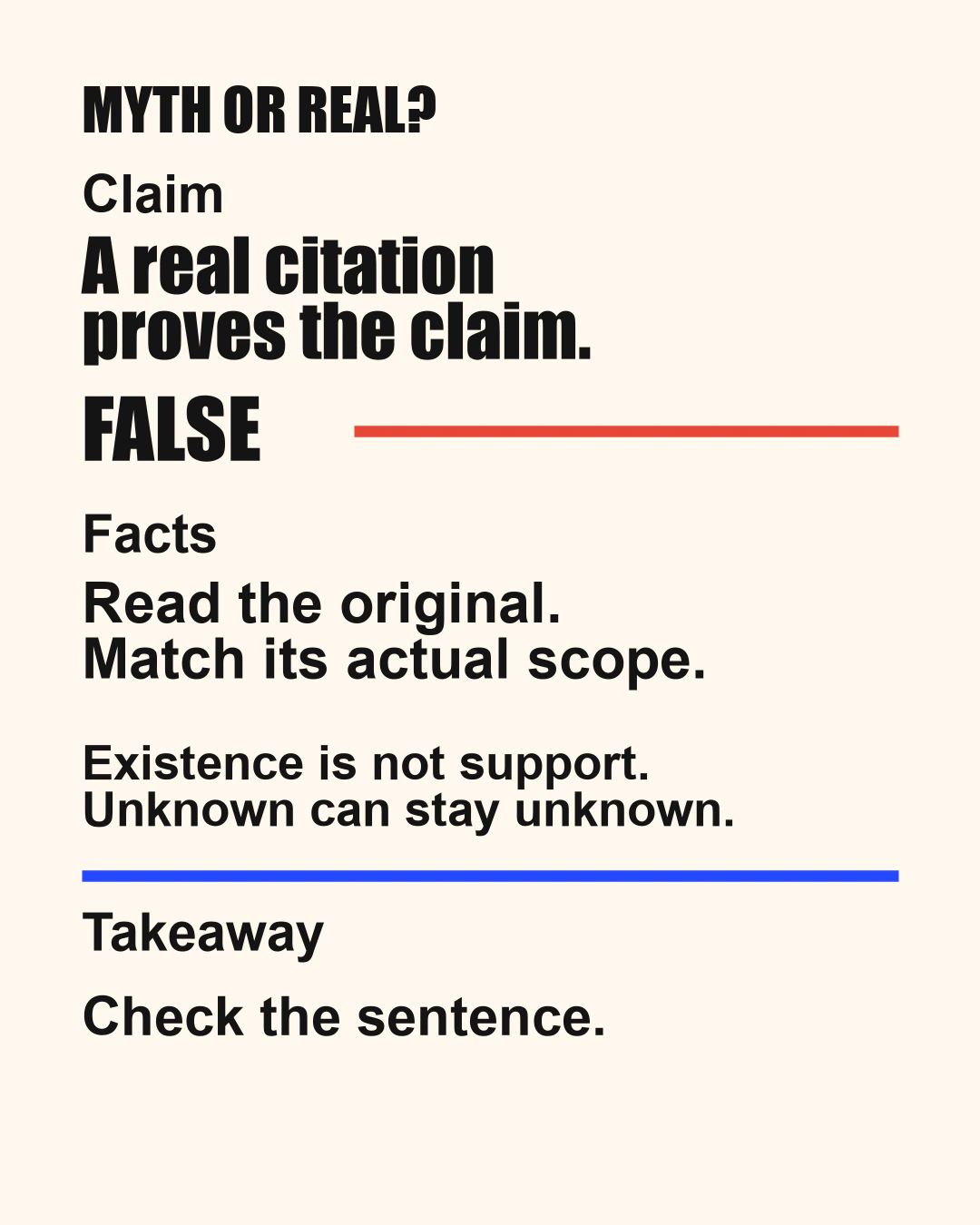
Claim
Social paraphrase: The existence of a real citation is sufficient proof that its source supports the attached claim.
Verdict
FALSE
Facts
Read the original relevant passage and qualifications, then compare its actual scope with the specific sentence.
FALSE rejects existence alone as sufficient proof, not every cited claim or the quality of every source.
An archived WritingWithAI question asks how people handle nonfiction research and difficulty tracing references. This card explicitly reframes that concern as an editorial sufficiency claim, not a quotation or belief attributed to the questioner. Promotional products, anecdotes, failure figures, comments and moderator removal are not verdict evidence. Crossref own publication explanation says a DOI alone does not signal quality; associated metadata supplies trust signals. Anthropic commercial issuer help advises reviewing originals because a synthesis may omit important context. These distinct scopes support rejecting citation existence alone as proof of exact claim support. FALSE does not mean every cited claim is false, every source is poor or a writer deliberately invented it. Read the relevant original passage, preserve qualifications and compare the sentence. A support gap may reflect a narrower source, incomplete access or missing information; uncertainty can remain. Crossref November4,2024 page and December volume are distinct; the linked full journal article was not read. No independent model benchmark, current growth, tested routine, clinical diagnosis or guaranteed accuracy is claimed. Ordinary optional reading only. Stop for privacy, access, expertise, distress or attention limits. Serious decisions require appropriate qualified help, and existing needed actions are not delayed.
Takeaway
Record what was inspected and what remains unknown. Keep, narrow, remove or leave unresolved.
Sources
Claim discussion: Archived question about handling nonfiction research and references.
Evidence: Scholarly metadata as trust signals: opportunities for journal editors; Claude is providing incorrect or misleading responses. What’s going on?.
Checked 2026-10-26. Scope: Ordinary optional reading and drafting only; explicit editorial reframe, not a quote or attributed belief. No universal truth/authorship detector, writer-intent inference, current growth, benchmark or routine trial.
Costs, risks and stop criteria
Checking can absorb more attention than the original question deserves. Set the scope around your purpose. An optional hobby post does not require you to inspect an entire field, chase every reference or reopen distressing material. No fixed time limit, daily quota or paid account is required here.
Do not upload confidential material or another person’s identifying information merely to get a second opinion from a tool. You can describe a generic question or stop. Do not contact a private individual, track down an author or reproduce a harmful post to complete this routine.
Stop if you lack access, relevant expertise or the attention to continue. Record the limitation if you need a note later. For a consequential decision, use the appropriate professional or responsible process rather than stretching this guide into an assessment. Existing responsibilities still apply; source checking is not a reason to postpone needed action.
If checking turns into persistent distress or interferes with daily life, appropriate qualified support is more useful than repeatedly testing your certainty. The guide offers no diagnosis, treatment or promise that further searching will make you feel settled.
How to assess the result
A useful local result has three parts: the exact claim, the original material you inspected and the qualification that follows. For example: the reference exists; the guidance describes a risk; the claimed tested benefit was not established by the sections read. That is a record of this check, not an accuracy score for you or the entire internet.
You may end with a narrower supported sentence, a removed sentence or an unresolved question. All can be reasonable outcomes. Confidence is not the target measure, and finding an attractive new citation is not automatically progress.
Before using the claim, ask whether your final wording makes your reading sound more complete than it was. Keep source roles and access limits visible. A real citation earns another question: what, exactly, does it support here?
Sources
- S1 — American Dialect Society: 2025 Word of the Year Is Slop, January 9, 2026. Dated language context for the 2025 selection; no current growth or audience figures adopted.
- S2 — NIST: Artificial Intelligence Risk Management Framework: Generative Artificial Intelligence Profile, AI 600-1, July 2024. Selected original sections: introduction/scope, printed pages 1–2; confabulation, page 6; human–AI configuration and information integrity, pages 9–10; suggested-action framing, pages 12–13. Printed pages differ from PDF page numbers. Advisory context, no tested benefit for this routine.
- S3 — Anthropic: Claude is providing incorrect or misleading responses. What’s going on?, March 16, 2026. Commercial issuer help; cited-original context, no independent performance comparison.
- S4 — Crossref: Scholarly metadata as trust signals: opportunities for journal editors, page dated November 4, 2024, describing a December 2024 journal issue. Crossref’s own landing-page explanation read; the linked full journal article is not treated as independently read evidence.
Sources accessed October 26, 2026. The worked case and checking sequence are original editorial illustrations. No new model evaluation, empirical intervention or qualified clinical review was performed.
FAQ
Common questions
Does a working DOI prove the claim?
No. It helps locate a work. Source identity, source quality and whether its actual content supports a specific claim remain separate questions.
Does missing support mean the statement is false?
A gap in the material inspected does not by itself prove falsity or writer intent. Another source or inaccessible section may matter; record the scope and uncertainty.
Was this checking sequence tested?
No personal routine trial or model evaluation was performed. The sources supply dated language context, advisory risk descriptions, commercial issuer help and a metadata explanation.
Topic hubs
Tags