You recognize the voice before the video starts. You know the running jokes, the favorite coffee order and the story about the terrible first job. When the creator says “we,” it is easy to feel included. Then a post goes unanswered, and the gap between being a familiar viewer and being personally known becomes harder to ignore.
That gap does not make your enjoyment embarrassing or imaginary. The question is what kind of connection the available evidence describes. You can appreciate someone’s work without making a public reply, a badge or repeated viewing carry the weight of a friendship.
Graphic context — 01-article-hero: This original qualitative sequence distinguishes familiarity with public stories and a voice from knowing whether a relationship is recognized by both people. The final question remains open; it is not a friendship test or evidence that the creator has a particular motive. Following alone does not establish mutual friendship.
Text equivalent: YOU KNOW THEIR STORIES. Public stories. Familiar voice. Mutual knowledge? Following alone is not proof of friendship. ARE YOU KNOWN TOO? Cambridge supplies dated language context and the review distinguishes media-use interaction from a relationship extending beyond it, while discussing actual social contact and conceptual limits. A viewer can appreciate public work without proving a personal bond. Genuine reciprocal online relationships remain possible; the diagram does not cancel them. No prevalence, observed outcome or benefit from this original sequence is encoded. Four actual primary publisher groups with dated language, historical descriptive-review, commercial issuer-feature and consumer-warning roles; no empirical routine-efficacy trial. No current growth/prevalence, pooled causal result, individual diagnosis/treatment, creator-intent finding, all-online-relationships-one-way claim, underlying-study/supplement/linked-data reproduction, friendship detector, legal/refund guarantee or measured wellbeing benefit.
Who this is for
This guide is for ordinary fans deciding how to describe a connection and what attention they want to give it. Think of following a cooking channel, enjoying a podcast or joining a discussion about a fictional character. It is not a test that diagnoses attachment, loneliness or any mental health condition.
Cambridge Dictionary named parasocial its Word of the Year for 2025. Its own November 18, 2025 blog describes a felt connection to someone a person does not know, including a famous person, fictional character or artificial intelligence. That is dated language context, not a measurement of how common the experience is now. [S1]
For this article, the useful distinction is between your familiarity with someone’s public presence and evidence of a relationship recognized by both people. This is not a diagnosis or a rule that every online connection is fake. People can form genuine friendships online; knowing a creator’s public work does not, by itself, establish one.
No purchase, subscription, message to a creator or account change is required to use the guide. It does not promise less loneliness, better mental health or a particular amount of screen time. If you need help with persistent distress or difficulty functioning, an appropriate qualified professional is a better source than a general fandom article.
Before you start
Choose one ordinary situation rather than evaluating your entire personality. Perhaps a familiar host thanked “everyone who supported the show,” or an account replied to your comment. Name what happened in plain terms before deciding what it means.
You might write: I watched a public video. My username appeared in a chat. I received a reply about the recipe. Those descriptions preserve the actual event. They do not require you to pretend it meant nothing, and they do not silently establish a wider personal relationship.
You also do not need to settle whether the creator is sincere. Public communication can be warm and sincere while still addressing an audience. A creator might appreciate viewers without knowing each viewer individually. Keep the question about what you know, rather than guessing another person’s motives or private feelings.
The same distinction matters when a familiar name contacts you privately. In a consumer warning originally published August 8, 2018, the FTC describes scammers posing as celebrities to ask fans for money. Familiarity with the real public figure is not verification of the account making contact. This warning does not mean every creator message is fraudulent. [S4]
What the research can explain
A descriptive review by Holger Schramm and colleagues, published in September 2024, distinguishes parasocial interaction during media use from a parasocial relationship that extends beyond that immediate viewing or listening moment. The distinction is about concepts researchers use; it is not a checklist that gives you a clinical classification. [S2]
The review examined English- and German-language empirical work first published from 2016 through 2020. The authors searched several databases, applied inclusion criteria and coded the studies. Their overview covers different media, methods and measures. It is not a new experiment on this article’s routine or a pooled estimate of what following someone will do to you.
The authors flag inconsistent definitions and measurement, many correlational designs, limited long-term research and samples that do not represent everyone. Some findings concern particular platforms or media settings. These limits matter: a research association does not tell you why a particular person follows someone or how their relationship will develop.
Social media also complicates a simple one-way picture. The review discusses actual replies and other interactions alongside parasocial experiences, and questions where the concepts need sharper boundaries. It would therefore be too strong to say that a reply can never be meaningful or that a genuine relationship cannot develop through a platform. [S2]
The practical proposal here is narrower: keep a description of what happened separate from what you infer about the relationship. That is an original reading and decision aid, not a tested intervention. None of the four sources establishes that completing these steps improves wellbeing or prevents every misunderstanding.
Graphic context — 02-concept-model: The three pairs separate following public work, receiving one reply and having an actual mutual relationship. A response may be pleasant and meaningful without, by itself, establishing an ongoing friendship or an obligation to respond again. The arrows map descriptions rather than stages every relationship must pass through.
Text equivalent: A REPLY IS NOT A FRIENDSHIP TEST. Follow Public work. Reply One reply. Friendship Mutual bond. A reply can matter. Its scope still matters. KEEP THE DIFFERENCE. The historical descriptive review discusses how genuine social contact and replies complicate a simple one-way concept. It does not justify saying that all online relationships are fake or that a reply never matters. A badge is a platform feature in YouTube issuer help, not a friendship certificate. Neither repeated viewing nor one exchange alone identifies the full scope of a relationship; actual ongoing reciprocity may supply different evidence. Four actual primary publisher groups with dated language, historical descriptive-review, commercial issuer-feature and consumer-warning roles; no empirical routine-efficacy trial. No current growth/prevalence, pooled causal result, individual diagnosis/treatment, creator-intent finding, all-online-relationships-one-way claim, underlying-study/supplement/linked-data reproduction, friendship detector, legal/refund guarantee or measured wellbeing benefit.
A badge is a feature, not a relationship certificate
YouTube’s own help describes channel-membership perks such as public badges, members-only posts, emoji and recognition features. Availability depends on what a creator offers and which features are enabled. That is commercial issuer information about platform features, rather than research on friendship. [S3]
A badge can truthfully show membership in a channel’s program. A highlighted message can make participation visible. Neither fact alone tells you how well the creator knows the individual behind the account. You do not need to dismiss the perk; just describe what it actually provides.
The same help page describes publicly visible membership information and possible sharing of information for perks. Before participating in any optional program, read its actual current details and decide whether the visibility suits you. This article recommends no membership, spending level or purchase, and makes no refund or privacy guarantee. [S3]
There are several possible reasons a public interaction feels personal: you recognize a familiar style, a reply addresses something you said, or a group has its own language and rituals. You can acknowledge those different experiences without treating them as equivalent evidence of mutual friendship.
Graphic context — 03-evidence-infographic: Four publisher groups serve different purposes: Cambridge supplies dated language context; Frontiers publishes the original historical descriptive review; Google explains commercial membership features; the FTC gives impersonation guidance. They are not four trials of this article’s reflection sequence or four current audience surveys.
Text equivalent: ONE REVIEW. FOUR SOURCE ROLES. Dictionary Dated term. Review Past corpus. Help / warning Context. No routine trial. No current prevalence. ROLES ARE NOT RESULTS. The September2024 review covers English/German empirical work first published2016-2020, with definition, measurement, design, sample and search limitations. Main review methods/results/limits/funding/conflicts were read, not its linked data, supplements or underlying studies. Cambridge November18,2025 publication and earlier November13 updated timestamp are distinct; no October2026 growth inferred. Google help is undated issuer context, not an independent friendship finding. FTC2018 publication and2022modified metadata are distinct; comments and current prevalence claims are excluded. None tests the original routine. Four actual primary publisher groups with dated language, historical descriptive-review, commercial issuer-feature and consumer-warning roles; no empirical routine-efficacy trial. No current growth/prevalence, pooled causal result, individual diagnosis/treatment, creator-intent finding, all-online-relationships-one-way claim, underlying-study/supplement/linked-data reproduction, friendship detector, legal/refund guarantee or measured wellbeing benefit.
Actions in order
1. Describe the contact you actually had
Start with the event, not a label. Did you watch, read, comment, receive a public response or have an ongoing exchange? Keep it specific enough that you would describe it the same way to somebody who had not seen the content.
If there was no individual contact, a useful description might be that the channel feels familiar because you watch regularly. If there was a reply, record its subject and scope without saving private or identifying details you do not need. You can also do this mentally; a journal or tracking app is optional.
2. Separate public information from mutual knowledge
Ask what you learned from material available to an audience. Knowing a creator’s published stories is different from both people choosing to share information with each other within an ongoing relationship. A general thank-you does not identify who was individually recognized.
Do not try to fill the gap by researching someone’s private life. You do not need their address, family information, schedule or contact details to decide how you want to engage with their public work. Privacy and ordinary boundaries still apply when the person is well known.
3. Keep the meaning proportionate to the event
A reply to a cooking question supports the statement that somebody answered the question. It might be pleasant, helpful or memorable. It does not by itself establish an ongoing friendship, an obligation to respond again or permission to enter private spaces.
Likewise, silence does not tell you why someone did not answer. You may not know who manages an account, whether a message was seen or what else the person was doing. You can leave that uncertainty in place instead of turning it into a verdict about your worth or the creator’s character.
Do not test reciprocity by sending extra messages, buying perks or disclosing private information. Those actions are not needed to apply this guide, and another person’s response would still need its own context. If you already have an actual reciprocal relationship, you do not need this routine to classify it or prove that your friendship is legitimate.
4. Choose a boundary that fits your purpose
Decide what you actually want from the content: recipes, entertainment, ideas or conversation with other fans. You might continue enjoying the public work, spend less attention on a discussion or leave a particular thread. None requires proving the relationship belongs in a particular category.
Keep the choice small and reversible where possible. You could decide not to revisit an unanswered comment, or to watch the next episode only if the topic interests you. These are examples of choices, not prescribed doses, a daily quota or a guarantee that a feeling will change.
5. Keep contact and account claims separate
If an unfamiliar account claims to be a public figure and asks for money or private information, do not use your familiarity with the real person’s work as identity verification. The FTC’s warning concerns that impersonation risk. It is not evidence that the real creator sent the request or that your interest caused it. [S4]
You do not have to respond, confront the account or investigate a private person to finish this guide. For a real account, payment or safety concern, use the relevant official support or appropriate help. This article does not determine entitlements, recover money or replace an existing safety procedure.
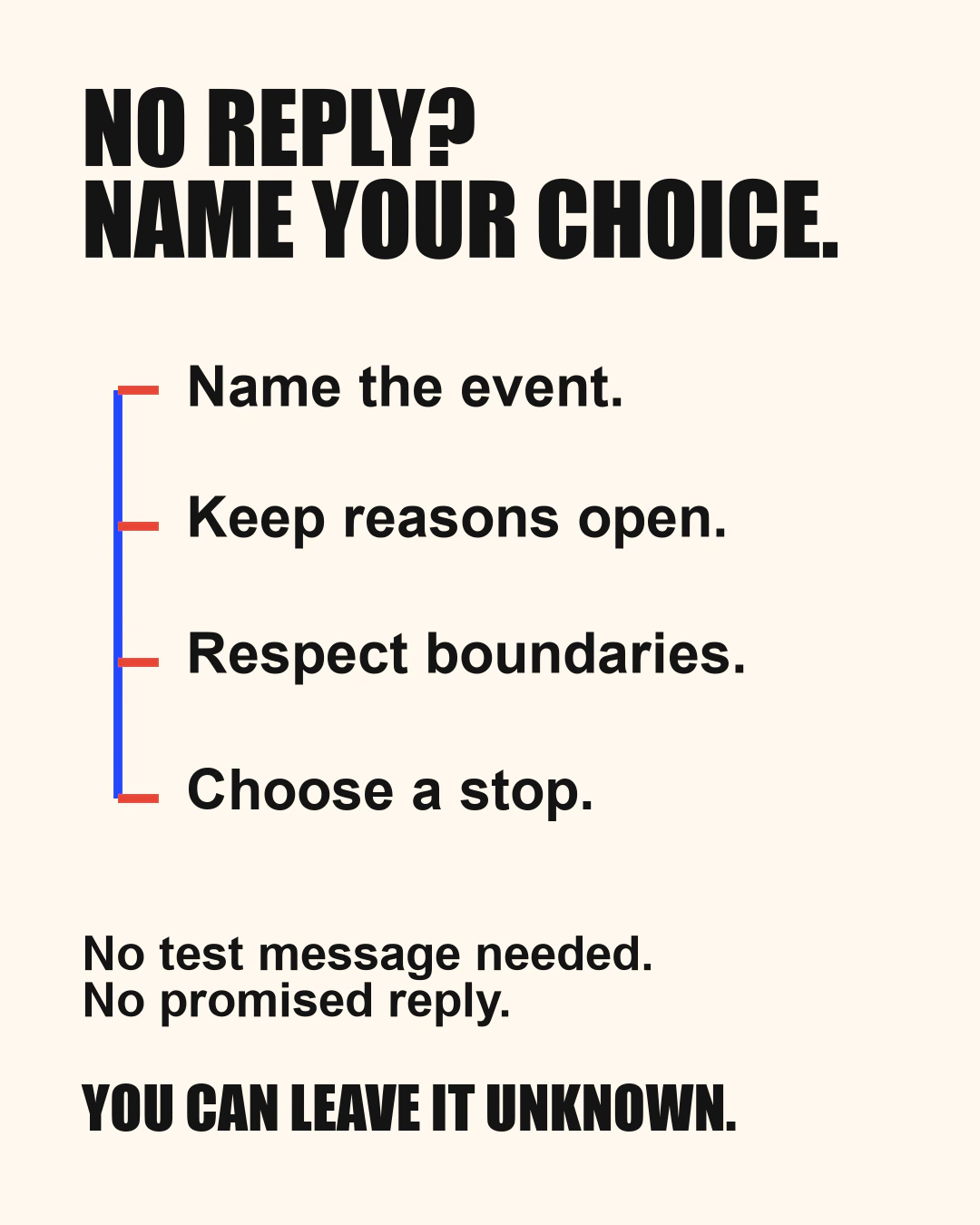
Graphic context — 04-practical-support: Four reminders condense five original optional actions: describe actual contact, distinguish public from mutual knowledge, keep an interpretation proportionate, choose engagement and separate account-identity claims. A descriptive result can leave motives unknown. This is an ordinary fandom decision aid, not a clinical or friendship score.
Text equivalent: KEEP THE CONTACT. DROP THE GUESS. Name the event. Keep unknowns. Choose a boundary. Respect privacy. Ordinary fandom only. No friendship score. NO TEST. NO PURCHASE. Do not test reciprocity by extra messages, buying perks or disclosing private information. An existing actual mutual relationship does not need this guide to classify or legitimize it. No private-life investigation, compulsory contact/account change or purchase is needed. Stop for repeated distressing exposure, privacy risks or excessive effort; choose suitable qualified support for persistent distress/interference and appropriate help for concrete threats or account-security concerns. FTC guidance does not imply every creator contact is fraudulent, and this routine determines no legal entitlement or financial outcome. Four actual primary publisher groups with dated language, historical descriptive-review, commercial issuer-feature and consumer-warning roles; no empirical routine-efficacy trial. No current growth/prevalence, pooled causal result, individual diagnosis/treatment, creator-intent finding, all-online-relationships-one-way claim, underlying-study/supplement/linked-data reproduction, friendship detector, legal/refund guarantee or measured wellbeing benefit.
One reply, several possible interpretations
Imagine a fictional viewer, Alex, who follows a gardening channel. Alex asks whether a planter in a video has drainage holes. The channel replies that it does. Later, Alex posts a separate question and gets no answer.
The first exchange is real within this invented example: a question about a planter received an answer. Alex can appreciate that helpful response. The later silence does not establish rejection, a broken personal promise or a plan to manipulate viewers. It leaves several details unknown.
A proportionate next step could be to use the published answer about the planter and stop checking the unanswered thread. Another could be to keep watching the channel for gardening ideas. Neither decision requires Alex to label the creator dishonest or to feel nothing about the exchange.
The viewer, channel and events are fictional illustrations, not a reported case or a finding from the review. The sources did not test Alex’s choice. The example shows how a narrow description can support more than one reasonable next action.
For a counterexample, suppose two people have an established reciprocal friendship and one also creates videos. Following that person’s channel does not cancel the friendship. The relevant evidence comes from the actual mutual relationship, rather than the follow alone. Being a creator and being a friend are not mutually exclusive roles.
Myth or Real?
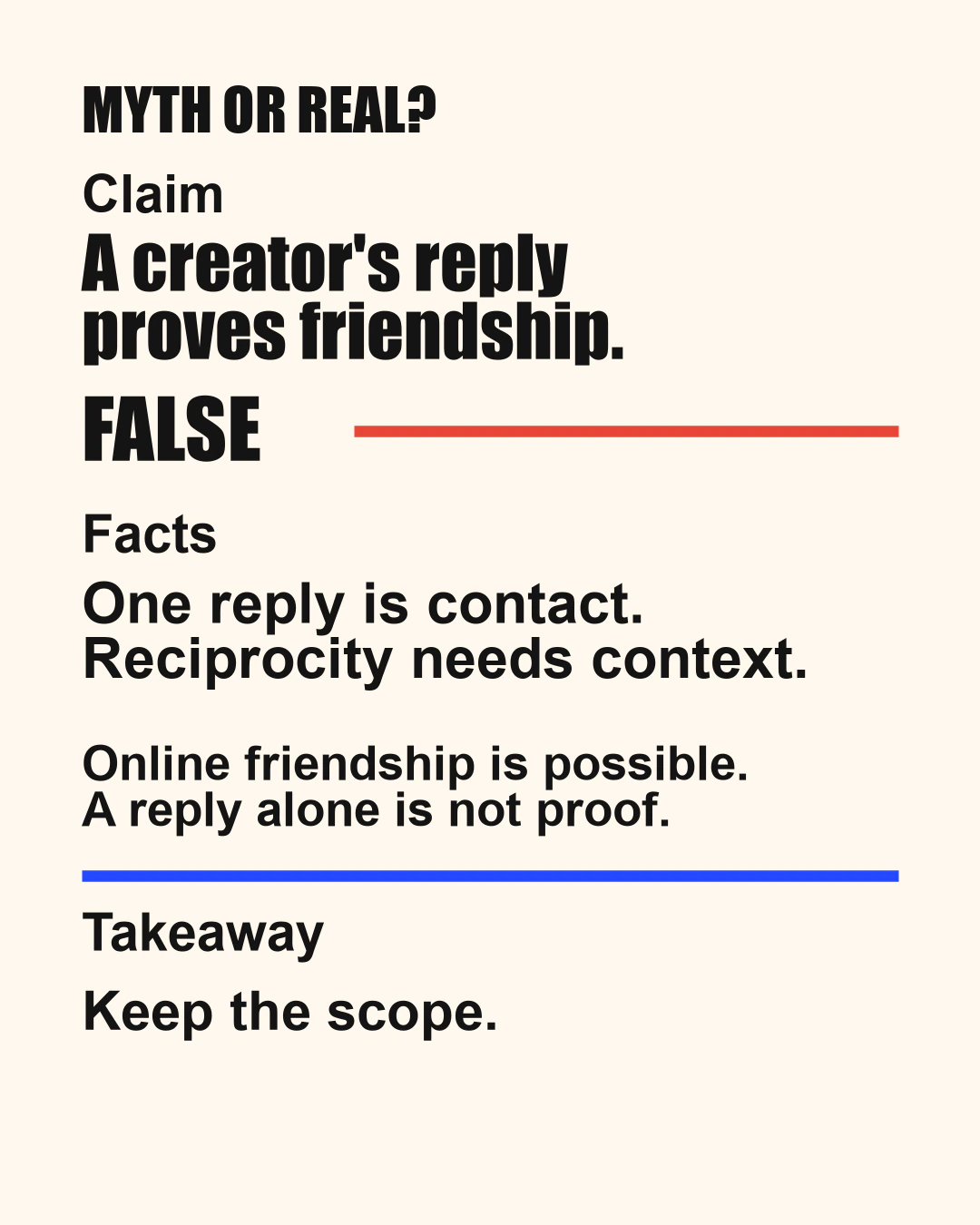
Claim
Social paraphrase: One public reply by a creator is sufficient proof that the viewer and creator have an ongoing mutual friendship.
Verdict
FALSE
Facts
A reply establishes an exchange; whether a mutually recognized ongoing relationship exists needs its own context.
FALSE rejects one reply alone as sufficient proof, not meaningful contact or genuine reciprocal online friendship.
An archived BeautyGuruChatter original question asks how viewers understand felt familiarity and friendship with creators. This card explicitly reframes that broad question as an editorial sufficiency claim about a single reply, not a quotation or belief attributed to the author. Comments, anecdotes, celebrity examples and allegations are not evidence. The original Frontiers descriptive review distinguishes interaction during media use from relationships beyond it and discusses actual replies/social contact and conceptual limits. Cambridge supplies dated language/definition context, not an individual diagnosis. Together these roles support distinguishing one exchange from proof of an ongoing mutually recognized friendship. FALSE rejects one reply alone as sufficient evidence; it does not say a reply is meaningless, real online friendship is impossible or anyone has deceptive intentions. The review covers English/German2016-2020 empirical work with method, measure, sample and search limitations. Main methods/results/conclusion/limits/funding/conflicts read, not underlying studies/supplements/linked data. CambridgeNovember18,2025 publication and earlierNovember13 updated timestamp remain distinct; no current growth/prevalence inferred. No trial of this original routine, clinical selftest or guaranteed feeling change. Do not test reciprocity with extra messages, purchases or private disclosure. Respect privacy, stop if effort/distress exceeds purpose and use appropriate qualified or account-security help for actual concerns.
Takeaway
Describe the actual contact and leave unknown scope or motives unknown; no contact, spending or private-disclosure test.
Sources
Claim discussion: Archived question about felt familiarity and friendship with a creator.
Evidence: Research trends on parasocial interactions and relationships with media characters. A review of 281 English and German-language studies from 2016 to 2020; Cambridge Dictionary’s Word of the Year 2025.
Checked 2026-10-26. Scope: Ordinary fandom reflection only. Explicit editorial sufficiency reframe, not quote/attributed belief or assessment of the questioner. No clinical/intent/friendship detector, currentprevalence, all-fandom harm or routine trial.
Costs, risks and stop criteria
This reflection can become less useful if it turns into repeated checking for certainty. Stop when you have a clear enough description for your ordinary purpose, or when the effort exceeds what the question deserves. You are allowed to leave a label unresolved.
Do not repeatedly expose yourself to upsetting content, save identifying information or seek a creator’s private contact to test an interpretation. A public reply, a membership feature or your own strong feeling does not create a duty for either person to continue an exchange.
Avoid using parasocial as an insult for a fan whose interests you dislike. A label is not a diagnosis, a measure of intelligence or proof that someone lacks meaningful relationships. This guide does not assess other people’s mental health from their comments or spending.
If a situation involves threats, unwanted contact or a concrete account-security concern, use appropriate support rather than trying to resolve it through a general reflection exercise. If distress persists or interferes with daily life, seek suitable qualified help. No particular feeling, time limit or result here determines whether you deserve support.
How to assess the result
Look for a descriptive result: you can say what contact occurred, which details remain unknown and what engagement you choose next. For example: I received an answer about the planter; I do not know why the next question was unanswered; I will stop revisiting that thread.
That is not a score for how healthy your fandom is. You may still enjoy the creator’s work or feel disappointed about a missed reply. The guide has not measured those feelings or established what will change them.
Ask whether the boundary respects both your purpose and the other person’s privacy. Keep public features, actual contact and reciprocal relationships distinct. You can value what a creator shares while leaving the parts of the relationship you do not know unclaimed.
Sources
- S1 — Cambridge Dictionary: Cambridge Dictionary’s Word of the Year 2025, published November 18, 2025. The separate earlier updated timestamp is retained in the source review; dated language context, no current growth figures or secondary celebrity examples adopted.
- S2 — Schramm, Liebers, Biniak and Dettmar: Research trends on parasocial interactions and relationships with media characters, Frontiers in Psychology, September 26, 2024. Descriptive review of English- and German-language work from 2016–2020. Main introduction, procedure, results, conclusion, limitations, funding and conflicts read; underlying studies, supplements and linked data were not independently read or reproduced.
- S3 — Google/YouTube: Use and manage your channel membership benefits, undated issuer help accessed October 26, 2026. Optional features, availability and visibility context; no membership recommendation, friendship certificate or independent benefit trial.
- S4 — FTC: Scammers impersonate celebrities on social media, published August 8, 2018; native metadata modified June 2, 2022. Original consumer guidance, with comments excluded; no current prevalence, legal entitlement or refund guarantee adopted.
Sources accessed October 26, 2026. Four publisher groups have different roles; they are not four trials of this guide. The sequence and worked example are original editorial applications. No new human study or qualified clinical review was performed.
FAQ
Common questions
Does one reply mean a creator is my friend?
A reply establishes an exchange. Whether an ongoing mutually recognized friendship exists needs its own context; a single response alone does not establish it.
Can real friendships form online?
Yes. Following a friend’s public work does not cancel an actual reciprocal relationship. The guide distinguishes public familiarity from that relationship, rather than denying online friendship.
Should I message or buy perks to test the connection?
No contact, spending or private-disclosure test is needed. Choose how to engage with public work while respecting privacy; the guide does not diagnose you or promise an emotional result.
Topic hubs
Tags