
The joke makes perfect sense in the group where it started. A friend knows the broken chair, the cancelled plan and the running argument about who brings the snacks. On your profile, the same sentence sits beside a work update, a family photo and people who have never heard the story. You are still thinking about the first conversation. The post may be available in several others.
That mismatch is a useful way into context collapse. Different social settings can meet around the same piece of content. It does not mean that everyone has seen your post, that somebody is judging you or that an awkward response proves a particular motive. It means that the audience you picture is not necessarily the whole audience your chosen setting allows.
Graphic context — 01-article-hero: This original qualitative rail separates the audience a writer pictures, the access a particular setting permits and actual readership that may remain unknown. The connections organise questions; they do not show a causal chain or prove that an additional audience saw a post.
Text equivalent: ONE POST. MANY CONTEXTS. Intended readers. Stated access. Actual readers? Possible is not proven. Keep the unknowns. WHO DID YOU PICTURE? The historical paper discusses imagined audiences and overlapping social contexts. Current issuer descriptions supply bounded feature vocabulary rather than a universal account rule. A broader possible audience is not evidence of broad actual reach. A small audience can include different backgrounds; a broad audience can be intentional. No audience detector, motive finding, privacy guarantee or benefit from this original sequence is encoded. Four actual primary publisher groups: historical nonrepresentative qualitative paper, dated commercial launch, dated public guidance and current issuer help; no empirical routine-efficacy trial. No current growth/prevalence, causal routine result, individual diagnosis/treatment, creator-intent finding, actual-audience detector, privacy/security/legal guarantee or underlying-reference/data/supplement reproduction. Full source dates, exact scope and limitations remain adjacent.
Who this is for
This guide is for an ordinary, optional posting decision: sharing a joke, showing a hobby project or deciding whether a small update belongs on a particular surface. You do not need a public following, a personal brand or an account on any named service. You can use the distinction while deciding not to post anything.
The term comes here through Alice Marwick and danah boyd’s research on imagined audiences and Twitter. Their article appeared online in 2010 and in a 2011 journal issue. It describes diverse, nonrepresentative responses rather than measuring all users or testing a posting technique. Its historical setting matters; it is not a description of every current platform. [S1]
Keep three things separate: whom you mean to address, whom a service’s actual audience setting permits, and whom you know actually received or read the content. These can overlap without being identical. Knowing one does not fill in every unknown about the others.
Before you start
Choose one low-stakes draft or imagined example. Do not bring private messages, another person’s identifying details, workplace records or sensitive information into an exercise. You do not have to reopen an upsetting exchange or reconstruct everyone who might have seen something. A fictional draft is enough to understand the distinction.
Decide what you want the communication to do. Are you giving a friend a useful update, recording a hobby result or inviting a response about a shared interest? A simple purpose helps you assess the draft without making it a performance for every possible reader. Your purpose can also be to keep the moment offline.
Notice the actual surface. A post, a video link and a message are different objects. Account labels, audience lists and individual content settings may also differ. Do not assume that a control used somewhere else has the same meaning here. Read the current information for the service and feature you are actually considering.
This is not a diagnosis or treatment. It is a way to describe a communication choice, not a test for anxiety, authenticity, intelligence or social skill. It cannot identify a hidden viewer or settle another person’s intentions. Persistent distress or interference with daily life deserves suitable qualified support, rather than repeated audience checking.
Graphic context — 02-concept-model: These three pairs distinguish stated access, relevant background and evidence of actual readership. A selected group can include people who know different parts of an event. The arrows map descriptions rather than stages, population proportions or an inevitable route of exposure.
Text equivalent: ACCESS IS NOT UNDERSTANDING. Audience Who may see it. Context What they know. Readership What you can prove. Access is not a view. A label is not context. KEEP THE QUESTIONS APART. Knowing a feature label does not establish shared understanding among every permitted reader. Knowing access rules also does not establish who actually viewed content. Google specifically distinguishes unlisted-link access from private chosen viewers; that issuer rule is not transferred to every service. Unknown actual readership stays unknown, and an ambiguous response or silence does not identify motive. No private-account inspection, screenshots or test post is needed. Four actual primary publisher groups: historical nonrepresentative qualitative paper, dated commercial launch, dated public guidance and current issuer help; no empirical routine-efficacy trial. No current growth/prevalence, causal routine result, individual diagnosis/treatment, creator-intent finding, actual-audience detector, privacy/security/legal guarantee or underlying-reference/data/supplement reproduction. Full source dates, exact scope and limitations remain adjacent.
A familiar label does not finish the question
Audience selection remains relevant in current products. Meta’s May 13, 2026 announcement of Instants describes choices involving Close Friends or mutual followers. That is dated commercial issuer context, not evidence of current adoption, a recommendation to use the feature or proof that this guide improves communication. [S2]
A familiar label can tell you something about the feature’s stated audience rules. It does not tell you whether everyone in a permitted group shares the same background, relationship or understanding of a sentence. Two people can both be friends and still know quite different parts of your life.
YouTube’s own help makes another useful distinction: an unlisted video can be watched and reshared by anyone with its link. Unlisted and private are separate settings. That is a specific issuer description, not a rule to transfer to every platform or a promise that another kind of content cannot circulate. [S5]
The NCSC’s social-media guidance advises thinking about what is posted, who has access and what detail is unnecessary. The page was published in 2019 and reviewed in 2022. Use that bounded planning question here, rather than treating the page as a current account manual or a guarantee of security. [S4]
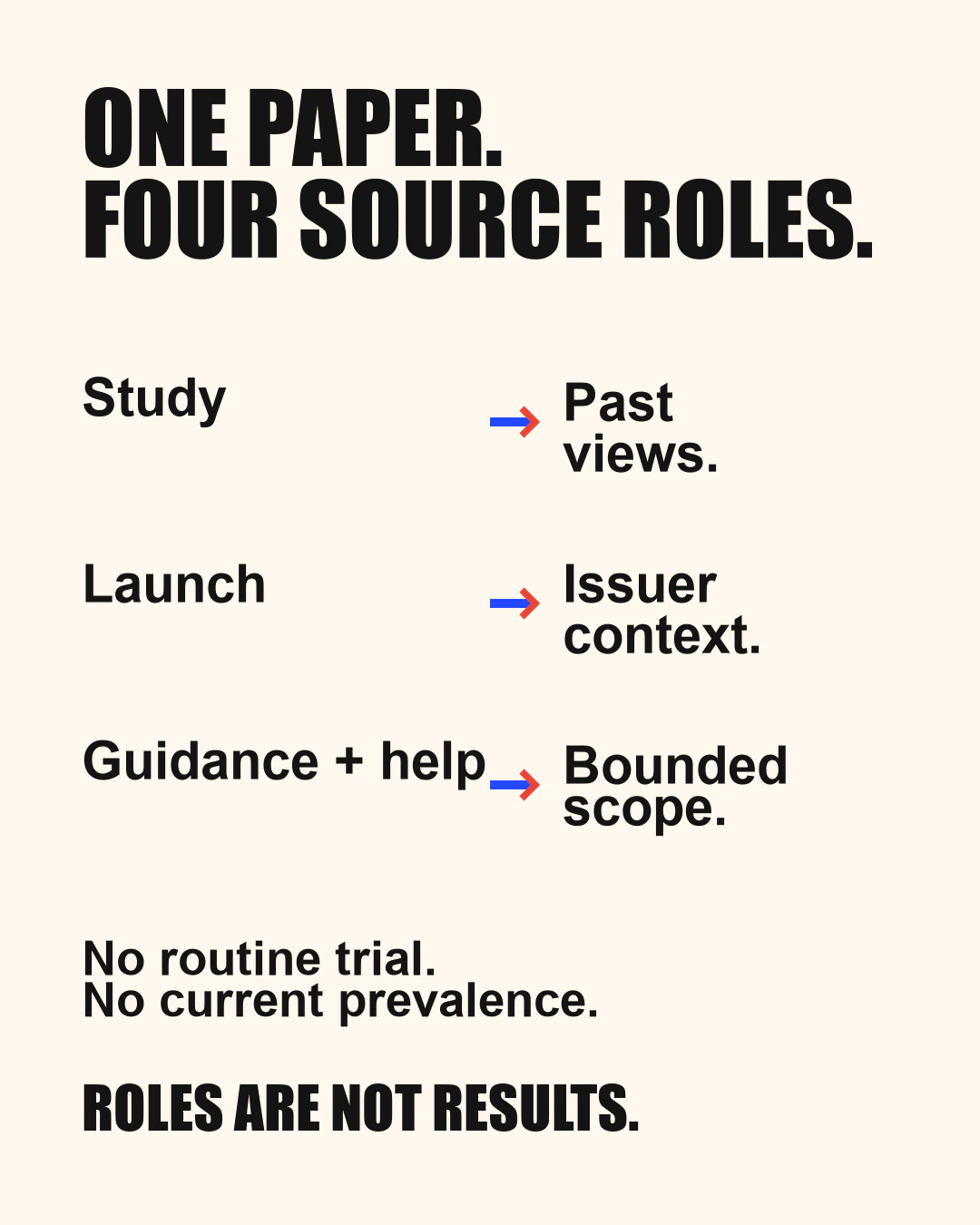
Graphic context — 03-evidence-infographic: Four publisher groups supply different evidence roles: the original Marwick and boyd historical qualitative paper, Meta’s dated commercial launch, NCSC’s public guidance and Google’s own help. They are not four trials of this original drafting sequence or current audience measurements.
Text equivalent: ONE PAPER. FOUR SOURCE ROLES. Study Past views. Launch Issuer context. Guidance + help Bounded scope. No routine trial. No current prevalence. ROLES ARE NOT RESULTS. The paper sought varied perspectives rather than a representative Twitter sample and could not establish reach or prevalence of its described techniques. Main methods, findings and limits were read, not underlying references, data or supplements. First-online 2010, issue 2011 and author-hosted upload 2018 are different dates. Meta’s native publication is May 13, 2026; adjoining May 12 is distinct. NCSC was published in 2019 and reviewed in 2022; related 2026 news is excluded. Google help is undated current issuer context. TikTok’s incomplete support shell is excluded. Four actual primary publisher groups: historical nonrepresentative qualitative paper, dated commercial launch, dated public guidance and current issuer help; no empirical routine-efficacy trial. No current growth/prevalence, causal routine result, individual diagnosis/treatment, creator-intent finding, actual-audience detector, privacy/security/legal guarantee or underlying-reference/data/supplement reproduction. Full source dates, exact scope and limitations remain adjacent.
Actions in order
1. Name the people you are picturing
Write a plain description such as the friends who joined the walk, the people following this project or the relative who asked for the update. You do not need names or a complete list. The point is to notice which shared context you are relying on when you compose the message.
If your description keeps changing, that can be useful information about the draft. Perhaps you are alternating between a private joke and a general announcement. You can decide which purpose matters, split the ideas into different drafts or leave the whole thing alone. There is no requirement to find the one correct audience.
Avoid turning this into a prediction about how each person will react. You cannot work backwards from a label such as colleague, friend or stranger to a reliable account of someone’s thoughts. Keep the description about the communication you intend, rather than a theory of other people’s personalities.
2. Check the stated audience of this particular item
Look at the current information for the actual feature before relying on a label. The relevant distinction may be between a named set of recipients, people holding a link or a more public surface. Availability, account conditions and interface wording can vary, so this guide does not provide a universal sequence of buttons.
An audience control can be useful without resolving every social question. A selected group may still contain people from different contexts. Equally, the possibility of a wider audience does not establish that a wider audience has actually appeared. State what the control says, and leave actual readership unknown unless you have appropriate evidence.
If you cannot tell what a control means, you can save the draft, use a less revealing version or not share it. You do not need to change your account, create another one, buy a service or contact a person to complete this exercise. Do not substitute this general guide for your own organisation’s requirements.
3. Find the context the draft leaves out
Read the sentence as if you knew the project but not the joke, or knew the people but not the event. Is a pronoun doing too much work? Does a caption depend on a conversation that is absent? Is an image showing a detail that the words never mention?
You can add a small explanation, remove an unnecessary detail or decide that the material belongs in a different conversation. Adding context does not mean exposing somebody else’s private story. If making the post understandable requires information that is not yours to share, leave that information out and consider whether the post still serves its purpose.
More explanation is not automatically better. A hobby update may need only a project name, while a joke may stop being worth sharing once it needs a long introduction. You can keep a draft brief or abandon it. The aim is a deliberate choice, not a message that no conceivable person could misunderstand.
4. Consider the difference between access and understanding
Ask two separate questions: could this person have access under the stated arrangement, and would the content make sense without the background I imagined? The answers may differ. A link can be available to someone who lacks the shared context; a close friend can understand a reference without needing every identifying detail.
This distinction also prevents a different mistake. A permitted audience is not a record of actual viewers. A reaction can show that an interaction occurred, but it does not reveal every reader, every interpretation or a person’s motive. Silence does not settle those questions either.
You do not need to inspect other people’s accounts or collect screenshots to resolve the uncertainty. For a routine optional post, it can be enough to choose a version you are comfortable making available under the actual setting, or decide not to make it available. No audience map can certify the result.
Do not publish a real draft as an experiment to discover who sees it or how they interpret it. This exercise does not require test messages, screenshots, viewer checks or additional disclosure. Keep any existing confidentiality or safety procedure in place; choosing an audience for an optional post does not replace those requirements.
5. Choose an ordinary stopping point
Keep the draft, revise it, choose an appropriate existing conversation or skip it. A useful answer might be that the project update works without the joke, or that the joke is only enjoyable among the people who were there. Neither answer is a finding about your worth or authenticity.
Stop when you have made the communication decision you needed to make. You do not have to repeat the exercise after every reaction, chase a perfect interpretation or check who might be checking you. If the exercise is generating more uncertainty than the optional post is worth, return to a simpler choice.
Graphic context — 04-practical-support: Four reminders condense five optional editorial actions: name the audience pictured, check the item’s stated access, inspect missing context, separate access from understanding and choose a stopping point. The result is a descriptive drafting choice, not a tested privacy or clinical outcome.
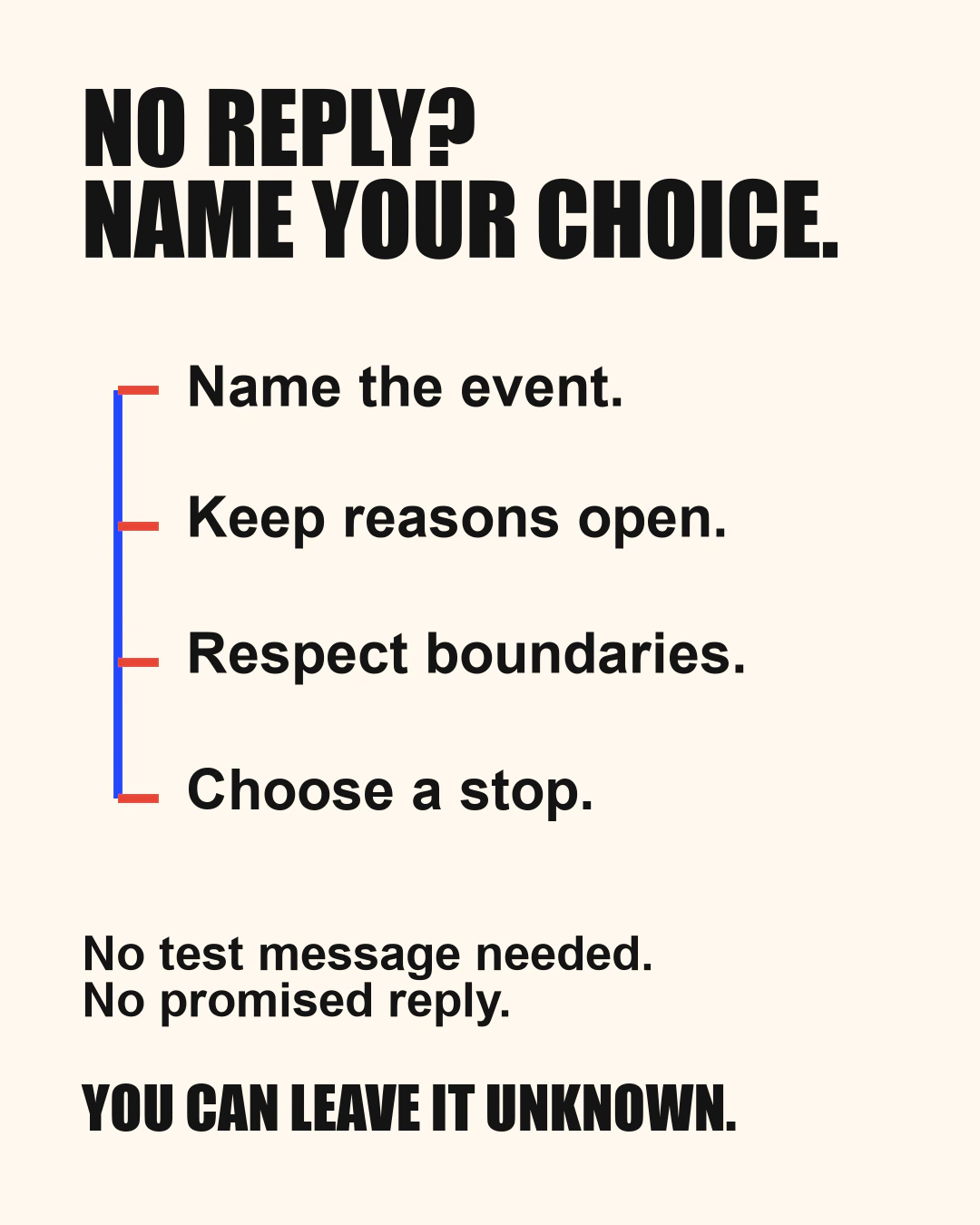
Text equivalent: BEFORE YOU POST, NAME THE GAP. Name the audience. Check stated access. Find missing context. Keep, revise or skip. No test post required. Privacy is not promised. A DRAFT CAN STAY A DRAFT. Do not publish a real draft as a viewer experiment, collect screenshots, inspect other people’s accounts or add private information to test understanding. An existing confidentiality or safety procedure stays in place. Sensitive records, concrete threats and applicable requirements need appropriate existing procedures and suitable help. Stop when effort or distress exceeds the optional post’s purpose. Public multiplicity can be intentional; keeping the original, revising or skipping are valid possibilities. No account change, contact, purchase or guaranteed interpretation is required. Four actual primary publisher groups: historical nonrepresentative qualitative paper, dated commercial launch, dated public guidance and current issuer help; no empirical routine-efficacy trial. No current growth/prevalence, causal routine result, individual diagnosis/treatment, creator-intent finding, actual-audience detector, privacy/security/legal guarantee or underlying-reference/data/supplement reproduction. Full source dates, exact scope and limitations remain adjacent.
One update, different backgrounds
Imagine a fictional reader, Jo, finishing a model bridge with a weekend club. Jo drafts a photo caption saying that the disaster committee finally delivered. Club members know the nickname refers affectionately to a previous attempt that collapsed during an ordinary demonstration. Other contacts do not have that background.
Jo notices two separate questions. Which people would the selected surface allow to see the photo? And which of those people would understand the nickname? Jo chooses a straightforward caption about the finished bridge, checks the image for other people’s unnecessary identifying details and keeps the joke in the existing club conversation.
That is an invented decision, not an observed case or a demonstrated improvement. No source measured Jo’s result. The exercise does not establish that the original caption would have caused a problem, that anyone would have objected or that the revised version is universally better.
For a counterexample, a person might intentionally write for a broad public audience and enjoy readers bringing different interpretations. Another person might have a small group whose members share the relevant history. Neither must narrow the audience or explain a joke simply because context collapse is a useful concept. The purpose and the actual situation still decide.
Costs, risks and stop criteria
The main cost is attention. The process has no validated duration, required frequency or measured saving of time. You do not need a paid tool, new account or an elaborate record of your social connections. A brief thought about one draft can be enough; skipping the optional post also requires no new service.
Keep ordinary care proportionate to the material. This guide does not provide an assessment of confidential work, safeguarding issues, legal obligations or a concrete threat. Use appropriate existing procedures and suitable help for those situations. Do not delay needed action while trying to make a perfect audience description.
Audience choices also involve other people. Leave out unnecessary identifying details and private exchanges. A person’s presence in a photo or a group does not mean they want every part of their life included in your example. This guide supplies no universal consent rule or legal entitlement; when permission or an applicable requirement is uncertain, use the appropriate route.
Be wary of using the idea to explain away every uncomfortable interaction. An ambiguous response can remain ambiguous. Context collapse does not prove malicious intent, hidden surveillance or a deliberate attempt to embarrass someone. It is also not a reason to blame a person for another person’s misuse of their content.
The sources have different roles. A historical qualitative paper explores audience perspectives, Meta describes its own launch, Google explains its own settings and the NCSC offers general guidance. They are not four experiments on this routine. No platform, clinical or independent professional review of this article is claimed.
How to assess the result
A descriptive result is enough: the audience I pictured, the stated access arrangement, the background the draft assumed and the choice I made. You can leave actual readership and reactions unresolved. There is no privacy score, social success threshold or certificate of complete control.
For Jo, the note could be: club members know the joke; the selected surface can include other contexts; the public update works with a plain caption. Another valid result could be to keep the original wording because its broad interpretation is intentional, or to leave the update unposted.
The distinction remains useful even when you do nothing visible. Intended audience, possible access and actual readership are different questions. Treating them separately can make a draft easier to describe; this article does not claim that it will make every interaction clearer or remove the uncertainties of sharing with other people.
Myth or Real?
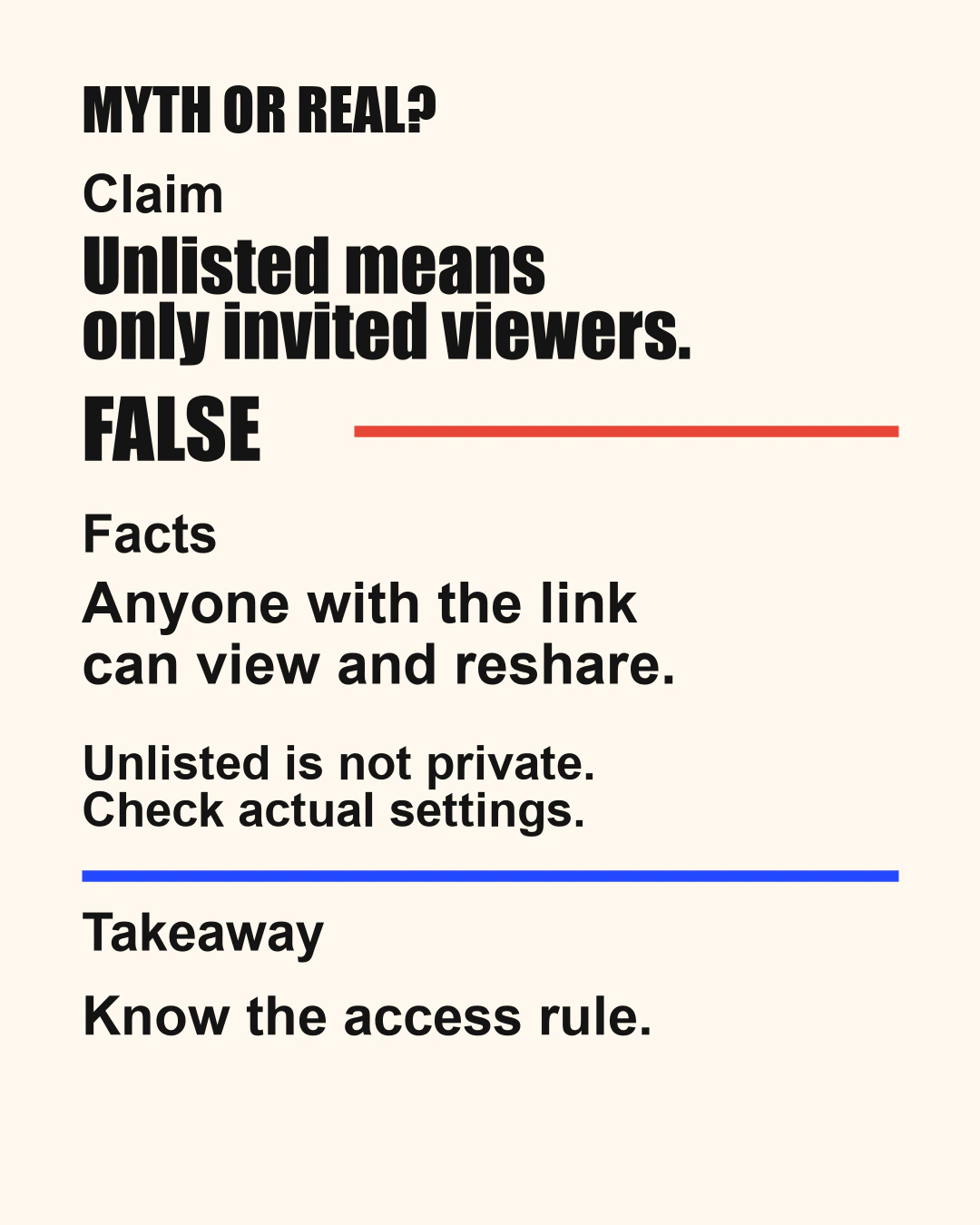
Claim
Social paraphrase: An unlisted YouTube video is accessible only to the people the uploader individually invites.
Verdict
FALSE
Facts
Google states that anyone with the link can view and reshare an unlisted video; private chosen-viewer access is distinct.
FALSE rejects unlisted as invitee-only access, not all privacy controls or every platform.
An archived original YouTube question asks about restricted access to a client video library while using unlisted links. This card explicitly reframes that practical question as an editorial access claim, not a quotation or false belief attributed to its author. Comments, apps, memberships and client anecdotes are not evidence or recommendations. Google’s own current help says anyone with an unlisted video link can view and reshare it, while private video access uses chosen viewers. FALSE rejects unlisted as invitee-only access. It does not establish who actually watched, prove inevitable circulation, make every platform equivalent or dismiss all privacy controls. Google is a commercial issuer explaining its own service, not an independent privacy benchmark. The help is undated and was accessed October26,2026. NCSC supplies bounded questions about content, audience and unnecessary detail; its page was published January24,2019 and reviewed September5,2022, not its unrelated2026sidebar dates. Its guidance is not a trial of this original drafting routine or a personal security certificate. Intended audience, stated access and actual readership remain distinct. No test upload, account change, viewer check, private disclosure, contact or purchase is required. Preserve any existing confidentiality or safety procedure and seek appropriate help for a serious concern.
Takeaway
Distinguish stated access from intended audience and actual viewers; no test upload or account change is required.
Sources
Claim discussion: Archived question about restricted access to an unlisted video library.
Evidence: Change video privacy settings; Social Media: how to use it safely.
Checked 2026-10-26. Scope: Specific YouTube unlisted/private distinction. No all-platform equivalence, actual-viewer detector, inevitable circulation or privacy/security/legal guarantee; no account action or routine trial.
Sources
- S1 — Marwick and boyd: I tweet honestly, I tweet passionately, original New Media & Society article, first online July 7, 2010; February 2011 issue. Historical qualitative audience research, not representative prevalence or a test of this guide. The author-hosted PDF upload date is not the publication date; underlying cited works and data were not independently reproduced.
- S2 — Meta: Introducing Instants, May 13, 2026. Dated commercial issuer launch context for stated audience choices, not measured adoption, effectiveness or a privacy guarantee.
- S4 — NCSC: Social Media: how to use it safely, published January 24, 2019; reviewed September 5, 2022. Bounded digital-footprint planning guidance, not a current universal settings manual, legal rule or security guarantee.
- S5 — Google: Change video privacy settings, undated help accessed October 26, 2026. Original issuer distinction between public, private and unlisted videos, including unlisted-link resharing; no account action or universal platform rule inferred.
These four original publisher groups provide one historical research paper and three other source roles. The ordered actions, fictional example and counterexample are original editorial applications, not evaluated interventions. The incomplete TikTok support response is retained in research records and excluded from evidence.
FAQ
Common questions
Does a post setting tell me who read it?
A stated access rule concerns who may access the post. It does not by itself establish who actually read it, understood it or passed it on.
Does unlisted mean only chosen invitees?
For YouTube, Google says anyone with an unlisted video link can view and reshare it. Private chosen-viewer access is distinct. Other platforms need their own current rules.
Do I need to publish a test post?
No test post, viewer check, account change, contact or purchase is needed. An optional draft can stay a draft; preserve any existing confidentiality or safety procedure.
Topic hubs
Tags